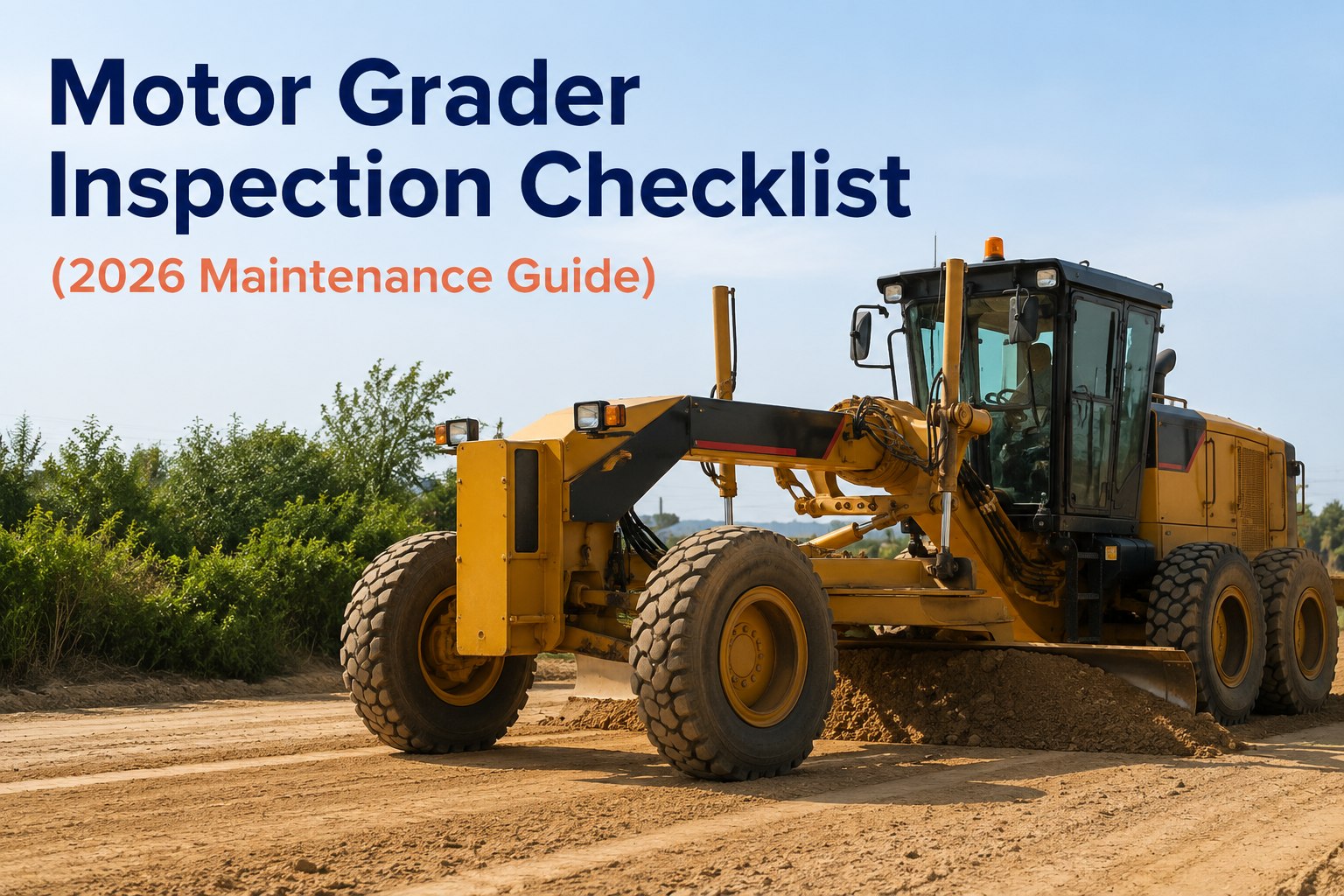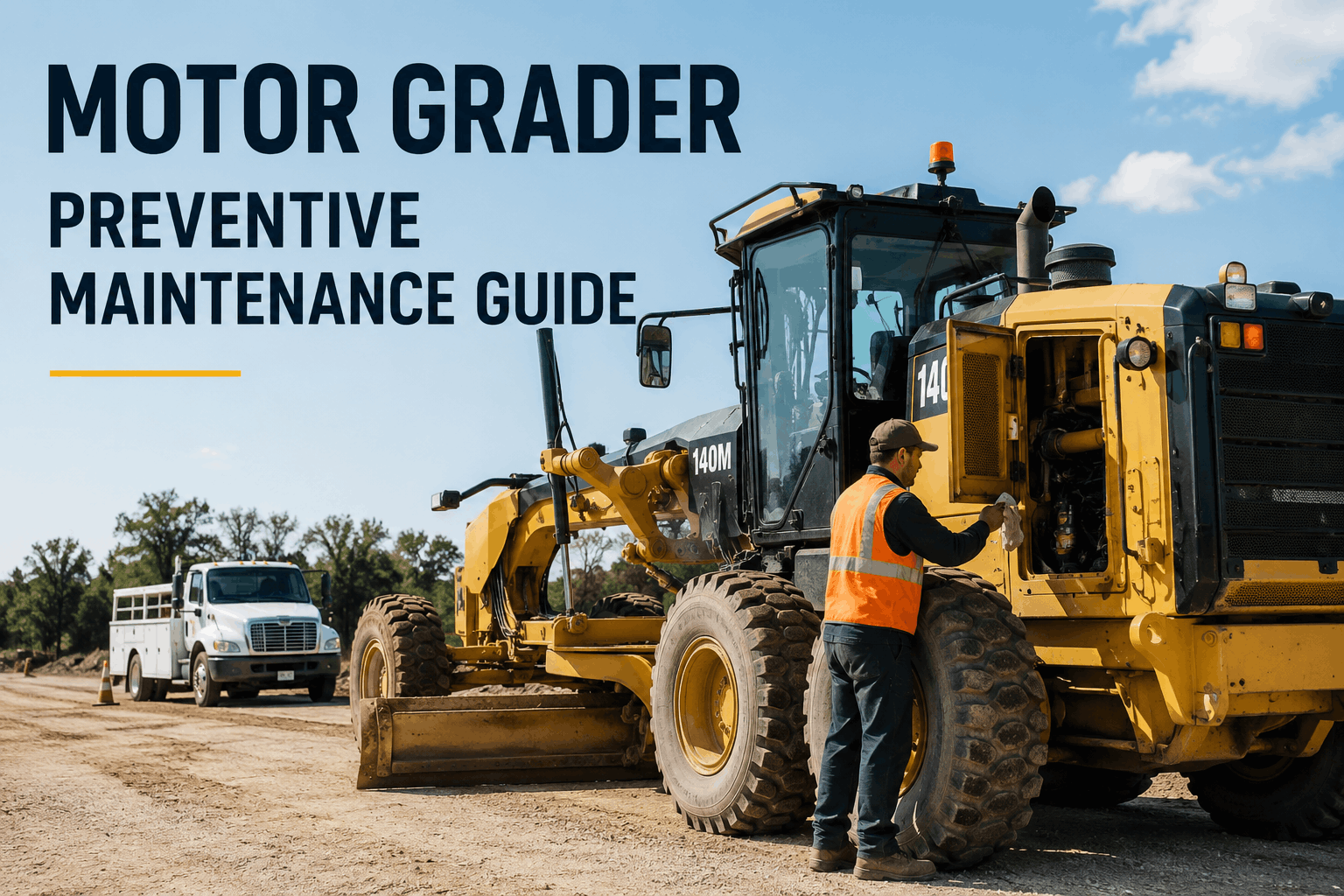
Motor grader inspection is unusual among heavy equipment checklists because two things matter roughly equally: safety and precision. A wheel loader that drifts an inch off is still a wheel loader. A motor grader that drifts an inch off means expensive rework on a haul road, a runway, or a mine bench — and the operator often can't tell during the pass. This daily motor grader inspection checklist walks the pre-shift routine that keeps both dimensions right: the blade, circle, and hydraulics that decide grade quality, plus the safety systems that OSHA 29 CFR 1926 Subpart O requires. Every check is measurable, every defect maps to a specific system, and every one is a five-to-fifteen-minute item that prevents a several-thousand-dollar downstream cost. Cutting edges alone can account for roughly 25% of grader lifetime cost when neglected. Book a demo to see grader-specific inspection templates built in.
The Daily Motor Grader Inspection Checklist
Three systems decide grade quality. Six zones decide safe operation. Fifteen minutes on the walk-around covers both — and prevents the rework that turns a $500 fix into a $50,000 project delay.
- Cutting edge wear
- Bolt torque
- End bit condition
- Rotation smoothness
- Gear & teeth wear
- Drift under load
- Cylinder response
- Fluid clarity
- No hose weeping
A motor grader is a precision instrument that also happens to weigh 30,000 to 60,000 pounds. Most other heavy equipment checklists lead with structural safety because the machine's primary job is moving material. On a grader, precision is the machine's primary job — a bent moldboard, drifting circle, or unbalanced cylinder produces a road surface that looks fine to the operator and costs the project real money on the next inspection. The inspection has to catch both dimensions.
The 4 numbers that shape the inspection
Every routine on the daily walk connects to one of these. Any single one alone justifies the fifteen-minute discipline.
- 25% Approximate share of grader lifetime cost consumed by blade & cutting edge system
- 500 hr Standard major PM interval — or 6 months, whichever comes first
- ±1″ Grade tolerance modern operations require — unreachable with worn circle or drifting cylinders
- 10,001 lb GVWR threshold: road-going graders above this trigger FMCSA DVIR under 49 CFR 396.11
The road-going threshold matters more than most operators realize. A motor grader travelling between sites on public roads is a commercial motor vehicle in the FMCSA sense — the DVIR chain applies, not just the pre-shift walk. Book a demo — see 1926 and FMCSA both covered
The 3 precision systems — deep dive
These are the systems where "checked" and "actually inspected" produce different outcomes. A generic checklist tick-mark on "blade" catches nothing. The specific measurements below catch everything that ruins grade quality on the next pass.
Blade, moldboard & cutting edge
45% of grade qualityCircle assembly & drawbar
30% of grade qualityHydraulic cylinders & controls
25% of grade qualityThree systems, twelve specific checks. Ten to fifteen minutes total when done in this order. Every measurement caught here is a defect that would show up as a wavy grade or lost project hour on the next production shift. Start free and log precision measurements per machine
The 6-zone daily walk-around
After the precision-critical trinity, the walk covers everything else the grader needs to be safe and dispatchable. Six zones, roughly one minute each, focused on safety and immediate mechanical issues.
Front frame & steering
1 min- Steering wheel play within OEM spec, no dead zone
- Front tie rod ends secure, no free play
- Front frame welds, no cracks at critical joints
- Headlights functional, lens intact
Articulation joint
Precision-critical- Frame lock pin present and functional (required for service)
- Articulation pins for wear — visible rocking = OEM spec exceeded
- Steering cylinders — no leaks, rod condition acceptable
- Hydraulic hose routing at joint, no chafing
Cab & safety systems
2 min- ROPS/FOPS intact, no unauthorized modification (1926.1000/1002)
- Seat belt intact and functional
- Horn, backup alarm, and all lights operational
- Fire extinguisher present, charged, and inspection tag current
Engine compartment
2 min- Oil, coolant, fuel, hydraulic reservoir all at spec
- Belts free of cracks, glazing, or fraying
- Radiator screen clear of debris (critical in dusty operations)
- No visible leaks around engine, transmission, or cooling system
Rear frame & tandem drive
2 min- Tandem drive — no unusual noise, smooth rotation both wheels
- Final drive seals dry, no oil weeping
- Service and parking brakes hold on grade test
- Backup alarm audible from ground level behind the machine
Tires & wheel condition
2 min- Pressure at spec on all six tires — uneven pressure ruins grade precision
- Tread condition, no sidewall damage, no exposed cord
- Lug nut torque check on suspect wheels; retorque per OEM interval
- Wheel hubs no oil leaks; wheel bearing condition acceptable
Six zones, ten minutes total when the operator knows what to look for. Combined with the precision trinity above, the whole inspection lands in fifteen minutes cold. See the 6-zone walk on a mobile DVIR
The 5 defects that ruin grade quality
These are the precision-killers — the defects that don't fail the truck, don't tag out the machine, but produce a road surface or bench that fails the next inspection. Every one is catchable at the daily walk if the operator knows where to look.
Circle drift under load
Blade rotates a few degrees during the pass without operator input. Produces a wave pattern in the finished grade that shows up only on final survey. Almost always cylinder seal wear or control valve leak-by. Catch: 30-second drift test with blade lowered, engine idle.
Uneven cylinder response
Left and right lift cylinders respond at different rates to the same control input. Blade tilts unintentionally during grade change. Caused by fluid contamination or valve wear. Catch: lift both cylinders simultaneously; watch for divergent speeds.
Bent moldboard
Impacts with buried rocks or curbs bend the moldboard subtly. Produces a curved edge on every subsequent pass. Often not visible externally — only measurable at the cutting edge across the width. Catch: straightedge across the full moldboard length.
Uneven tire pressure across the six tires
Different pressure on left vs right axles tilts the entire machine subtly — enough to affect grade on a long pass. All six tires must be within spec, not just "close enough." Catch: gauge on every tire cold, every daily inspection.
Excessive drawbar ball socket play
Wear at the connection between drawbar and circle allows the blade to shift laterally under load without operator input. Effect on grade shows up over the length of the pass. Catch: lift blade slightly, look for visible movement at socket beyond OEM tolerance.
None of these will fail an OSHA audit. Every one of them will fail a survey and reappear as rework the fleet manager gets billed for. This is why data-driven grader inspection catches issues weeks before the paper checklist notices anything wrong. Start free and track precision measurements per machine
The motor grader tag-out-of-service list
These are the safety-critical failures that mean the grader does not go to work today, no exceptions. Digital DVIR platforms enforce these structurally — flagging any of them blocks dispatch until a signed repair certification clears the record.
- ROPS damage or unauthorized modificationOSHA 1926.1000/1002 required. Structural integrity is the difference between a rollover and a fatality.
- Seat belt inoperative or damagedFederal requirement on any ROPS-equipped machine. No exceptions.
- Frame or moldboard structural crackFatigue failure at load is catastrophic and non-recoverable. Weld & inspect before dispatch.
- Brake failure or dragging brakeLoaded stopping on grade with a 40,000-lb machine is where brake weakness turns fatal.
- Steering malfunction or dead zoneLoss of directional control with the blade engaged is not survivable near equipment or crews.
- Hydraulic hose burst or major leakBlade control lost; fluid injection injury from pressurized leaks.
- Non-functional horn or backup alarm29 CFR 1926.602 requires audible warning on bidirectional equipment.
- Missing or expired fire extinguisherRequired per site policy and OSHA general duty clause. Grade fires from hot exhaust on dry material happen.
Every one of these is a five-minute catch on the daily walk. Skipping any of them for "just one shift" is where preventable incidents start. Book a demo — see tag-out enforcement in the app
From a foreman running a mixed grader fleet on highway work
We had a D-Series grader that kept producing a subtle wave on the finished lift. Operator was experienced, machine looked fine, GPS grade control was calibrated. Took us three weeks to figure out the circle was drifting a couple degrees under load. Cylinder seal weep at the drive cylinder. Two-hundred-dollar fix.
What changed for us was making circle drift a required 30-second test on the daily inspection app. Blade lowered, engine idle, watch for movement. It's silly how simple the fix was. The paper form never had a slot for that measurement — the digital template does, and the trend view flagged it before the next grade check would have.
Frequently asked questions
What does a daily motor grader inspection cover?
A complete daily motor grader inspection covers two dimensions that most other heavy-equipment inspections don't have to balance equally: precision and safety. The precision trinity covers three systems that decide grade quality — the blade and cutting edge (measure wear, verify bolt torque, check end bits, inspect moldboard integrity), the circle assembly (rotation smoothness both directions, gear tooth wear, drawbar ball socket play, drift under load), and the hydraulic system (cylinder rod condition, fluid clarity, hose routing at the articulation joint, control function response). The six-zone walk-around covers everything else: front frame and steering, articulation joint, cab and safety systems (ROPS/FOPS per 29 CFR 1926.1000/1002, seat belt, horn, backup alarm, lights, fire extinguisher), engine compartment (fluids, belts, radiator screen), rear frame and tandem drive, and all six tires. The whole inspection lands in about 15 minutes when the operator knows what to look for.
What OSHA regulations apply to motor graders?
Motor graders are covered by OSHA 29 CFR 1926 Subpart O (Motor Vehicles, Mechanized Equipment, and Marine Operations) when operated in construction settings. Key sections include 29 CFR 1926.600 for general motor vehicle safety requirements, 29 CFR 1926.601 for motor vehicles specifically, 29 CFR 1926.602 for material-handling equipment which includes audible warning devices such as horns and backup alarms, and 29 CFR 1926.1000 and 1926.1002 for rollover protective structures (ROPS) and falling-object protective structures (FOPS) which are required on graders manufactured after specific dates. If the grader is road-going and exceeds 10,001 pounds gross vehicle weight rating, it also falls under FMCSA jurisdiction as a commercial motor vehicle and requires DVIR reporting under 49 CFR 396.11 when driven on public roads between job sites. General duty clause requirements around fire extinguisher availability, operator training, and safe operating practices apply throughout regardless of specific subsection citation.
How often should a motor grader cutting edge be inspected?
Cutting edge condition is inspected every shift as part of the daily pre-use walk-around, because wear rate depends heavily on material being graded and can shift quickly with a change in job site conditions. Measurement of remaining edge thickness at three points across the blade width is a weekly minimum best practice for high-utilization graders, becoming daily for high-abrasive applications like mining haul roads or heavy gravel. Bolt torque on the cutting edge is critical because a loose bolt allows edge flex during grading, accelerating wear and eventually damaging the moldboard itself — retorque per OEM interval, typically weekly, and check every daily inspection on high-hour machines. End bit condition matters as much as edge condition because once end bits wear through, the moldboard corners contact the ground directly, and moldboard replacement is roughly ten times the cost of end bit replacement. Blade cutting edge system is estimated to account for approximately 25% of grader lifetime maintenance cost when properly managed, and considerably more when neglected.
What are the most common precision-affecting defects on a motor grader?
Five defects produce nearly all precision-related grade quality problems on motor graders. First and most common is circle drift under load, where the blade rotates a few degrees during a grading pass without operator input, producing a wave pattern in the finished grade that shows up only on final survey. The cause is almost always cylinder seal wear or control valve leak-by, and the daily catch is a 30-second drift test with blade lowered and engine at idle. Second is uneven cylinder response between left and right lift cylinders, causing unintentional blade tilt during grade changes; caused by fluid contamination or valve wear, catchable by lifting both cylinders simultaneously and watching for divergent speeds. Third is a bent moldboard from buried rock impact, which produces a curved edge on every subsequent pass — measurable with a straightedge across the full length. Fourth is uneven tire pressure across the six tires, which tilts the entire machine subtly enough to affect grade on long passes. Fifth is excessive play at the drawbar ball socket, which allows the blade to shift laterally under load. None of these will fail a safety inspection; all five will fail a grade survey.
When should a motor grader be tagged out of service?
Any safety-critical defect that could cause loss of control, injury, or fatal incident triggers immediate tag-out. On a motor grader specifically, that means ROPS damage or unauthorized modification (OSHA 1926.1000/1002 required for operator survival in a rollover); seat belt inoperative or damaged; frame or moldboard structural crack that could fail catastrophically under load; brake failure or dragging brake which is critical because a 40,000-pound machine loaded and moving on a grade is where brake weakness becomes fatal; steering malfunction or dead zone that makes directional control unreliable; hydraulic hose burst or major leak, both because blade control is lost and because pressurized hydraulic fluid injection injuries are catastrophic; non-functional horn or backup alarm required under 29 CFR 1926.602 on any bidirectional equipment; and missing or expired fire extinguisher, required per site policy and OSHA general duty clause. Each defect requires photo documentation, notification to maintenance, and a physical lockout tag. The grader must not return to service until repair is completed, signed off by a qualified person, and the record shows the sign-off. Digital DVIR platforms enforce this structurally by blocking dispatch until the tag-out condition is cleared.
Run the daily grader inspection that catches grade defects
HVI turns the motor grader inspection into a guided workflow: precision-trinity checks with photo-verified circle drift measurement, 6-zone walk-around covering OSHA 29 CFR 1926 Subpart O safety items, tag-out enforcement built in structurally, and cutting-edge wear trending that predicts moldboard replacement before it shows up as rework. Live on your fleet in under two weeks.
No credit card · No hardware · Grader-specific templates ready