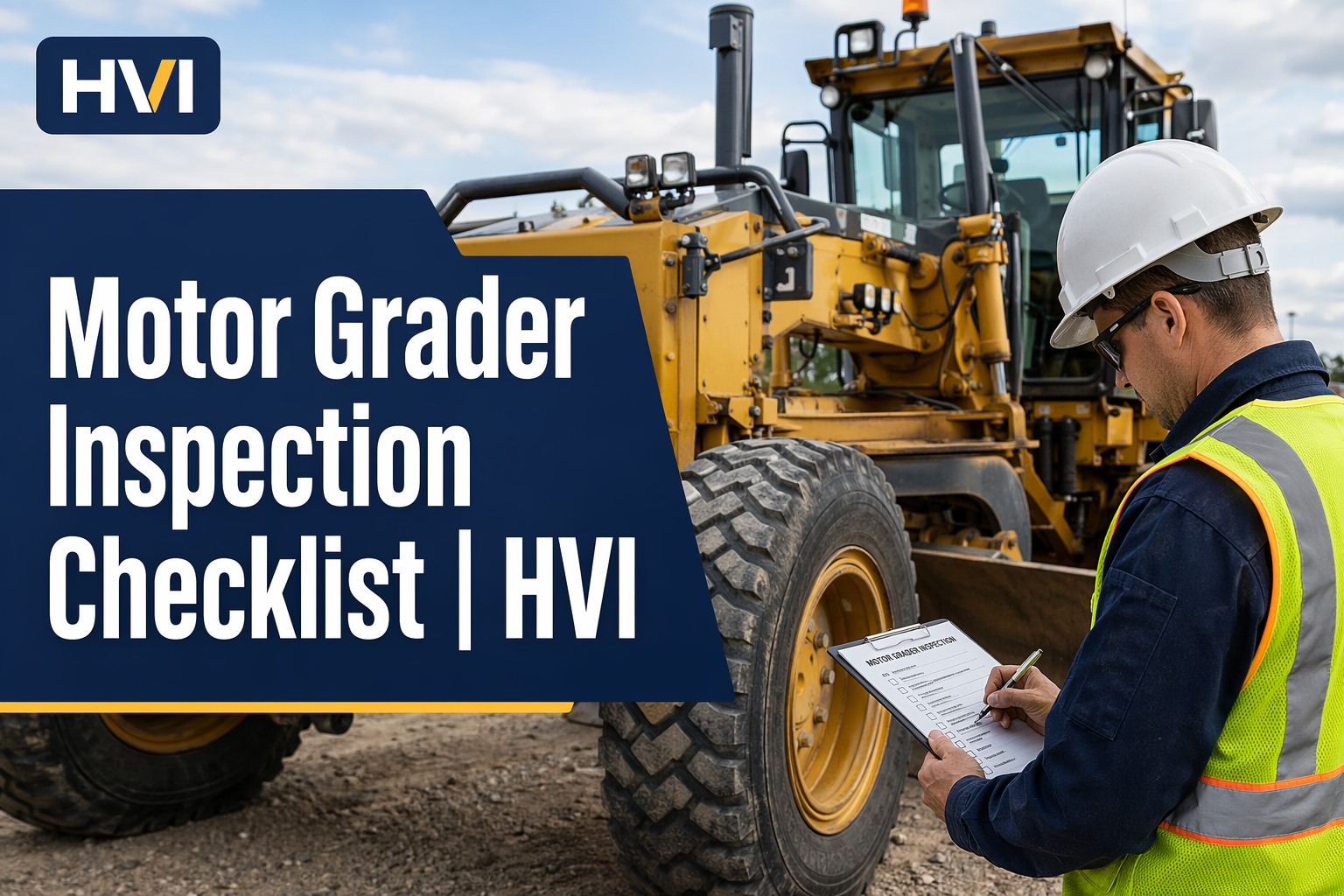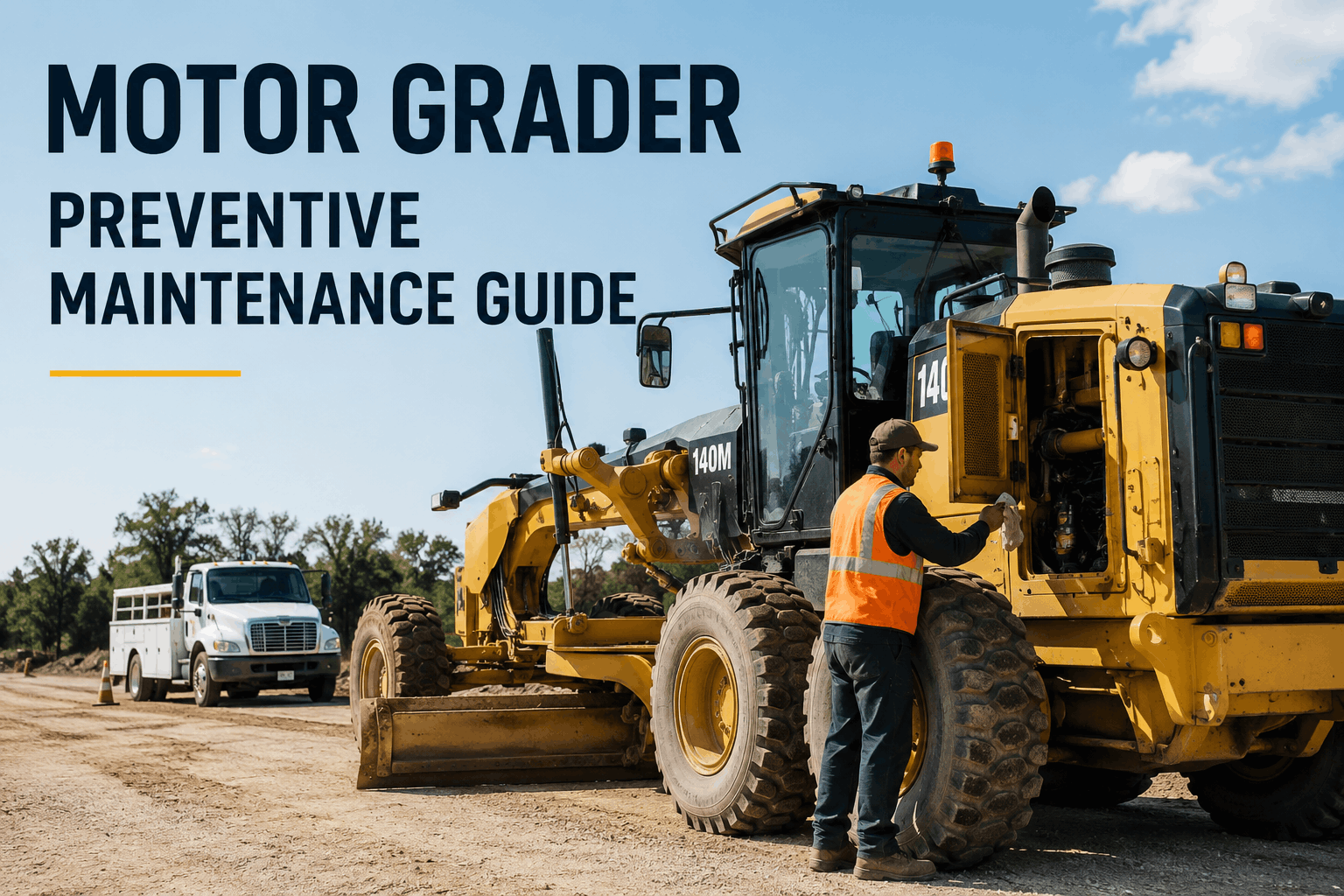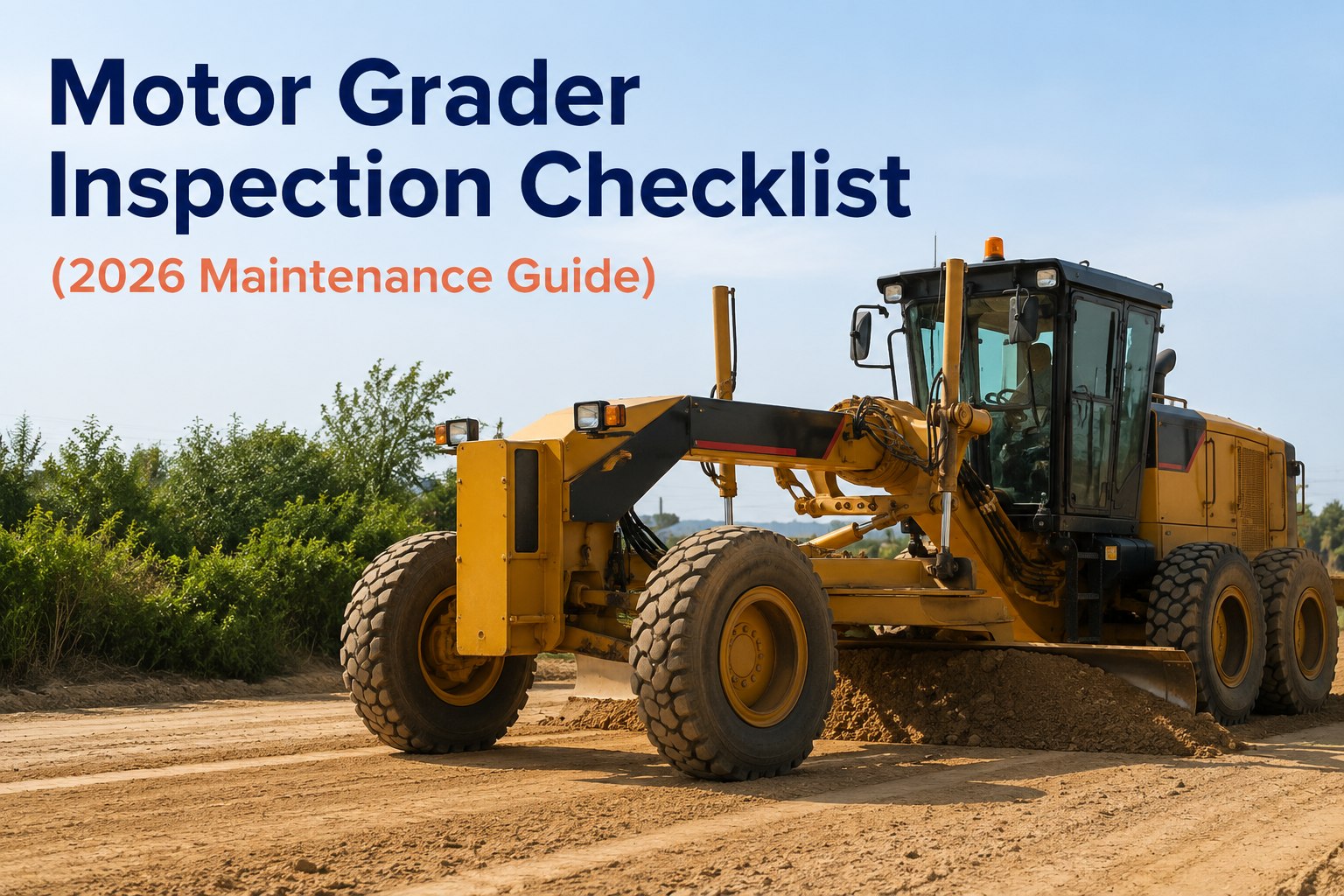
A motor grader is one of the most complex pieces of equipment on a construction or municipal fleet — six hydraulic functions, an articulation joint under constant stress, a moldboard that takes thousands of pounds of side-load force on every pass, and a tandem drive that transfers torque through terrain no paved-road truck would survive. When a grader goes down mid-project, the entire site schedule shifts. This is the complete motor grader inspection checklist for 2026, organized by the systems that fail most often. Book a demo to digitize your grader inspections.
Motor Grader Inspection: 6 Systems, 36 Items, Before the Blade Hits Dirt
Construction, mining, and municipal graders share the same six failure zones. Your daily inspection covers all of them.
System 1: Moldboard + Bladethe business end — cutting edges, end bits, and the hardware that holds it all
The moldboard takes the highest sustained load of any component on the grader. Cutting edges wear at rates that depend on the material being graded — soft clay barely touches them; rocky base course can wear a set in 40 hours. The pre-start inspection catches wear before it reaches the moldboard itself.
Measure remaining thickness. Replace when worn to within 1/4 inch of the moldboard. Worn edges damage the moldboard face — a $2,000 edge replacement prevents a $15,000+ moldboard repair. Rotate or flip edges to extend life where possible.
Check for cracks and excessive wear. End bits protect the moldboard corners — a missing end bit exposes the moldboard to direct impact from rocks and curb strikes.
Check torque on all mounting bolts. Vibration loosens hardware constantly. A loose moldboard shifts under load, producing uneven grading and accelerating wear on the circle drive. Book a demo — track blade wear digitally in HVI
System 2: Articulation Jointthe highest-stress pivot on the machine — requires daily attention
The articulation joint connects the front and rear frames, carrying the full weight of the machine through every turn and every side-load grading pass. It's the single highest-stress mechanical joint on a motor grader, and it requires more frequent lubrication than any other point on the machine.
Inspect for excessive play or wobble. Measure bushing wear if gauge is available. Worn bushings allow frame misalignment that degrades grading precision and accelerates tire wear.
Articulation pins require daily greasing. Insufficient lubrication is the #1 cause of premature articulation wear. Grease until fresh grease appears at the seals. Use NLGI #2 EP grease.
Inspect both articulation steering cylinders for rod scoring, seal leaks, and secure pin connections. A failed steering cylinder means loss of directional control. Start free — build grader-specific inspections in HVI
Check the articulation area for dirt, rocks, and material buildup. Debris restricts articulation range, increases hydraulic load, and can jam the joint during a turn — a safety hazard at road speed.
Systems 3 & 4: Hydraulics + Circle Drivesix functions, dozens of hoses, one circle that positions everything
A motor grader runs six or more hydraulic functions: blade lift (left and right), blade shift, blade tilt, circle rotation, articulation, and front attachments (ripper, snow wing, or dozer blade). The circle drive rotates the moldboard 360 degrees. Both systems need daily inspection.
Systems 5 & 6: Tandem, Tires, Engine + Cabwhat keeps the grader moving, stopping, and keeping the operator alive
From a county road superintendent running 12 motor graders
We lost a Cat 140M for six weeks to a tandem failure that started as a slow oil leak the operator noted on a paper checklist but nobody followed up on. By the time maintenance saw the report — buried in a stack of weekly paperwork — the tandem was dry. The repair was $22,000 plus six weeks of a rented replacement.
Digital inspections solved two problems at once: the operator flags a tandem leak on their phone, and a work order hits the shop foreman's screen before the grader leaves the yard. We went from finding defects on paper that nobody read to catching them in real time. Blade wear tracking was the bonus — we started rotating edges at the right time instead of waiting until the moldboard was scarred.
Frequently asked questions
How often should a motor grader be inspected?
Motor graders should be inspected daily before the first operating shift, with a comprehensive walkaround covering all six primary systems: moldboard and blade, articulation joint, hydraulics, circle drive, tandem and tires, and engine and cab. OSHA requires pre-shift inspections for construction equipment, and most manufacturers (CAT, John Deere, Komatsu, Volvo, CASE) specify daily pre-start checks in their operator manuals. Beyond the daily inspection, graders need 250-hour, 500-hour, and annual maintenance intervals covering fluid changes, filter replacements, and more detailed component evaluations. The articulation joint requires daily greasing at all lubrication points.
What are the most important motor grader inspection items?
The five most critical motor grader inspection items are cutting edge thickness (worn edges damage the moldboard, turning a $2,000 edge replacement into a $15,000+ moldboard repair), articulation joint pins and bushings (worn bushings cause frame misalignment and loss of grading precision), hydraulic system integrity (20+ hoses that can chafe, bulge, or leak, causing blade drift or loss of control), circle drive condition (worn teeth or shoes cause the moldboard to shift under load), and tandem drive oil level (a tandem running low on oil leads to $20,000+ repair bills). Each of these has specific inspection criteria in the daily pre-start checklist.
How often should motor grader cutting edges be replaced?
Cutting edge replacement frequency depends entirely on the material being graded. Soft clay and loam produce minimal wear, and edges can last hundreds of hours. Rocky base course, gravel with sharp aggregate, or frozen material can wear a set of edges in 40 to 80 hours. The daily inspection should include a thickness measurement and a visual check for cracks or uneven wear patterns. Replace edges when worn to within approximately 1/4 inch (6mm) of the moldboard face. Many operators rotate or flip reversible edges to extend total life before replacement. Keeping spare cutting edges on hand minimizes grader downtime during replacement.
Why is the articulation joint so critical on a motor grader?
The articulation joint is the single highest-stress mechanical joint on a motor grader because it carries the full weight of the machine through every turn and absorbs the lateral forces generated during grading passes. It connects the front frame (which carries the blade, circle, and front axle) to the rear frame (which carries the engine, cab, and tandem drive). The joint requires daily greasing at all lubrication points because insufficient lubrication is the primary cause of premature articulation wear. The steering cylinders that control articulation must also be inspected daily for rod scoring, seal leaks, and secure pin connections, since a failed steering cylinder means complete loss of directional control.
Can I digitize motor grader inspections?
Yes. HVI (Heavy Vehicle Inspection) lets construction, municipal, and mining fleets build per-model motor grader inspection templates covering all six systems in one digital flow. Operators complete the inspection on a phone or tablet with required photo capture at cutting edges, articulation pins, hydraulic connections, and circle drive. Blade wear is tracked over time through photo comparisons, so maintenance can predict edge replacement timing instead of reacting to moldboard damage. Defects auto-generate work orders that reach the shop foreman before the grader leaves the yard. Every inspection is timestamped, GPS-tagged, and signed digitally, creating audit-ready records for OSHA, insurance, and fleet management.
A $2,000 edge replacement or a $15,000 moldboard repair. The inspection decides.
Build per-model templates for CAT, John Deere, Komatsu, Volvo, CASE. Track blade wear with photo comparisons. Require photos at articulation and hydraulics. Auto-generate work orders. GPS and timestamp every record. Live in under a week.
No credit card · No hardware · Works with any grader make or model