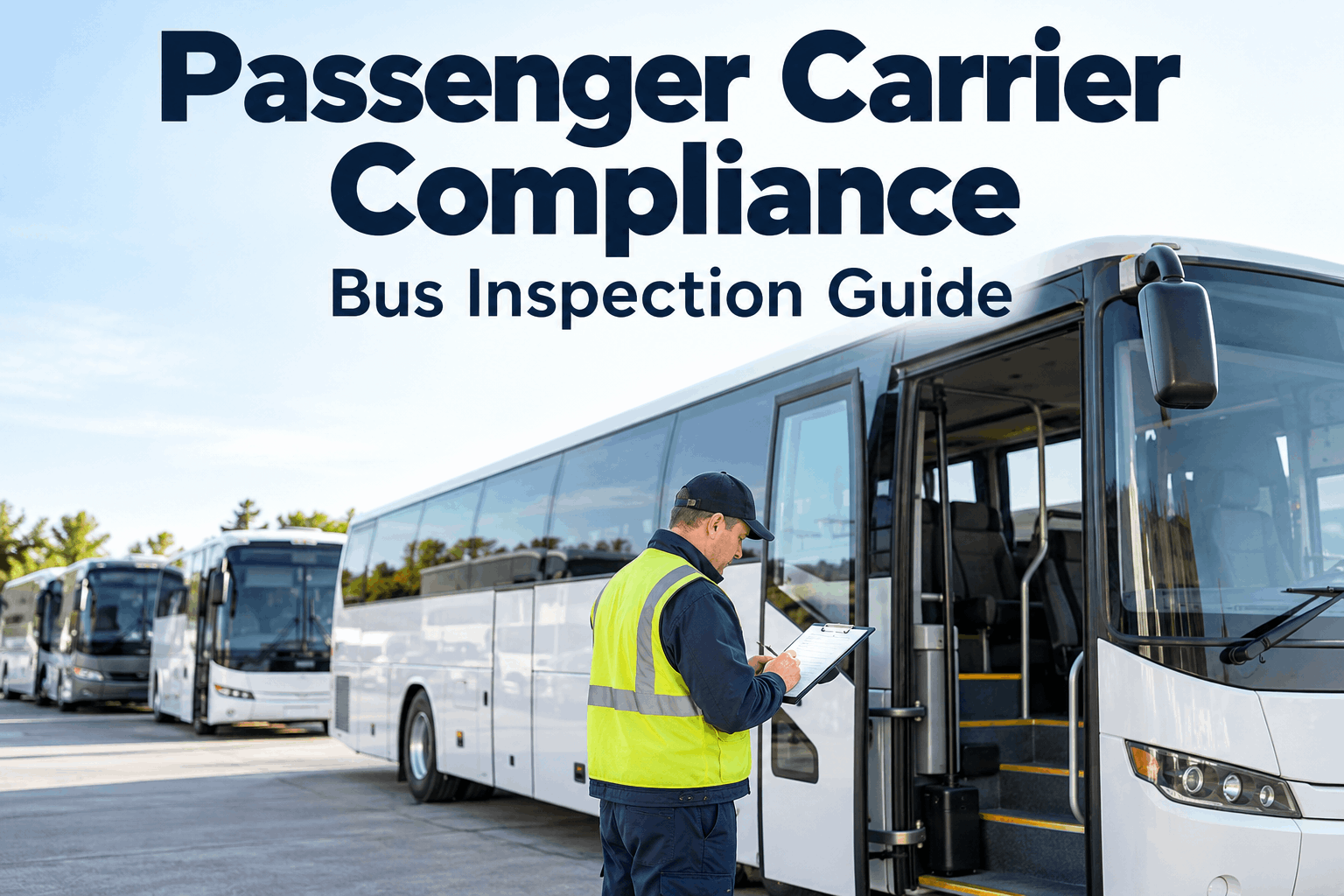
Passenger carrier compliance carries a weight a freight fleet never does: a defect on a bus isn't a delayed load, it's forty people who can't get out an emergency exit. That's why a passenger vehicle inspection covers things a truck check never touches — exits, pushout windows, wheelchair lifts, interior safety. Book a demo to manage passenger-fleet compliance in one place.
A Bus Check Covers What a Truck Check Can't
Passenger carrier compliance is a freight inspection plus everything that keeps people safe on board — emergency exits, pushout windows, lifts and interior safety. Miss those and the vehicle isn't compliant, however sound the engine.
Here's the passenger carrier compliance picture — why carrying people raises the bar, the passenger-specific inspection areas a freight check skips, the layered inspection cadence buses run on, the driver and record requirements that back it, and how to keep it all documented across every bus. (This guide covers US FMCSA passenger-carrier rules; requirements vary by state and service type.)
Carrying people raises the barwhy passenger compliance is stricter than freight
A freight inspection asks whether the vehicle can safely move a load. A passenger inspection asks that too — and then a whole second question: can everyone on board get out safely if something goes wrong? That second question is what makes passenger carrier compliance its own discipline, with equipment and checks a truck simply doesn't have.
The engine can be perfect and the bus still fail. Passenger carrier compliance hinges on the safety systems that protect people — emergency exits that open, pushout windows that release, a wheelchair lift that works and secures. These aren't secondary checks; on a passenger vehicle they're as central as the brakes, and an auditor treats them that way.
The passenger-specific inspection areaswhat a freight check leaves out
Beyond the standard commercial-vehicle items — brakes, tires, lights, steering — a passenger vehicle inspection adds a set of checks built entirely around the people on board. These are the areas that define passenger carrier compliance and the ones most likely to be missed by a generic truck checklist.
Emergency exits & doors
Every emergency exit and door must open freely, latch correctly and be clearly marked — the single most safety-critical passenger check.
Pushout windows
Release mechanisms must function so windows can be pushed out in an evacuation — checked for operation, not just presence.
Wheelchair lift & securement
The lift must cycle reliably and the securement points hold — an accessibility requirement and a safety one at once.
Interior safety
Seats anchored, handrails secure, aisle clear, and emergency equipment — extinguisher, first-aid, reflectors — present and in date.
Each of these is a place a standard truck check has no line item, which is exactly why passenger carriers need an inspection built for buses, not a freight form with a few boxes added. And these items fail in ways that stay invisible until they matter — an emergency exit can look perfect and still be seized from disuse, a pushout window's release can corrode, a lift can pass a glance but stall mid-cycle. The only way to know is to operate them on the check, not eyeball them. A dedicated daily bus inspection checklist is where these passenger-specific items live. Book a demo to build a passenger inspection profile
The layered inspection cadencedaily, periodic and service-based, together
Passenger carrier compliance isn't one inspection — it's a layered rhythm. A daily pre-trip catches the immediate safety items before the first passenger boards, a periodic inspection covers the deeper annual requirements, and preventive maintenance runs on a schedule set by how hard the bus works.
The layers matter because they catch different things: a daily check finds what changed overnight, the periodic inspection finds slow wear that a quick pre-trip would never surface, and PM prevents the failure before it happens at all. Skip any one layer and you leave a category of problem unwatched — which is why a fleet can't lean on a thorough annual inspection to excuse a skipped pre-trip, or the reverse. A high-frequency transit bus and a weekend charter coach need very different PM intervals, which is why cadence has to follow service type. The periodic bus inspection checklist covers the deeper layer. Start free and set each layer per bus.
Driver qualifications for passenger servicethe endorsement and records behind the wheel
Passenger carrier compliance extends past the vehicle to the person driving it. Operating a bus generally requires a CDL with a passenger (P) endorsement — and for school transport, a school bus (S) endorsement — plus the medical certification and record-keeping that prove the driver is qualified.
Passenger endorsement
A CDL with the P endorsement for passenger vehicles, and the S endorsement where school transport applies.
Medical certification
A current medical certificate on file, tracked so it never lapses while the driver is carrying passengers.
Qualification records
The driver file — license, endorsements, medical, training — kept current and ready to produce.
The theme is the same as the vehicle side: it's not enough to be qualified, you have to be able to prove it on demand. A lapsed medical certificate or an expired endorsement doesn't just risk a finding — it can mean a driver was carrying passengers unqualified, which is a far more serious exposure than a paperwork slip. Keeping driver files current alongside the inspection records, with alerts before anything expires, is what makes a passenger operation defensible under the scrutiny it attracts. Book a demo to keep driver and vehicle records together
Where passenger compliance slipsthe four gaps that surface in an audit
When a passenger carrier takes a compliance finding, it usually comes from one of these four gaps — each a consequence of running buses on tools or habits built for freight or for memory.
The common thread is that passenger safety items get treated like routine checks instead of the critical ones they are. Closing the gaps means an inspection built for buses, defects tracked to closure, and every record in one place — the approach behind audit-ready safety and compliance management. Book a demo to close the passenger-safety gaps
Every defect, tracked to closurewhere compliance meets passenger safety
On a passenger vehicle, an open safety defect isn't a maintenance backlog item — it's a bus that may still be carrying people with a fault. Passenger carrier compliance depends on catching defects, routing them to repair, and proving they were closed before the vehicle ran again.
Bus-specific inspections
Exits, windows, lift and interior safety built into every check, so passenger items are never skipped.
Defects routed & closed
A safety defect becomes a work order and stays open until it's fixed and verified, not lost in a log.
Records exported on demand
Inspection, defect and driver records pulled for any bus and period when a regulator asks.
That's what a passenger operation needs that a freight one can treat more loosely: proof, per bus, that every safety-critical item was checked and every defect resolved. A closed-loop record — defect found, work order raised, repair verified, bus cleared — is both the safety mechanism and the audit trail at once, which is why it can't live in a paper logbook that ends at "noted." Start free and track every bus defect to closure.
From a passenger fleet safety manager
We came from a mixed freight-and-passenger background, and for a while we ran the coaches on a version of our truck pre-trip. It looked thorough until an auditor asked a driver to demonstrate an emergency exit release and he'd honestly never been prompted to check it — the form just said "exits: OK." That was the wake-up call. We rebuilt the inspection around the passenger items, made the lift cycle and the pushout windows a required test with a photo, and set any exit defect to pull the bus until it's signed off. It slowed the pre-trip by about two minutes and completely changed our audit posture. When you're carrying people, "OK" isn't a record — a tested, timestamped check is.
How HVI simplifies passenger fleet complianceprofile the bus, layer the checks, prove it
Passenger carrier compliance gets manageable when the inspection is built for buses, the cadence follows service type, and every record is one export away. HVI's region-configurable profiles, multi-interval scheduling and export do exactly that across a passenger fleet.
Profile the bus
A passenger-specific inspection with exits, lift and interior safety built in.
Layer the cadence
Daily, periodic and PM intervals set by each bus's service type.
Prove it on demand
Defects tracked to closure and records exported for any audit.
See how a passenger fleet's inspections, defects and driver records come together in HVI's digital inspection and maintenance platform. Walk through your own bus profiles in a quick demo
Passenger carrier compliance: quick answers
What is passenger carrier compliance?
Passenger carrier compliance is the set of requirements that keep buses and motorcoaches — and their drivers and records — in line with the safety regulations for carrying people. Under US FMCSA rules it covers everything a freight inspection does, plus passenger-specific systems: emergency exits and doors, pushout windows, wheelchair lifts and securement, interior safety and emergency equipment. It also includes driver qualifications like the passenger endorsement and the inspection, maintenance and driver records that prove all of it. Specific requirements vary by state and service type.
How is a bus inspection different from a truck inspection?
A bus inspection includes all the standard commercial-vehicle checks — brakes, tires, lights, steering — and then adds a whole layer built around passenger safety that a truck check has no reason to include. That means testing that emergency exits and doors open and latch, that pushout windows release, that the wheelchair lift cycles and secures, and that seats, handrails, aisle and emergency equipment are sound and in date. On a passenger vehicle these items are as safety-critical as the brakes, so a generic truck form isn't sufficient for passenger carrier compliance.
How often must passenger vehicles be inspected?
Passenger carriers run a layered cadence rather than a single inspection. A daily pre-trip inspection is done before the vehicle carries passengers, checking the immediate safety items. A periodic inspection — typically annual — covers the deeper documented requirements for the full safety system. On top of those, preventive maintenance runs on an interval set by how hard the bus works, so a high-frequency transit bus is serviced far more often than an occasional charter coach. All three layers work together; none replaces the others.
What driver qualifications are required to operate a passenger vehicle?
Operating a bus generally requires a commercial driver's license (CDL) with a passenger (P) endorsement, and a school bus (S) endorsement for school transport. Drivers also need a current medical certification and a complete qualification file — license, endorsements, medical certificate and any required training — kept up to date. As with the vehicle side, being qualified isn't enough on its own; the carrier has to be able to produce the records that prove each driver's qualifications on demand.
How does HVI help with passenger carrier compliance?
HVI lets a passenger fleet build a bus-specific inspection profile — emergency exits, pushout windows, wheelchair lift and interior safety — with its own daily, periodic and PM intervals per service type. Every defect is captured against the bus and routed to a work order that stays open until it's fixed and verified, so a safety item can't quietly stay unresolved. All inspection, defect and driver records are kept centrally and exported on demand, which turns passenger carrier compliance from scattered paperwork into a documented, audit-ready record for every vehicle.
Keep every bus compliant and provable
HVI turns passenger carrier compliance into a bus-built inspection profile, a cadence per service type, and defects tracked to closure — every emergency exit, lift and interior check documented, and every record one export away when a regulator asks.
No credit card · US passenger-carrier focused · Build your first bus profile today
- Test exits & pushout windows, don't just tick
- Cycle the wheelchair lift & securement
- Check interior safety & emergency gear
- Layer daily, periodic & PM by service
- Track defects to closure, keep the records