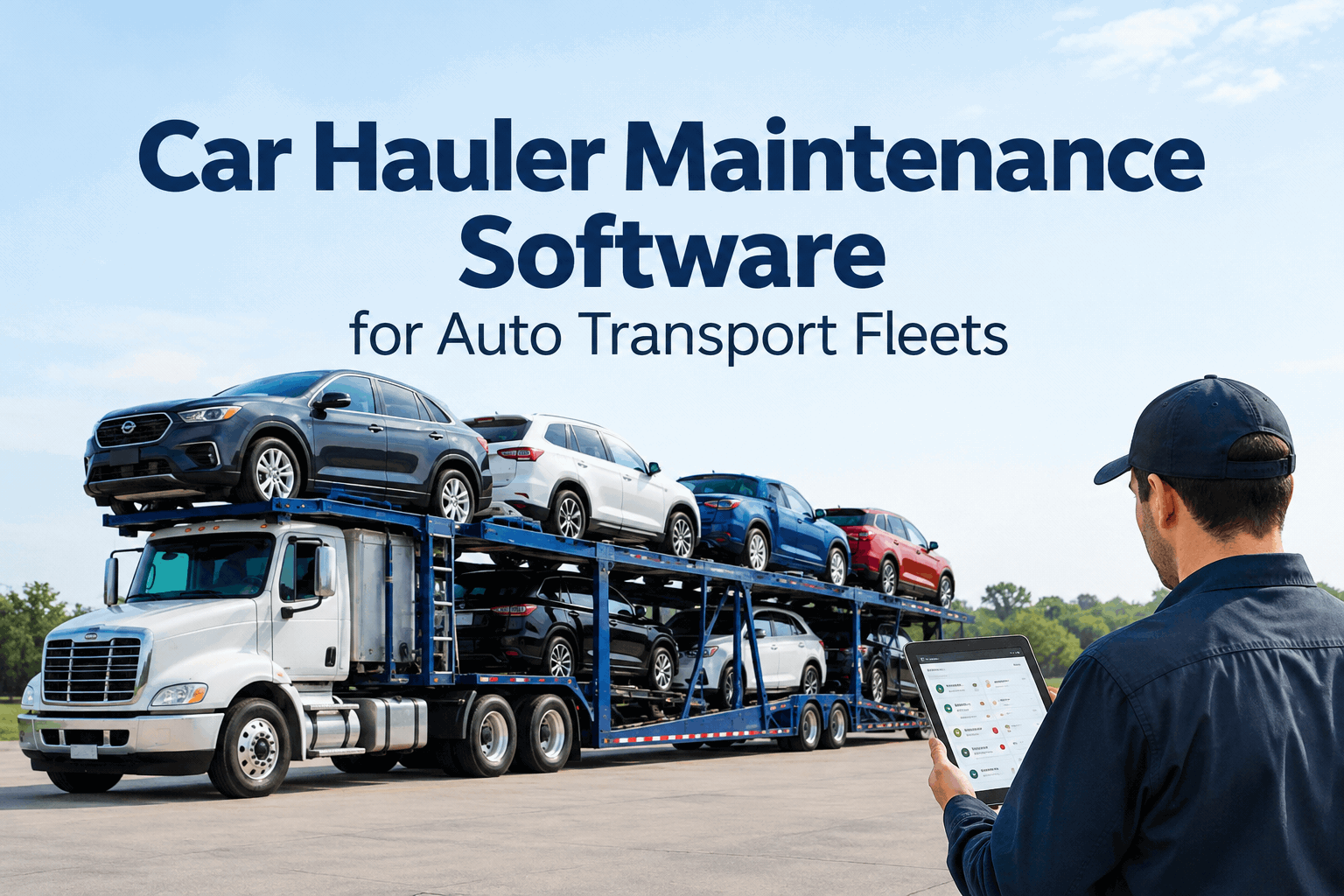
A car hauler carries ten high-value vehicles on a hydraulic deck held up by chains and straps. When something fails, it's never cheap: a cylinder that won't hold drops a deck, a worn strap lets a $60,000 SUV shift, and either one turns into a cargo-damage claim and a rig stuck on the shoulder. Car hauler software built for auto transport puts the hydraulics, decks and tie-downs on a schedule — before the load, not after the claim. Book a demo to see it on your rigs.
Car Hauler Software That Keeps the Hydraulics, Decks and Tie-Downs Load-Ready
Inspections, preventive maintenance, defects and repairs for auto transport trailers — in one system, so a weeping cylinder or frayed strap is caught before the cars go on.
A dry van hauls boxes. A flatbed hauls one secured load. A car hauler hauls up to ten vehicles stacked on folding hydraulic decks, each held by its own straps and chains — a machine with far more that can fail, and a cargo value that makes every failure expensive. That's why auto transport fleet software can't be a brakes-and-lights app: the hydraulics and the securement gear need their own inspection lines, schedules and history.
Two systems strand a car haulerwhy car hauler software has to watch hydraulics and securement, not just the chassis
Ask any auto transport operator what parks a rig, and it's almost never the engine. It's the hydraulics that raise the decks, or the straps and chains that hold the cars. Those are two different systems with two different failure modes — and a generic fleet app tracks neither.
- Cylinder seal weep — a deck that won't hold under load
- Low fluid, clogged filter or hose chafe on the pump side
- Deck pins, skid rails and headramp lock levers worn
- Weld cracks where the deck meets the frame
- Strap cuts, abrasion and heat damage past safe use
- Chain stretch and worn hooks below working load limit
- Cracked or distorted anchor points and ratchet heads
- Aggregate WLL that no longer matches the cargo weight
One drops a deck; the other lets a vehicle shift into the one behind it. Both need tracking a dry-van template has no line for. A purpose-built digital inspection puts both systems on the checklist with a photo on every flag. Book a demo of a car hauler template.
A weep today, a dropped deck next weekwhy car hauler software catches the cylinder before the load
A hydraulic cylinder doesn't fail all at once. It starts as a seal weep and a deck that drifts a little under load. Catch it on a scheduled check and it's a seal kit. Miss it and it lets go with cars on the deck.
A little fluid on the rod, a deck that drifts under load. Caught on a pre-load check, empty.
A seal kit, on your scheduleThe deck no longer holds its set height. Loading gets sketchy; the driver shims and hopes.
A loaded deck you don't trustCylinder fails with cars on it. Vehicle damage, a claim, and a rig down roadside.
Cargo claim + lost rigThe seal kit and the dropped deck are the same part caught at different times. Scheduled checks and reminders are what preventive maintenance scheduling is built for — the cylinder gets looked at on a cadence, not at the auction ramp. Book a demo on your own auto transport fleet.
Each system, its own workflowhow car hauler software maps to the way an auto transport rig actually fails
Auto transport fleet software earns its keep when each car-hauler system lands in the module built to manage it — and they're connected, so a flagged cylinder becomes a work order becomes a cost line without anyone re-typing a unit number.
Tie it together in the maintenance management workflow, keep a per-unit parts and inventory record for straps and seal kits, and the car-hauler side gets managed the way general auto hauler inspection checklist work only describes.
The car hauler checklistwhat the software runs on every auto transport rig, by phase
A car hauler is checked in phases — the hydraulics and securement before loading, the road-legal basics for the DOT pre-trip, and a quick re-check after unload. Each line ties to the unit, takes a photo on a flag, and opens a work order on a fail.
- Cylinders hold set height under load, no rod scoring or seal weep
- Hydraulic fluid level correct, filter clean, no hose chafe or seepage
- Deck pins fully seated, skid rails clear, deck-to-frame welds sound
- Straps, chains and anchors within wear limits and WLL for the load
- Tires, tread and inflation across all positions
- Brakes, slack adjusters and air lines within limits
- Lights, reflectors and electrical connection working
- Headramp lock lever, coupling and suspension sound
- Straps and chains re-checked for cuts, abrasion and heat damage
- Decks and ramps checked for load damage or new weld cracks
- Hydraulic drift re-confirmed after a full day of cycling
- Any flagged defect carried to an open work order
Run this on paper and the hydraulics and securement lines are the first skipped on a tight delivery day. In the software, a flagged cylinder or strap can hold the rig from dispatch until it's cleared. Start a free trial and load this checklist on your fleet this week.
Every rig, one recordwhat a car hauler looks like inside the platform
Open any unit and the whole story is there — last check, open defect, next service, parts on hand and cost to date — instead of a clipboard in one truck and a service log in the office.
When a shipper disputes damage, or an auditor asks for your records, you open the unit, not a filing cabinet. It all ties into the analytics and reporting dashboard, so a hauler that keeps costing you surfaces as a number. Book a demo on a rig from your own fleet.
From an auto transport carrier that stopped eating claims
We run nine-car rigs between auctions and dealers, and our worst money was always hydraulic — a cylinder weeping for weeks until a deck wouldn't hold and we damaged a car loading it. Once the cylinders, straps and chains were on a scheduled check the app flagged, we started catching the weeps as seal kits. Last year we caught two before they'd have cost us a claim, and the office finally sees every rig's hydraulics without a phone call to the yard.
Car hauler software FAQs
What is car hauler software?
How is it different from a general fleet maintenance app?
Can it schedule hydraulic and tie-down maintenance automatically?
Does it handle the DOT pre-trip and defect reporting too?
How long until it's running on our auto transport fleet?
Keep every car hauler load-ready
Car hauler software should track the hydraulics and securement gear, not just the brakes and lights. Put inspections, PM, defects and repairs on one platform and catch the cylinder before it drops a deck.
- Hydraulic & securement templates
- Cylinder & strap PM scheduling
- Defect-to-work-order in one tap
- Per-rig cost & claim history