The single most expensive credential in your fleet is the one that expired last week and nobody noticed. A CDL that lapsed on Tuesday, a DOT medical card that ran out during dispatch, a HazMat endorsement that quietly went stale — every one of them is a potential $19,277 out-of-service violation, an automatic CSA Driver Fitness BASIC hit, an insurance surcharge at renewal, and a broker vetting failure. And every one is 100% preventable with automated tracking. This guide covers what a working CDL and DOT medical card expiration tracking system looks like, the 90-60-30 alert cascade that best-in-class fleets use, and why manual tracking (spreadsheets, file cabinets, calendar reminders) fails at scale. Book a demo to see automated credential tracking on your fleet.
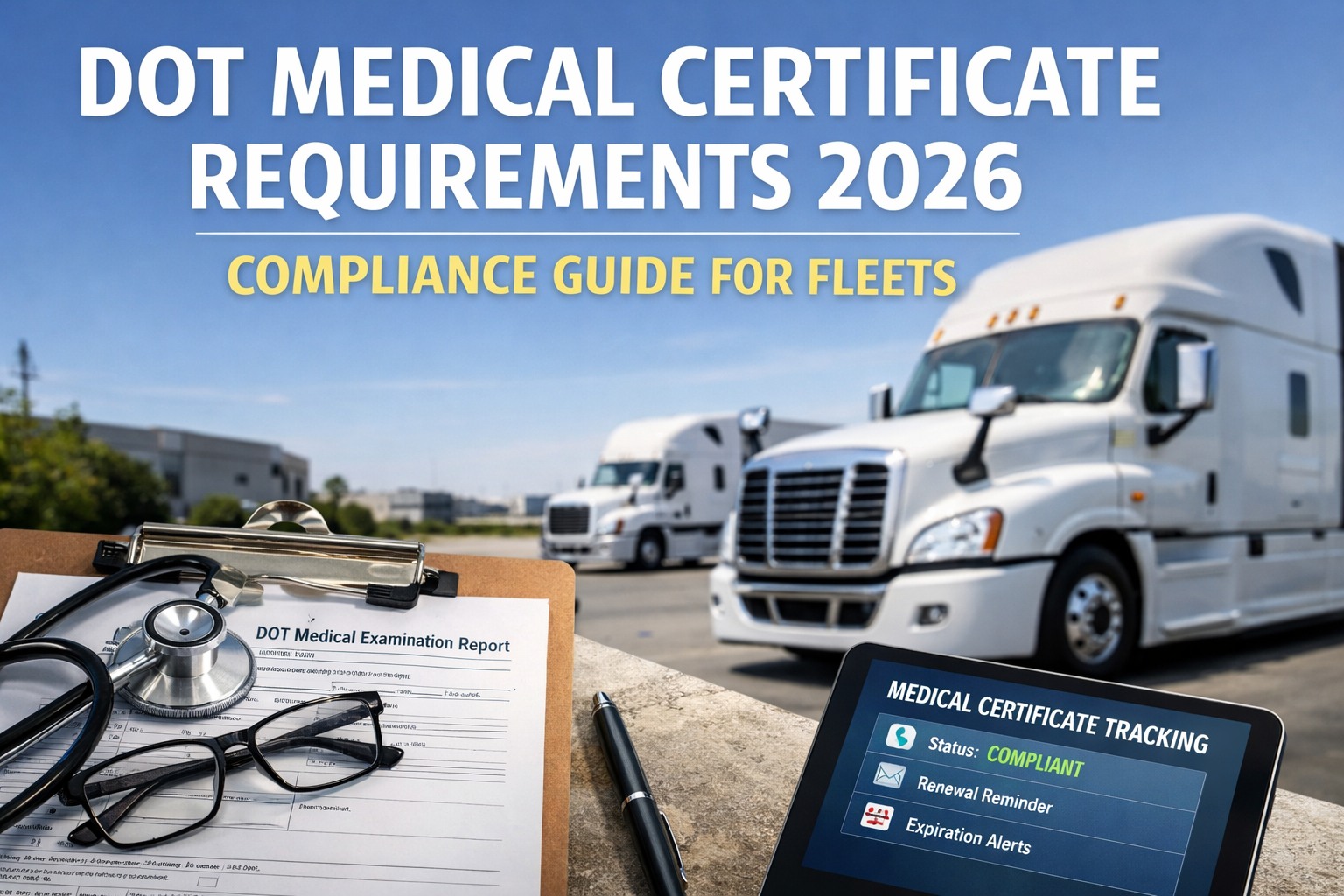
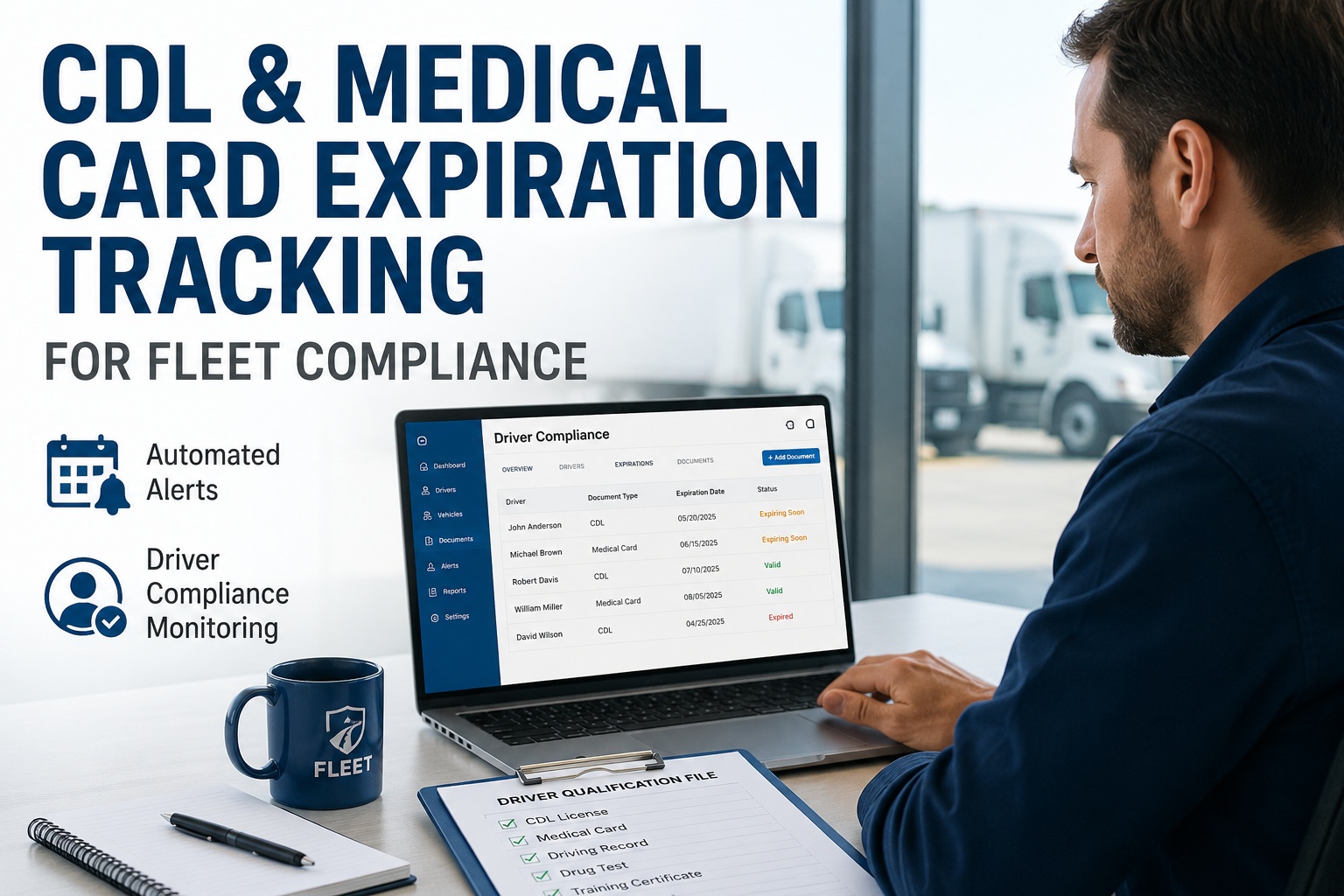
Every driver credential, every expiration, one screen
Color-coded status · automatic countdown · alert cascade at 90/60/30 days
What breaks when a credential expires unnoticed
Every fleet manager thinks they'd catch an expiring CDL. Every audit finds otherwise. Here's what actually happens when one slips through — and why the math on prevention is overwhelming.
Up to $19,277 per instance for operating an OOS vehicle (expired CDL/medical). Stacks per event, not per fleet.
Driver Fitness BASIC violation at renewal typically drives 8–15% premium increase — permanent hit for 24 months.
Truck stops on the shoulder. Driver can't continue. Load rebooking, customer notification, potential delivery penalty.
Violation counts against 12-month rolling window (2026 CSA rules). Pushes percentile toward intervention threshold.
One expired credential typically costs $22,000–$28,000 in first-cycle direct impact plus a 24-month tail of insurance and CSA consequences. And this excludes the broker vetting fallout — some shippers auto-drop carriers with any Driver Fitness violation in the last quarter. Start a free trial to eliminate this exposure across your fleet in under a week.
The 4 credentials every fleet must track
Not every credential belongs on the alert cascade — but these four do, on every driver, without exception.
Commercial Driver's License (CDL)
Renewal typically every 4–8 years depending on state. Different classes (A, B, C) with different endorsement requirements.
DOT Medical Examiner's Certificate
Required every 24 months for most drivers, more frequent (3–12 months) for drivers with monitored medical conditions.
HazMat / Tanker / Passenger endorsements
HazMat requires TSA background check every 5 years. Tanker and Passenger endorsements renew with the CDL.
Motor Vehicle Record (MVR) review
Annual review required under 49 CFR 391.25 for every driver. Documents driving history and any new violations.
Each of these has a different cadence and different alert timing. Manually juggling 4 credential types across 30+ drivers is where compliance breaks down. Book a demo to see all four credential types tracked on a single dashboard
The 90-60-30 alert cascade
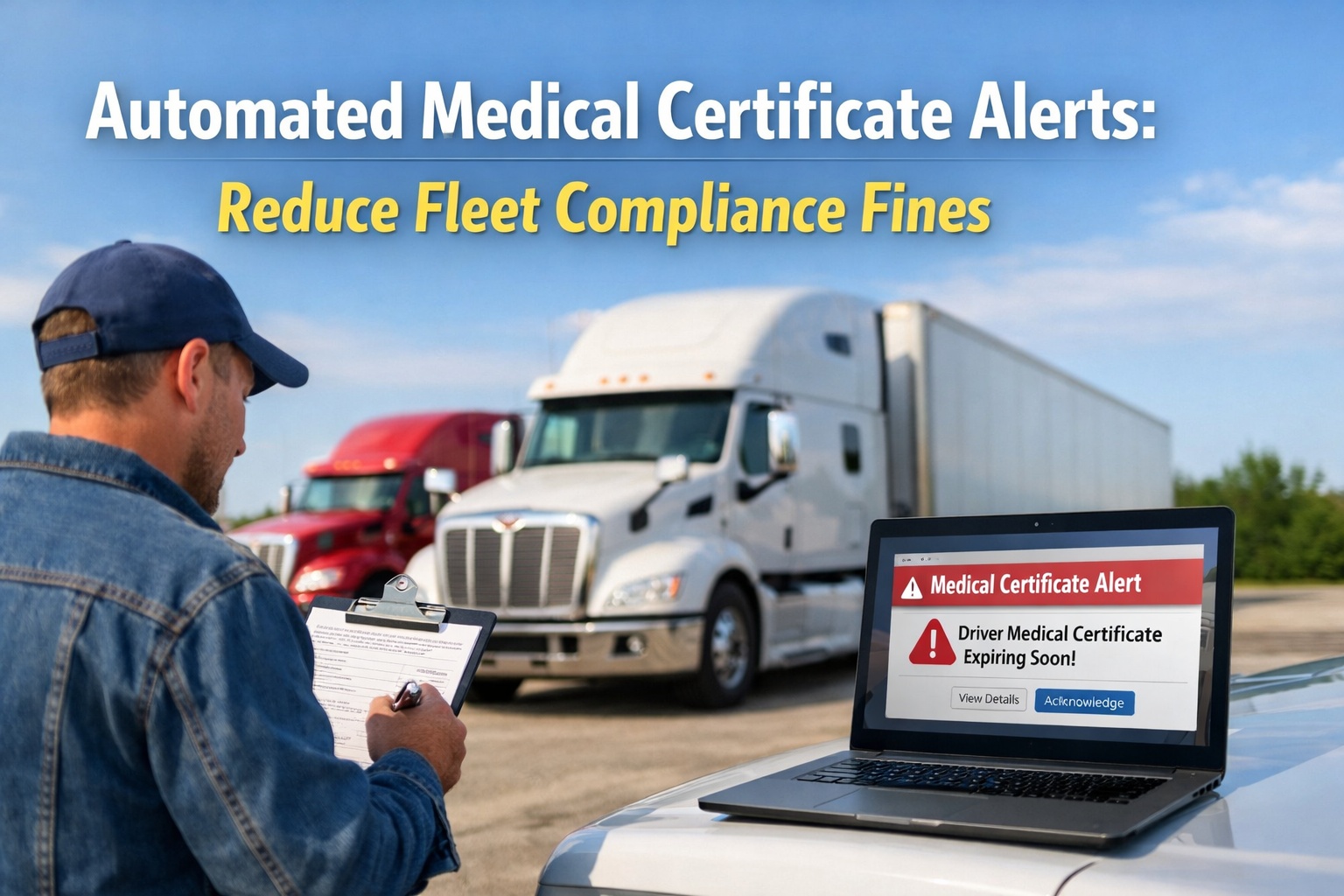
A single reminder at 30 days out isn't enough. Best-in-class fleets run a graduated cascade that starts early, escalates, and ends with an automatic dispatch lock. Here's the visual anatomy of a working alert system.
Email to driver + safety manager. "Your CDL expires in 90 days. Book DMV appointment now."
SMS + email escalation. Safety manager gets a report of all drivers in the 60-day window.
Daily reminders to driver. Safety manager gets an escalation flag. Renewal appointment must be scheduled.
Dispatch manager notified. Load assignments reviewed. Backup driver identified. Renewal must be proven.
Driver blocked from load assignment until renewed credential is uploaded and verified. Zero manual intervention.
Every step is automatic. No safety manager tracking a spreadsheet. No dispatch supervisor manually checking dates. The system handles the escalation, the driver handles the renewal, and the platform enforces the dispatch lock if the deadline passes. Book a demo to see the alert cascade running on real drivers
Manual tracking vs automated tracking
Every fleet already tracks credentials somehow. The question is whether the tracking method actually catches expirations before they become violations.
- Safety manager maintains a spreadsheet of driver credential dates
- Reminders depend on someone opening the sheet
- Missed dates are silent — no alarm until roadside inspection
- New driver onboarding often creates data-entry gaps
- Audit prep requires manually pulling every driver's file
- Dispatch has no visibility into upcoming expirations
- Effective for fleets under ~15 drivers, fragile above that
- Every credential entered once at onboarding, tracked forever
- 90-60-30 alert cascade to driver + safety manager + dispatch
- Missed dates trigger automatic dispatch lock
- Onboarding checklist enforces credential capture
- Audit exports in seconds, DOT-ready format
- Dispatch sees credential status on every load assignment
- Effective at any fleet size, scales without additional overhead
The migration path from manual to automated is straightforward — most fleets import their existing credential spreadsheet in an hour and are running the alert cascade by end of week one. Start a free trial to import your credential data and see the alerts running on real drivers this week.
From a safety director who eliminated credential violations in one quarter
We had 48 drivers on a shared Google spreadsheet. Two safety coordinators updated it. Every quarter we'd find one or two drivers whose medical card had lapsed weeks earlier because someone forgot to update the sheet after they came back from the clinic.
Automated credential tracking with the 90-60-30 cascade eliminated the whole class of problem. First quarter after switchover: zero credential lapses. Insurance renewal that fall came in flat instead of the 11% increase we'd been braced for. The platform paid for itself before the first renewal cycle even closed.
Frequently asked questions
How often do CDL and DOT medical cards need to be renewed?
CDLs typically renew every 4 to 8 years depending on the state of issue, with most states on either a 4-year or 5-year cycle. DOT Medical Examiner's Certificates renew every 24 months for the majority of drivers, but drivers with monitored medical conditions (managed hypertension, diabetes, sleep apnea, cardiac conditions) can be issued shorter certifications of 3, 6, or 12 months at the medical examiner's discretion. Some drivers hold rolling short-term certs and can have 3 or 4 medical renewals inside a single CDL cycle. HazMat endorsement requires a TSA Threat Assessment every 5 years. MVR (Motor Vehicle Record) review is required annually under 49 CFR 391.25. The interlocking cycles are exactly why manual tracking fails at scale — each driver has 4 to 6 different renewal dates on different cadences, and human tracking systems inevitably miss one.
What happens if a driver operates with an expired CDL or medical card?
Operating with an expired credential is an immediate out-of-service violation with cascading consequences. Direct FMCSA fines can reach $19,277 per instance for operating an OOS vehicle plus additional penalties for the driver personally. The driver is placed out of service at roadside inspection — the truck cannot move until a qualified driver arrives. The violation feeds directly into the Driver Fitness BASIC on your CSA score under the 12-month rolling window, weighted 2× if it results in OOS placement. Insurance underwriters typically raise premiums 8–15% at renewal for any Driver Fitness violation, and that increase persists for 24 months. Broker vetting systems often auto-flag or auto-drop carriers with any Driver Fitness violation in the trailing quarter. Total exposure for one expired credential is typically $22,000 to $28,000 in first-year direct impact plus the multi-year insurance and CSA tail.
Can a driver be dispatched if their medical card has expired?
No — and dispatching a driver with an expired medical card exposes the carrier to significant liability. Under 49 CFR 391.41, a CDL driver must be medically qualified with a current DOT Medical Examiner's Certificate to operate a commercial motor vehicle. If the certificate has expired, the driver is not qualified, period. Dispatching such a driver constitutes a violation of 49 CFR 390.11 (requiring carriers to comply with all applicable regulations) and can trigger both driver-level and carrier-level enforcement. In post-crash litigation, dispatching a driver with expired medical qualification is one of the most damaging evidence points for a fleet's defense, often resulting in punitive damages beyond the underlying accident claim. Automated credential tracking systems solve this by blocking load assignment automatically when a credential lapses — no manual verification required.
How far in advance should credential renewal reminders start?
The industry best-practice is a 90-60-30-7 day cascade with dispatch lock at day 0. First reminder at 90 days gives the driver enough time to book a DMV appointment (which can have 2 to 6-week wait times in some states) without pressure. Second reminder at 60 days confirms the appointment is scheduled. Third reminder at 30 days is a hard escalation with daily follow-up until proof of renewal is uploaded. Final alert at 7 days pulls in dispatch to review upcoming load assignments and identify a backup driver if needed. At day 0, the platform automatically locks the driver from dispatch until the renewed credential is uploaded and verified. This cascade balances driver autonomy (early reminders give time to plan) with fleet protection (automatic lock prevents unauthorized dispatch). Fleets running this cascade consistently eliminate credential-related violations entirely.
Can credential tracking be done in a spreadsheet?
For very small fleets (under 10-15 drivers with stable rosters and simple credential profiles), a well-maintained spreadsheet can work if it's actually opened and reviewed weekly. Above that size, spreadsheets fail predictably. The failure modes are consistent: someone forgets to update the sheet after a renewal, a new driver's data is entered incompletely, the sheet becomes fragmented across multiple owners, reminder emails depend on someone remembering to trigger them, dispatch has no real-time visibility, and audit prep becomes a manual scramble. The math for any fleet over 15 drivers is straightforward: one prevented credential violation ($22,000–$28,000 impact) pays for automated tracking software for multiple years. For fleets over 50 drivers, the economics are overwhelming — the question isn't whether to automate, it's how quickly to migrate off the spreadsheet.
Turn credential tracking from a spreadsheet risk into an automated discipline
HVI tracks CDL, DOT medical card, endorsements, and MVR reviews across your entire fleet on one dashboard. The 90-60-30 alert cascade runs automatically to drivers, safety managers, and dispatch. Any expired credential auto-locks the driver from dispatch until renewal is verified. Live in under two weeks — typical payback inside the first prevented violation.
No credit card · Import from any spreadsheet · Works with any ELD or telematics provider