The hammer that was on Excavator 4 last week isn't on Excavator 4 today. Nobody signed it out, nobody logged where it went, and the crew waiting on it stands around while someone drives site to site trying to spot a breaker that looks familiar — because equipment attachment tracking by memory stops working past about six attachments. See every attachment on one live record
Give Every Attachment the Same Asset Record Your Machines Already Have
A bucket has no VIN. A quick coupler has no title. HVI gives each one its own record — assignment history, inspections, hour-based PM,and cost — so nothing valuable moves through your fleet invisible to the system.
- One asset ID per attachment, from intake to retirement
- Hour- and calendar-based PM, tracked per attachment type
- Every reassignment logged, offline on remote sites
What Untracked Attachments Are Actually Costing Youit's rarely one dramatic loss — it's a slow leak
Nobody notices an attachment inventory shrink by 8 or 9 percent over a year. It happens in small moments — left on a finished job site, swapped onto a rental machine and never swapped back, buried under scrap at the back of the yard. HVI closes that gap by giving each attachment its own asset record the day it arrives, so a shrinking count becomes a flagged reassignment instead of a mystery at the annual physical.
5–10%of portable tool and attachment inventory is lost to theft, misplacement, or damage every year, industry surveys consistently find — without anyone noticing until the count comes up short.
$500–$3,000is the typical replacement cost of a single lost attachment — a quick coupler, a set of forks, a small breaker — and few of those purchases ever get budgeted for.
$400,000+a year is what mid-size fleets can end up spending on replacement purchases alone once enough small attachments and tools disappear one at a time.
~48 min/shiftis spent by the average crew member hunting for a tool or attachment somebody else moved — roughly a tenth of every eight-hour shift, gone before any real work starts.
None of that shows up as one bad headline. It shows up as dozens of small delays and a replacement-parts budget that never quite makes sense — which is exactly why attachment inventory management gets ignored right up until a big job needs a specific breaker and nobody in the company can say where it is. See the assignment log that ends the site-to-site search.
What Belongs on Your Attachment Tracking Listif it bolts on, swaps off, or wears out on its own schedule — track it
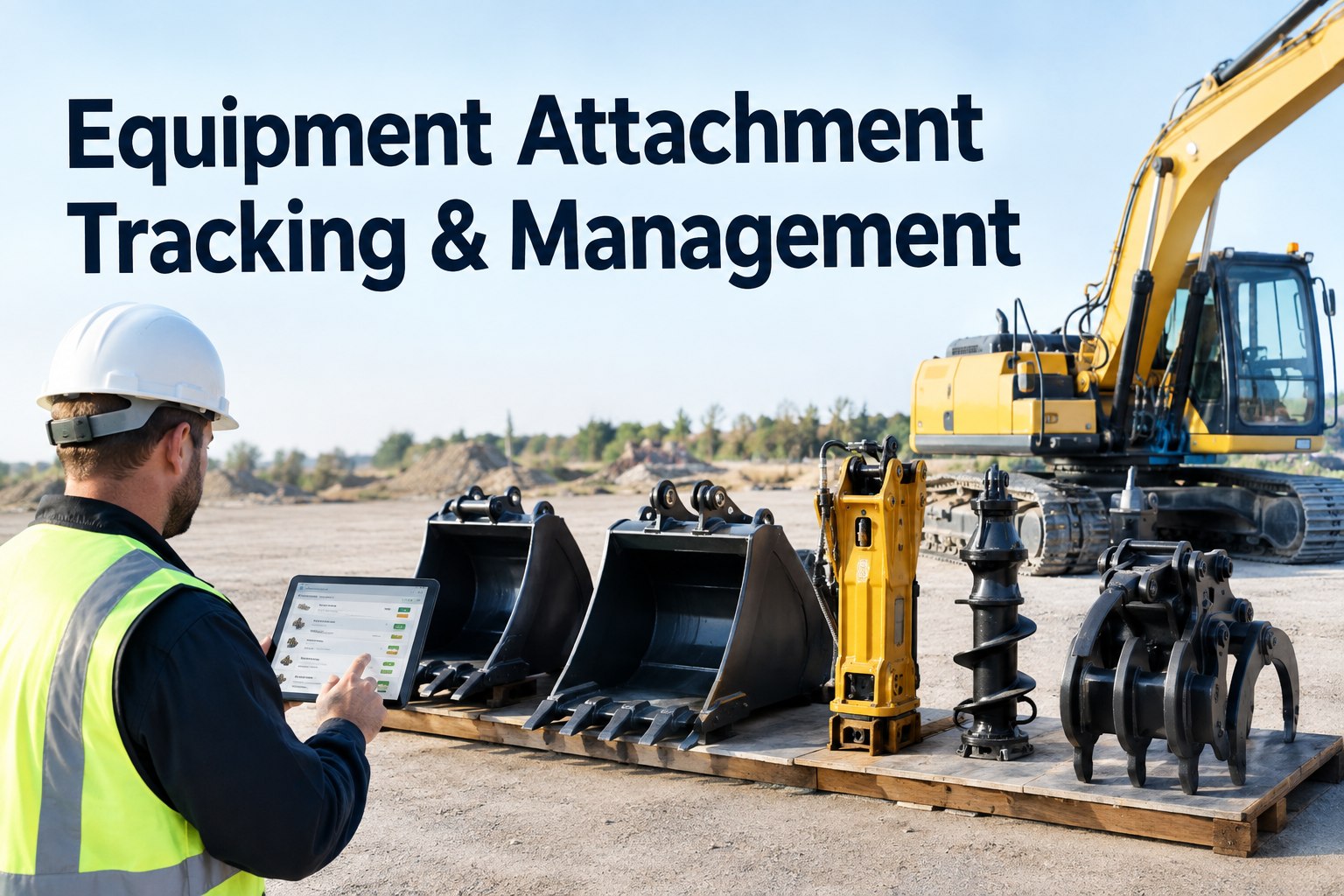
Not every hand tool needs its own maintenance record, but anything hydraulic, load-bearing, or expensive enough to notice missing does. HVI holds a configurable inspection template and a PM interval for each of these attachment types, so the schedule below is set once and applied to every unit of that type across the fleet.
| Attachment | Main wear point | Typical PM interval | Replacement cost |
|---|---|---|---|
| Buckets | Cutting edge, teeth, side wear plates | Every 250 hrs | $1,500–$6,000 |
| Hydraulic hammers | Tool bushings, seals, nitrogen charge | Every 100–150 hrs | $8,000–$30,000 |
| Augers | Teeth, gearbox oil, drive shaft | Every 50–100 hrs | $2,000–$10,000 |
| Quick couplers | Locking pins, wedge wear, hydraulics | Daily visual + 250 hrs | $1,000–$4,000 |
| Grapples | Grapple arms, pivot pins, hydraulic cylinders | Every 100–200 hrs | $3,000–$12,000 |
A quick coupler inspection deserves special attention here — a worn locking pin or a wedge that isn't seating fully is how an attachment separates from a machine mid-lift, and that failure mode has nothing to do with the attachment being lost. HVI runs it as a daily pre-use check that turns a flagged defect straight into a work order. See the coupler check flag a defect into a work order.
The Life of an Attachment, From Delivery to Retirementfive stages, five places the paper trail usually breaks
Attachment tracking fails at predictable moments — almost always at a handoff. HVI keeps one continuous asset record across all five, so the reassignment that used to get lost in a text message becomes a timestamped line in the same history the technician and the office both see.
-
1
Intake New attachment gets its own asset ID, purchase cost, and serial number logged in HVI — imported from a spreadsheet or added on the spot, the same day it arrives.
-
2
Assignment Linked to a machine or a site. If it moves to a different excavator or crosses to another job, that reassignment is logged in the record, not texted to a supervisor.
-
3
Inspection Pre-use visual check plus scheduled PM — pins, bushings, hydraulics — against hour or calendar intervals set for that specific attachment type, captured from a phone or tablet.
-
4
Maintenance Every repair, part, and labor cost attaches to that specific asset record, so a hammer that's eaten three sets of bushings in a year is visible, not buried in a general parts bill.
-
5
Retirement Full cost-per-hour history available before deciding whether to rebuild, sell, or scrap — instead of guessing based on how old it feels.
Stage two is where most yards lose the thread completely — the reassignment nobody wrote down. Sign up free and log your first attachment today
Spreadsheet Tracking vs. a Real Asset Recordthe same information, two very different outcomes
Most yards don't have zero tracking — they have a spreadsheet somebody built two years ago that's now missing half the fleet. It looks like a system. It behaves like a guess. Here's what changes when each attachment lives in a real HVI asset record instead.
The spreadsheet
- Updated whenever someone remembers — usually after something goes missing
- No link between an attachment and its actual maintenance history
- One version lives on a laptop, another in someone's inbox
- Hour-based PM intervals tracked by eyeballing a hobbs meter, if at all
- Reassignments between machines and sites go unrecorded
A real asset record in HVI
- Updated at the moment of assignment, inspection, or repair — by whoever's holding the phone
- Full cost, inspection, and repair history tied to one attachment ID
- One system every site and every technician sees the same version of
- PM triggers automatically off logged hours, cycles, or calendar days
- Every handoff between machines or sites is a timestamped record
The gap between those two columns isn't a technology upgrade — it's the difference between finding out an attachment failed and finding out it was overdue. Watch a spreadsheet turn into a live asset record.
From an equipment manager running attachments across six sites
We used to find out a breaker needed bushings when the operator called it in dead on a job. Now every attachment has its own hour meter logged against it, and the system flags it before it ever gets that far.
The bigger win honestly wasn't maintenance, it was just knowing where things were. We had three couplers we thought were lost for good turn up on machines at other sites once we started logging every reassignment instead of trusting people to remember.
Derek's couplers were never actually lost — just invisible to the system that was supposed to track them. See how a "lost" attachment turns up on the dashboard.
Frequently asked questions
What counts as an "attachment" that should be tracked separately from the machine?
Anything hydraulic, load-bearing, or expensive enough to matter if it goes missing: buckets, hydraulic hammers, augers, quick couplers, grapples, forks, compactor plates, and similar tooling. If it moves between machines, has its own wear parts, or costs more than a few hundred dollars to replace, it deserves its own asset ID rather than being lumped in as "accessories" under the carrier machine.
How often should a hydraulic hammer be inspected and serviced?
Most hydraulic hammer maintenance runs on a 100 to 150 hour interval for bushing wear, seal condition, and nitrogen charge pressure, with a quick visual and grease check before every use. Bushings are usually the first thing to wear, and running a hammer with worn bushings accelerates wear on the tool and the housing both, which is why hour-based tracking matters more here than on almost any other attachment type.
What should a quick coupler inspection check for?
A quick coupler inspection should confirm the locking pin is fully engaged and shows no visible wear or elongation, the wedge or hook mechanism seats completely with no gap, hydraulic couplers on hydraulic quick couplers show no leaks, and the safety lock or secondary confirmation device functions correctly. This is a daily, pre-use check, not a monthly one — a coupler failure while an attachment is suspended is one of the more serious incidents in off-highway equipment operation.
Why do attachments get lost more easily than the machines they attach to?
A machine has a VIN, a title, and usually one operator responsible for it that day. An attachment has none of that. It swaps between machines, gets handed off between crews, and moves between job sites without a single consistent owner, which makes it far easier for a reassignment to go unrecorded and for the attachment itself to end up somewhere nobody thinks to look.
How does attachment cost tracking actually save money?
Attachment cost tracking attaches every repair, part, and labor cost to a specific asset instead of a general maintenance budget. That makes it possible to see when a specific bucket or hammer is costing more in repeated repairs than it would take to replace it, and it stops repeat purchases of "missing" tools that were never actually lost, just unrecorded on a different machine or site.
Every bucket, hammer and auger, tracked like it's worth tracking
HVI gives every attachment its own record — assignment history, inspections, PM schedule, and cost — alongside the machines they bolt onto, so nothing valuable moves through your fleet invisible to the system. Live in under two weeks.
No credit card · Works offline on remote sites · Mixed-asset PM ready on day one