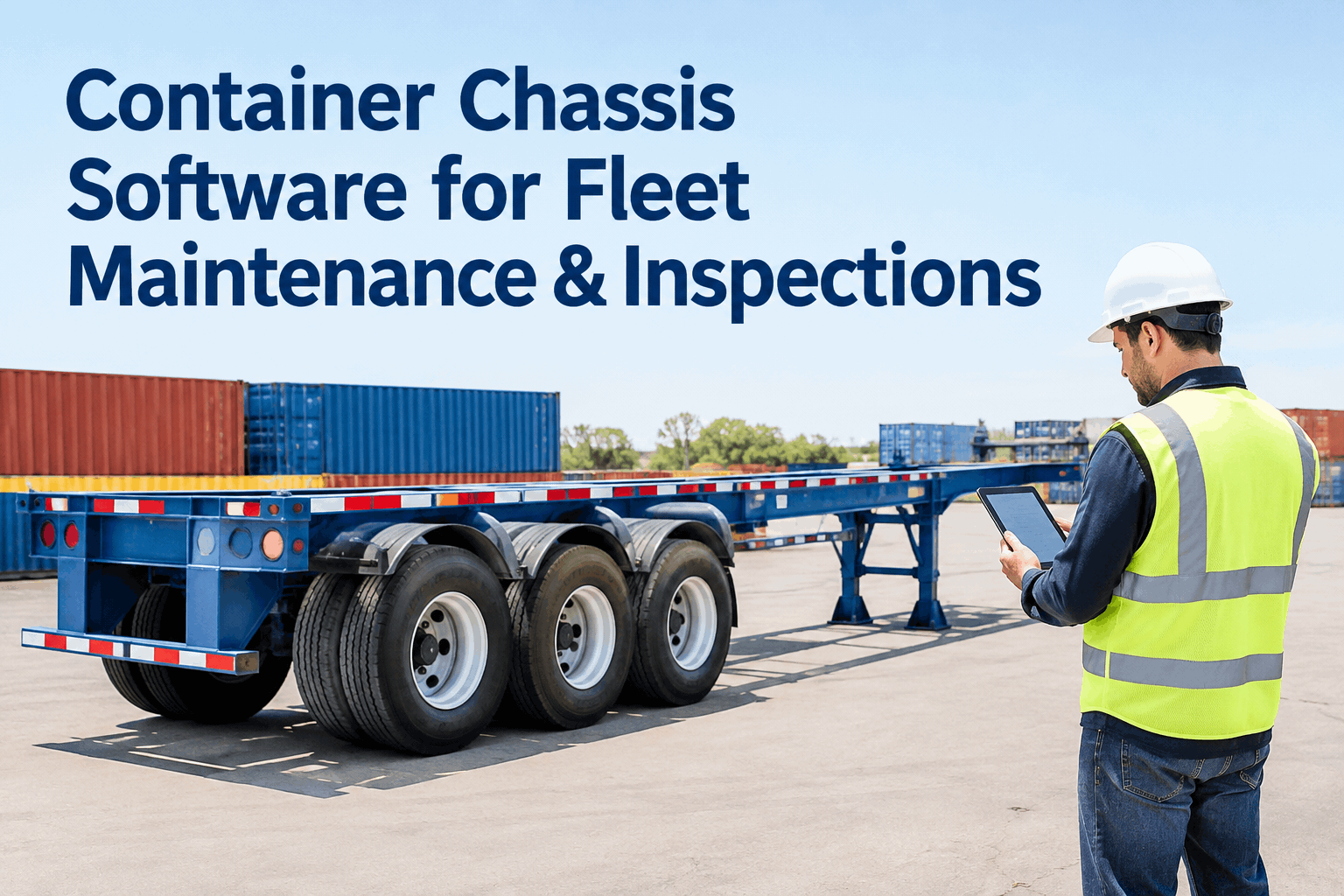
Your drayage fleet never owns the same chassis twice in a row. You pull one from a pool Monday, swap it at the ramp Tuesday, return it to a different IEP Wednesday, and somewhere in there a brake light dies and nobody logs it. Container chassis software is how a fleet stops running that on paper and group chats and starts running it as one tracked system. Book a demo to see chassis tracked by unit and watch where the gaps close.
Container Chassis Software That Runs Inspections, Repairs and PM as One System
Stop stitching chassis condition together from paper gate checks, texts and three different pool portals. One record per unit, from the pre-trip to the closed work order.
A chassis is a simple asset with a complicated life. It belongs to a pool, gets pulled by whoever has the next box, and the roadside citation lands on the carrier holding the wheel. The problem was never the inspection itself. It is that the record of what happened to that unit lives in five places and reaches nobody in time. That is the gap the right software closes.
Five tools, one chassiswhy fleets reach for container chassis software built for the job
Most drayage fleets aren't missing effort. They're missing a single place for it to land. The driver checks the chassis, the dispatcher hears about the bad light by phone, the mechanic finds out when it's parked, and the office reconstructs it all for the audit. Here's the same bad tail lamp, handled two ways.
- Driver notes it on a paper sheet that stays in the cab
- Dispatch hears a vague voicemail hours later
- No work order exists until the unit is already parked
- PM and tire history live in a spreadsheet nobody opens
- Audit means rebuilding the trail from memory
- Driver logs it with a photo, tied to the chassis unit ID
- Defect pushes to dispatch and the shop the moment it's saved
- A work order opens from the defect in one tap
- PM, tire and repair history sit under the same unit record
- Audit is an export by unit, driver or date
The difference isn't how hard anyone works. It's whether the record follows the chassis. A dedicated digital fleet inspection system ties every check to a unit, so condition at pickup is never a matter of whose memory you trust. Book a demo of the chassis defect-to-repair flow and see both columns side by side.
One record, five stageshow container chassis software moves a defect from gate to closed
The value of container chassis software isn't a prettier checklist. It's that the pre-trip, the defect, the work order, the scheduled service and the cost all attach to the same unit and flow in one line — no re-keying, no lost handoff.
-
1
Inspect at pickup
Driver runs the chassis pre-trip in the app with photos, tied to the unit ID scanned off the IEP marking.
-
2
Flag the defect
A failed item becomes a logged defect with a photo and timestamp, visible to dispatch and the shop instantly.
-
3
Open a work order
One tap turns the defect into a work order with parts, labor and the assigned tech — no separate system.
-
4
Schedule the PM
Preventive maintenance runs on a calendar or usage trigger, so the next service is planned, not discovered.
-
5
Roll up the cost
Parts, labor and downtime total per unit, so a problem chassis shows up as a number, not a hunch.
Because every stage shares one unit record, the work order already knows what the inspection found, and the analytics and reporting dashboard already knows what the work order cost. Nobody types the same chassis number twice. Book a demo to watch a defect flow to a closed work order.
Built for the chassis jobwhich part of the platform handles which chassis problem
Container chassis software earns its keep when each module maps to a real chassis headache — not generic fleet features bolted on. Here's how the pieces line up against the way a chassis actually fails.
Pre-trip templates for tires, brakes, lights, kingpin, landing gear and frame — with photos tied to the unit ID and a signed, timestamped record.
A flagged defect becomes a work order with parts, labor and tech assignment, so the gate finding doesn't stall waiting for someone to write it up.
Schedule chassis service by calendar or usage so brake, bearing and light work is planned ahead of the roadside, not after it.
Track tread, position and replacement per chassis — tires are the single highest-frequency chassis finding, so they get their own record.
Know whether the glad hand, light or brake chamber is on the shelf before the chassis is held, so a repair isn't a parts-run surprise.
Repair, downtime and recurring-defect cost roll up per unit, so a chassis that keeps costing you shows up before it drains a quarter.
Explore the maintenance management workflow that ties these together, or see how per-chassis tire tracking works. For the driver-side pre-trip itself, there's a dedicated container chassis inspection checklist covering the 49 CFR 396.12 categories in detail.
What the software does on every unitthe container chassis software checklist that separates a real tool from a spreadsheet
Before you shortlist any container chassis software, run it against this. These are the things a real chassis system does on every unit, every interchange — the capabilities that actually move your roadside numbers and win your damage disputes.
- Inspections tie to the chassis unit ID, not a free-text note
- Photo capture on every flagged item at pickup
- Every check is timestamped and signed by the driver
- Works offline at the ramp and syncs when signal returns
- A defect opens a work order without re-keying
- Dispatch and the shop see the flag the moment it's saved
- A unit can be held in-app until the defect is cleared
- Parts availability is visible before the chassis is parked
- PM schedules by calendar or usage per chassis
- Full inspection, tire and repair history under one unit
- Repeat-offender units surface from the defect log
- Records export by unit, driver or date for an audit
If a tool can't check most of these, it's a digital form, not chassis software. HVI does all of them in one platform. Sign up free and run your first chassis unit through it this week, or walk the list with us on a live call.
Every unit, as a recordwhat one chassis looks like inside the platform
This is the point of container chassis software: open any unit and the whole story is there — last inspection, open defects, next PM, tire status and cost to date — instead of four systems and a phone call.
When a provider sends a damage bill or an officer asks for your inspection history, you open the unit, not a filing cabinet. This is also where the split in chassis defect responsibility between you and the pool stops being an argument and becomes a record. Book a demo on a unit from your own fleet.
From a drayage fleet that moved off paper
We pull from three pools and for years our chassis records were whatever a driver scribbled at the gate, which meant nothing unless the unit was obviously broken. Once every pre-trip tied to the unit number with a photo, two things changed fast: our roadside OOS on chassis dropped hard, and the day a pool tried to bill us for a bent rail, I pulled the pickup photo and the charge was gone in an hour.
Container chassis software FAQs
What is container chassis software?
We pull from multiple IEP pools. Does that matter?
Is this different from a general fleet maintenance tool?
Does it handle the driver pre-trip inspection?
How long until it's running on our fleet?
Put every container chassis on one system
Container chassis software should do more than digitize a form. Stop inheriting other people's defects and rebuilding trails for audits — track inspections, repairs, PM, tires and cost per unit, and open any chassis to see the whole story.
- Pre-trip templates tied to unit ID
- Defect-to-work-order in one tap
- PM, tire & parts tracking per chassis
- Audit-ready export by unit or date