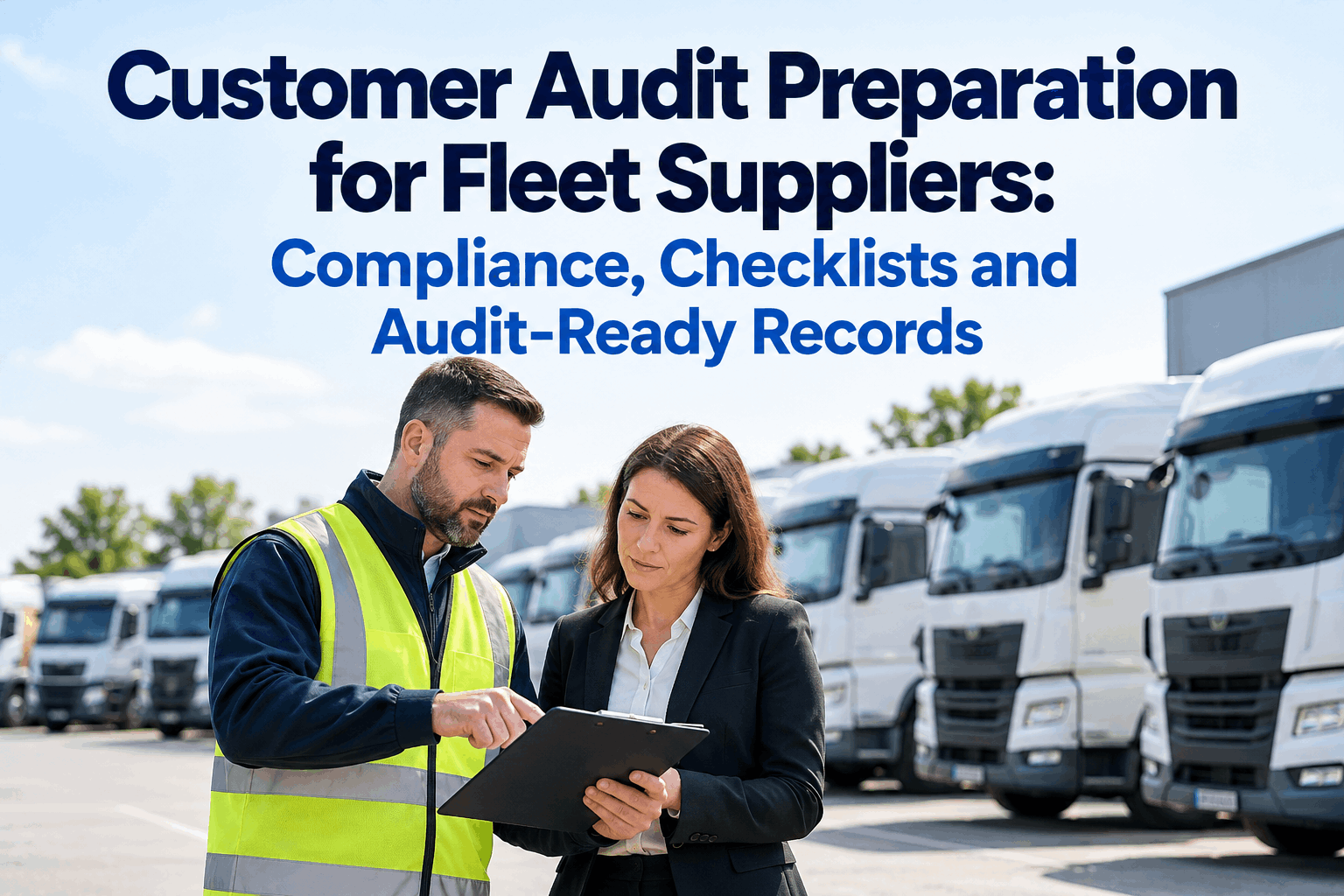
Customer audit preparation for fleet suppliers starts long before an auditor requests a vehicle file. Customers may review inspection histories, preventive maintenance, defect closure, driver qualifications and evidence that contractual controls actually operate. The strongest approach is to map each customer requirement to a current, retrievable record, test the evidence before the visit and resolve gaps with documented corrective actions.
Customer Audit Preparation for Fleet Suppliers
Turn scattered inspection and maintenance paperwork into a traceable evidence pack that helps protect customer confidence and contract renewals.
One requirement should lead to the actual record, responsible owner and review status—not just a policy statement.
What Customers Actually Check During a Fleet Supplier Audit
A second-party audit is conducted by a customer or its representative to assess supplier performance against agreed requirements. Its scope can cover fleet safety, service reliability, training, legal obligations and contractual standards.
Start with the contract, not a generic checklist
Review the service-level agreement, customer supplier manual, audit notice and applicable local requirements. A transport customer's evidence requests may differ from those of a construction contractor or an industrial equipment customer.
Auditors commonly sample individual vehicles, maintenance events and personnel files. They may compare an inspection defect with a repair work order, check whether preventive maintenance was completed on time or ask how a repeated problem was escalated.
Do not claim every requested document is legally mandated. Separate customer-specific expectations from statutory requirements and internal procedures, then assign an owner to each.
Book a Demo to See HVI Vehicle-Level Inspection Histories →Vehicle TRK-214 • Evidence Request
Six Record Groups to Prepare Before the Audit
Use a requirement-to-evidence register rather than storing everything in one folder. Each entry should identify the requested period, document owner, record location, last review date and any known gap.
Vehicle inspections
Pre-use checks, DVIRs where applicable, defect notes, inspection dates and vehicle IDs.
Preventive maintenance
Service intervals, due dates, completed work, overdue exceptions and approvals.
Defect-to-repair chain
Original finding, work order, technician action, verification and release status.
People & training
Driver qualifications, role-specific training and competency records where required.
Incidents & safety
Incident reports, investigations, corrective actions and follow-up reviews.
Contract performance
Service reports, downtime trends, customer complaints and SLA exception records.
Need inspection and repair history in one place? Start free to organize fleet inspection records with HVI.
Prove the Full Defect-to-Repair Trail
A closed work order is not always enough. An auditor may ask whether a reported defect was assessed, whether the vehicle was restricted when necessary and what evidence supported return to service.
Make Maintenance Evidence Easier to Find
See how HVI inspection histories, maintenance records and work orders can support a clearer customer audit trail.
A Practical Five-Stage Customer Audit Preparation Plan
Use a staged approach that tests whether the fleet can produce accurate records, not merely whether the files exist.
Confirm scope
Collect the customer criteria, site list, vehicle sample rules and deadlines. Identify legal versus contractual obligations.
Build evidence index
Assign each requirement a record source, responsible person and status. Preserve version history where appropriate.
Run a self-audit
Sample vehicles, drivers and work orders as an auditor would. Check dates, signatures, identifiers and closure proof.
Resolve and disclose gaps
Correct issues, assign action owners and distinguish completed fixes from actions still in progress.
Prepare audit-day access
Confirm contacts, permissions, exports, site access and a process for answering follow-up questions.
Schedule a short readiness meeting with operations, maintenance, safety and commercial teams. Agree who will answer questions about service performance, who owns technical records and who is authorized to share sensitive information with the customer.
Fleet Supplier Customer Audit Preparation Checklist
Adapt this list to the customer and jurisdiction. It is a working self-assessment aid, not a certification checklist.
Before the visit
✓ Confirm audit criteria and sampling period.
✓ Validate the current fleet and asset register.
✓ Check overdue preventive maintenance.
✓ Review inspection records for gaps.
✓ Match defects with corrective work orders.
✓ Verify training and qualification evidence.
During and after the visit
✓ Assign an audit lead and document owners.
✓ Provide controlled, relevant record access.
✓ Answer with evidence, not assumptions.
✓ Record requests and findings accurately.
✓ Assign corrective action owners and dates.
✓ Verify closure and report follow-up status.
Want faster access to vehicle-level records? Book a Demo to Explore HVI Audit-Ready Retrieval.
Why Fleet Suppliers Receive Audit Findings
Many audit problems are documentation and process failures rather than a single mechanical breakdown. The goal is to identify the control that failed and prevent recurrence.
Missing inspections
Vehicle records are absent, unsigned or outside the requested period.
Response:Determine why capture failed, restore the process and monitor completion.
Overdue PM
Required maintenance dates do not align with completed work evidence.
Response:Assess asset risk, resolve backlog and improve scheduling escalation.
Unverified repairs
Defects are marked closed without sufficient technician or release evidence.
Response:Standardize repair verification and link findings to work orders.
Expired qualifications
Role-specific training or qualification records are outdated or unavailable.
Response:Assign an owner, verify current eligibility and monitor expirations.
Example: A Customer Questions a Fleet's Brake Defect Records
Consider a fictional supplier operating 60 delivery vehicles. During a second-party audit, the customer samples a vehicle that had a brake-related inspection finding two months earlier.
Driver records a brake concern during inspection.
Supervisor assesses the defect and removes the vehicle from service pending evaluation.
Technician completes repair and records the work order.
Authorized release is documented after verification.
Supplier retrieves the linked inspection, repair and release evidence.
What a strong response demonstrates
The customer can follow the event from the first observation to a documented decision and completed repair. If a link is missing, the supplier should acknowledge the gap and establish a corrective action rather than reconstruct or backdate records.
Evidence of a good response supports customer confidence; it does not guarantee a passing audit or contract renewal.
Respond to Audit Findings with Verifiable CAPA
Corrective and preventive action (CAPA) should address both the immediate nonconformity and the process weakness that allowed it. Keep each finding tied to an owner, target date, evidence and effectiveness check.
Use the customer's required response template and deadlines. A corrective action should not be closed solely because a task was assigned; check that the fix was implemented and that the problem has not recurred.
KPIs That Show Whether Your Fleet Is Actually Ready
Track indicators that expose missing evidence before the customer finds it. Define denominators and reporting periods so results can be compared consistently.
Inspection completion
Completed required inspections ÷ scheduled inspections.
On-time PM
PM services completed by due date ÷ PM services due.
Defect closure time
Time from defect identification to verified resolution.
Evidence retrieval time
Time needed to produce a complete requested vehicle file.
Open audit findings
Unresolved findings by severity and days overdue.
CAPA effectiveness
Closed actions with documented effectiveness checks.
Use HVI as the Record Layer Behind Customer Audit Preparation
HVI can help fleet teams organize the operational records that customer auditors commonly request. The supplier still owns the underlying compliance obligations, accuracy of evidence and customer responses.
Inspection History
Retrieve checks and reported issues against identifiable fleet assets.
Maintenance Records & Work Orders
Follow service activity and corrective maintenance through vehicle history.
Defect Follow-Up
Support the link between reported issues, maintenance actions and review.
Access & Reports
Use appropriate permissions and available exports to prepare evidence packs.
Customer Audit • Fleet Sample
See how inspection and maintenance records can support your next supplier review: Book a Demo for HVI Fleet Customer Audit Preparation.
Fleet Supplier Audit Preparation FAQs
What is a fleet supplier customer audit?
It is a customer-led or customer-appointed assessment of a supplier's fleet operations against agreed requirements. It may cover inspections, maintenance, safety, driver qualifications, contract performance and the evidence supporting those controls.
What documents should fleet suppliers prepare?
Typical records include vehicle inventories, inspection histories, preventive maintenance schedules, work orders, defect closure, driver qualifications, training, incidents and corrective actions. The exact list depends on the customer, jurisdiction and scope.
How should a supplier handle missing inspection records?
Identify the affected assets and period, assess any operational risk, investigate the cause, implement a corrective action and disclose limitations accurately. Do not create backdated records to fill historical gaps.
How can fleets demonstrate defect-to-repair closure?
Connect the original inspection finding with the repair work order, technician details, verification evidence and authorized return-to-service decision, where required. Consistent identifiers make the chain easier to audit.
Can HVI guarantee a successful customer audit?
No. HVI can support inspection, maintenance and record retrieval workflows, but audit outcomes depend on actual compliance, customer criteria, record accuracy, employee practices and effective corrective action.
Be Ready When Your Customer Asks for Proof
Organize the vehicle checks, maintenance histories and corrective-action records behind your supplier commitments. Make evidence easier to retrieve before the next customer assessment.