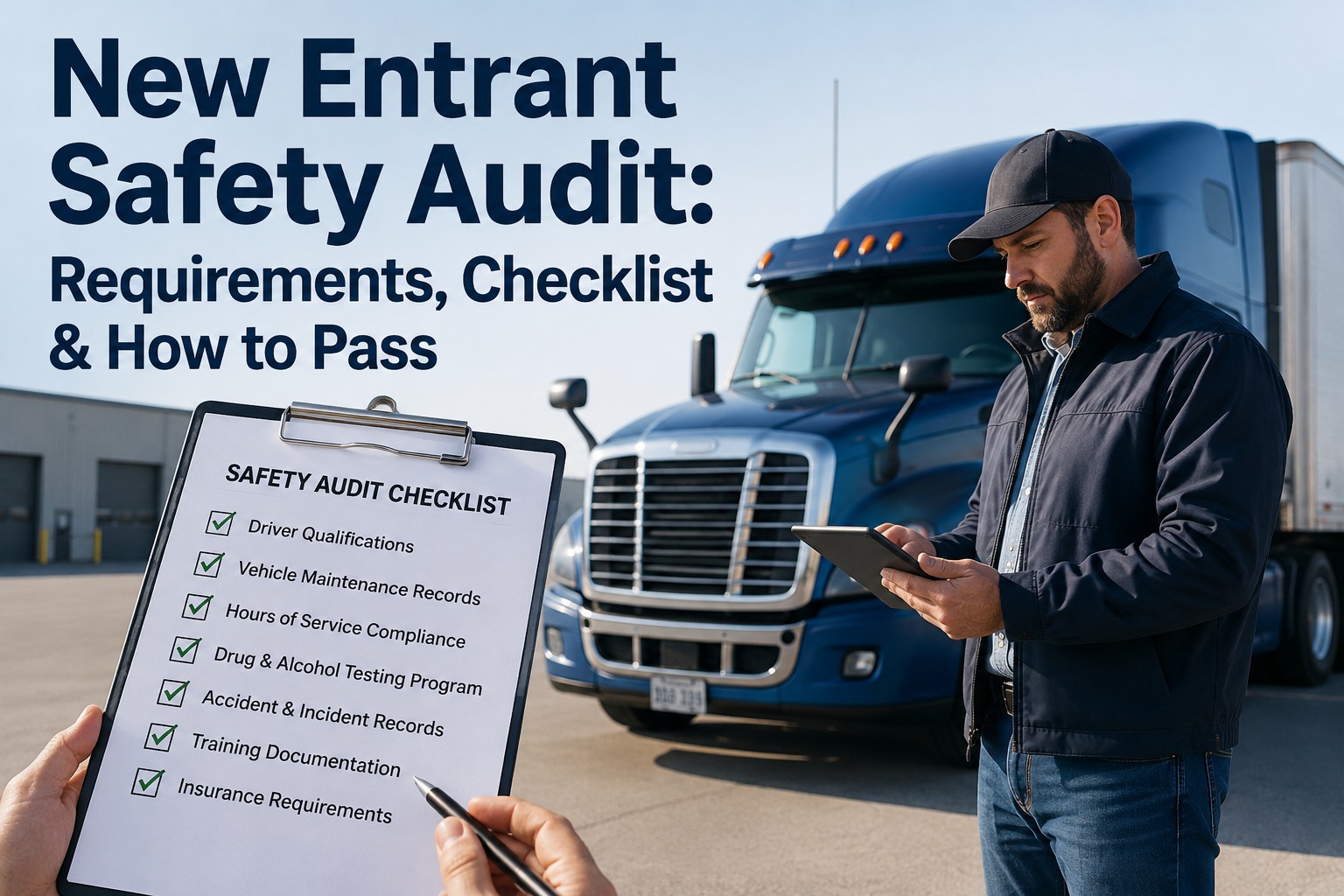
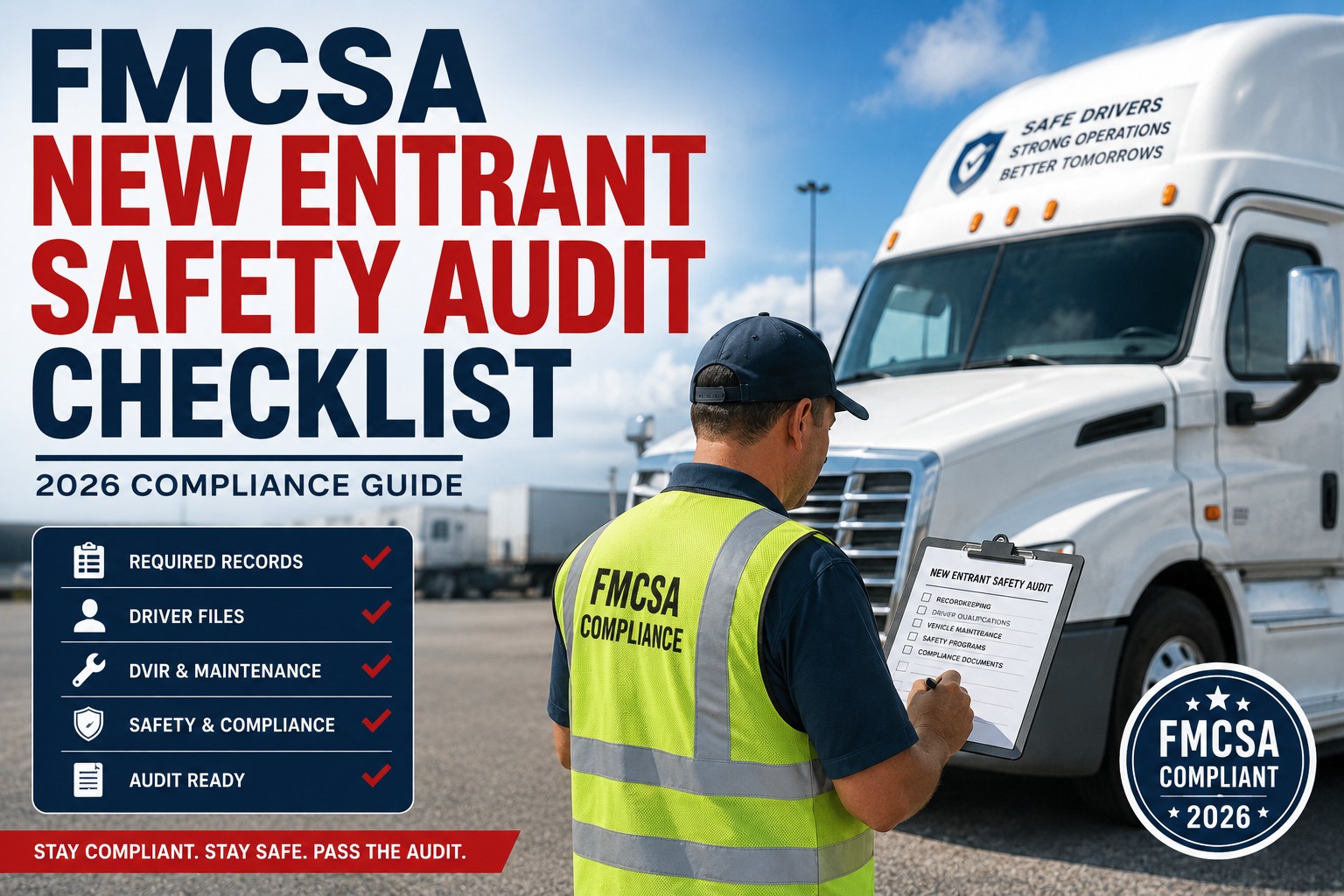
Here's what catches new carriers off guard: the FMCSA new entrant safety audit isn't a road test. Nobody checks your brakes. An auditor sits down with your paperwork and asks you to prove on paper that you've run safely since day one. Most carriers who fail aren't unsafe; they're disorganized. They did the work but can't produce the records, and in your first year you can't recreate what was never written down. This guide covers what the audit checks and how to be ready. Book a demo to see day-one compliance records in HVI.
New Entrant Safety Audit: Requirements, Checklist & How to Pass
Every new motor carrier faces this audit in its first year. It's a records test, not a road test — and the carriers who pass are simply the ones who can produce the proof.
Educational overview based on 49 CFR Part 385 — not legal advice. Requirements and enforcement can change; always confirm current rules at fmcsa.dot.gov.
When you activate a new USDOT number, FMCSA places you in the New Entrant Safety Assurance Program — an 18-month monitoring period governed by 49 CFR Part 385, Subpart D. Somewhere in that window, usually within your first 12 months, you'll get a safety audit. It exists to verify one thing: that you have basic safety management controls in place. Pass and your registration becomes permanent. Fail and don't fix it, and FMCSA can revoke your authority before your first year is out. The good news is that this is one of the most preparable challenges in trucking — if you start on day one.
What the audit actually is
The single biggest misconception is that this is a vehicle inspection. It isn't. It's a document review — an auditor examining your records to confirm your safety program is real and functioning. Understanding that reframes your entire preparation.
An FMCSA- or state-certified auditor reviews your paperwork, on-site or electronically. They're verifying documentation, not testing your trucks on the road.
You're typically notified in advance — often around 30 days or less. That's enough time to organize existing records, but not enough to create a year of history you never kept.
This is the whole game. If the work happened but the record doesn't exist or can't be found, to the auditor it didn't happen. Retrievable proof is everything.
FMCSA will notify you in writing whether you passed or failed, generally no later than 45 days after the audit. Frame the whole thing as a systems test: do your policies exist, do your records match reality, and can you hand over evidence on request. Carriers who treat it that way pass on the first try. Book a demo to keep audit-ready records from your first load
The violations that fail you instantly
Most of the audit is scored on the overall picture — but not everything. Under 49 CFR 385.321, there are 16 specific violations where a single occurrence automatically fails the entire audit, no matter how clean the rest of your records are. These are the ones to obsess over. They fall into a few groups.
- No alcohol and/or controlled-substances testing program in place
- Using a driver who tested positive, or refused a required test
- Using a driver known to have an alcohol concentration of 0.04 or greater
- Using a driver without a valid CDL
- Using a driver who is disqualified, or whose CDL is suspended, revoked, or canceled
- Using a driver without a valid medical certificate
- Operating without the required levels of financial responsibility (insurance)
- Failing to require hours-of-service records, or knowingly using false records
- Operating a vehicle declared out-of-service before the required repairs are made
- Using a vehicle not periodically (annually) inspected as required
A note on scope: some of these apply based on your operation — the drug-and-alcohol and CDL items apply to carriers running CDL drivers, and hazmat-specific rules apply if you haul hazardous materials. Confirm which requirements apply to your specific operation, because the list isn't identical for every carrier. Start free on HVI to organize the vehicle inspection and maintenance side from day one.
The six record areas auditors examine
The audit looks across the core areas of safety management. Each is tied to a part of the federal regulations, and each needs complete, retrievable documentation. Here's what belongs in each.
A file per driver: application, 3-year employment history, prior-employer safety inquiries, CDL copy, current medical certificate, MVR, and road-test or equivalent.
Written policy, pre-employment testing, a random testing pool at the required rates, and Clearinghouse queries — for carriers with CDL drivers.
ELD data or logs with supporting documents, checked for false logs, form-and-manner errors, and unassigned driving time.
A maintenance file per vehicle, annual DOT periodic inspections, and driver vehicle inspection reports (DVIRs) — the area HVI is built for.
A register of recordable accidents with supporting documentation for each, plus any post-accident testing records where applicable.
Proof of the required insurance levels, with the correct legal name and USDOT/MC numbers on the certificates.
Look closely and a theme emerges: this is overwhelmingly a documentation challenge, not a safety-practices challenge. Most new carriers are running safely — they just haven't built the filing discipline to prove it across six areas at once. Two of these six, vehicle maintenance and inspection records, are exactly what HVI keeps organized and retrievable from your first day. Book a demo to see maintenance and inspection files audit-ready per vehicle
Your day-one compliance setup
The carriers who breeze through the audit didn't cram — they built the system before they hauled their first load. Here's the setup to stand up immediately, so records accumulate correctly from the start instead of being reconstructed in a panic.
Build the Part 391 file the day you hire, not the day you're audited. Application, history, CDL, medical card, MVR — complete and dated.
If you run CDL drivers, get the testing program and Clearinghouse set up before anyone drives. This is the most common failure point — make it airtight early.
From the first day each unit runs: DVIRs, the annual periodic inspection, and every repair. This is the record trail HVI builds automatically.
Get your ELD or logging in place immediately and keep the supporting documents. Gaps and unassigned driving time are exactly what auditors look for.
Confirm your insurance meets the required levels with correct legal details, and start the accident register even if it's empty.
Once a month, review each area as if the auditor were coming. Catching a gap in month three is trivial; catching it under a 30-day notice is not.
Notice the phrase that keeps repeating: from day one. That's not a motivational slogan — it's the actual mechanism. Because records can't be honestly recreated after the fact, the entire difficulty of this audit collapses if the documentation simply built itself as you operated. Start free and stand up your inspection and maintenance records this week.
Why new carriers fail — and what happens next
Understanding the common failure patterns helps you avoid them. Almost none of them are about being an unsafe carrier — they're about records and setup.
- No drug-and-alcohol testing program set up before running CDL drivers
- Incomplete driver qualification files — missing inquiries, MVRs, or medical cards
- No maintenance file or annual inspection records per vehicle
- Missing or inconsistent hours-of-service documentation
- Insurance not at required levels, or wrong details on the certificate
- Records that exist somewhere but can't be produced during the audit
- FMCSA notifies you in writing of the result and the deficiencies
- You're generally given the chance to submit a Corrective Action Plan (CAP)
- A satisfactory CAP, showing you've fixed the issues, can preserve your authority
- Fail to submit or satisfy the CAP, and FMCSA can revoke your new-entrant registration
- The specifics and deadlines are set by FMCSA — respond quickly and get qualified help
The reassuring reality is that a failed audit isn't automatically the end — the corrective-action process exists precisely because most failures are fixable paperwork problems. But it's a stressful, deadline-driven scramble you'd much rather avoid, and the way you avoid it is the setup described above. Because enforcement steps and timelines can change, confirm the current process directly with FMCSA and consider qualified compliance help if you're facing a failed audit. Book a demo to keep the records that prevent a failure in the first place
From an owner-operator who passed on the first try
I got my authority and honestly forgot the audit was even coming — I was focused on finding loads and keeping the truck moving. When the notice showed up giving me about a month, I braced for a nightmare. The thing that saved me was that I'd been logging every inspection and repair from the first week, almost by accident, because I'd set it up as a habit.
The auditor asked for maintenance records and DVIRs and I just pulled them up, all in one place, dated. What I didn't have as tight was the driver-side paperwork, and that's where I sweated. Lesson learned: it's not about being safe — I was safe. It's about being able to show it instantly. Set it up before you need it, because you cannot go back and create records you never kept.
The audit rewards preparation, not perfection
The new entrant safety audit feels intimidating because your whole business rides on it, but it's genuinely one of the most winnable challenges in trucking. It's a records review under 49 CFR Part 385, not a road test — an auditor confirming you have basic safety management controls across driver qualification, drug and alcohol testing, hours of service, vehicle maintenance and inspection, accidents, and insurance. Sixteen violations under 385.321 can fail you on a single occurrence, so the drug-and-alcohol program and driver qualification demand attention before your first driver rolls. Everything else comes down to whether you can produce complete, consistent records on request — and because your operating history is short, those records can't be honestly manufactured after a notice arrives. Prepare from day one and the audit becomes a formality; wait, and it becomes a scramble.
That's where a records system earns its place. HVI helps a new carrier organize inspection and maintenance documentation from the very first load — DVIRs, annual periodic inspections, work orders, and a searchable maintenance file per vehicle — so the vehicle side of your audit is ready long before the notice arrives, and starting is free. To be clear about the boundary: HVI keeps your inspection and maintenance records organized and retrievable, but it doesn't run your drug-and-alcohol program, provide your insurance, or serve as legal or compliance advice, and it can't guarantee any audit outcome — the full program is yours to build, and requirements vary by operation. Because FMCSA regulations, guidance, and enforcement procedures can change, always confirm current requirements directly at fmcsa.dot.gov. Start early, stay organized, and the audit that worries every new carrier becomes the one you pass on the first try. Book a demo to get audit-ready from day one with HVI.
Frequently asked questions
What is the FMCSA new entrant safety audit?
The new entrant safety audit is a mandatory compliance review that every newly authorized motor carrier must complete, governed by 49 CFR Part 385, Subpart D. When you activate a new USDOT number, FMCSA places you into the New Entrant Safety Assurance Program, an 18-month safety monitoring period, and somewhere in that window — usually within your first 12 months of operation — you'll undergo the safety audit. Its purpose is to verify that you have basic safety management controls in place: essentially, that your safety program is real and functioning across areas like driver qualification, drug and alcohol testing, hours of service, vehicle maintenance and inspection, accident recording, and insurance. A crucial point that surprises many new carriers is that this is a records review, not a road test or a vehicle inspection. An FMCSA- or state-certified auditor examines your documentation, either on-site at your place of business or electronically through document submission, to confirm your records demonstrate compliance. If you pass, your registration ultimately becomes permanent and FMCSA evaluates you like any other carrier going forward. If you fail and don't successfully correct the deficiencies, FMCSA can revoke your operating authority. Because it's a documentation review, the carriers who pass are consistently the ones who are organized and can produce their records, not necessarily the ones with the newest equipment.
When will a new carrier be audited?
Most new carriers undergo the safety audit within the first 12 months of beginning operations under their new authority, though the exact timing depends on FMCSA scheduling and your safety data. The broader context is that every new entrant is subject to an 18-month safety monitoring period, and the audit is the central checkpoint within it. Importantly, the audit is generally announced rather than a surprise — you'll typically receive notice in advance, often around 30 days or less, telling you whether it will be conducted on-site or off-site through electronic document submission. That notice period is enough time to gather and organize records you've been keeping all along, but it is not enough time to create a year's worth of history you never documented, which is the core reason preparation has to start from your first day of operation rather than when the notice arrives. After the audit is completed, FMCSA will notify you in writing of the result — whether you passed or failed — generally no later than 45 days afterward. Because scheduling and procedures are set by FMCSA and can change, it's wise to confirm the current process directly at fmcsa.dot.gov and to keep your records continuously audit-ready rather than trying to predict the exact date.
What automatically fails a new entrant safety audit?
Under 49 CFR 385.321, there are 16 specific violations that will automatically fail the entire safety audit if even a single one is found, regardless of how strong the rest of your records are. They cluster into a few groups. In drug and alcohol testing — the most common failure area for carriers with CDL drivers — automatic failures include not having implemented a required alcohol and controlled-substances testing program, using a driver who tested positive or refused a required test, and using a driver known to have an alcohol concentration of 0.04 or greater. In driver qualification, they include using a driver without a valid CDL, using a driver who is disqualified or whose CDL is suspended, revoked, or canceled, and using a driver without a valid medical certificate. Other automatic failures include operating without the required levels of insurance or financial responsibility, failing to require hours-of-service records or knowingly permitting false ones, operating a vehicle that had been placed out of service before making the required repairs, and using a vehicle that hasn't had its required periodic (annual) inspection. Because a single occurrence in any of these categories fails the whole audit, they deserve priority attention from day one — particularly the drug-and-alcohol program and driver qualification. Note that which specific items apply can depend on your operation, so confirm the requirements relevant to your business.
What records do I need for the safety audit?
The audit spans the core areas of safety management, each tied to federal regulations, and you'll need complete, retrievable records in each. Driver qualification files under Part 391 include, per driver, an application with three years of employment history, prior-employer safety performance inquiries, a copy of the CDL, a current medical certificate, a motor vehicle record, and road-test or equivalent documentation. The drug and alcohol program under Part 382 — for carriers with CDL drivers — includes a written policy, pre-employment testing, a random testing pool at the required rates, and Clearinghouse queries. Hours-of-service records under Part 395 include ELD data or logs plus supporting documents. Vehicle maintenance and inspection records under Part 396 include a maintenance file for each vehicle, annual periodic inspection records, and driver vehicle inspection reports. The accident register under Part 390 lists recordable accidents with supporting documentation. And insurance or financial-responsibility documentation under Part 387 proves you carry the required coverage levels with correct legal identifiers. The recurring lesson is that most of this is documentation you generate simply by operating, and the failures usually come from records being incomplete or unretrievable rather than the underlying work not happening. Keeping each area organized continuously — especially the vehicle maintenance and inspection files, which accumulate constantly — is what makes the audit straightforward.
What happens if I fail the new entrant safety audit?
Failing the audit is serious but, in most cases, not automatically the end of your operation. FMCSA will notify you in writing of the result and identify the deficiencies found. From there, you're generally given the opportunity to submit a Corrective Action Plan, which is documentation showing that you've addressed the problems that caused the failure — for example, standing up a compliant drug-and-alcohol program, completing driver qualification files, or fixing your maintenance recordkeeping. If you submit a satisfactory Corrective Action Plan demonstrating the deficiencies are resolved, you can preserve your operating authority and continue operating. If you fail to submit an adequate plan or don't correct the issues, FMCSA can revoke your new-entrant registration, which would stop your operation. The exact process, required content, and deadlines are set by FMCSA, and they can carry tight timeframes, so the right response to a failure is to act quickly, follow FMCSA's instructions precisely, and strongly consider getting qualified compliance or legal assistance. The far better position, of course, is to avoid the failure altogether — and since most failures come down to missing or disorganized records rather than genuinely unsafe operations, disciplined day-one recordkeeping is the most reliable way to never need the corrective-action process at all. Because enforcement procedures can change, confirm the current requirements directly with FMCSA.
Get audit-ready from day one with HVI
Your operating history starts now — and so should your records. HVI lets new carriers and owner-operators organize inspection and maintenance documentation from the very first load: DVIRs, annual periodic inspections, work orders, and a searchable maintenance file per vehicle. When the audit notice lands, the vehicle side is already done. Starting is free, it's mobile-first for the cab and the shop, and you can be running in minutes — not waiting until an audit is scheduled to get organized.
Free to start · Inspection & maintenance records · DVIRs and audit-ready history from day one
.png)