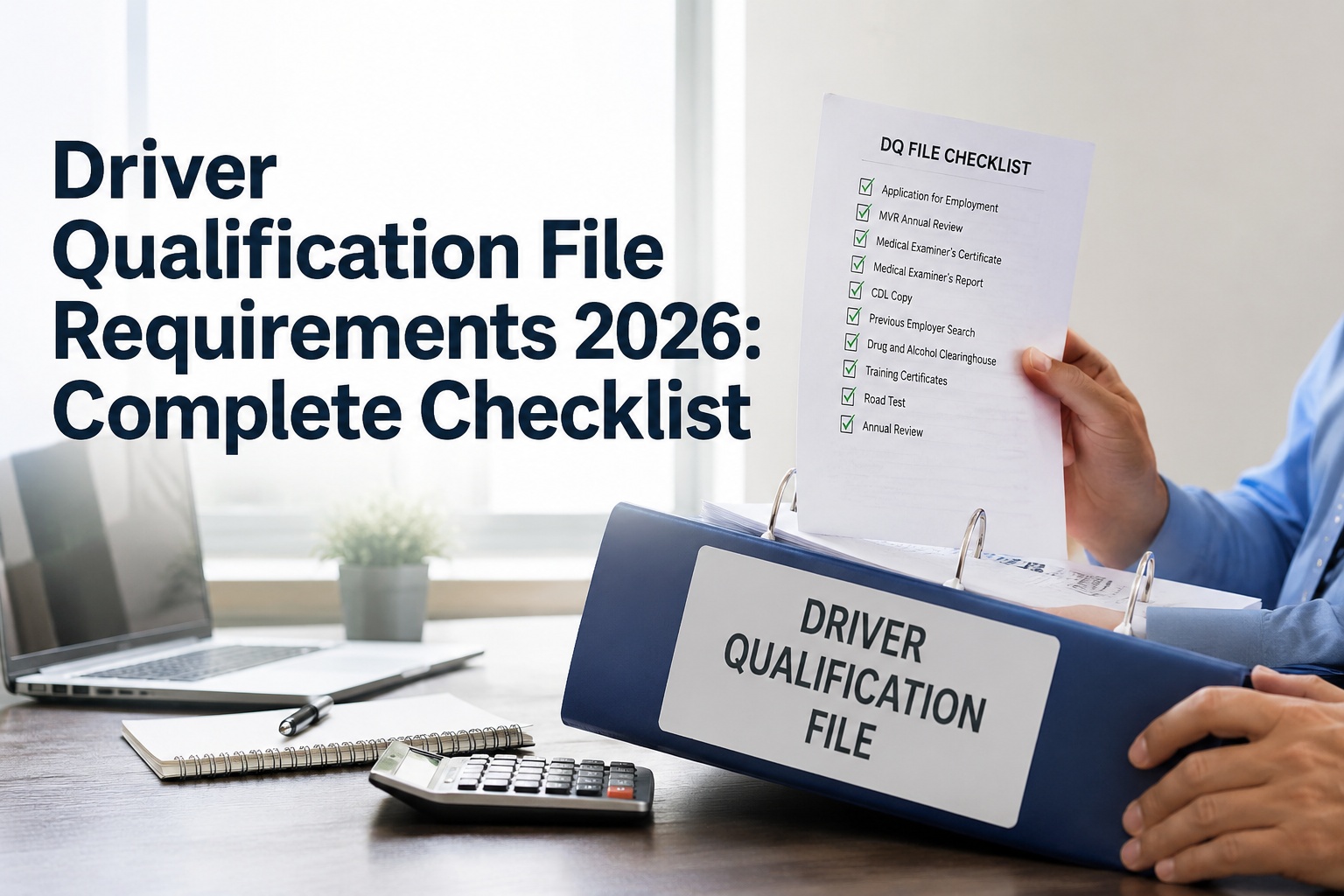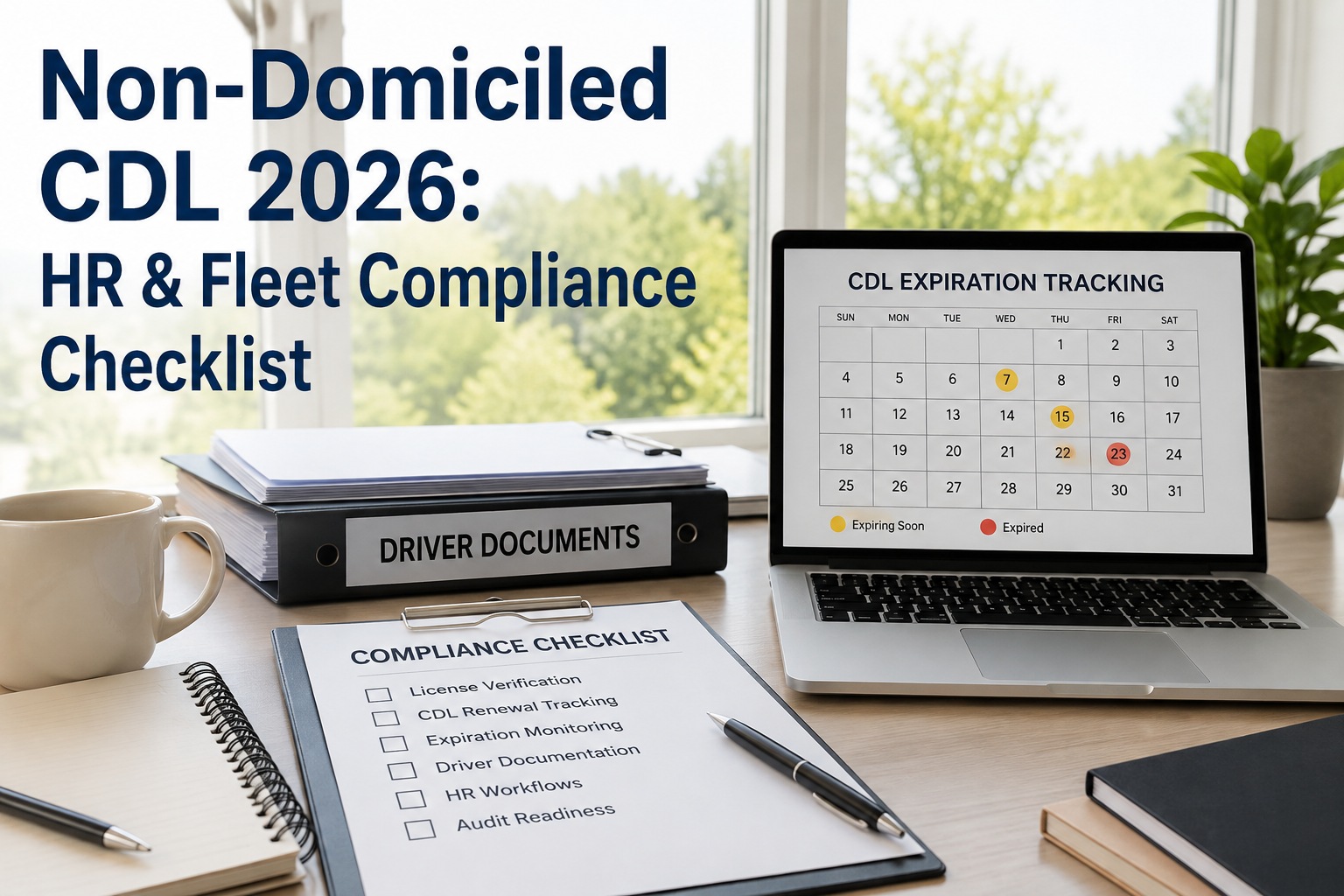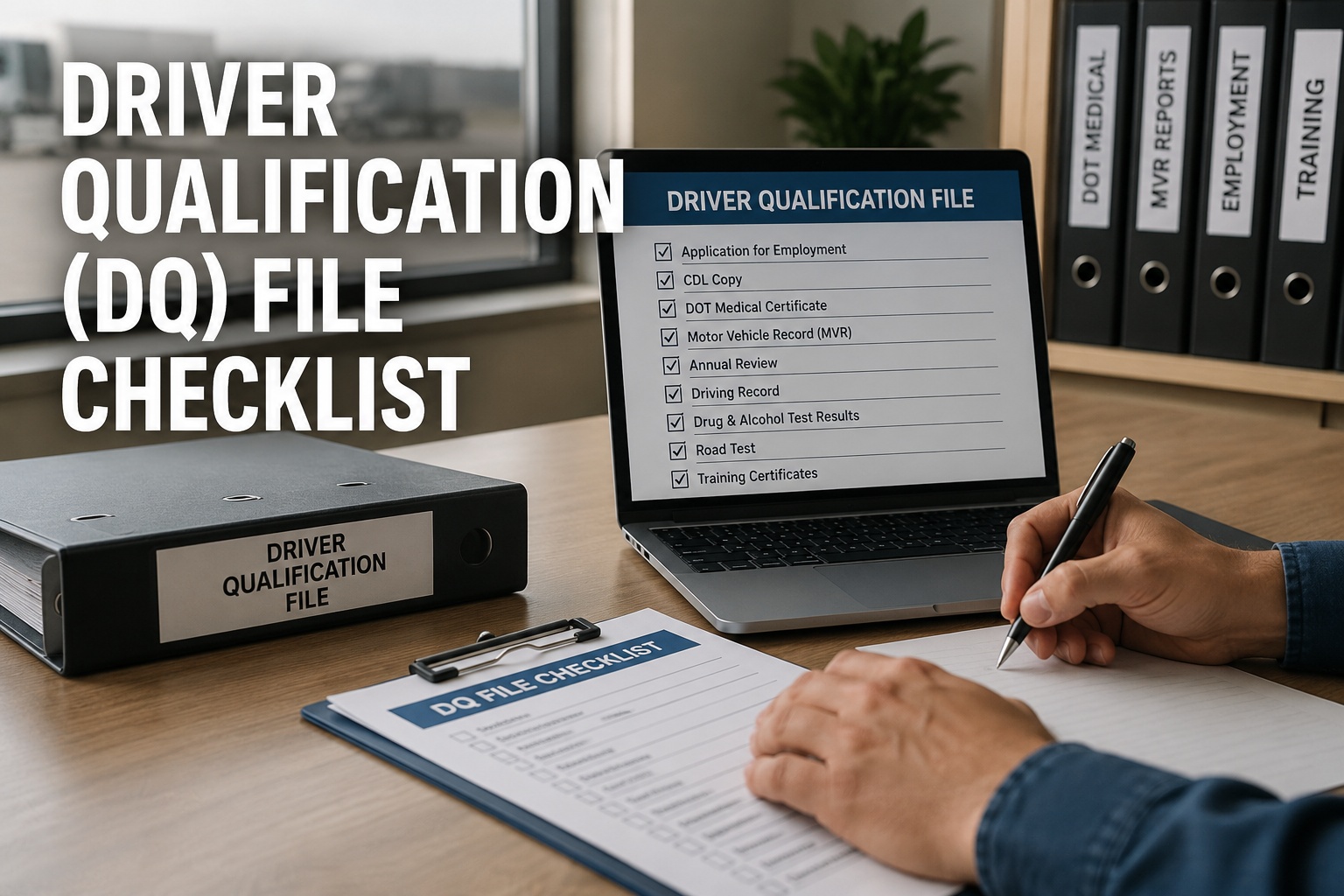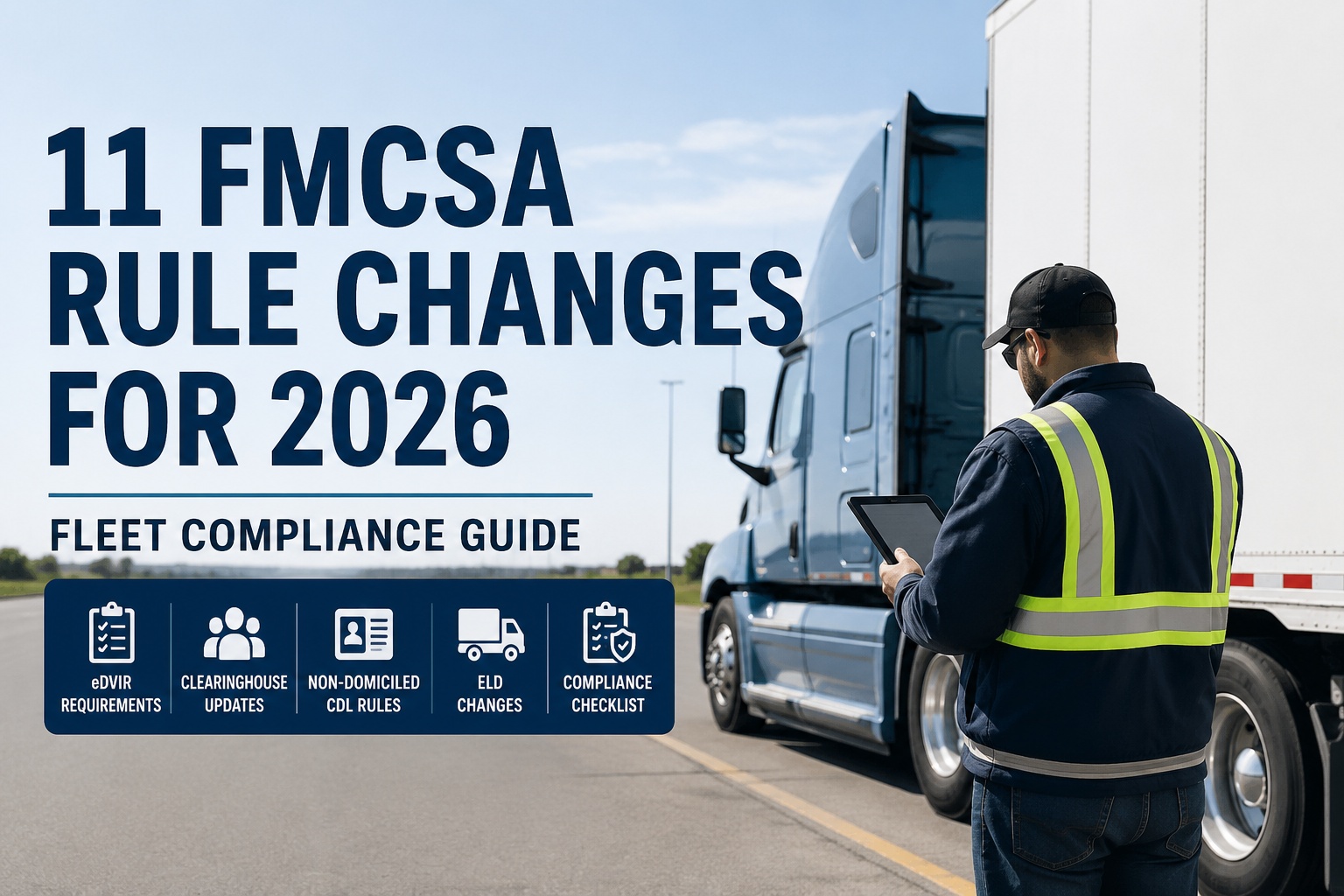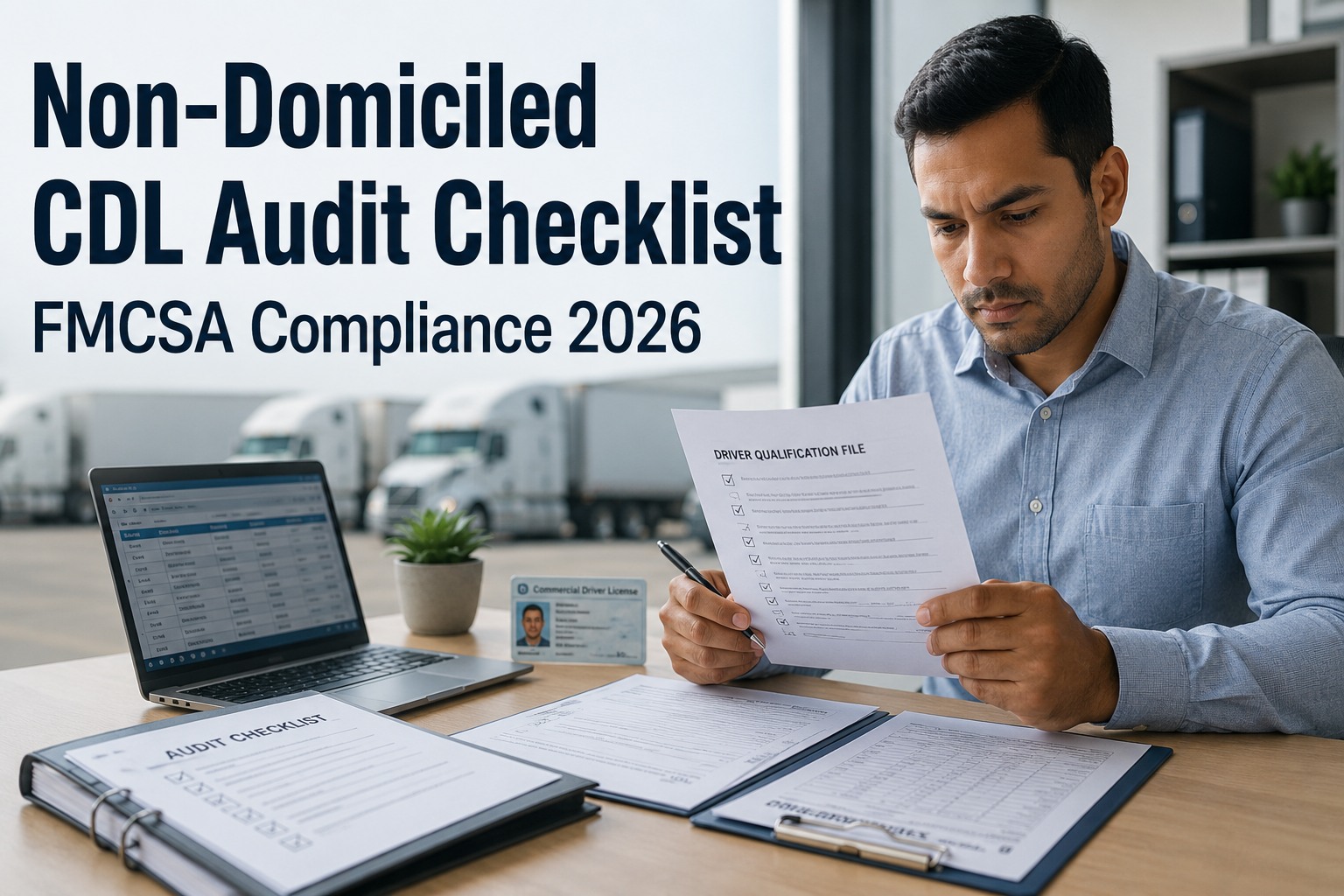
The FMCSA non-domiciled CDL audit checklist for 2026 has one job: identify every driver on your roster whose CDL is at risk under the March 16, 2026 Final Rule, verify the compliance documents in each non-domiciled driver's qualification file, and plan for the drivers who won't qualify for renewal. The rule (91 FR 7044) restricted non-domiciled CDL eligibility to just three visa categories — H-2A, H-2B, and E-2 — and roughly 97% of the estimated 200,000 non-domiciled CDL holders don't hold any of them. That's ~194,000 drivers who cannot renew when their current CDL expires. This is the operational audit workflow: how to sort your roster, what documents to verify, and what to do next. Book a demo to run the roster audit on live fleet data in under a day.
The Non-Domiciled CDL Audit Checklist
Sort your driver roster into three buckets. Compliant. Verify now. Renewal risk. Everything else in the audit follows from this.
The FMCSA Final Rule does not automatically revoke currently valid non-domiciled CDLs on March 16, 2026. What it does is restrict every future issuance, renewal, transfer, and upgrade to the three eligible visa categories only. Drivers with lawful non-domiciled CDLs today can continue operating until their CDL expires — but if they don't hold H-2A, H-2B, or E-2 status, they cannot renew. The rolling replacement of the affected 194,000 drivers is the workforce-planning problem this audit produces.
The 4 numbers that shape the audit
Any single one of these justifies the roster review. Together they explain why compliance managers who wait until the second half of 2026 will be doing workforce planning under pressure.
- 194,000 Drivers estimated to be affected — ~97% of non-domiciled CDL holders
- 3 visas Only H-2A, H-2B, and E-2 remain eligible — EADs alone no longer count
- 1 year Maximum CDL term — down from up to 5 years — adds annual re-audit cadence
- $7,000+ Average DQ file violation penalty — DQF issues = 17% of all FMCSA citations
The 1-year maximum term is the operational hit most fleets underestimate. What used to be a document check every 3-5 years becomes an annual verification for every non-domiciled driver — passport, I-94, visa status, employer sponsorship documentation. Manual tracking of that cadence across a mixed fleet is where audit findings start. Book a demo to see annual credential tracking automated
The 6-step non-domiciled CDL audit workflow
Run this sequence per driver, in order. Each step depends on the one before it — skipping ahead produces incomplete files that fail on the auditor's spot-check. Estimated audit time: 15 minutes per non-domiciled driver on file.
-
01
Pull the roster and isolate non-domiciled CDLs
Export every active CDL driver. Sort by CDL type: identify any credential marked "non-domiciled" (or "limited term" — the pre-rule terminology some states used). This is your audit scope. Domiciled CDLs are out of scope for this rule.
-
02
Identify each driver's immigration category
For each non-domiciled driver, determine the immigration status the CDL was issued under: H-2A, H-2B, E-2, EAD-only, DACA, TPS, asylum, refugee, or other. This categorization is the pivot point of the audit — it determines which bucket the driver goes into.
-
03
Verify the I-94 Admit Until Date
Under the Final Rule, CDL validity cannot exceed the I-94 Admit Until Date. Pull the current I-94 from the CBP portal for each non-domiciled driver. Compare against CDL expiration. Any CDL expiring past the I-94 date was non-compliantly issued and is subject to state revocation.
-
04
Confirm passport & visa documents in the file
For H-2A/H-2B/E-2 drivers: unexpired foreign passport copy in the DQF, I-94 corresponding to the eligible status, employer sponsorship documentation. Missing any of the three creates a documentation gap the auditor will find first.
-
05
Assess renewal eligibility & timeline
Note current CDL expiration date for every non-domiciled driver. Drivers holding H-2A/H-2B/E-2 can renew at expiration under the new 1-year term. Drivers holding any other status cannot renew — the CDL sunsets at expiration. Sort the renewal-ineligible drivers by CDL expiration date to build the workforce-planning timeline.
-
06
Plan replacement & document the audit
For each renewal-ineligible driver: identify replacement, evaluate whether transition to an eligible visa via employer sponsorship is possible, or plan route/assignment adjustment before the expiration date. Document every audit finding, decision, and action taken — this record is your audit-defense trail.
The full six-step audit for a 100-driver fleet with 15% non-domiciled roster runs to roughly 4 hours of compliance-manager time. Automated document management platforms cut that to about 30 minutes because roster sorting, I-94 comparisons, and expiration alerts run automatically from imported credential data. Start free and import your driver roster to run the 6-step audit
The 7-document verification per non-domiciled driver
These are the specific documents FMCSA auditors request when they open a non-domiciled driver's file. Missing any one is a citable DQ file finding at ~$7,000 average penalty. Every non-domiciled driver's DQF must contain all seven, current and legible.
Item 7 is the ongoing operational task — every other item is a static file. Automated 60/30/7-day alerts against the earlier of CDL or I-94 expiration are what keep the audit clean between formal reviews. Book a demo — see 90/60/30-day credential alerts running on real driver data
The 3 eligible visa categories — deep dive
Only these three nonimmigrant visa statuses qualify a driver for a non-domiciled CDL under the Final Rule. FMCSA selected them because each involves enhanced consular vetting and interagency screening that substitutes for the domestic driving-history verification the rule cites as the underlying safety concern.
H-2A
- Seasonal / temporary agricultural work sponsored by U.S. employers
- Requires DOL labor certification + petition approval
- Typical validity: up to 3 years with extensions
- Common use: agricultural haul carriers, seasonal farm equipment operators
H-2B
- Non-agricultural temporary work sponsored by U.S. employers
- DOL certification + annual numerical cap applies
- Typical validity: up to 3 years with extensions
- Common use: temporary CMV operators in non-agricultural sectors
E-2
- Investors from treaty countries with substantial U.S. business investment
- Requires treaty-country nationality + qualifying investment
- Validity: renewable in 2-year increments indefinitely
- Common use: owner-operators of treaty-country origin
Notable exclusions that surprised many carriers: standalone EADs (work permits without a qualifying visa), DACA recipients, TPS holders, asylum seekers, and refugees. Drivers in these categories can complete their current CDL term but cannot renew — regardless of driving record, employment history, or years of clean CMV operation. Start free and tag every driver by visa category on import
From a director of compliance who ran the audit in March
Rule went final February 13. We had 22 non-domiciled drivers across 140 tractors. First cut of the roster, I thought we were fine — most of them had current, valid CDLs. Then I checked the visa categories. Two H-2Bs, one E-2, nineteen EAD-only. Nineteen drivers we cannot renew.
What saved us was starting the audit two weeks after the Final Rule dropped. Earliest CDL expiration in that group was August. We had 5 months to plan replacements, sponsor two candidates through employer visas, and adjust routes for the rest. If we'd started in July, we'd have been scrambling on the compliance side and short-staffed on the operations side simultaneously.
Frequently asked questions
What is the non-domiciled CDL Final Rule and when does it take effect?
The FMCSA Final Rule titled "Restoring Integrity to the Issuance of Non-Domiciled Commercial Driver's Licenses" was published in the Federal Register on February 13, 2026 (91 FR 7044, docket FMCSA-2025-0622) and became effective March 16, 2026. The rule restricts eligibility for non-domiciled Commercial Learner's Permits and Commercial Driver's Licenses to non-immigrants who hold one of three specific employment-based nonimmigrant visa categories: H-2A (temporary agricultural workers), H-2B (temporary non-agricultural workers), or E-2 (treaty investors). Employment Authorization Documents alone are no longer accepted as sufficient proof of eligibility. The rule also caps the maximum term of a non-domiciled CDL at 1 year (down from up to 5 years under prior rules), requires the credential's validity to not exceed the I-94 Admit Until Date, requires the word "non-domiciled" to be conspicuously displayed on the face of the credential, and requires state driver licensing agencies to downgrade non-domiciled CDLs within 30 days if federal authorities notify the state that a driver no longer has lawful immigration status. The rule does not automatically revoke previously issued non-domiciled CDLs on the effective date; those credentials generally remain valid until expiration, though FMCSA strongly encourages states to audit all unexpired non-domiciled CDLs and revoke any that were non-compliantly issued.
Which drivers are affected by the new rule?
FMCSA estimates approximately 200,000 non-domiciled CDL holders were in effect on the rule's effective date, and roughly 194,000 of them — about 97% — hold immigration statuses that do not qualify for renewal under the new framework. Affected categories include holders of standalone Employment Authorization Documents (EADs) without a qualifying visa, DACA recipients, Temporary Protected Status (TPS) holders, asylum seekers, refugees, and any other non-H-2A/H-2B/E-2 status. These drivers can continue operating under their current non-domiciled CDL until it expires, but cannot renew, transfer, or upgrade the credential under the Final Rule. The impact is gradual rather than immediate because most currently-valid non-domiciled CDLs were issued with validity periods of up to 5 years under prior rules; the affected driver pool will decline through expiration over the 2026-2030 window. Carriers with even a small number of non-domiciled drivers should run the audit workflow immediately to identify which drivers will not qualify for renewal and to build workforce-planning timelines based on each driver's specific CDL expiration date.
What documents does an auditor request for a non-domiciled CDL driver?
FMCSA auditors requesting a non-domiciled driver's file typically ask for seven categories of documentation. First, the current CDL or CLP copy showing "non-domiciled" clearly displayed per §383.153(c). Second, unexpired foreign passport copy including biographical page and entry stamp. Third, current Form I-94 or I-94A pulled from the CBP portal, ideally within the past 90 days. Fourth, visa category documentation appropriate to H-2A (DOL labor certification plus petition approval), H-2B (DOL certification plus counted allocation), or E-2 (treaty investor documentation). Fifth, employer sponsorship record tying the driver to the sponsoring employer under the visa terms. Sixth, the complete standard Driver Qualification File under 49 CFR Part 391 covering MVR, medical certificate, drug and alcohol Clearinghouse query, road test certificate, and 3-year employment history verification. Seventh, an active renewal alert schedule showing 60, 30, and 7-day advance notification against the earlier of CDL or I-94 expiration date. A missing item on any of the seven is a citable DQF finding, and DQ file violations average approximately $7,000 per finding, with the DQF category representing roughly 17% of all FMCSA citations.
Do carriers face additional requirements from this rule?
The Final Rule does not directly impose new requirements on motor carriers, freight brokers, or shipper clients — it modifies what state driver licensing agencies must do when issuing non-domiciled CDLs. However, carriers face significant operational and compliance exposure through their existing 49 CFR Part 391 obligation to engage only qualified drivers. If a driver's CDL is revoked or downgraded because the underlying immigration status doesn't meet the new eligibility criteria, and the carrier continues to dispatch that driver, the carrier faces standard driver qualification violations averaging $7,000+ per finding plus CSA score impact. Practical carrier actions include: immediate audit of the current non-domiciled roster to identify who won't qualify for renewal; workforce-planning based on the earlier of each driver's CDL expiration or I-94 Admit Until Date; verification workflows that check driver credentials at least annually against the shorter maximum term now in effect; and documentation trails proving good-faith reliance on state-issued credentials. The Final Rule remains under legal challenge in the D.C. Circuit (A. Rivera Lujan v. FMCSA and related petitions), but carriers should comply with the current framework while monitoring litigation developments.
How does automation help with non-domiciled CDL audit compliance?
Manual audit of non-domiciled CDL compliance requires roster review, per-driver document verification, cross-referencing CDL expiration against I-94 Admit Until Date for every driver, and 60/30/7-day alerting for both credentials against whichever expires first. For a 100-driver fleet with 15% non-domiciled roster, the initial audit runs approximately 4 hours; ongoing quarterly re-verification and expiration monitoring is another 3-6 hours per quarter of compliance-manager time. Automated fleet compliance platforms handle this by importing driver credentials with expiration dates, flagging every non-domiciled CDL automatically, storing visa category and I-94 documentation in the driver qualification file, running expiration alerts against the earlier of CDL or I-94 dates on rolling schedules, blocking dispatch on any driver whose credential status has lapsed, and producing audit-ready reports on demand. For carriers with non-domiciled drivers, the compliance-cost savings are real, but the audit-defense benefit is arguably larger — every audit finding of a missing I-94 verification or a lapsed sponsorship document produces a citation that automated tracking prevents at zero marginal cost per driver.
Turn the 4-hour audit into a 30-minute review
HVI imports every CDL credential, flags non-domiciled status automatically, tracks I-94 expiration alongside CDL expiration, alerts at 60/30/7 days on whichever expires first, and produces the audit-ready DQ file report FMCSA auditors ask for. Live in under two weeks — and the first week almost always finds two to five drivers whose renewal path had never been clarified.
No credit card · No hardware · DQ file automation ready day one