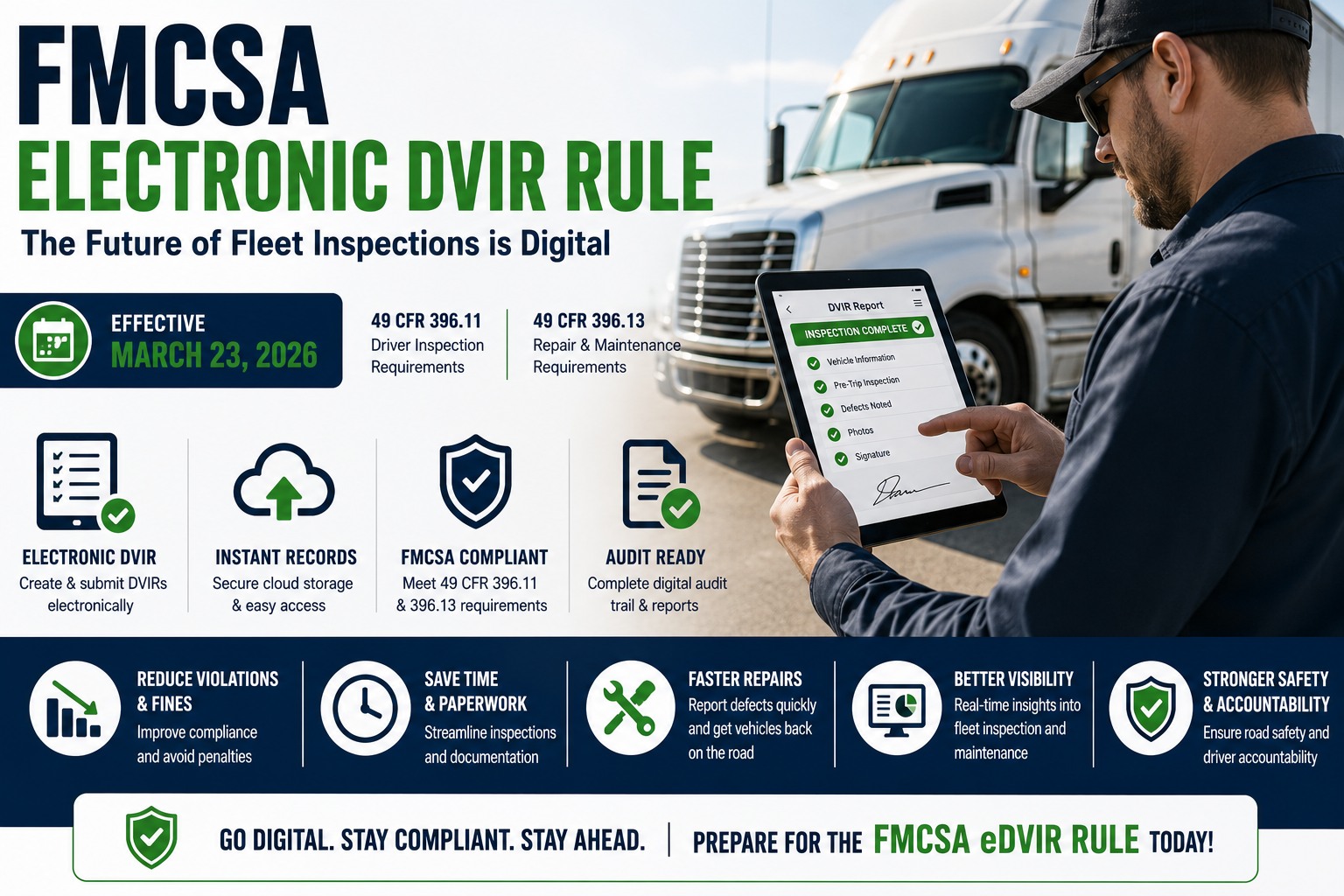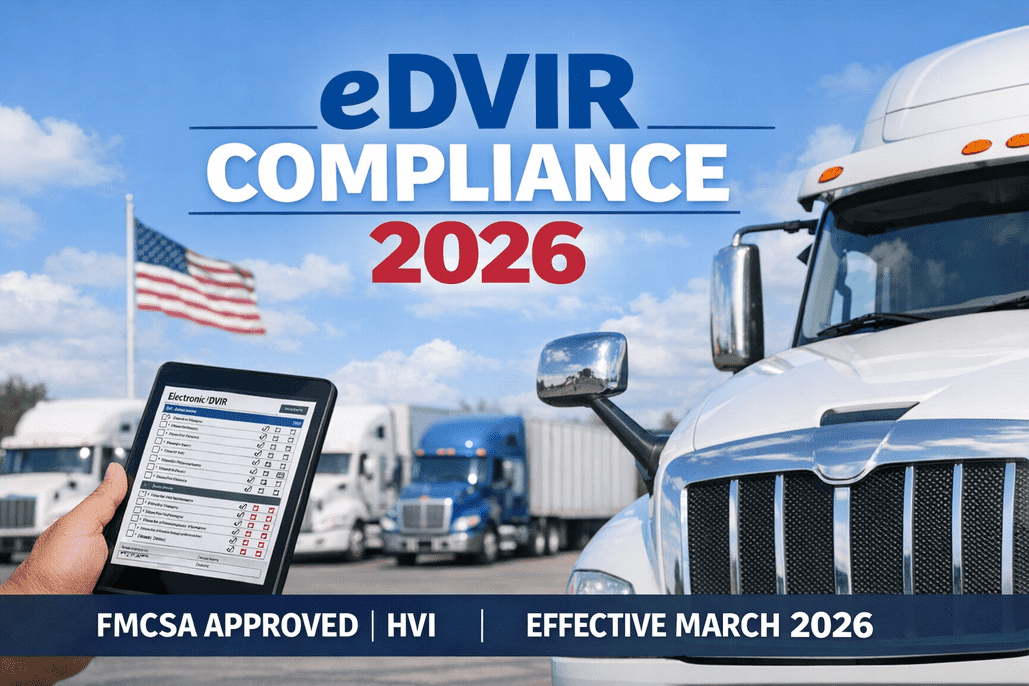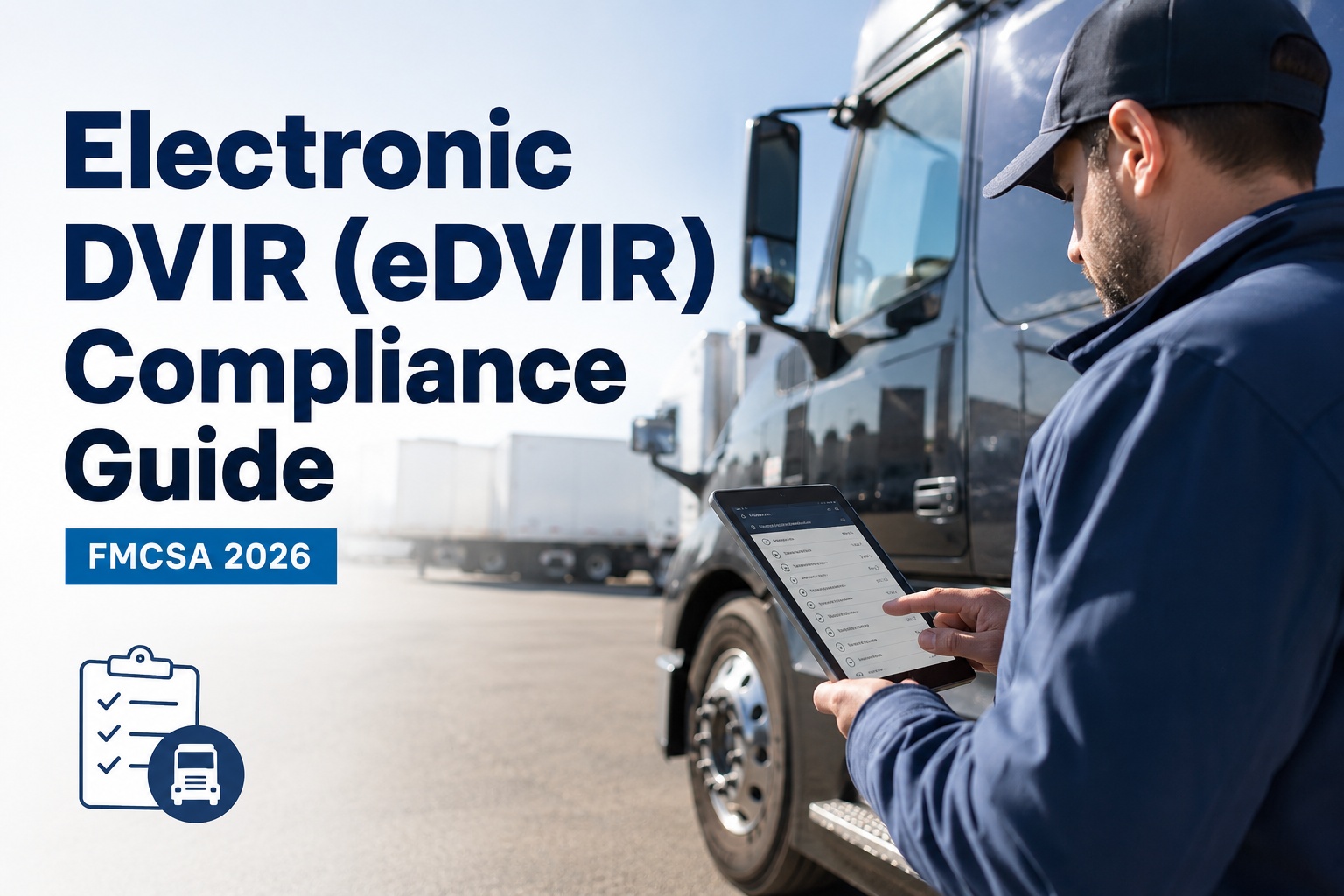
Electronic DVIR (eDVIR) is the digital replacement for paper Driver Vehicle Inspection Reports — and after the FMCSA Electronic DVIR Final Rule took effect February 19, 2026, it's officially the gold standard for fleet compliance. A truly compliant eDVIR platform enforces every required item under 49 CFR §396.11 and §392.7, captures timestamped photos of critical checkpoints, routes defects directly into work orders, preserves audit-ready records with digital signatures from both driver and mechanic, and produces the complete inspection history within 10 seconds during a DOT audit. This eDVIR compliance guide walks what makes a platform truly FMCSA-compliant, the daily workflow that connects pre-trip to post-trip to repair, the audit readiness standard, the measurable ROI of switching from paper, and the five common mistakes fleets make during the migration. Book a demo after you see the full workflow end to end.
Paper DVIR vs Electronic DVIR
Same regulation. Two completely different audit outcomes. Below is what an FMCSA auditor actually sees when they ask for 60 days of inspection records.
Both records above satisfy the letter of 49 CFR §396.11 on paper. Only one survives an actual FMCSA audit. Below is what makes an eDVIR platform truly compliant under the February 2026 Final Rule, how the daily workflow connects pre-trip to post-trip to repair, the 10-second audit-readiness standard, the measurable ROI, and the five mistakes fleets keep making during migration from paper.
What makes an eDVIR platform truly FMCSA-compliant
Not every "digital DVIR" app on the market clears the February 2026 Final Rule bar. Use these eight requirements as your evaluation checklist — each one maps to a specific FMCSA rule or audit expectation.
Digital signatures for both driver and mechanic
February 2026 Final Rule confirms digital signatures are legally valid — no wet ink required. Platform must capture and preserve both.
All required inspection items per §396.11
Service brakes, parking brake, steering, lighting, tires, horn, wipers, mirrors, coupling, wheels, and emergency equipment — every category defined in the rule.
Photo verification on critical items
FMCSA doesn't mandate photos, but auditors expect them for brakes, tires, lighting, and any defect. Photos are the strongest audit defense a fleet has.
GPS coordinates and timestamp per item
Proves the inspection actually happened at the yard, not filled in later at the truck stop. Every check should carry location + time metadata.
Automatic defect-to-work-order routing
When the driver flags a defect, the platform creates a work order immediately — not the next day, not manually. Closed-loop verification is what auditors look for.
Retention for 3+ months minimum
§396.11 requires 3 months. Best practice is 12+ months to align with the 2026 CSA counting window. Records must be searchable and indexed by truck, driver, and date.
ELD integration and data synchronization
FMCSA specifically noted streamlined compliance when DVIR and ELD systems connect. Timestamp mismatches between the two systems trigger deeper audit scrutiny.
Producible in under 10 seconds during audit
Filter by truck, date range, driver — complete report with photos and signatures downloadable instantly. This is the practical audit-readiness standard.
A platform hitting all eight requirements above satisfies both the letter and the practical expectations of the FMCSA Final Rule. Missing any one creates a gap that surfaces during audit. Book a demo to see all eight requirements live in the HVI platform
The eDVIR workflow — pre-trip, drive, post-trip, repair
A compliant eDVIR isn't just a form — it's a workflow that connects the driver's mobile device, the truck, the mechanic's shop, and the fleet's compliance record. Below is what an ideal cycle looks like.
Pre-trip trigger
Driver receives shift-start pre-trip notification on mobile. Truck can't be dispatched until inspection completes.
Walk-around + photos
Driver walks the truck, checks each item on the digital form, captures required photos on brakes, tires, lighting.
Digital sign-off
GPS + timestamp locked. Driver signs digitally. Record filed to fleet system. Dispatch cleared.
Drive with ELD active
ELD logs hours-of-service. Any en-route defect noted via mobile app immediately, timestamped and located.
Post-trip DVIR
End-of-shift walk-around. Defects flagged with photos and description. Second driver signature filed.
Defect → work order → certified
Flagged defects auto-generate work orders. Mechanic completes repair, photos and signs. Loop closes.
Every stage of the loop is timestamped, photo-verified, and preserved in the digital record. Auditor request for "DVIR history on truck #217 for last 60 days" returns a complete, filterable report — no digging, no missing signatures, no illegible fields. Start free and get the workflow running this week
The measurable ROI of switching from paper DVIR to eDVIR
The eDVIR business case doesn't rest on convenience — it rests on four specific measurable outcomes that show up on the P&L within the first quarter of adoption.
The ROI math is straightforward: $30 per truck per month vs one $4,000 unscheduled repair a paper system missed. Multiply across the fleet, layer in the CSA percentile improvement, and the business case writes itself. Book a demo to see the ROI calculation for your fleet size
5 common mistakes fleets make when migrating from paper DVIR to eDVIR
Every fleet that adopts eDVIR badly can trace the failure to one of five predictable mistakes. All five are preventable with the right rollout plan.
Choosing a platform without photo verification
Some "digital DVIR" apps just replicate the paper form on a screen. Without required photos on critical items, the audit defense is barely stronger than paper — and none of the OOS reduction shows up.
Skipping driver training on the mobile interface
Fleet rolls out eDVIR, drivers get a login and no walkthrough. Adoption stalls, drivers revert to paper "just in case," fleet ends up running two systems for 6 months.
Not enforcing mechanic sign-off in the digital system
Driver files defect on eDVIR. Mechanic repairs on paper work order. The eDVIR record shows an open defect forever. Next audit: incomplete records.
Not migrating 12 months of past records
Fleet goes digital on March 1. Auditor arrives June 15 and asks for records back to previous September. Paper records are in a warehouse, half unreadable.
Treating eDVIR as data collection instead of workflow enforcement
Platform captures inspections but doesn't block dispatch on missing items or expired inspections. Drivers roll on incomplete DVIRs. Auditor finds gaps. Fleet loses the CSA percentile advantage the platform was supposed to build.
Every mistake above compounds until the first audit. The fleets doing eDVIR right treat it as a compliance workflow enforced by software, not a paper form that happens to be digital. Book a demo to see enforced eDVIR in production — or start free and skip the migration mistakes .
From a fleet compliance manager who ran the paper-to-eDVIR migration
We put off eDVIR for two years because "paper works fine." Paper worked fine right up until the FMCSA audit in November. Auditor asked for 60 days of DVIRs on 15 specific trucks. We produced 47 out of 90 expected records. The rest were either missing signatures, illegible, or simply not filed.
We had 30 days to fix it before the follow-up. Went digital in 22. The February 2026 Final Rule made the decision easier — there's no ambiguity now about digital signatures. Wish we'd done it two years ago.
Frequently asked questions
What is an electronic DVIR (eDVIR)?
An electronic DVIR (eDVIR) is the digital replacement for a paper Driver Vehicle Inspection Report required under 49 CFR §396.11. Instead of a paper form filled out by hand, the driver completes the inspection on a mobile app or tablet, checking each required item (brakes, tires, coupling, lights, mirrors, wipers, wheels, horn, emergency equipment), capturing photos on critical checkpoints, and signing digitally. GPS coordinates and timestamps lock the record. Defects auto-generate work orders that route to the maintenance shop for repair and mechanic sign-off. Records are stored electronically and retrievable within seconds for FMCSA or CVSA audits. The FMCSA Electronic DVIR Final Rule, effective February 19, 2026, formally confirmed that eDVIRs are legally equivalent to paper DVIRs, including digital signatures without wet ink required from both driver and mechanic.
Is eDVIR legally required by FMCSA in 2026?
No, eDVIR is not required. Paper DVIRs remain permitted under the February 19, 2026 Electronic DVIR Final Rule. The rule explicitly authorizes electronic DVIRs and confirms their legal equivalence to paper. However, most fleets are migrating to eDVIR proactively because the practical compliance gap has grown too wide to justify staying on paper. Under the 2026 CSA overhaul, records must be producible within minutes of an auditor's request, digital signatures are now the default, defect-to-work-order integration matters more than it used to, and audit-ready photo verification is the strongest defense in an OOS dispute. Paper DVIRs can meet the letter of the rule but rarely survive rigorous audit scrutiny. Best practice for 2026: adopt eDVIR before your next audit, not after.
What must an eDVIR platform include to be FMCSA-compliant?
A truly FMCSA-compliant eDVIR platform must include eight core capabilities. First, digital signatures for both driver and mechanic (no wet ink required). Second, all required inspection items per §396.11 (service brakes, parking brake, steering, lighting, tires, horn, wipers, mirrors, coupling, wheels, emergency equipment). Third, photo verification on critical checkpoints (brakes, tires, lighting, and any flagged defect). Fourth, GPS coordinates and timestamps per item to prove the inspection actually happened. Fifth, automatic defect-to-work-order routing that closes the loop between driver report and mechanic repair. Sixth, retention for 3+ months minimum with best practice at 12 months to match the CSA counting window. Seventh, ELD integration and timestamp synchronization to prevent audit red flags. Eighth, records producible in under 10 seconds during audit through filter-by-truck-date-driver search. Missing any capability creates a gap that surfaces during audit.
How long must eDVIR records be retained?
The federal minimum retention period for DVIRs under 49 CFR §396.11 is 3 months from the date of the inspection. This applies to both paper and electronic DVIRs. However, best practice for eDVIR platforms in 2026 is 12+ months of active retention to align with the 2026 CSA scoring counting window (reduced from 24 months to 12 months under the overhaul). Some fleets retain 24 months or longer for warranty defense and long-term audit protection. During a DOT audit, the auditor will typically request 12 months of records; producing only the 3-month minimum can create the appearance of incomplete compliance. Digital retention is essentially free once the platform is in place, so there's no practical reason to purge records at the federal minimum. Set retention to 24 months and let the storage cost be trivial compared to the audit defense value.
How does eDVIR help with a DOT audit?
During a DOT audit, the auditor will typically request DVIRs for specific trucks over a specific date range — often 12 months of records on 10-20 vehicles. Paper systems take 30-90 minutes per truck to produce, and the records are frequently incomplete: missing signatures, illegible entries, defect notes without follow-up work orders. eDVIR platforms produce the complete record with photos and signatures within 10 seconds per truck through filter-by-truck-date search. Every record is timestamped, GPS-located, digitally signed by both driver and mechanic, and traceable through the defect-to-work-order-to-repair loop. Fleets running compliant eDVIR platforms consistently report the shortest audit durations and lowest violation counts. The audit-defense value alone justifies the platform cost within a single audit event, and most fleets see the ROI compound through reduced roadside OOS rates and improved CSA percentiles within the first quarter.
Every eDVIR compliance requirement on this page is live in HVI today
HVI captures GPS-stamped photo-verified inspections per shift, enforces both driver and mechanic digital sign-off, routes every defect into a work order automatically, and produces the complete audit record in under 10 seconds. Live in under two weeks. Typical customers eliminate paper DVIR audit risk within the first month.
No credit card · No hardware · eDVIR ready day one