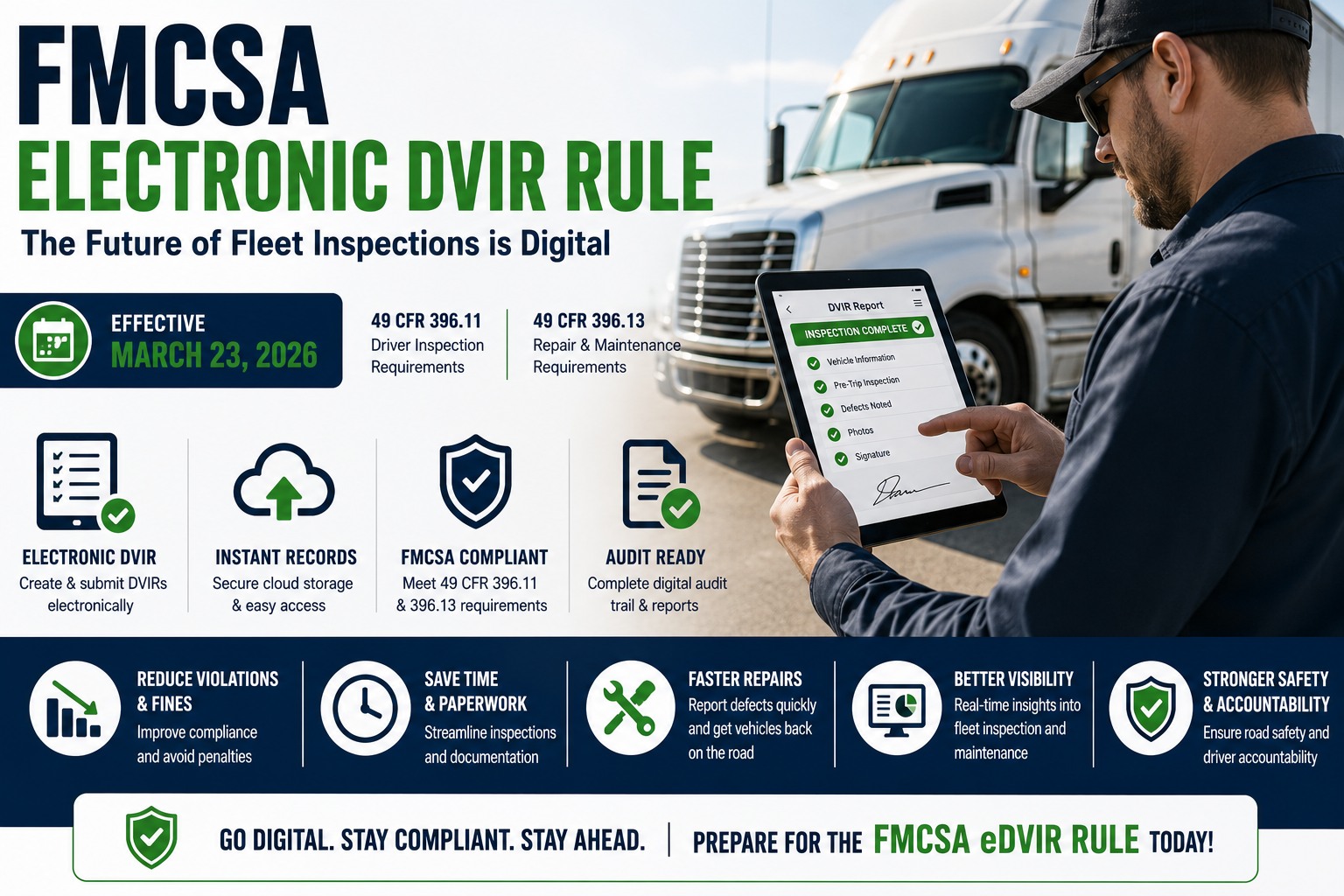
On March 23, 2026, the FMCSA electronic DVIR rule officially took effect — a one-sentence amendment to 49 CFR 396.11 and 396.13 that quietly ends a decade of interpretive grey area. Electronic DVIRs were technically permissible under 49 CFR 390.32 since 2018, but auditors, attorneys, and DOT officers read the paper-centric language differently, and cautious carriers stayed on paper "just to be safe." That excuse is gone. This guide breaks down exactly what Docket FMCSA-2025-0115 changed, what it deliberately did not change, the three-signature chain that still governs every defect report, the 11 inspection categories that still have to be covered, and whether you need to switch. Book a demo to see a compliant eDVIR live under the new rule.
The FMCSA Electronic DVIR Rule: What Changed on March 23, 2026
The new rule adds explicit electronic-DVIR language to 49 CFR 396.11 and 396.13. Paper is still legal, the three-signature chain is unchanged, the 11 categories are unchanged — but the grey area that kept fleets on paper is now gone.
- Docket
- FMCSA-2025-0115
- Published
- Feb 19, 2026 (Vol. 91 · No. 33)
- Effective
- March 23, 2026
- Sections amended
- 49 CFR 396.11 & 396.13
- Electronic DVIRs explicitly authorized
- Paper DVIRs still legal
- No-defect reporting NOT reinstated
The reasonable reaction to a rule that "clarifies existing regulation" is to skip past it — and it's the wrong reaction here. The rule didn't invent new obligations, but it changed what a defensible answer to "why are you still on paper?" sounds like in front of a DOT auditor, an insurance underwriter, or a jury. The rest of this guide walks the exact language change, what stayed the same, and what a practical migration looks like.
How the rule got here — a 10-month timeline
The rulemaking was short and quiet because it was a clarification, not a new requirement. Three dates matter.
- May 30, 2025 NPRM published FMCSA proposed explicit eDVIR language in response to public comment from NTTC. 60-day comment window opens.
- Jul 29, 2025 Comments close Five comments received. Four in favor (NTTC, OOIDA, ATA, individual); one revision suggestion from NSTA on paper.
- Feb 19, 2026 Final rule published Federal Register Vol. 91, No. 33. No changes from the NPRM. FMCSA agrees to continue permitting paper.
- Mar 23, 2026 Effective Rule live. Deadline for petitions for reconsideration on the same date. eDVIR ambiguity officially resolved.
The rule was supported by ATA, OOIDA, and NTTC, and the NSTA asked that paper remain a compliance option — which FMCSA agreed to. It's a rare piece of regulation where every major stakeholder essentially got what they asked for. See what compliant looks like under the new rule
What actually changed — and what didn't
Read the FAQ pages and you'd think the whole DVIR world was rewritten. It wasn't. One sentence was added in two places — and understanding what stayed the same is more important than the sentence itself.
What the rule added
- Explicit language in 396.11 stating the required reports may be created and maintained in electronic format, per 390.32
- Matching explicit language in 396.13 authorizing electronic creation and maintenance of the next-driver acknowledgment
- Regulatory backing for E-SIGN Act digital signatures across the full three-signature chain
- Clarity that cloud storage satisfies the 3-month retention obligation
What did not change
- Paper DVIRs remain legal as a compliance alternative
- The three-signature chain (driver → mechanic → next driver) is unchanged
- The 11 required inspection component categories are unchanged
- 3-month retention minimum still applies
- No-defect DVIR reporting was NOT reinstated for property carriers
- Passenger-carrying CMVs still require a DVIR every operating day, defects or not
The practical takeaway: if you were doing paper right, you can keep doing paper. If you weren't sure whether digital was really okay, now you know it is — explicitly, and codified into the sections auditors quote. Start free and get on the codified side of the rule
The three-signature chain — still the whole game
The signature chain is the thing 89% of DOT compliance reviews audit and where most citations come from. The 2026 rule didn't touch its structure. It only clarified that every signature can be captured electronically with a timestamp.
-
1
Driver post-trip
Driver AAt the end of the day's work, the driver signs the report documenting any defects or deficiencies affecting safe operation across the 11 required categories. Property carriers may skip filing if truly no defects; passenger carriers file every day.
-
2
Repair certification
Mechanic / carrier officialBefore the vehicle is dispatched again, a carrier official or mechanic must certify that the defects were repaired — or that repair was deemed unnecessary because the item didn't affect safe operation. Signed and dated.
-
3
Next-driver acknowledgment
Driver BThe next driver reviews the prior DVIR and repair certification, then signs acknowledgment before operating. Under 396.13 this is the most commonly missed signature in the chain — and the one that pulls fleets into audit findings.
All three now unambiguously electronic. The value of that isn't the digital signatures themselves — it's that they carry timestamps, and a timestamped chain is essentially uncontestable. See the full chain captured in one workflow
The 11 required inspection categories
These are the components a DVIR must cover under 49 CFR 396.11. They're unchanged by the 2026 rule, and they're the checklist a template in any compliant eDVIR needs to enforce.
- 1Service brakes, including trailer connections
- 2Parking (hand) brake
- 3Steering mechanism
- 4Lighting devices & reflectors
- 5Tires
- 6Horn
- 7Windshield wipers
- 8Rear-vision mirrors
- 9Coupling devices
- 10Wheels & rims
- 11Emergency equipment
Generic templates that don't map to these 11 categories create compliance gaps — and are one of the more common findings in a focused review. Vehicle-specific templates that walk the driver through in physical-order matter more than the fact of being digital. Start free with templates already mapped to 396.11
Should you actually switch? An honest matrix
Paper is legal. That doesn't make it equal. Here's what the two systems actually produce when an auditor asks for 90 days of records, and where paper has quietly become an operational disadvantage rather than a compliance one.
- Dimension Paper DVIR eDVIR
- Legality Legal Legal & explicit
- 48-hour audit package Hours to days Minutes
- 3-signature chain enforcement Manual, often broken Blocked until complete
- Defect → work order Someone has to notice Automatic on submit
- Litigation defense Handwriting & ink Timestamps, GPS, photos
- CSA Driver Observed data Retrospective only Trend visibility weekly
Paper isn't wrong — it's just slower, more likely to break the signature chain, and less defensible in a lawsuit. Fleets that switch typically finish the transition in two to four weeks with a single driver-training session. Book a demo to see a two-week transition
Enforcement outlook — why this matters even if paper is legal
The rule change lands during a period where FMCSA enforcement has quietly intensified. Two shifts are worth noting because they interact with the eDVIR decision even though neither is technically part of Docket FMCSA-2025-0115.
Offsite audits, 48-hour demands
FMCSA offsite audits have grown substantially, and inspectors now routinely request 90 days of DVIRs, defect reports, and repair certifications with 48-hour notice. Paper systems distributed across yards struggle to hit that window — digital archives don't.
CSA "Driver Observed" split
The 2026 CSA overhaul introduces a separate "Driver Observed" vehicle-maintenance category. Roadside citations for items a walk-around should catch — lights, tires, coupling, visible leaks — are now scored on their own, making DVIR quality directly visible in the fleet's score.
Neither of these changes is caused by the eDVIR rule, but both make the "paper vs. digital" calculus lopsided in a way it wasn't two years ago. Start free before the next 48-hour demand
From a compliance manager mid-transition
Honestly, the rule change didn't force our hand. What forced our hand was a 48-hour records demand in December we barely met. We were pulling paper out of three different yards and photocopying signatures at midnight.
When the March rule came out, we already knew we were switching — the rule just made it clean. Now the audit export is a button. And the 396.13 next-driver signature, which used to break constantly, can't be skipped because the app won't dispatch the truck until it's signed. That alone paid for the whole project.
Frequently asked questions
What is the FMCSA electronic DVIR rule effective March 23, 2026?
The FMCSA electronic DVIR rule is Docket FMCSA-2025-0115, published in the Federal Register on February 19, 2026 (Vol. 91, No. 33) and effective March 23, 2026. It adds explicit language to 49 CFR 396.11 and 396.13 stating that the required Driver Vehicle Inspection Reports and next-driver acknowledgments may be created and maintained in electronic format, in accordance with 49 CFR 390.32. Electronic DVIRs were technically permissible under 390.32 since 2018, but the previous paper-centric wording in 396.11 and 396.13 was interpreted inconsistently by auditors, attorneys, and DOT officers. The 2026 rule removes that ambiguity. It does not mandate digital — paper DVIRs remain legal. It also does not reinstate no-defect reporting for property carriers, which the 2014 rule rescission removed. The rulemaking was requested by NTTC and supported by ATA, OOIDA, and NTTC through the public-comment process.
Are paper DVIRs still legal after March 23, 2026?
Yes. The 2026 rule explicitly preserved paper DVIRs as a compliance option after NSTA requested during comments that paper remain permitted, and FMCSA agreed. A paper DVIR completed under 49 CFR 396.11 and 396.13 that meets all substantive requirements — covering the 11 inspection categories, documenting any defects, capturing the three required signatures across driver, mechanic or carrier official, and next driver, and retained for at least three months — remains fully compliant. What the rule changed is not the legality of paper but the practical calculus of choosing it. FMCSA has explicitly encouraged carriers to adopt electronic cost-saving methods, and paper systems increasingly struggle with 48-hour audit demands, CSA Driver Observed scoring, and the litigation defensibility that timestamps and photos provide. Paper is still allowed; it is not still equivalent.
What does the three-signature chain require under 396.11 and 396.13?
The three-signature chain is the accountability sequence for any defect reported on a DVIR, and it is unchanged by the 2026 rule. First, the driver signs the post-trip DVIR at the end of the workday, documenting any defects or deficiencies affecting safe operation across the 11 required inspection categories. Second, before the vehicle is dispatched again, a carrier official or mechanic must certify on the DVIR that the reported defects were repaired — or, if the item did not affect safe operation, that repair was deemed unnecessary — and sign the certification. Third, under 49 CFR 396.13, the next driver must review the prior DVIR and the repair certification and sign an acknowledgment before operating the vehicle. All three signatures may now be captured electronically with timestamps under the 2026 rule. The next-driver acknowledgment is statistically the most commonly missed link in the chain, which is why systems that block dispatch until it is captured are the strongest defense against a broken-chain citation.
Do electronic signatures satisfy the FMCSA DVIR requirement?
Yes, unambiguously, under both the 2026 rule and the federal E-SIGN Act of 2000. The FMCSA electronic DVIR final rule adds explicit language to 49 CFR 396.11 and 396.13 authorizing electronic creation and maintenance of the reports, and E-SIGN gives digital signatures the same legal weight as handwritten ones. In practice, digital signatures on compliant eDVIR platforms tend to be more defensible than wet ink because they can attribute the signature to a specific individual through a login identity, capture a server timestamp, record GPS coordinates at the moment of signing, log the device the signature was made from, and produce a tamper-evident audit trail. That combination is not available on a paper form. The rule does not specify a particular signature technology; any implementation that meets E-SIGN standards and satisfies the substantive DVIR requirements will be accepted.
How long must DVIRs be retained under the new rule?
The retention requirement did not change. Under 49 CFR 396.11(a)(4), a motor carrier must retain the original DVIR, the certification of repairs, and the next-driver acknowledgment for at least three months from the date the report was prepared. All three documents together form the complete compliance record; retaining only the driver's original DVIR without the accompanying repair certification and next-driver signature creates the kind of incomplete record that auditors regularly cite. The 2026 rule confirms that cloud storage of the electronic records satisfies this three-month minimum. Many carriers voluntarily retain records substantially longer — often several years — because litigation on truck-crash cases can take years to develop, and a defensible DVIR history is one of the strongest exhibits available to a defense attorney. Digital storage makes extended retention essentially cost-free, which is one reason fleets that switch generally keep records indefinitely rather than at the three-month floor.
Meet Docket FMCSA-2025-0115 on the codified side of the line
HVI runs the entire 396.11 and 396.13 workflow electronically — guided inspections across all 11 required categories, E-SIGN Act digital signatures across the three-signature chain, timestamps and GPS on every submission, automatic defect-to-work-order routing, and cloud storage that produces a 48-hour audit package in minutes. Not "digital enough to pass." Purpose-built for the rule that took effect in March.
No credit card · No hardware · Live on your fleet in two to four weeks