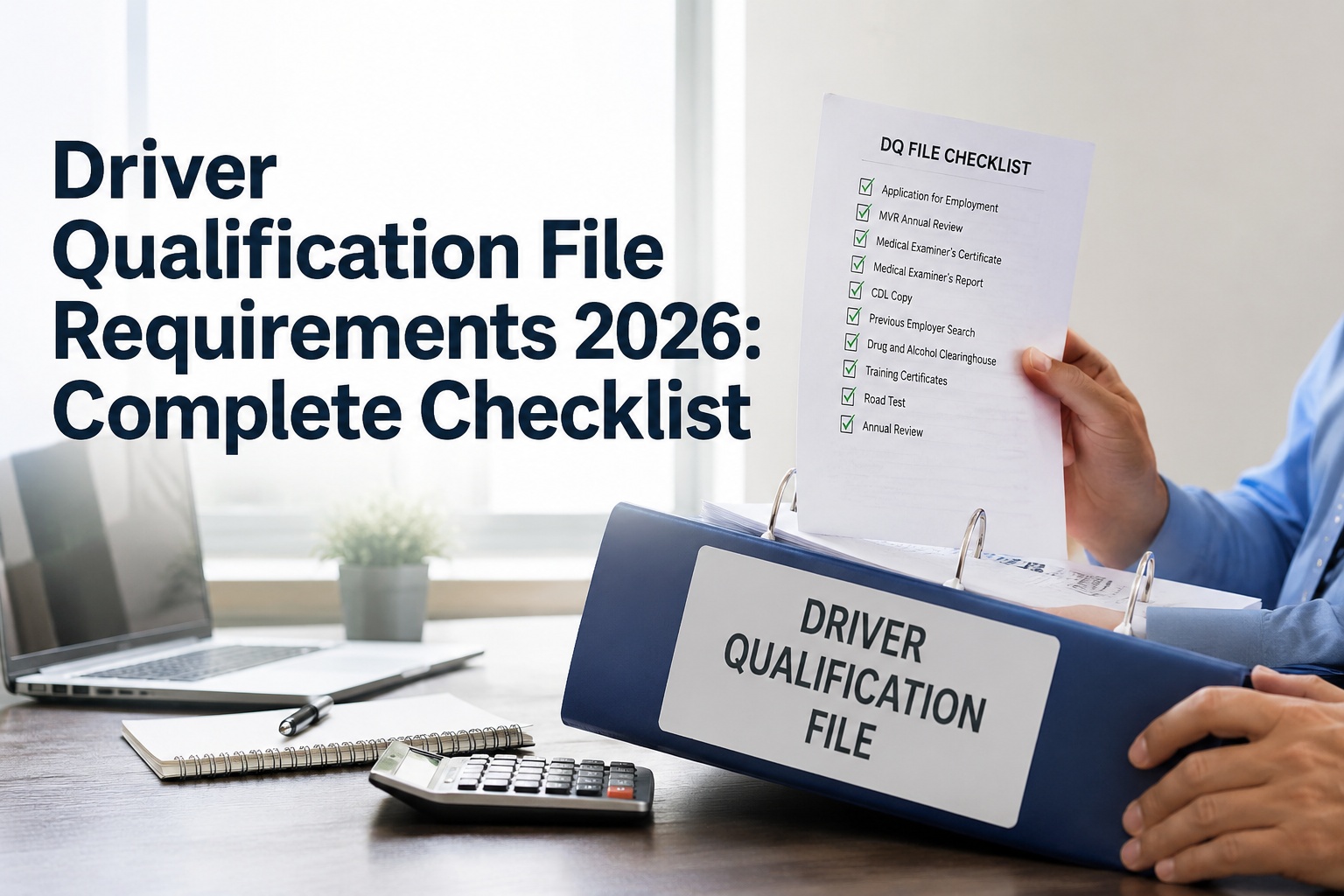
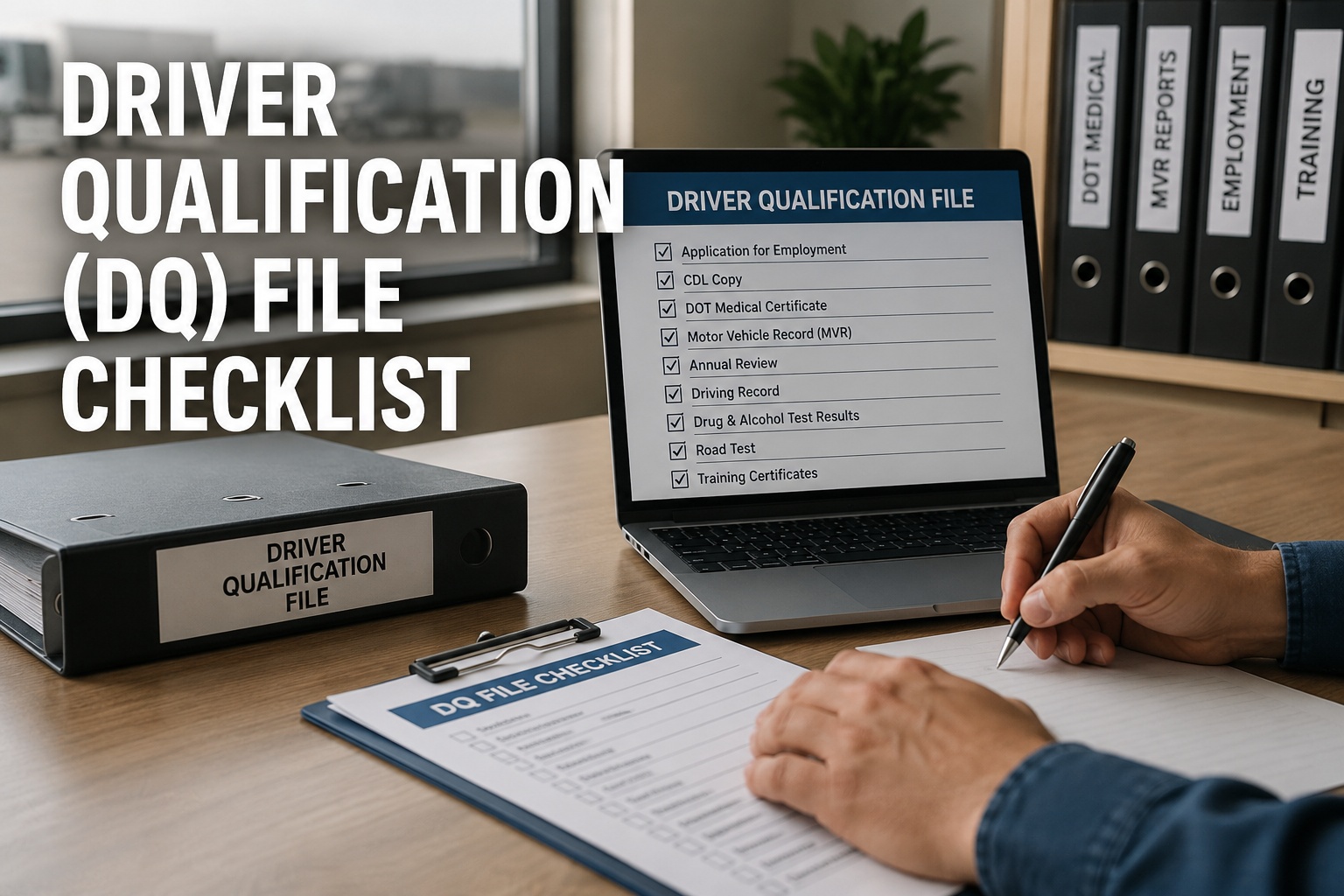
A Driver Qualification File is the first thing an FMCSA auditor asks to see — and one missing document per driver, across a fleet of 50, is not a stack of small violations. It's a pattern finding. Under 49 CFR Part 391, every motor carrier must maintain a complete DQF for every driver, retain it for employment plus 3 years per § 391.51(d), and produce it on request. This 2026 guide walks driver qualification file requirements by lifecycle phase — hire, active, termination — with citations. Book a demo .
The DQF Across the Full Driver Lifecycle
A driver qualification file isn't a snapshot — it's a lifecycle record. Every phase has its own document set. Miss one and the audit finds it.
Driver Qualification File findings are among the most-cited categories in FMCSA compliance reviews because the requirements are precise, the documents are numerous, and the retention windows overlap in ways that trip up manual recordkeeping systems. A single missing document per driver — multiplied across a mid-size fleet's 50 drivers — becomes a systemic finding rather than an isolated error. What separates fleets that pass audits from fleets that don't isn't heroic recordkeeping; it's a defined process that catches gaps before the auditor does, and a retention system that respects both the 3-year DQF clock and the 5-year drug/alcohol clock as independent.
Phase 01: What must be in the file within the first 30 days of hireThe hiring package under 49 CFR §§ 391.21–27
Six documents constitute the hiring package under Part 391. Each has its own citation, its own collection method, and its own audit failure mode. Missing any one produces a violation regardless of how thorough the other five are. Book a demo to see the hiring-phase collection workflow in HVI
Employment application (§ 391.21)
Specific content required: driver's name, DOB, address, license class/number/state, list of accidents in past 3 years, 3-year driving history, driver signature certifying accuracy. Generic HR job application forms do NOT satisfy § 391.21 — the content requirements are federal.
Previous employer investigation (§ 391.23)
Investigation into the driver's employment for the previous 3 years (or up to 10 years if in safety-sensitive positions). Documented contacts with prior employers and their responses. Best-practice: written attempts and copies of responses filed. A "no response" attempt still needs the record of the attempt.
Motor Vehicle Record (MVR) — every state (§ 391.23)
Current MVR from every state where the driver held a license during the past 3 years. Ordered within 30 days of hire. A driver licensed in 3 different states over 3 years needs 3 MVRs, not one.
Road test OR CDL equivalent (§§ 391.31, 391.33)
Either a road test administered by the carrier with a signed certificate on file (§ 391.31), or a copy of the driver's valid CDL used in lieu of the road test (§ 391.33). One or the other — not both, but not neither.
Medical Examiner's Certificate (§ 391.43)
Copy of the driver's current Medical Examiner's Certificate issued by a certified medical examiner listed on the National Registry. For CDL drivers, the certificate is verified via CDLIS MVR download from the state licensing authority in most cases — the state-of-record is the authoritative source.
Clearinghouse pre-employment query (CDL drivers)
Under the FMCSA Drug & Alcohol Clearinghouse rule, carriers must run a full pre-employment query on all CDL drivers before permitting them to operate a CMV. Result and consent documentation retained in the driver file. Non-CDL drivers exempt from Clearinghouse.
Phase 02: The recurring 12-month cycle that keeps files currentAnnual requirements under §§ 391.25, 391.27 — and where fleets fall behind
Every DQF requires 5–6 recurring items annually. This is where manual systems break down first: the hire phase is a single event with a clear checklist; the annual phase repeats on 50 different anniversary dates for a 50-driver fleet. Missed anniversaries produce most of the DQF findings in a modern audit.
Annual MVR
Fresh MVR pulled from every state the driver has held a license in during the past year. Not just the state of primary residence — every state on record. Kept for 3 years from date of creation, independent of overall DQF retention.
Annual review of driving record
Manager review of the MVR to determine the driver still meets minimum qualifications and is not disqualified under § 391.15. Documented with reviewer name, review date, and safe-driving assessment. Signed note in file.
Annual driver certification of violations
Driver's own signed list of all traffic violations (other than parking) in the past 12 months, or a signed statement that no violations occurred. Driver signature required, dated within the past 12 months.
Annual limited query (CDL only)
Limited query on every CDL driver within any consecutive 12-month period, with driver's general consent on file. Result documented. Missing query is a common 2025–2026 finding as Clearinghouse enforcement has matured.
Medical certificate renewal
Maximum 24-month medical certification cycle; many drivers with conditions carry 12-month certificates. Track expiration by driver; loss of valid medical cert = immediate ineligibility to operate CMVs. Renewal captured on file.
Ongoing disqualification monitoring
Driver conviction of any 49 CFR § 391.15 offense (felony involving CMV, controlled substances, 2nd DUI, leaving accident scene, etc.) triggers disqualification. Carrier must know and act — not "find out at next MVR review."
The math is not subtle: a 20% miss rate on a 50-driver fleet is 10 findings waiting for the next FMCSA visit. Book a demo to see automated anniversary tracking in HVI
Retention — the two clocks that fleets confuse most oftenDQF is employment + 3; drug and alcohol is employment + 5
Retention is where paper-file systems and undisciplined digital systems produce their most preventable violations. Two different clocks apply, and they don't align. Deleting a driver's records when the DQF clock ends can leave the fleet non-compliant on the D&A clock. Start a free trial and set retention timers by document class instead of by driver.
DQF documents: employment + 3 years
Drug & alcohol records: employment + 5 years
The right electronic system treats retention as an automated document-class property, not a per-driver spreadsheet chore. Book a demo to see document-class retention rules in HVI
From a DOT compliance manager on DQF audit preparation
Our first FMCSA compliance review was where I learned that DQF findings compound. On a fleet of 78 drivers, the auditor pulled 10 files at random. Six had at least one deficiency — a missing annual MVR here, an expired medical certificate there, one driver whose Clearinghouse annual query was three months overdue. Individually small; collectively, we got hit with pattern findings across three separate DQF categories.
We rebuilt the process around anniversary tracking — every driver, every document, every renewal date automated with alerts 30 days out. Random-sample audits went from stressful to routine. When the next FMCSA review came around, we produced the requested files inside two hours with zero deficiencies. Nothing about the regulations changed. What changed was that the anniversary dates stopped being someone's spreadsheet responsibility and started being the system's default behavior.
Frequently asked questions
What documents are required in a driver qualification file?
Under 49 CFR Part 391, a complete driver qualification file must contain: (1) the employment application per § 391.21 with federally-required content (name, DOB, address, license class/number/state, 3-year accident list, 3-year driving history, driver signature); (2) documented investigation of the driver's employment for the past 3 years, or up to 10 years for safety-sensitive positions, per § 391.23; (3) motor vehicle records from every state the driver held a license in during the past 3 years, per § 391.23; (4) a road test certificate under § 391.31 OR a copy of the driver's valid CDL used in lieu under § 391.33; (5) the driver's Medical Examiner's Certificate per § 391.43 (verified via CDLIS MVR for CDL drivers); (6) FMCSA Drug & Alcohol Clearinghouse pre-employment query result for CDL drivers; and annual recurring records including MVR, annual review of driving record, driver certification of violations per § 391.27, Clearinghouse limited query, and medical certificate renewal on the applicable cycle.
How long must a driver qualification file be retained?
Under 49 CFR § 391.51(d), the DQF must be retained for the duration of the driver's employment plus 3 years after separation. However, drug and alcohol testing records follow a separate and longer clock under 49 CFR § 382.401 — those records must be retained for 5 years. Individual documents within the DQF have their own creation-date clocks: annual MVRs and annual reviews of driving record must each be retained for 3 years from the date they were created, whether the driver is currently employed or not. Deleting a driver's D&A records when the 3-year DQF clock ends is a recurring audit finding because the D&A records still have 2 years to run on their own clock. Best practice: retain all records for the longer of the two applicable clocks and never delete based on the DQF window alone.
Can driver qualification files be maintained electronically?
Yes, FMCSA permits electronic maintenance of DQF and drug/alcohol records provided the system meets specific criteria: records must be readily accessible at the carrier's principal place of business, printable on demand, secure with regular backups, and available for authorized DOT representatives during inspection or audit. Electronic systems must maintain the same content requirements and retention periods as paper files. In practice, digital systems typically produce cleaner audit outcomes than paper because they can track anniversary dates automatically, alert on missing documents, and maintain immutable timestamps on each record. Paper file cabinets are not a compliance advantage — and once fleet size passes roughly 20 drivers, manual retention discipline typically breaks down before annual audits catch the drift.
Does HVI provide driver qualification file management?
HVI supports organizing driver qualification records by driver, tracking which documents are on file versus missing, managing review and renewal anniversary dates, documenting compliance actions and corrective steps, and maintaining searchable driver-level records that can be produced quickly during audit preparation. HVI is not itself a Clearinghouse portal or a state MVR/CDLIS service — those queries are run through FMCSA's Drug & Alcohol Clearinghouse and state DMV licensing systems respectively. What HVI does is store the results of those queries, track the anniversary and renewal dates for every document per driver, alert on approaching or missed deadlines, and organize the file for the day an FMCSA compliance review pulls a random sample. The audit-defense value is in the anniversary tracking and the missing-document visibility, not in replacing the state and federal systems that generate the source records.
Do owner-operators need to maintain their own driver qualification file?
Yes. Owner-operators who operate under their own DOT authority are both the motor carrier and the driver, and FMCSA holds them to the same § 391.51 standard as any fleet — a complete DQF must be maintained on themselves, with every required document and every annual renewal. Owner-operators leased on to another carrier typically have their DQF maintained by the leasing carrier under the lease agreement, but this should be confirmed in writing; "I assumed they had it" is not a defense during an FMCSA compliance review. Regardless of business structure, if the DOT number is yours and the driver is operating under that authority, the DQF responsibility is yours. When a leased driver's file becomes an issue during audit, the leasing carrier owns the finding — not the owner-operator's separate business entity.
Make DQF compliance the system's default, not your team's spreadsheet
HVI supports driver qualification file organization, anniversary date tracking, missing-document alerts, corrective action documentation, and searchable driver-level records for audit preparation. HVI is not a Clearinghouse portal or state MVR/CDLIS service — those source-record systems remain FMCSA and state authorities. HVI is the fleet-side documentation layer that catches gaps before the auditor does.
No credit card · No hardware · DQF templates ready on day one