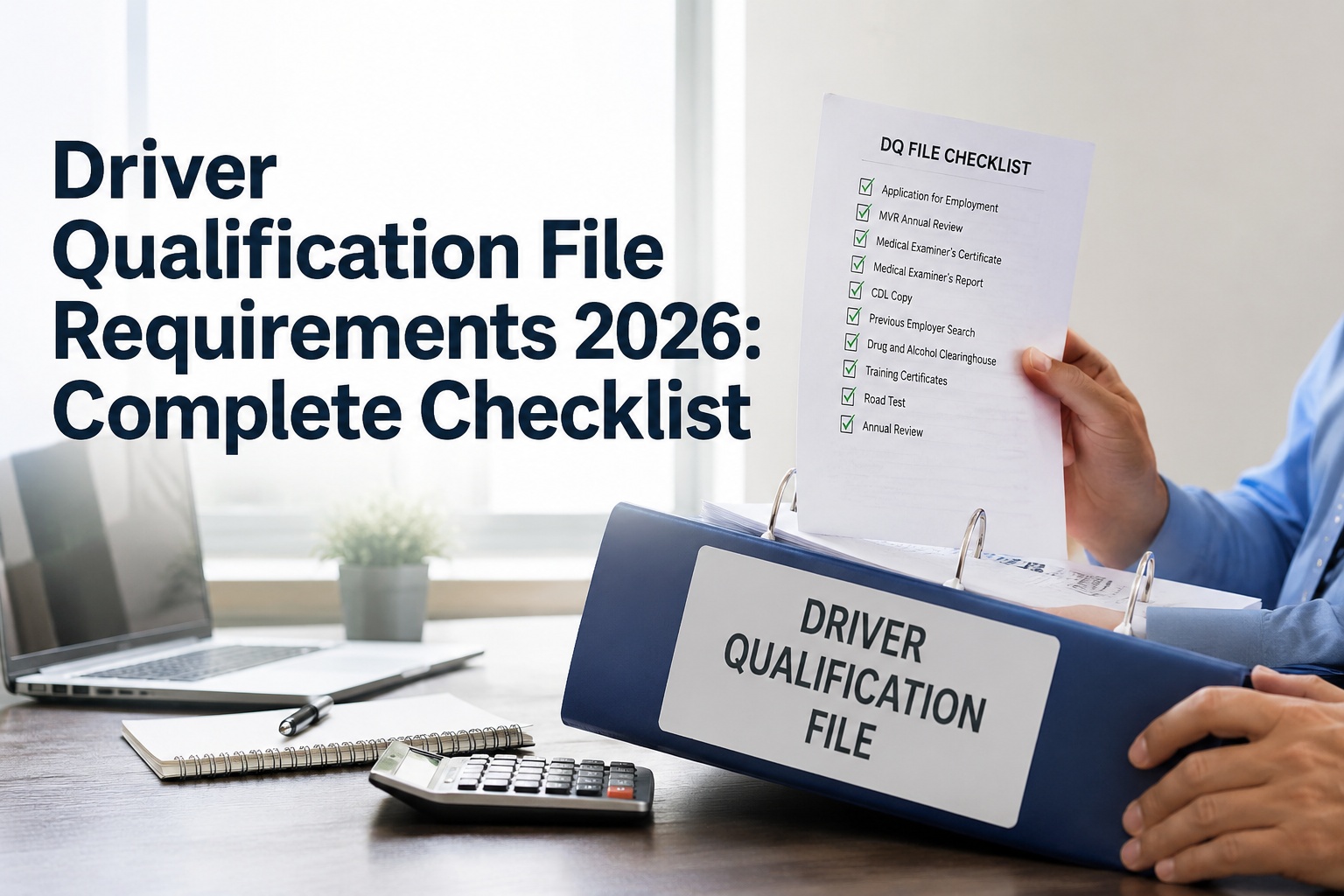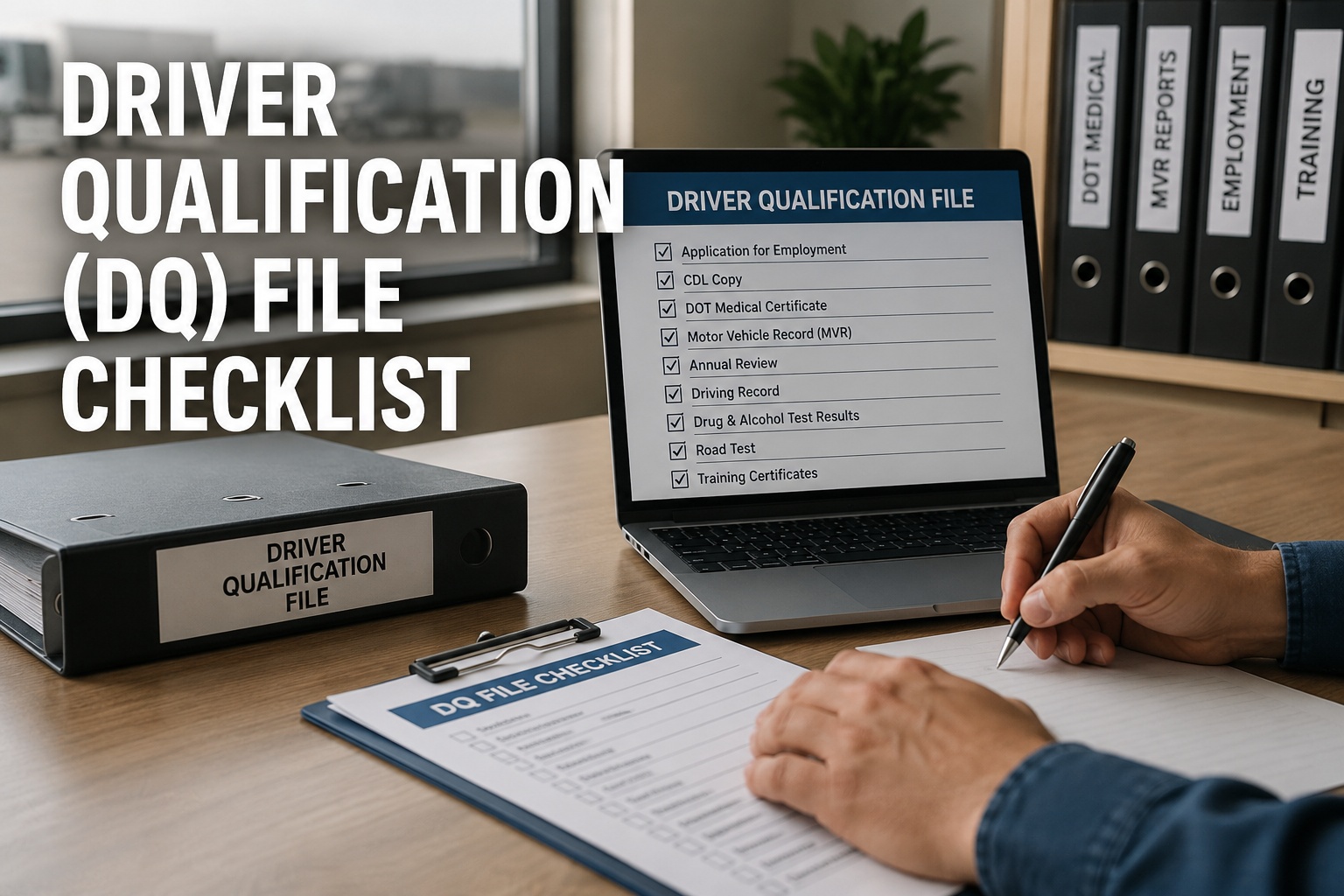
A Driver Qualification (DQ) file is the single document set that determines whether a driver is legally authorized to operate a commercial motor vehicle under FMCSA rules. Under 49 CFR 391.51, every carrier must maintain a complete DQ file for every driver — from the day of hire through 3 years after separation. Missing or incomplete DQ files are one of the top 5 findings in FMCSA compliance reviews, and each documentation gap can trigger civil penalties, elevated Driver Fitness BASIC exposure, insurance surcharges, and broker vetting failures. This checklist covers the 12 documents required in every DQ file, the 3-phase employment lifecycle, the most common audit findings, and why paper-folder DQ management fails at scale. Book a demo to see a live audit-ready DQ file for your fleet.
Every document. Every regulation. One file.
Michael K. · Driver #4471 · Hired March 2024 · 12 required documents tracked
The 12 documents required in every DQ file
Organized by lifecycle stage — hiring documents are captured once and stay permanent; ongoing documents renew annually; conditional documents apply based on driver type and endorsements.
Captured at onboarding · permanent to file
- Employment Application49 CFR 391.21 · 3-year employment history + 10-year commercial driving history
- Previous Employment Investigation49 CFR 391.23 · Contact of all DOT-regulated prior employers
- Road Test Certificate or CDL Copy49 CFR 391.31 / 391.33 · CDL copy satisfies for licensed drivers
- Initial MVR49 CFR 391.23 · From each state where driver held license in past 3 years
- ELDT Certificate49 CFR 380 · Required for CDLs issued after Feb 7, 2022
Renewed annually or bi-annually
- Annual MVR49 CFR 391.25 · Reviewed every 12 months from each licensed state
- Annual Review of Driving Record49 CFR 391.25 · Signed documentation of the annual MVR review
- Certification of Violations49 CFR 391.27 · Driver self-certifies violations in past 12 months
- DOT Medical Certificate49 CFR 391.43 · 24 months standard, less for monitored conditions
- National Registry Verification49 CFR 391.23 · Verify medical examiner within 15 days
Required based on driver profile
- HazMat Endorsement Records49 CFR 1572 · TSA background check every 5 years for HazMat haulers
- Safety Performance History49 CFR 391.23 (d) · Records from prior DOT employers over past 3 years
These 12 items constitute the FMCSA-required minimum. Best-practice fleets add: signed employer handbook acknowledgment, drug & alcohol testing records (kept separately), dispatch training documentation, and defensive-driving certifications. But the 12 above are non-negotiable at audit. Book a demo to see the full 12-document template configured for your fleet
The DQ file lifecycle: from hire to file destruction
DQ files aren't static — they accumulate documents through the employment relationship and continue their retention obligation for 3 years after the driver leaves.
Employment application collected, prior employer verifications initiated, MVR pulled from each state, National Registry verified within 15 days of hire.
All 5 hiring documents filed. Road test performed or CDL copy filed. ELDT verified. HazMat endorsement + TSA verified if applicable. File active.
Annual MVR pulled, annual review documented, certification of violations collected. Medical cert every 24 months (or less). Endorsements verified.
File archived from active roster. Retention obligation begins — complete file must be retained for 3 additional years. Do not destroy.
3-year post-separation retention complete. File can be destroyed per company records policy. Prior to 3 years, file must remain intact.
The 3-year post-separation retention is where most fleets accumulate audit exposure — separated drivers' files get moved to archive storage and are often incomplete or lost by the time an FMCSA investigator asks for them. Book a demo to see how digital archiving eliminates the post-separation gap
Top 5 DQ file findings in FMCSA compliance reviews
Based on FMCSA compliance review data, these five gaps show up in the majority of audits — and every one is preventable with a documented DQ file discipline.
Most common finding. Driver's annual MVR either was never obtained or is beyond 12 months old at time of audit.
Driver never signed the annual certification listing violations from the past 12 months, or the certification is more than 12 months old.
Required investigation of prior DOT-regulated employers within past 3 years was never completed or documentation is missing.
Driver's medical cert lapsed and no current certificate on file. Frequently missed because renewal cycles vary from 3 to 24 months.
MVR was pulled but no signed documentation showing the safety manager reviewed and evaluated the record.
Each finding above carries civil penalty exposure plus CSA Driver Fitness BASIC impact. Cumulatively, they represent a large majority of DQ-related audit citations across the industry. Start a free trial to eliminate every gap on this list before your next compliance review, or book a demo to see how HVI auto-flags each of these gaps at onboarding.
Manual DQ folder vs digital DQ file
Every carrier maintains DQ files somehow — paper folder in a filing cabinet, shared network folder, or a purpose-built platform. The operational difference matters at audit time.
The audit-prep difference alone typically justifies the platform — a fleet with 30+ drivers can spend 15–30 hours preparing paper DQ files for one FMCSA review. Digital exports take minutes. Book a demo to see a full DQ file export in real time
From a safety director who eliminated DQ audit findings entirely
Our last compliance review flagged 14 DQ file gaps across 41 drivers — missing annual MVRs, expired violations certifications, one driver whose safety performance history from a prior employer was never actually captured. We were fined and got put on a 90-day corrective action plan.
Digital DQ files closed every one of those gaps by the next review. Every hiring document gets captured at onboarding or the driver can't be dispatched. Annual renewals fire automatically 90 days out. When our next FMCSA investigator showed up, we exported the full DQ file for every driver in under 5 minutes and had zero findings. The compliance headache became a checkbox.
Frequently asked questions
What documents must be in a Driver Qualification file?
Under 49 CFR 391.51, every DQ file must contain 12 core documents organized in three categories. Hiring documents (permanent to the file): (1) Employment Application under 391.21 including 3-year employment history plus 10-year commercial driving history; (2) Previous Employment Investigation under 391.23 documenting outreach to all DOT-regulated employers from the past 3 years; (3) Road Test Certificate or copy of CDL under 391.31/391.33; (4) Initial MVR from each state where the driver held a license in the past 3 years; (5) ELDT Certificate under 49 CFR 380 for any CDL issued after February 7, 2022. Ongoing documents (renewed annually): (6) Annual MVR under 391.25; (7) Annual Review of Driving Record documentation under 391.25; (8) Driver's Certification of Violations under 391.27; (9) current DOT Medical Examiner's Certificate under 391.43; (10) National Registry Verification of the medical examiner. Conditional documents: (11) HazMat Endorsement + TSA Threat Assessment for HazMat haulers under 49 CFR 1572; (12) Safety Performance History request under 391.23(d).
How long must a DQ file be retained after a driver leaves?
Three years after driver separation, under 49 CFR 391.51(d). The complete DQ file must remain intact and accessible for the full 3-year period following the driver's last day of employment with the carrier. This retention obligation applies whether the driver left voluntarily, was terminated, or moved to a non-driving role. During this 3-year window, FMCSA investigators can request the separated driver's DQ file during any compliance review, and any missing documents count against the carrier's compliance record even though the driver no longer works there. Digital DQ platforms handle this retention automatically by archiving the file with a 3-year timer that only permits destruction after the retention period expires. Paper-folder fleets frequently lose separated-driver files through office moves, storage transitions, and general document decay — making post-separation retention one of the most common audit-exposure gaps in the industry.
What are the penalties for an incomplete DQ file?
FMCSA civil penalties for DQ file violations vary by specific documentation gap, typically ranging from $500 to $5,000 per instance for standard documentation violations, up to $12,700 for falsifying DQ records, and up to $19,277 for using an unqualified driver. Beyond direct fines, the consequences compound: every DQ file gap feeds the Driver Fitness BASIC in your CSA score under the 12-month rolling window, pushing the percentile toward the 80% intervention threshold. Elevated Driver Fitness triggers increased roadside inspection targeting, insurance premium increases at renewal (typically 8–15% for one BASIC over threshold), and broker vetting failures. In post-crash litigation, an incomplete DQ file for the involved driver is one of the most damaging evidence points a plaintiff's attorney can present, often resulting in punitive damages beyond the underlying claim. Total exposure for one seriously incomplete DQ file can exceed $30,000 in first-year direct impact plus multi-year insurance and CSA consequences.
Can DQ files be stored electronically?
Yes — electronic DQ files are explicitly permitted under FMCSA regulations, and are now the strongly preferred format for any fleet operating more than a handful of drivers. Under 49 CFR 390.31, electronic records satisfy the recordkeeping requirements provided they are accurate, complete, and can be reproduced in legible form upon request. Best-practice electronic DQ platforms provide: timestamped audit trails on every document, automatic flagging of missing or expired items, integration with National Registry for medical certificate verification, 90/60/30-day renewal alert cascades, secure cloud retention that survives office moves and personnel changes, and export capabilities that produce audit-ready packets in seconds. The migration path from paper to electronic is straightforward — most fleets scan existing paper files during a one-time onboarding project and maintain digital-only records going forward. The compliance benefits and audit efficiency gains typically justify the platform cost within the first compliance review cycle.
Do owner-operators need to maintain their own DQ file?
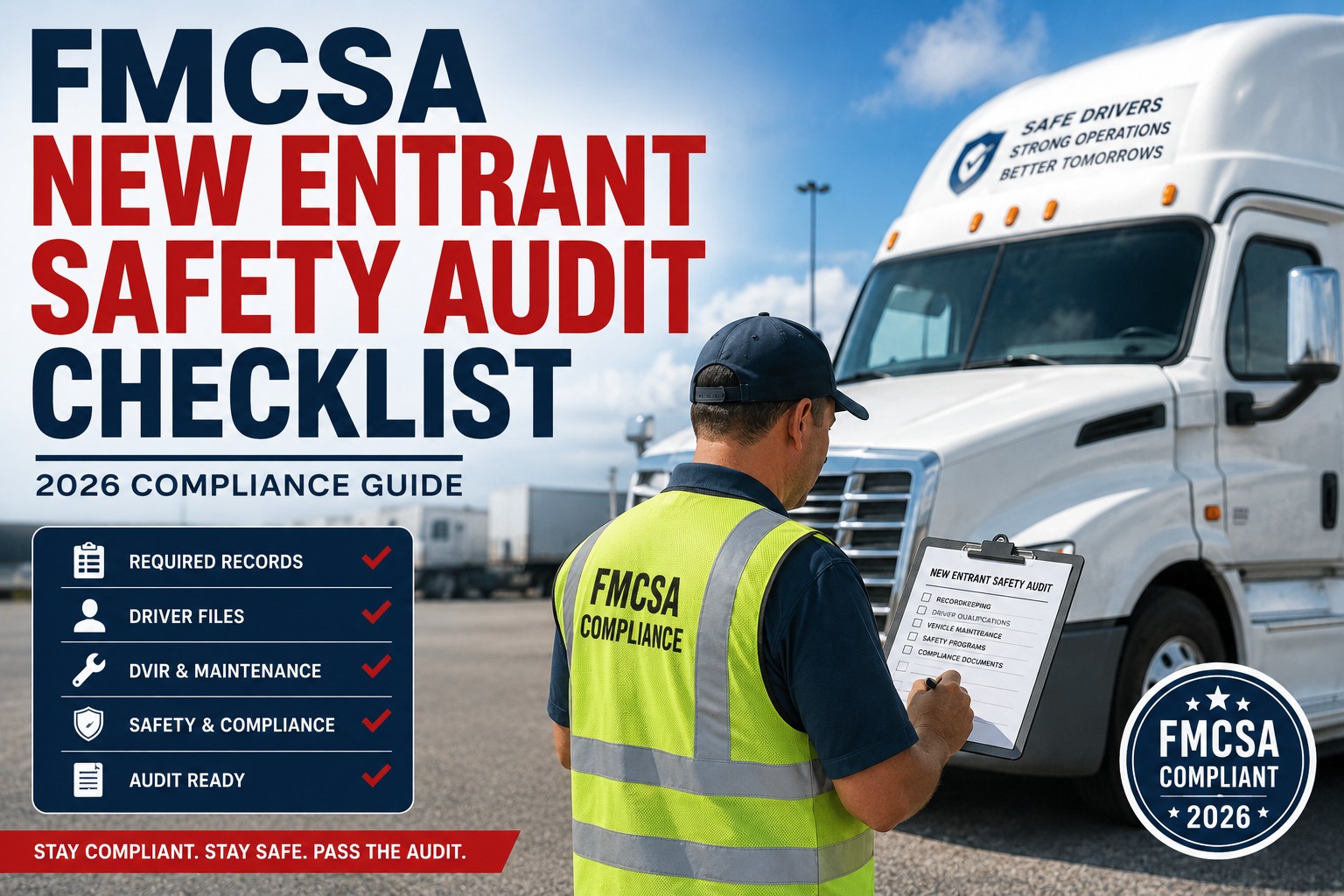
Yes — owner-operators with their own DOT authority must maintain a DQ file for themselves and any additional drivers they employ, following the same 49 CFR 391.51 requirements as any other carrier. For a single owner-operator DBA, this means maintaining the full 12-document DQ file on themselves, including employment application (for their own carrier entity), previous employment investigation, initial and annual MVRs, medical certificate, annual violations certification, and all other applicable items. Owner-operators leased to another carrier under 49 CFR 376 typically have their DQ file maintained by the lessee carrier, but the underlying obligation remains. Small carriers with 1–3 drivers often underestimate the DQ file discipline required — the same 12 documents apply whether the fleet has 3 drivers or 300. Compliance reviews for small fleets are increasingly common under FMCSA's new-entrant safety audit program and CSA-triggered investigations, and small carriers are audited on the same standards as large ones. Digital DQ platforms typically offer per-driver pricing that scales appropriately for small fleets.
Turn your DQ files from an audit liability into a competitive advantage
HVI ships with the complete 49 CFR 391.51 DQ file template pre-configured. Missing documents auto-flag at onboarding, annual renewals fire automatic reminders, and every file exports in FMCSA-audit format in seconds. Import your existing paper files during the first week — live for your fleet in under two weeks total.
No credit card · 3-year cloud retention included · FMCSA-audit-ready templates