On January 10, 2026 the paper medical examiner's certificate stopped being valid for CDL drivers. On the same enforcement calendar, CSA's Driver Fitness threshold moved to 80%, and Clearinghouse-driven CDL revocations accelerated. A driver qualification file that was audit-ready in 2024 may not be today — and one missing document averages $7,000+ in fines. This guide walks the ten documents every DQF needs, what's new in 2026, and how to keep files current — book a demo to automate DQF tracking in HVI.
The DQF Isn't One Snapshot — It's a Rolling Timeline
Half the documents get signed once and live in the file forever. Half are recurring deadlines that expire on their own schedule. Miss the difference and the file is out of compliance without anyone noticing.
Day 0–30
Every 24 mo max
Every 12 mo
After separation
Missing any one of these ten documents during a FMCSA compliance review is a critical violation. Missing several turns a Satisfactory rating into a Conditional or Unsatisfactory one — and takes months to earn back.
The rest of this page covers exactly what each document must contain, what's new for 2026, and how to catch expirations before the auditor does. Book a 30-minute demo to see automated DQF tracking with 90-, 60-, and 30-day expiration alerts.
What changed for 2026 — the three regulatory shifts fleets need to know
The DQF rules under 49 CFR Part 391 haven't been rewritten — but the surrounding compliance environment has shifted enough in the last 12 months that files audit-ready two years ago may not clear a review today. Three changes matter most.
Paper medical certificate no longer valid for CDL drivers
The Medical Examiner's Certification Integration final rule took full effect. For CDL holders, the medical certification information now flows electronically from the National Registry of Certified Medical Examiners through state driver licensing agencies into the CDLIS motor vehicle record. Carriers must obtain the CDLIS MVR from the current licensing state and place it in the DQF. The paper medical card, if a driver still hands one over, is no longer the compliance document — the CDLIS MVR is.
Driver Fitness threshold raised to 80%
The Compliance, Safety, Accountability program's intervention threshold for the Driver Fitness BASIC now sits at 80% for non-hazmat carriers. DQF violations feed directly into this BASIC. A single carrier with weakening DQF discipline can cross the intervention threshold on a small number of stops, triggering FMCSA outreach, off-site investigations, and eventually on-site compliance reviews.
Clearinghouse-driven CDL revocations
Drug & Alcohol Clearinghouse violations now trigger state-level CDL downgrades and revocations more aggressively than in prior years. A driver's CDLIS record can change status between annual reviews, meaning a driver you cleared 11 months ago may no longer be qualified today — and continuing to dispatch them creates joint liability for the carrier. Real-time or near-real-time CDLIS monitoring, rather than a single annual pull, is now the safer standard.
The 10 required documents — what each one must contain
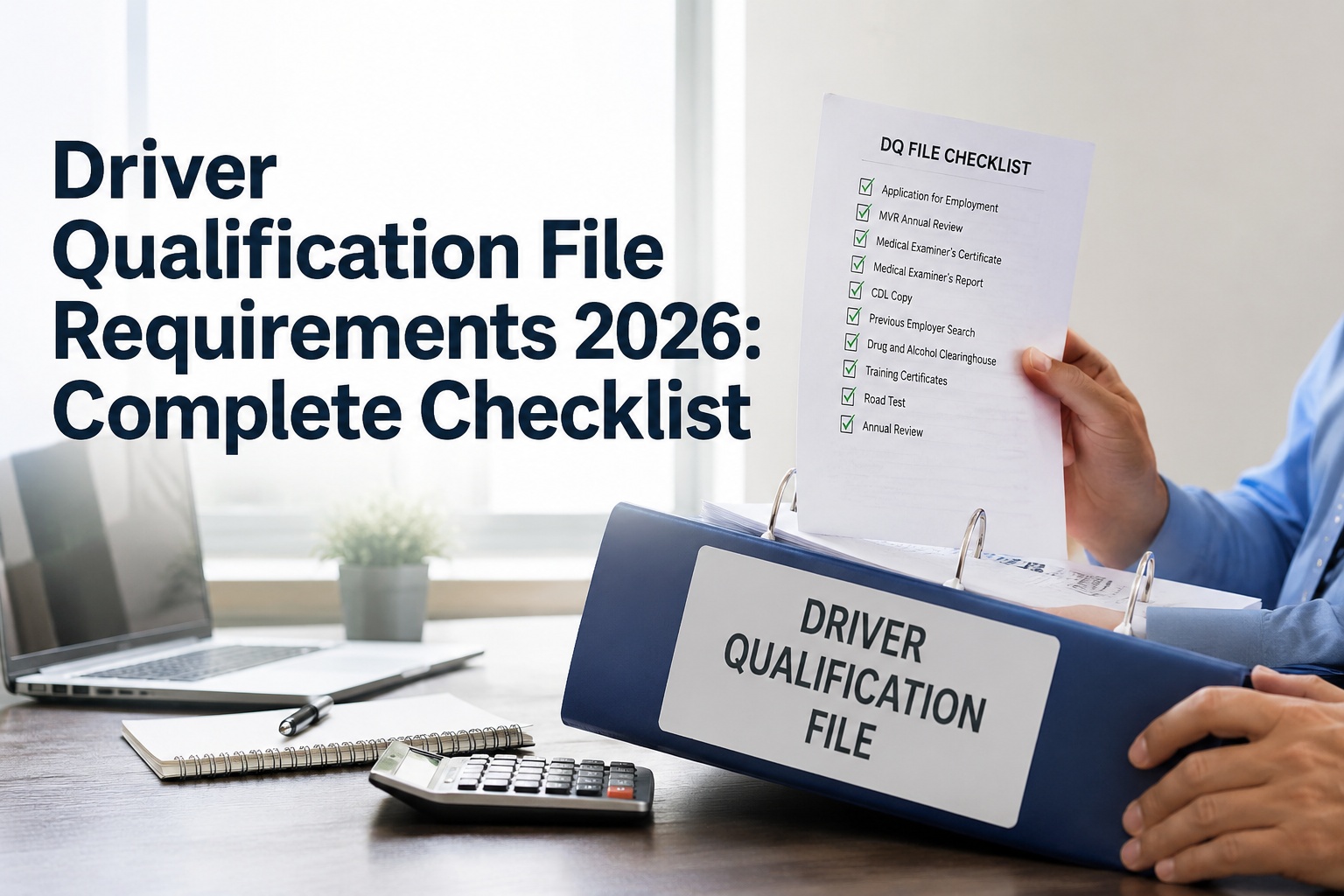
49 CFR 391.51 defines the DQF contents. Each document below is required for every driver operating a CMV under your USDOT number. Missing any one is a critical violation during a compliance review.
| # | Document | Regulation | Frequency | Common failure |
|---|---|---|---|---|
| 1 | Employment application | 391.21 | One-time at hire | Missing 10-year work history; unsigned |
| 2 | Previous employer safety performance history | 391.23(d) | One-time at hire (within 30 days) | Not requested from all DOT-regulated employers in last 3 years |
| 3 | Initial motor vehicle record | 391.23(a) | One-time at hire (from every state licensed in last 3 years) | Only pulled from current state; missed prior-state records |
| 4 | Road test certificate OR CDL equivalent | 391.31 / 391.33 | One-time at hire | Neither document present; assumed CDL sufficed |
| 5 | Medical examiner's certificate OR CDLIS MVR | 391.43(g) / 391.51(b)(7) | Every 24 months max (may be shorter) | Expired — the #1 audit failure |
| 6 | Medical variance / SPE certificate (if applicable) | 391.49 | Only if driver holds variance | Missing when driver has known variance |
| 7 | NRCME verification note | 391.23(m) | One-time at each medical exam | Not documented; only certificate on file |
| 8 | Annual MVR inquiry | 391.25(a) | Every 12 months | Skipped year; MVR older than 12 months at audit |
| 9 | Annual driver review certification | 391.25(c) | Every 12 months | MVR pulled but no signed review documentation |
| 10 | Annual list of violations (or equivalent MVR) | 391.27 | Every 12 months from driver | Not collected in years where clean MVR "seemed enough" |
A valid CDL can serve as the road-test equivalent under 391.33, and most carriers use that option. Note the crossover on medical certification: for CDL holders after January 10, 2026, the CDLIS MVR obtained from the current licensing state satisfies the medical certificate requirement — and in the event of a conflict, the CDLIS record controls. For non-CDL drivers, the paper certificate on file is still the required document. Book a demo to see HVI track each of the 10 documents per driver with per-item expiration alerts.
The recurring deadlines that get missed most
Onboarding documents get signed once and stay in the file. The recurring items are where compliance drift happens — because the file was complete on Day 1 and nobody set a reminder for Day 366. These are the four recurring obligations, and the specific failure modes that show up in FMCSA compliance reviews.
Annual MVR inquiry (391.25(a))
Pull the MVR from every state where the driver holds a license. Most fleets pull only the current state's record. That's insufficient if the driver has been licensed in multiple states in the past three years. Set the reminder to fire 30 days before the anniversary of the last pull — not the anniversary of hire, because those drift apart for drivers hired mid-year.
Annual driver review (391.25(c))
Review the MVR against your fitness-to-drive standards; document the review. This is not the same as pulling the MVR — it's the certification that a qualified person examined the MVR against your carrier's disqualification criteria. Auditors regularly find the MVR on file but no signed review document. Both are required.
Annual list of violations (391.27)
Collect a written list from the driver of every conviction in the previous 12 months. A clean MVR does not eliminate this requirement — the driver's signed statement is a separate document. Many fleets stop collecting these when MVRs come back clean; that's a documented critical violation.
Medical certification (391.43 / 391.51(b)(7))
For CDL drivers, obtain the CDLIS MVR from the current licensing state. The paper card the driver hands you is no longer the compliance document as of January 10, 2026 — the CDLIS MVR is. Medical certificates can be issued for less than the maximum 24 months at the examiner's discretion based on the driver's health conditions, so the expiration is not always predictable from the last certification date.
The pattern in every miss: nobody owned the deadline. Assigning DQF renewal ownership to a specific role — not "the safety department" — is the single change that most reduces recurring compliance failures. Book a demo to see HVI assign each recurring DQF item to a specific role with automated escalation when the deadline slips.
Retention periods — how long you must keep what
Retention rules under 49 CFR 391.51 vary by document type. Get any one wrong and the file fails audit for a document that no longer even needs to be there, or is missing when it should be.
Duration of employment + 3 years
Applies to: employment application, initial MVR, previous employer inquiries, road test certificate (or CDL equivalent), and the driver's certification/annual reviews accumulated during employment. Keep the entire file for three years after the driver leaves your carrier's employ.
3 years from creation
Applies to: annual MVRs, annual review documentation, annual list of violations. Older copies can be purged, but only after the three-year window has fully passed on each document independently.
Until superseded + 3 years
Applies to: medical examiner's certificates and CDLIS MVR pulls containing medical certification status. When the next medical cert or CDLIS record supersedes the previous one, the older document must still be retained for three years before it can be purged.
Duration + 3 years (variance/SPE)
Applies to: medical variances, Skill Performance Evaluation certificates, and any Federal medical exemption letters. Retain for the driver's full employment plus three years after separation, same as core onboarding documents.
The 6-step DQF audit self-check
Run this sequence on a random 10–20% sample of your driver files quarterly. Fleets that do this consistently find their own gaps before FMCSA does. The alternative is finding them during a compliance review, when the fine is $7,000+ per missing document and the rating downgrade is public.
-
1Random sample — pull 10–20% of active driver files15 min
Not the files you know are complete — genuinely random selection. Include recent hires, long-tenure drivers, and any driver who has changed medical examiners or license states in the past year.
-
210-document checklist against each file15 min per file
Walk each of the ten required documents. Present? Complete? Signed where required? Dated within the applicable window? Any absent or expired item is a fail, no matter how minor it seems.
-
3Medical certification currency — verify against CDLIS5 min per driver
For every CDL driver, pull the current CDLIS MVR and confirm the medical certification status is current and matches your file. The paper card the driver may have on file is no longer the compliance document — the CDLIS record is.
-
4Annual recurring items — 12-month window check5 min per driver
Annual MVR, annual driver review, annual list of violations — each must be within the past 12 months. Not "some time last year" — the specific date matters. An MVR pulled 13 months ago fails the check.
-
5Clearinghouse query — annual (or on-demand) verification5 min per driver
Every CDL driver requires at least an annual Clearinghouse query. Given the pace of Clearinghouse-driven CDL actions in 2026, many carriers now query more frequently — and monitor for status changes in real time rather than batching once a year.
-
6Log the sample audit result — fix systemic gaps10 min
The value of the sample audit isn't the individual fixes — it's spotting the systemic gap. Multiple files missing the same document type means the intake or renewal process is broken and needs fixing at the process level, not one file at a time.
Fleets that run this quarterly self-check catch their own gaps months before FMCSA does, and turn every finding into a process fix rather than a one-file scramble. Start a free HVI trial to run the same 6-step audit against your active driver roster with per-document status stamped and searchable in one place.
The mistake that costs most under 2026 enforcement
Assuming the paper medical certificate is still the compliance document
The single most consequential DQF change in 2026 was the elimination of the paper medical examiner's certificate as the compliance document for CDL drivers. On or after January 10, 2026, the CDLIS motor vehicle record obtained from the current state driver licensing agency is the required proof of medical certification for CDL holders. The medical examiner uploads the certification electronically through the National Registry, the state records it on the CDLIS MVR, and the carrier obtains that MVR from the current licensing state and places it in the DQF. A carrier that continues to rely on the paper card — even a valid one the driver hands over — is not meeting the current standard for CDL drivers, and the DQF fails audit despite appearing complete. In the event of any conflict between the paper card and the CDLIS record, the electronic CDLIS record controls. This is the pattern auditors are now looking for specifically. For non-CDL drivers, the paper medical certificate remains the required document — the electronic-only rule applies to CDL holders. Verify your document collection and renewal workflow against the current CDLIS-based standard before your next scheduled or unscheduled compliance review.
A safety director who ran the sample audit and found the gap
We ran the quarterly sample audit on 22 driver files — roughly 15% of our roster — expecting to find one or two issues. Instead we found 11 files missing the annual list of violations. Every one had a clean annual MVR on file, so whoever renewed the file that year decided the driver's signed statement was redundant. It's not. That's a documented critical violation on every one of those files.
The fix wasn't the 11 driver conversations. It was the renewal SOP. We rewrote it so the annual review packet always includes the driver-signed violations list regardless of what the MVR shows, and set an automated 30-day reminder before every driver's anniversary. Next quarterly sample: zero missing. Two years since and we haven't lost a document at audit.
Frequently asked questions
What documents are required in a driver qualification file?
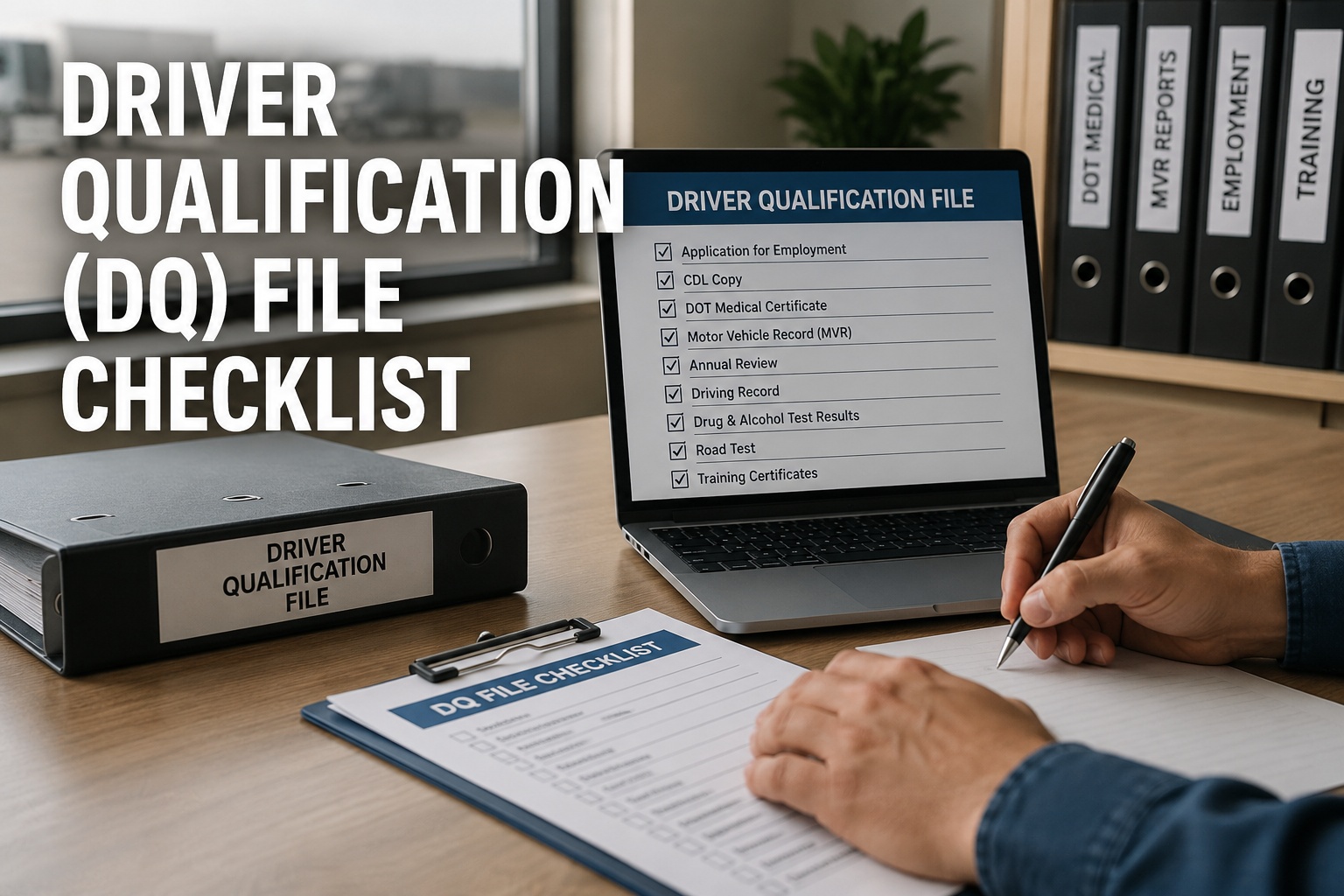
Under 49 CFR 391.51, every motor carrier must maintain a DQF for each driver operating a commercial motor vehicle. The ten required documents are: (1) the employment application meeting 391.21 requirements including 10-year work history; (2) previous employer safety performance history inquiries under 391.23(d) for all DOT-regulated employers in the past three years; (3) the initial motor vehicle record from every state where the driver has held a license in the past three years; (4) a road test certificate under 391.31, or the CDL equivalent under 391.33; (5) the medical examiner's certificate or, for CDL drivers, the CDLIS motor vehicle record containing medical certification status; (6) any medical variance or Skill Performance Evaluation certificate if applicable; (7) the note verifying the medical examiner was listed on the National Registry of Certified Medical Examiners at the time of the exam; (8) the annual MVR inquiry from every state licensed in; (9) the annual driver review certification; and (10) the annual list of violations from the driver. Missing any one document is a critical violation during an FMCSA compliance review.
What changed for driver qualification files in 2026?
Three regulatory shifts materially affect DQF compliance in 2026. First and most significant: on January 10, 2026, the paper medical examiner's certificate stopped serving as the compliance document for CDL drivers. Medical certification information now flows electronically from the National Registry of Certified Medical Examiners through state driver licensing agencies into the CDLIS motor vehicle record, and carriers must obtain the CDLIS MVR from the current licensing state and place it in the DQF. In any conflict between paper and electronic, the electronic CDLIS record controls. Second, the FMCSA's CSA program raised the Driver Fitness BASIC intervention threshold to 80% for non-hazmat carriers, meaning DQF-related violations now flow more directly into the score that triggers FMCSA outreach, off-site investigations, and on-site compliance reviews. Third, Drug & Alcohol Clearinghouse enforcement is driving state-level CDL revocations more aggressively than in prior years — a driver's CDLIS status can change between annual reviews, making near-real-time monitoring the safer standard rather than a single annual pull.
How long do I need to keep driver qualification files?
Retention periods under 49 CFR 391.51 vary by document type. Onboarding documents — the employment application, initial MVR, previous employer inquiries, and road test certificate or CDL equivalent — must be retained for the duration of the driver's employment plus three years after separation. Recurring documents including annual MVRs, annual driver review certifications, and annual lists of violations must be retained for three years from the date of creation independently. Medical certificates and CDLIS MVR pulls containing medical certification status must be retained until superseded by the next document, plus three years after that. Medical variances, Skill Performance Evaluation certificates, and Federal medical exemption letters are retained for the driver's full employment plus three years after separation, same as core onboarding documents. Purging documents before their retention window expires is itself a violation, and purging after the window is optional — some carriers retain longer as a matter of policy, particularly for litigation-support purposes.
What are the most common DQ file violations at audit?
Five failure patterns dominate FMCSA compliance review findings. First, expired medical certification — the single most common individual violation, driven by carriers missing the two-year renewal window or continuing to rely on paper cards after the January 10, 2026 CDLIS transition. Second, missing annual list of violations — carriers with clean annual MVRs frequently stop collecting the separately required driver-signed statement under 391.27, which is a critical violation regardless of MVR results. Third, incomplete previous-employer safety inquiries — particularly common with drivers who have worked multiple DOT-regulated carriers in the past three years, when only some employers were contacted. Fourth, missing MVRs from prior license states — when a driver has been licensed in multiple states in the past three years and only the current state's MVR was pulled. Fifth, missing driver review certifications — the MVR is on file but the required signed review documentation is not, so auditors can't confirm the review actually happened. All five are preventable with disciplined process and per-item deadline tracking.
Do I still need a paper medical card in the DQ file?
For CDL drivers, no — and after January 10, 2026 the paper card is no longer the compliance document for that population. The Medical Examiner's Certification Integration final rule now routes medical certification information electronically from the National Registry of Certified Medical Examiners through state driver licensing agencies into the CDLIS motor vehicle record. Carriers meet the requirement by obtaining the CDLIS MVR from the current licensing state and placing it in the DQF, not by filing the paper card. In the event of a conflict between a paper card and the electronic CDLIS record, the electronic record controls. For non-CDL drivers operating a CMV, the paper medical examiner's certificate remains the required document in the DQF — the electronic-only rule applies to CDL holders. Carriers with mixed rosters need to handle the two populations differently: paper for non-CDL drivers, CDLIS MVR for CDL drivers, both filed and tracked to their respective expiration dates.
Stop chasing DQF renewals — get the deadlines to chase themselves
HVI tracks each of the 10 required documents per driver, stamps issue and expiration dates, and fires 90-, 60-, and 30-day reminders on every recurring item. When the FMCSA compliance review arrives, the full DQF is one click per driver, and no document is missing because nobody knew it was expiring. Live in under two weeks. No hardware. No credit card.
Trusted by fleets across North America · Ready on day one