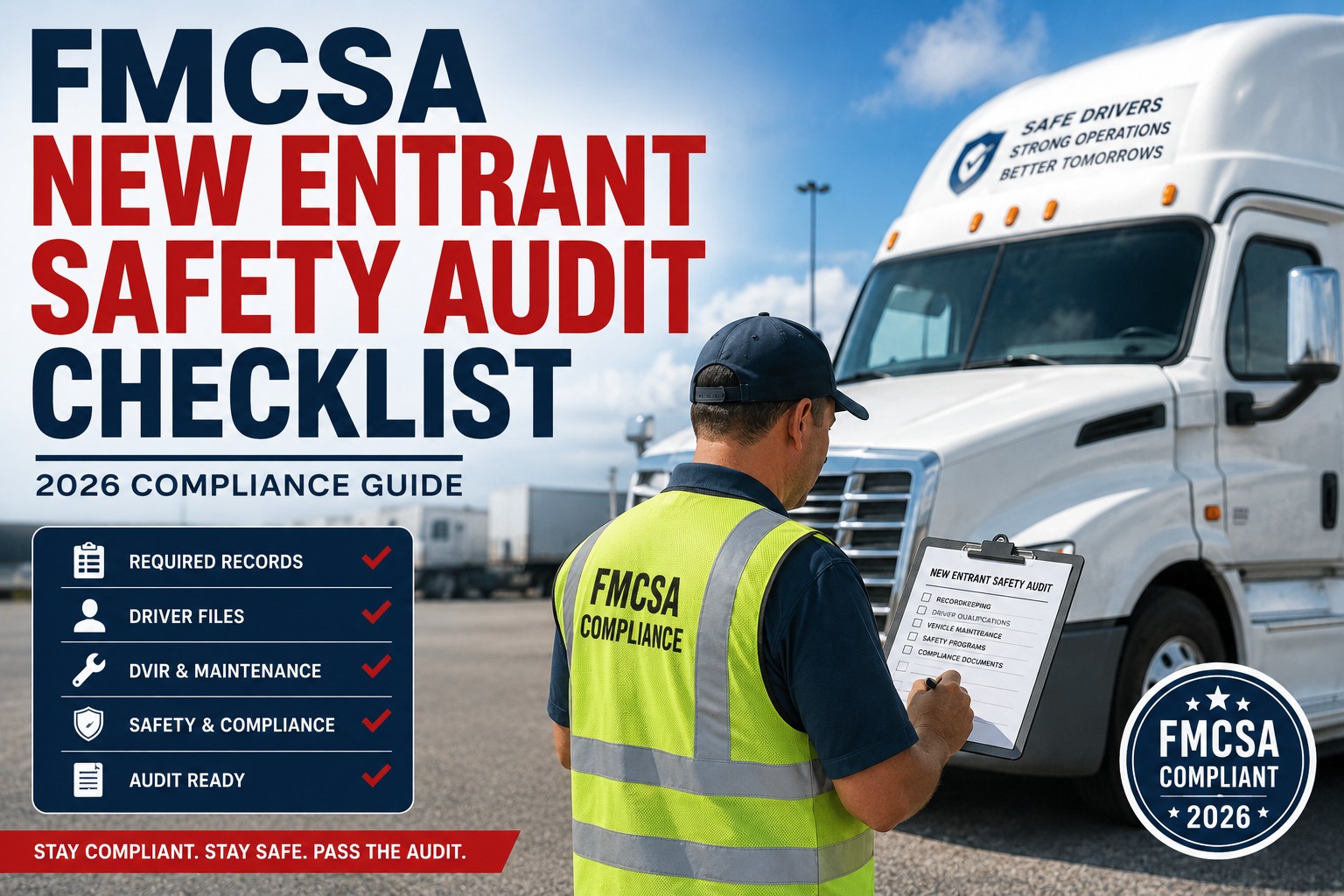
FMCSA New Entrant Safety Audit is the make-or-break federal compliance verification every new motor carrier faces within the first 12 months of receiving operating authority. Governed by 49 CFR Part 385 Subpart D, the audit checks six safety management control areas across driver qualification, drug and alcohol testing, hours of service, vehicle maintenance, insurance, and accident tracking. Sixteen specific violations under §385.321 trigger automatic failure regardless of everything else. Book an HVI demo to build audit-ready records from day one.
Six control areas. 18-month monitoring. Sixteen automatic failure triggers.
Every new USDOT-registered carrier enters the New Entrant program. Passing isn't optional — failing without a satisfactory corrective action plan can revoke your operating authority before your first year ends.
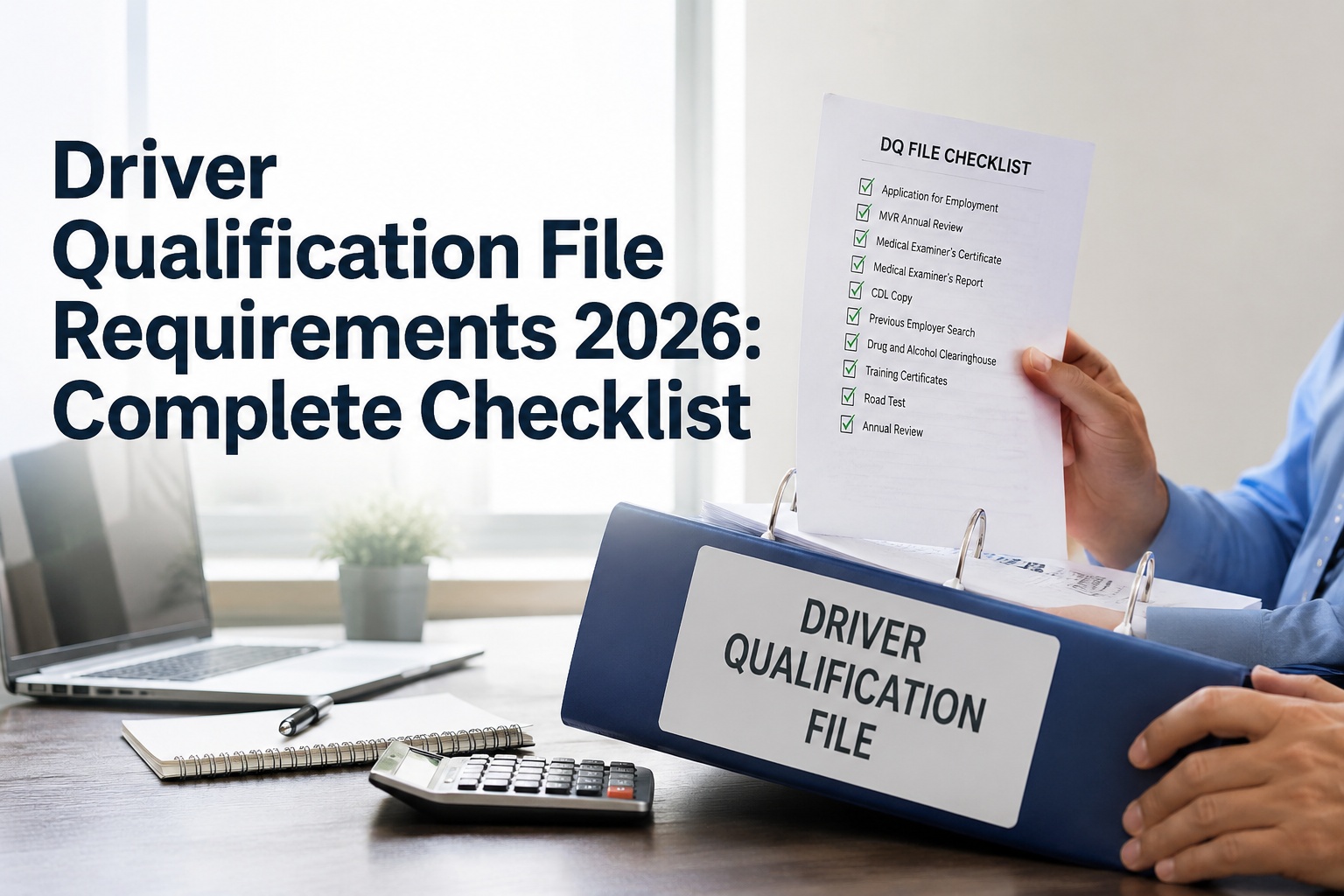
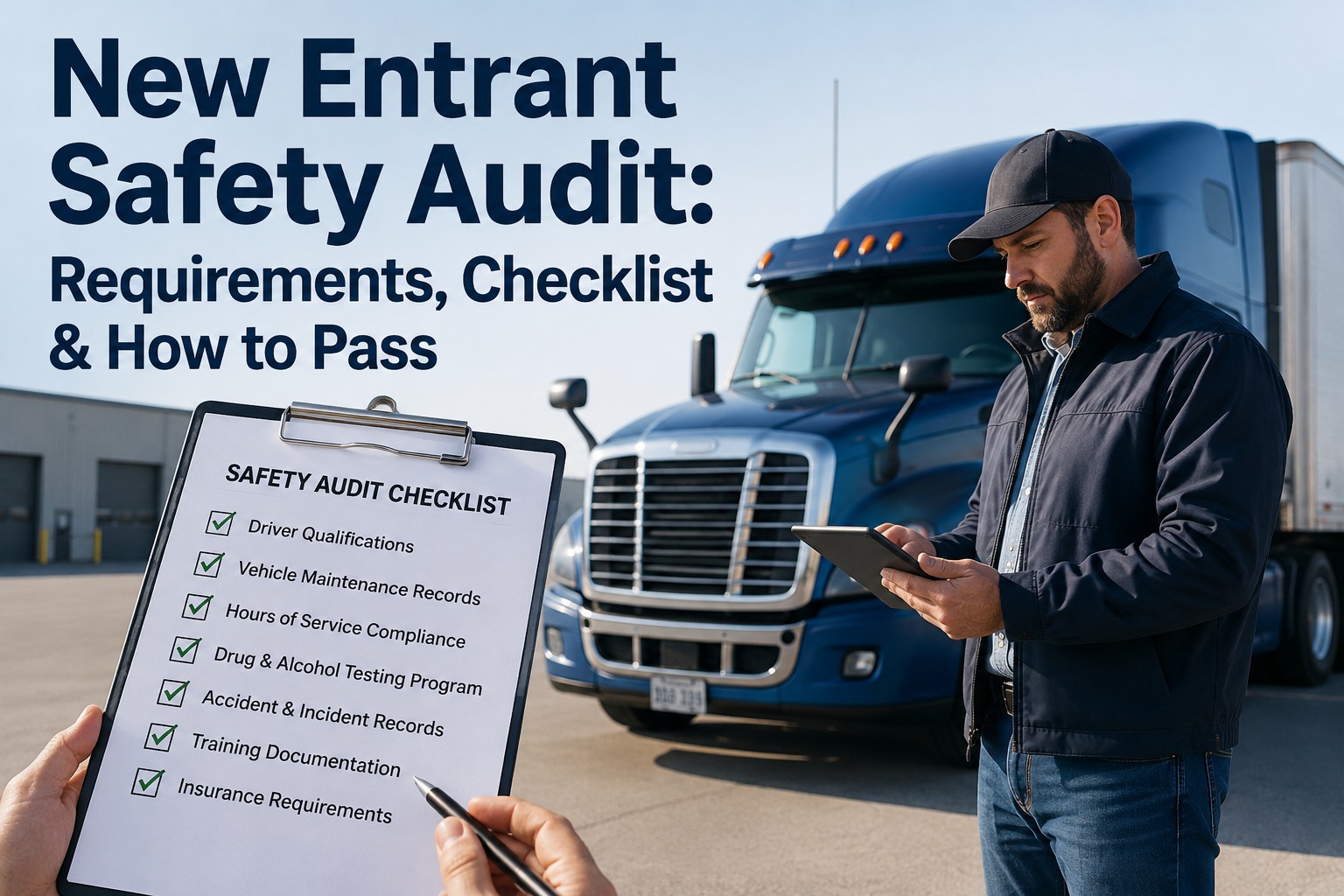
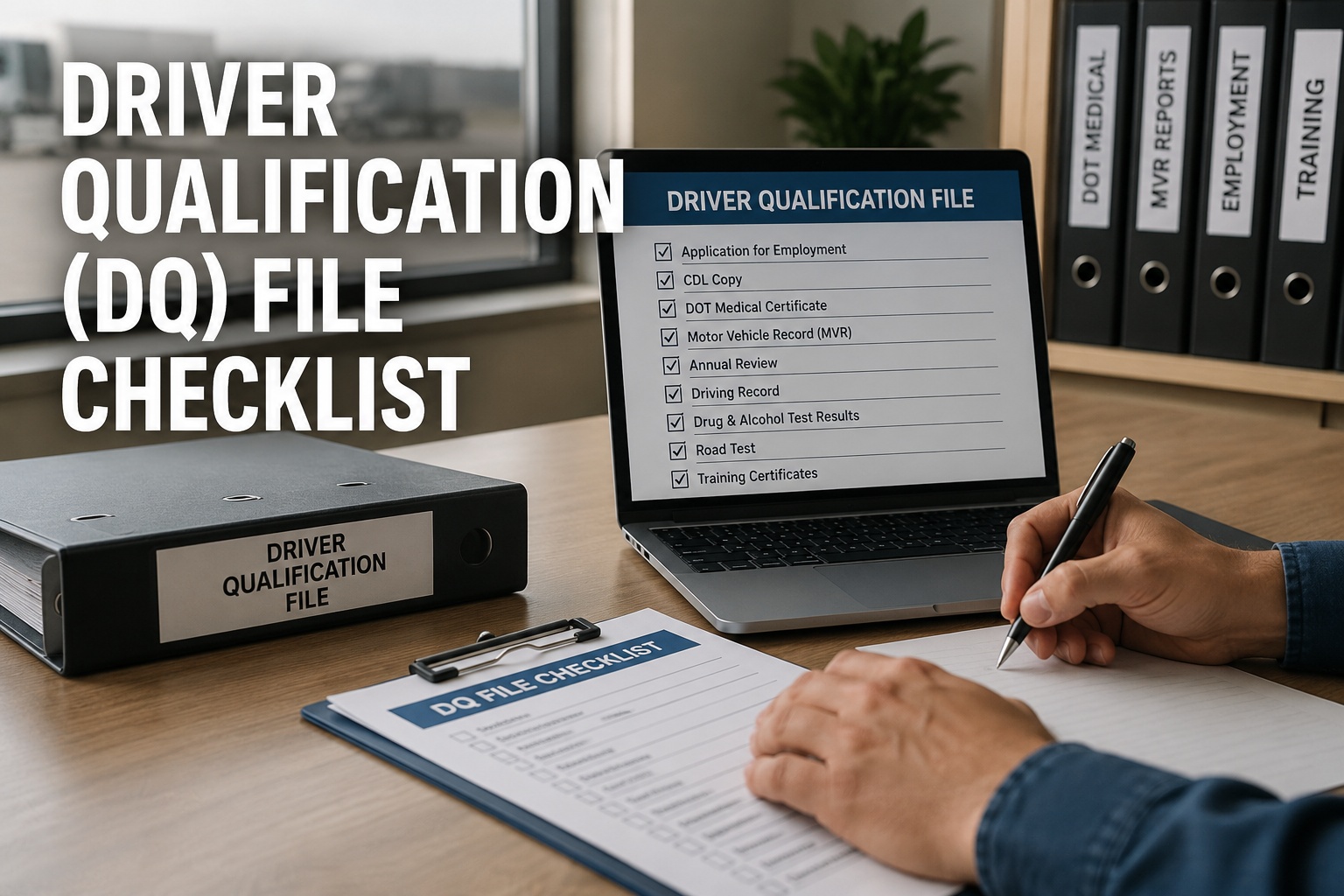
DQ files complete for every driver: application, MVR, road test, medical certificate, previous employer inquiries, annual review.
Consortium enrollment, pre-employment testing, random testing, Clearinghouse queries, supervisor reasonable-suspicion training.
ELD records for last 6 months, supporting documents retained, driver training on HOS rules, unassigned driving time reconciled.
Annual inspection per vehicle, DVIR completion, systematic PM schedule, defect correction records, out-of-service repair documentation.
Minimum financial responsibility per operation type, valid policy on file with FMCSA, filing current with no lapses in monitoring period.
Accident register maintained for 3 years, DOT-recordable accidents documented with copies of reports, HazMat records if applicable.
When the audit hits — timing, scope, and notification
The audit clock starts the moment your USDOT number activates. Under MAP-21 (Moving Ahead for Progress in the 21st Century Act), FMCSA has 12 months to complete the safety audit for property carriers — shortened from the original 18-month window. Passenger carriers operating motorcoaches face an even tighter 120-day requirement. Most audits happen at months 9-12, though state partner agency backlogs can push some closer to month 18. What accelerates your timeline: a poor early roadside inspection record. Fleets generating violations in their first few months typically see audit notices arrive earlier than expected.
The notification arrives by phone, email, or mail from FMCSA or a state partner agency. Once received, the clock is running — you'll have a specific deadline to submit documents or prepare for the review. The majority of new entrant audits today are conducted off-site through remote document review via portal upload, though some remain on-site or by video. Written notification of pass or fail arrives within 45 days of audit completion. Passing keeps your operating authority intact through the remaining monitoring period. Failing triggers a Corrective Action Plan (CAP) process with tight deadlines — miss the window and FMCSA can revoke your operating authority. Book an HVI demo to build audit-ready record architecture before the notice arrives
The six evaluation areas — what auditors actually review
FMCSA safety auditors review documentation across six specific evaluation areas. Each area maps to a CFR part, has its own record retention requirements, and produces its own automatic failure triggers. Understanding what auditors look for in each area lets you build documentation architecture rather than scramble when the notice arrives.
Each driver DQ file must contain: employment application, motor vehicle record from every state licensed in during past 3 years, road test certificate or CDL equivalent, medical examiner's certificate current, previous employer safety performance history inquiries, and annual MVR review. Missing any item on any driver = citation. Systematic gaps across multiple drivers = potential automatic failure trigger.
Consortium/TPA enrollment documentation, pre-employment test results before safety-sensitive duties, random testing at required annual rate (50% for drugs, 10% for alcohol currently), reasonable-suspicion supervisor training, post-accident testing procedures, and current Clearinghouse queries (pre-employment full query, annual limited query per driver). Any hiring decision made without Clearinghouse query is a critical finding.
ELD records retained for prior 6 months per driver, supporting documents (bills of lading, dispatch records, toll receipts, fuel purchases) retained, driver training on HOS rules documented, unassigned driving time reconciled to specific drivers, ELD malfunction procedures documented. Systematic HOS violations or falsified records trigger automatic failure.
Annual DOT inspection per vehicle retained 14 months, DVIR completion for every shift with defect follow-through, systematic preventive maintenance schedule with completion records, roadside inspection reports filed within 24 hours per §396.9, out-of-service defect repair documentation. Operating vehicles with unresolved OOS status = automatic failure.
Current insurance certificate on file with FMCSA showing minimum financial responsibility per operation type ($750K general freight, $1M-$5M for hazmat or passenger). Continuous coverage through entire monitoring period. Any coverage lapse creates a gap the auditor will find. Filing must be current — a valid policy alone is insufficient if the FMCSA filing lapsed.
Accident register maintained for 3 years per §390.15 covering DOT-recordable events (fatality, injury requiring immediate medical treatment away from scene, or vehicle towed from scene). HazMat-specific records if applicable: shipping papers retained, training records per §172.704, incident reports filed with PHMSA.
All six areas must show documented evidence — not just policy statements. Auditors expect to see specific records that prove the safety management controls are actually being used, not merely documented as intended. Try HVI free to deploy audit-ready templates across all six evaluation areas simultaneously.
The 16 automatic failure violations under §385.321
Sixteen specific violations under 49 CFR §385.321 trigger automatic failure of the safety audit regardless of everything else the carrier does correctly. These are binary: one violation fails the audit. Grouped by category:
- No alcohol/controlled substances testing program in place
- No pre-employment testing before safety-sensitive duty
- Failing to conduct random testing at required rates
- Using driver who refused testing
- Using driver with BAC 0.04 or higher
- No supervisor reasonable-suspicion training
- Using drivers without required CDL/endorsements
- Knowingly using medically unqualified drivers
- Using disqualified or Clearinghouse-prohibited drivers
- Operating without required minimum insurance
- Insurance filing lapsed or missing
- No HOS records where required
- No ELD where required
- Falsified records or systematic noncompliance
- Operating vehicles placed out of service without repair
- Failing to require periodic (annual) inspections
- Missing DVIRs where required
The automatic failure list is unforgiving: even excellent performance across all other audit areas won't save you from one §385.321 violation. Try HVI free to systematically prevent every category of automatic failure through structured record-keeping from day one.
Why new carriers actually fail — the pattern
Most carriers who fail the New Entrant Safety Audit aren't unsafe operators — they're disorganized. The audit is fundamentally a documentation review, not a road test. Failure patterns are remarkably consistent across the industry.
New carriers build compliance reactively as issues arise instead of installing systematic record-keeping from day one. When the audit notice arrives, they scramble to reconstruct 9-12 months of records from scattered sources. Documentation gaps are inevitable in reconstruction.
Missing MVR from a state the driver held a license in during past 3 years. Missing previous-employer inquiry responses. Missing annual MVR review. Any single incomplete DQ file becomes a citation; systematic gaps trigger automatic failure.
Pre-employment full queries and annual limited queries missed. Even if the driver tests clean, hiring without the query is a critical finding. The Clearinghouse process is easy to overlook and hard to backfill.
Drivers complete DVIRs but the carrier doesn't systematically retain them for the 3-month period, doesn't track defect follow-through, and can't produce the audit trail. Paper-DVIR carriers fail this consistently.
Policy renewal happens but the FMCSA filing (Form BMC-91X, MCS-90) lapses between old and new coverage. Even a one-day gap in filing during the monitoring period is a critical finding.
Vehicles operating past their annual DOT inspection anniversary date because no one tracked the 12-month cycle. Digital PM platforms with automatic inspection due-date alerts prevent this specific failure entirely.
Pre-audit preparation playbook
Preparation for the New Entrant Safety Audit isn't a project you start when the notice arrives. It's an operational discipline installed from day one of authority. Here's the framework that gets new carriers to a passed audit.
Before the first driver hires, establish DQ file templates, drug/alcohol consortium enrollment, ELD deployment with supporting document workflow, digital DVIR platform, insurance filing tracker, and accident register template. Every subsequent hire and every dispatch feeds into structured systems.
DVIRs completed and retained per shift. Clearinghouse queries before every hire. Random testing at required rates from month 1 of consortium enrollment. Annual PM cycle started immediately, not deferred. Insurance filing verified quarterly. Every DOT-recordable event logged the same day.
Conduct internal audit against the §385.321 automatic failure list. Verify no gaps in any of the six areas. Test ELD data transfer readiness. Confirm consortium random testing rates hit required annual percentages. Address any gaps immediately — well before the FMCSA notice arrives.
Once notice arrives, compile requested documents into clearly-named PDFs/CSVs matched to the auditor's request format. Off-site portal-based review is now standard; document organization matters as much as content. Respond within the specified deadline; requesting extensions signals disorganization.
Fleets that install audit-ready architecture from month 1 consistently pass New Entrant audits without corrective action plans. Those that scramble at month 10 don't. Book an HVI demo to install six-area architecture before your first hire.
From a compliance officer who passed her first New Entrant Safety Audit with zero findings
I inherited compliance for a startup dry van carrier during month 4 of operations. We had 22 tractors, growing fast, and paper everything. I looked at the §385.321 list and counted six ways we were at risk of automatic failure. DQ files missing MVRs. No documented Clearinghouse process. DVIRs on paper going into a filing cabinet nobody could search.
Month 5 we deployed HVI. Six-area architecture installed. Digital DVIRs with automatic retention. DQ tracking with alerts on annual review dates. Clearinghouse workflow built into onboarding. Audit notice arrived month 11. Portal submission month 12. Result letter month 13: pass with zero findings. Auditor emailed to say ours was one of the cleanest new-entrant portfolios he'd reviewed. Architecture works; scrambling doesn't.
Frequently asked questions
What is the FMCSA New Entrant Safety Audit?
The FMCSA New Entrant Safety Audit is a mandatory one-time compliance review every new motor carrier must complete after receiving operating authority under a USDOT number. Governed by 49 CFR Part 385 Subpart D, the audit verifies you have basic safety management controls in place across six evaluation areas: driver qualification files, drug and alcohol testing program, hours of service records, vehicle inspection and maintenance, insurance and financial responsibility, and accident register. Every carrier that activates a USDOT number automatically enters the New Entrant Safety Assurance Program (NESAP), an 18-month monitoring period during which FMCSA evaluates safety performance through both the audit and roadside inspection data. Under MAP-21 (Moving Ahead for Progress in the 21st Century Act), FMCSA has 12 months to complete the safety audit for property carriers, shortened from the original 18-month window. Passenger carriers operating motorcoaches face a tighter 120-day requirement. The audit itself is primarily a document review rather than a road test — most carriers who fail aren't unsafe operators; they're disorganized. Passing the audit keeps your operating authority intact through the remaining monitoring period. Failing triggers a Corrective Action Plan (CAP) process with tight regulatory deadlines. If the CAP is not submitted or accepted within the required window, FMCSA can revoke your operating authority before your first year is complete. The audit is not a formality; it determines whether your business can continue operating in interstate commerce.
When will my new carrier be audited?
Most new entrants are audited around months 9 through 12 after their USDOT authority goes active. Under MAP-21, FMCSA has 12 months to complete the safety audit for property carriers — the deadline was shortened from the original 18 months. Passenger carriers operating motorcoaches face a tighter requirement: audits within 120 days of beginning operations. Some audits may occur closer to month 18 depending on state partner agency backlog, since the majority of new entrant audits are conducted by FMCSA's state partners under the New Entrant Safety Audit program. What can accelerate your timeline: a poor early roadside inspection record. Fleets that generate violations in their first few months typically see audit notices arrive earlier than expected because the FMCSA risk-based selection algorithm flags carriers showing early compliance issues. You will be notified by phone, email, or mail from FMCSA or a state partner agency — you cannot schedule the audit yourself. Once you receive the notice, the clock is running: you'll have a specific deadline to submit documents or prepare for the review. The majority of new entrant audits today are conducted off-site through remote document review via portal upload, rather than the traditional in-person visit. Even with the shift to off-site format, the underlying documentation requirements are unchanged. Preparation architecture should be installed from day one of operations, not day one of the audit notice.
What documents does FMCSA review during the audit?
FMCSA reviews documentation across six safety management control areas. Driver Qualification Files (49 CFR 391) for every driver: employment application, motor vehicle record from every state licensed in during the past 3 years, road test certificate or CDL equivalent, current medical examiner's certificate, previous employer safety performance history inquiries, and annual MVR reviews. Drug and Alcohol Testing Program (49 CFR 382): consortium/TPA enrollment documentation, pre-employment test results before safety-sensitive duty, random testing at required annual rates (50% for controlled substances, 10% for alcohol), reasonable-suspicion supervisor training records, post-accident testing procedures, and Clearinghouse queries (pre-employment full query, annual limited queries per driver). Hours of Service and ELD records (49 CFR 395): ELD data for the prior 6 months per driver, supporting documents (bills of lading, dispatch records, toll receipts, fuel purchases), driver training on HOS rules, unassigned driving time reconciliation, and ELD malfunction procedures. Vehicle Inspection and Maintenance (49 CFR 396): annual DOT inspection per vehicle retained 14 months, DVIRs with defect follow-through, systematic PM schedule with completion records, roadside inspection reports filed per §396.9. Insurance (49 CFR 387): current filing on file with FMCSA showing minimum financial responsibility per operation type. Accident Register (49 CFR 390.15): DOT-recordable events maintained for 3 years, plus HazMat records under Parts 171-180 if applicable. Documents should be presented as clearly-named PDFs or CSVs organized by evaluation area for portal-based submission.
What causes automatic failure of a New Entrant Safety Audit?
49 CFR §385.321 defines 16 specific automatic failure violations. One violation triggers audit failure regardless of everything else the carrier does correctly. Grouped by category: Drug and Alcohol Program failures include operating without any alcohol/controlled substances testing program, no pre-employment testing before safety-sensitive duty, failing to conduct random testing at required rates, using a driver who refused testing, using a driver with BAC 0.04 or higher, and no supervisor reasonable-suspicion training. Driver Qualification failures include using drivers without required CDL or endorsements, knowingly using medically unqualified drivers, and knowingly using disqualified or Clearinghouse-prohibited drivers. Insurance and Records failures include operating without required minimum insurance, insurance filing lapsed or missing at FMCSA, no HOS records where required, no ELD where required, and falsified records or systematic noncompliance. Vehicle Operation failures include operating vehicles placed out of service without repair, failing to require periodic (annual) inspections, and missing DVIRs where required. The automatic failure list is binary and unforgiving: even excellent performance across all other audit areas cannot save you from one §385.321 violation. This is why prevention through systematic record-keeping from day one is the only reliable strategy. Modern fleet compliance platforms track every category of automatic failure risk automatically — consortium enrollment, Clearinghouse query completion, annual inspection anniversary dates, insurance filing status, and DVIR retention all become visible dashboards rather than scattered paper trails at risk of gaps.
What happens if I fail the New Entrant Safety Audit?
Failing the New Entrant Safety Audit does not immediately end your operations, but it starts a tight corrective process that can end them if not resolved. FMCSA provides written documentation detailing the specific violations that caused the failure. The carrier must develop and submit a Corrective Action Plan (CAP) explaining exactly how each violation will be addressed. For most violations, the CAP window is 60 days from the failure notice, though certain critical categories carry shorter deadlines. The CAP must be substantive: specific actions with specific completion dates, not general commitments to improve. FMCSA reviews the CAP and either accepts it (allowing you to continue operating while implementing the corrections), requires revisions, or rejects it. Rejection or non-submission within the deadline leads to revocation of operating authority and an Out-of-Service Order — you cannot legally operate in interstate commerce. Reinstatement after revocation is not automatic: you must satisfy the original violations, potentially demonstrate corrective action, and in some cases start the entire authority application process over. The revocation consequence is permanent for many small operations that cannot survive months without revenue. Preventing failure is dramatically easier than recovering from it: install six-area documentation architecture from day one, conduct internal audits against the §385.321 list at months 6 and 9, and address any identified gaps before the FMCSA notice arrives. Digital fleet compliance platforms with automated record retention and audit-preparation workflows produce the highest first-time pass rates for new-entrant audits.
Audit-ready from day one — deployed in 5-7 days.
HVI ships with pre-built New Entrant Safety Audit templates covering all six evaluation areas. Digital DVIRs with 14-month retention. DQ file tracking with annual review alerts. Random testing consortium logs. ELD supporting document management. Insurance filing tracker with lapse alerts. Accident register with DOT-recordable classification. Every automatic failure category under §385.321 prevented by design. Live for your fleet in 5-7 days — ready before your audit notice ever arrives.
49 CFR Part 385 Subpart D aligned · MAP-21 12-month audit window ready · SOC 2 Type II