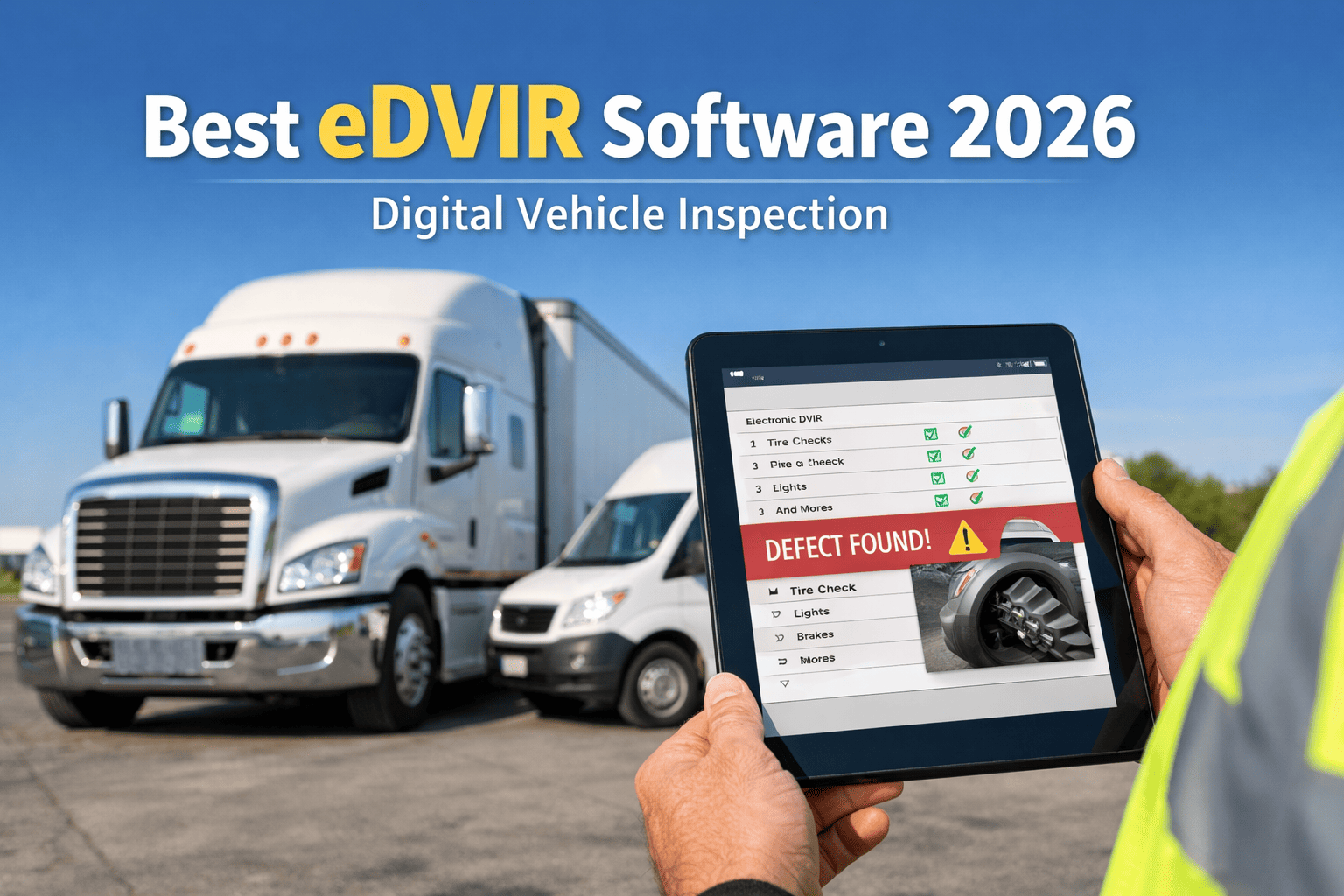
The FMCSA electronic DVIR rule that took effect in March 2026 formalizes what most well-run fleets already knew: digital driver vehicle inspection reports are legally equivalent to paper when the software meets specific requirements around signature authenticity, timestamp integrity, retention, and audit format. The rule doesn't force fleets to switch — paper DVIR is still permitted — but it removes the regulatory gray zone that kept some carriers hesitant, sets clear standards for e-DVIR software, and effectively marks the end of the paper era for fleets that want efficient audit outcomes. This page walks what the 2026 rule changed, the six requirements every compliant e-DVIR platform must meet, the 90-day transition roadmap, and the readiness self-check for fleets preparing now. Book a demo after you check the compliance card below.
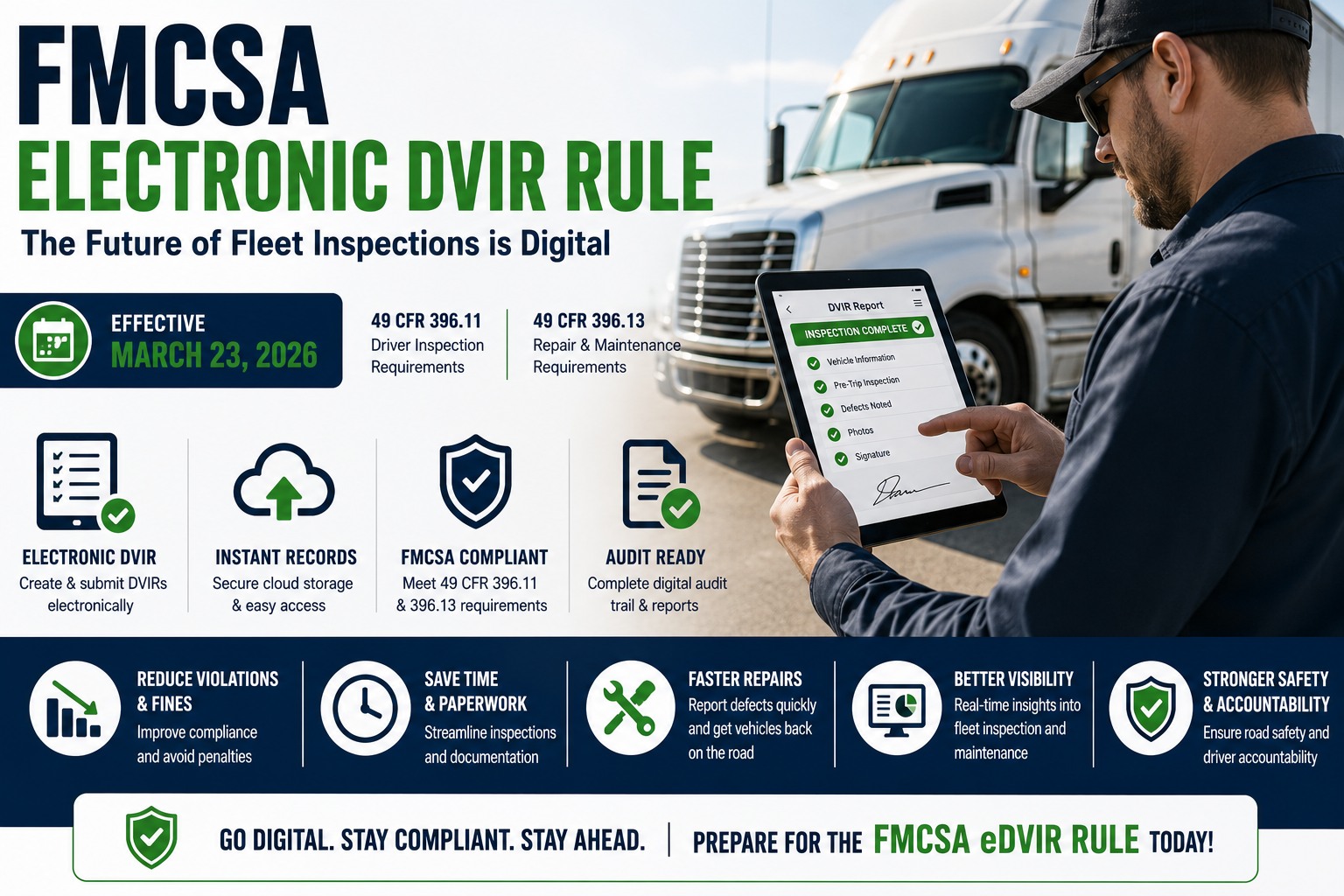
The 2026 electronic DVIR rule — at a glance.
Six specific requirements define what compliant electronic DVIR software must deliver. Below is exactly what auditors look for — and what modern e-DVIR platforms provide by default.
Every requirement above is what auditors will examine during compliance reviews under the 2026 rule. Fleets already running electronic DVIR are ready by default; fleets still on paper have a defined window to switch — not because paper is illegal, but because paper systematically fails the requirements above the moment an audit starts examining signature authenticity, timestamp integrity, and retention. Below is what the rule actually changed, the six compliance requirements in detail, the 90-day transition roadmap, and the readiness self-check for your current setup.
What the 2026 electronic DVIR rule actually changed
The 2026 rule doesn't rewrite the underlying DVIR regulation itself — 49 CFR §396.11 and §396.13 still govern what an inspection must cover, when it must be prepared, and who must sign. What the rule does is formalize digital compliance: it explicitly recognizes electronic DVIRs as legally equivalent to paper when specific conditions are met, and sets those conditions in language auditors can enforce. In practice, the compliance conversation shifts from "is your DVIR system compliant" to "does your DVIR system meet the six requirements" — a specification test rather than a category dispute.
Pre-2026 practice
- Handwritten signatures with legibility risk
- Physical file cabinet retention — 3-month rule spotty in practice
- Signature timestamp = whatever the driver wrote
- Defect information lives on paper until someone types it
- Auditor pulls records manually over 1–3 days
- No verification the driver was actually at the vehicle
2026 rule-compliant
- Digital signatures with cryptographic authenticity
- Automatic cloud retention retrievable indefinitely
- Timestamp integrity via server-side clock
- Defects auto-route to work orders in real time
- Auditor requests full export; delivered in seconds
- GPS verifies the driver was at the vehicle location
The rule change formalizes the trajectory that was already underway — moving inspection records from a paper artifact managed by whoever remembers to file it, to a structured digital record managed by workflow. The 2026 rule effectively means paper is now the exception that has to prove itself compliant, not the default. Book a demo to see the compliant e-DVIR workflow end-to-end
The 6 requirements every compliant e-DVIR platform must meet
The FMCSA electronic DVIR rule sets six specific requirements for compliant e-DVIR software. Each addresses a specific failure mode of paper DVIR — signature authenticity, timestamp integrity, retention, defect handling, audit accessibility, and signature chain enforcement. Every credible e-DVIR platform is built to all six by design, but not every "digital inspection app" clears the bar. The six are the buyer's checklist.
Time-stamped digital signatures
Server-side timestamps on every signature, with cryptographic authenticity that ties the signature to the specific driver, vehicle, date, and inspection event. Not a typed name in a field or a scanned image of a paper signature.
GPS-verified inspection location
Coordinates captured at the moment of signature, proving the inspection happened at the vehicle location. Auditors accept this as definitive proof of physical inspection; paper cannot provide equivalent verification.
Automatic 3-month retention
Every DVIR archived in the cloud at signature time. Retention window enforced by the software, not by physical file management. Longer retention (12 months to indefinite) is standard best practice and adds no operational cost.
Real-time defect logging & routing
Any defect noted on a DVIR opens a work order automatically, routes to the shop, and locks the truck's next assignment until the mechanic certifies the fix. No manual paper handoff step, no "did the mechanic get the note" gap.
Audit-ready export format
On auditor request, filtered export by date range, vehicle, or driver produces the DVIR record in a format the auditor's system reads directly. Reviews close in minutes instead of days — and finding rates typically drop to zero.
Signature chain enforcement
Driver signature, mechanic certification (if defects), and next-driver review captured in sequence with no possibility of skipping steps. The workflow enforces §396.11 signature requirements structurally, not by policy memo.
Fleets running compliant e-DVIR before the rule took effect faced zero disruption from the change; fleets still on paper face escalating compliance risk with each audit. The math on transition cost vs. audit exposure lands squarely on switching now. Start free and get all six requirements met on day one
Your 90-day transition roadmap
Moving from paper DVIR to electronic DVIR is not a technology project — it's a workflow project. The technology side takes days; the driver adoption and mechanic integration takes weeks. Below is the 90-day timeline most fleets follow, from software selection through full compliance under the 2026 rule.
Selection & integration
- Evaluate platforms against the 6 requirements
- Verify telematics + fuel card integrations
- Confirm state portal export compatibility
- Sign contract, provision accounts
Pilot deployment
- Roll out to 5–10 pilot trucks
- Train pilot drivers (30–60 min each)
- Test full workflow end-to-end
- Refine defect routing to shop
Fleet-wide rollout
- Deploy in weekly waves (25% per week)
- Coaching for drivers outside pilot
- Retire paper DVIR forms + cabinets
- Verify capture across all systems
Compliance & audit prep
- Run internal audit on 30 random DVIRs
- Close any signature-chain gaps
- Ready for real FMCSA audit under new rule
- Ongoing monitoring dashboard live
The 90-day timeline is comfortable — most fleets could compress to 60 days if pushed, though driver adoption benefits from the extra breathing room. Fleets that started their transition ahead of the March 2026 effective date arrived at the deadline with the workflow already routine. Book a demo to see the 90-day roadmap with an implementation partner
Your compliance readiness self-check
Below is a 10-item readiness self-check to run against your current DVIR program. Every item you can check off = one less thing to worry about at the next audit under the 2026 rule. Unchecked items are the specific gaps to close in your transition plan.
Every unchecked item above is a specific work item in your transition plan. Fleets running compliant e-DVIR check every box by design — the software enforces the workflow rather than the compliance manager remembering it. Book a demo to see all ten checked automatically — or start free and get your fleet compliant this quarter .
From a compliance director who transitioned ahead of the deadline
We ran paper DVIR through five FMCSA audits over 12 years. Every audit was 2 to 3 days of pulling folders, and every one produced $3,000 to $8,000 in fines from missing signatures or unreadable handwriting. We switched to electronic DVIR ahead of the 2026 rule specifically to get in front of the compliance change.
First audit under the new system: 45 minutes total, zero findings on 100 DVIRs the auditor pulled. Transition took 60 days end-to-end. If I'd known how straightforward it would be, I'd have done it years ago.
Frequently asked questions
What is the FMCSA electronic DVIR rule?
The FMCSA electronic DVIR rule is the formal recognition, effective March 2026, that electronic driver vehicle inspection reports are legally equivalent to paper DVIRs when they meet specific software requirements. The rule doesn't change the underlying inspection regulation (49 CFR §396.11 and §396.13) — the 15-item inspection scope, the post-trip trigger, and the three-signature chain (driver, mechanic, next driver) all remain identical to paper practice. What the rule does is set six explicit standards for what constitutes compliant e-DVIR software: time-stamped digital signatures with cryptographic authenticity, GPS-verified inspection location, automatic 3-month retention, real-time defect logging and workflow routing, audit-ready export format, and signature chain enforcement. Fleets running compliant e-DVIR software meet the rule by default; fleets still on paper are not automatically non-compliant, but face escalating audit risk because paper systematically fails the six requirements once an auditor examines signature authenticity, timestamp integrity, and retention.
When did the 2026 electronic DVIR rule take effect?
The FMCSA electronic DVIR rule took effect in March 2026. From that date forward, electronic DVIRs meeting the six specification requirements are legally equivalent to paper DVIRs for all FMCSA compliance purposes, including Safety Audits and Compliance Reviews. Fleets that were already running compliant electronic DVIR before the effective date faced no disruption — they were treated as compliant by default under the new framework. Fleets still on paper DVIR at the effective date remain permitted to use paper, but face two escalating pressures: audit findings on paper systems continue to accumulate at historical rates ($200 to $500 per missing signature, $1,000 to $2,000 per retention failure), while new-fleet expectations from insurance underwriters, sustainability-focused shippers, and OEM warranty programs increasingly assume digital records. Most fleets treating the rule seriously started their transition in the 6 to 9 months preceding the effective date to arrive with the workflow already routine rather than scrambling on the deadline itself.
Does the rule require fleets to switch to electronic DVIR?
No. Paper DVIR remains permitted under FMCSA rules, and the 2026 electronic DVIR rule does not create a mandatory transition deadline. What the rule does is remove the regulatory ambiguity around electronic DVIR — before the rule, some carriers were hesitant to switch because compliance treatment of e-DVIR was inconsistent between audits; the rule formalizes electronic DVIR as fully compliant when the six specifications are met. The practical effect is that fleets choosing to stay on paper do so knowing paper is systematically harder to run compliantly, not because of any specific regulatory prohibition. Common findings on paper DVIR — missing signatures, illegible handwriting, retention gaps, missing mechanic certifications, unverified inspection locations — continue to drive fines during audits. Fleets making the transition to electronic DVIR typically report FMCSA audit times dropping from days to under an hour and finding rates dropping to zero, which is the actual economic case for the switch even without a mandatory deadline.
What specific requirements must compliant e-DVIR software meet?
The rule sets six specifications for compliant electronic DVIR software. First, time-stamped digital signatures with cryptographic authenticity that ties the signature to a specific driver, vehicle, date, and inspection event — a typed name or a scanned image of a paper signature does not qualify. Second, GPS-verified inspection location captured at signature time, proving the inspection happened at the vehicle. Third, automatic 3-month retention in the cloud enforced by software. Fourth, real-time defect logging that opens work orders automatically without a manual handoff. Fifth, audit-ready export in a filterable format that auditor systems read directly. Sixth, signature chain enforcement that captures driver, mechanic, and next-driver signatures in sequence with no possibility of skipping steps. Every credible modern e-DVIR platform meets all six by design; the buyer's job is to verify the specific vendor's implementation before signing.
How long does the transition from paper to electronic DVIR take?
Most fleets complete the transition in 60 to 90 days end-to-end, though the technology side takes only days. Days 0 to 14 cover software selection and integration setup: evaluating 2 to 3 e-DVIR platforms against the six compliance requirements, verifying integration with telematics and fuel card systems, and confirming state-portal export compatibility. Days 15 to 30 are pilot deployment on 5 to 10 trucks with driver training (30 to 60 minutes per driver) and end-to-end workflow testing. Days 31 to 60 are fleet-wide rollout in weekly waves of roughly 25% of the fleet, with paper forms formally retired. Days 61 to 90 are compliance validation and audit preparation, including running an internal audit simulation on 30 random DVIRs to catch any signature-chain or retention gaps before a real audit. The timeline can compress to 45 to 60 days if driven, though driver adoption benefits from the extra breathing room.
Get 2026-rule compliant — before the next audit, not the next deadline
HVI meets all six FMCSA electronic DVIR rule requirements by default: GPS-stamped signatures, cryptographic authenticity, automatic retention, defect-to-work-order routing, one-click audit export, and signature chain enforcement. Live in under two weeks — full fleet-wide rollout in 60 to 90 days — and the first FMCSA audit under the new rule typically closes with zero findings.
No credit card · No hardware · e-DVIR ready day one