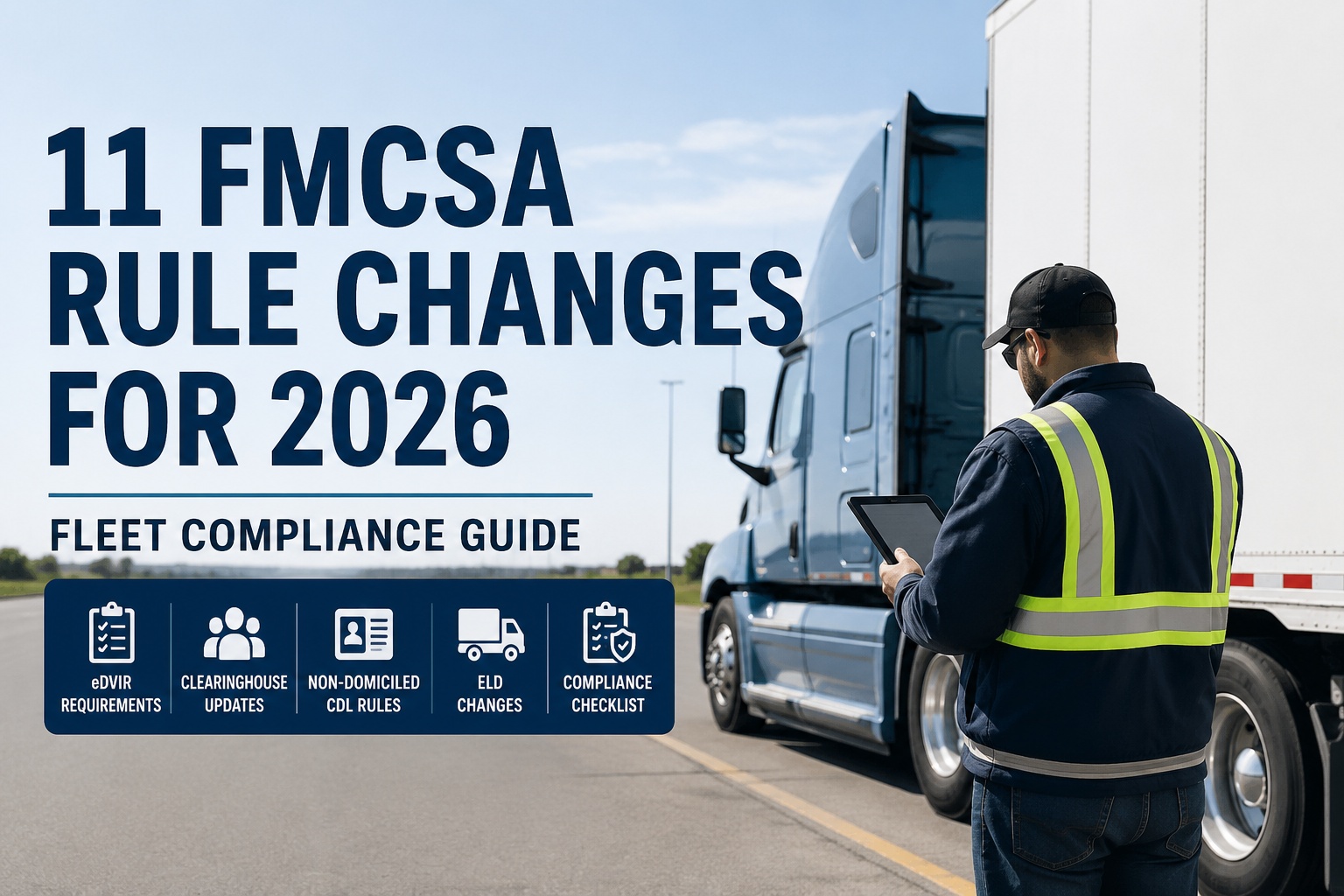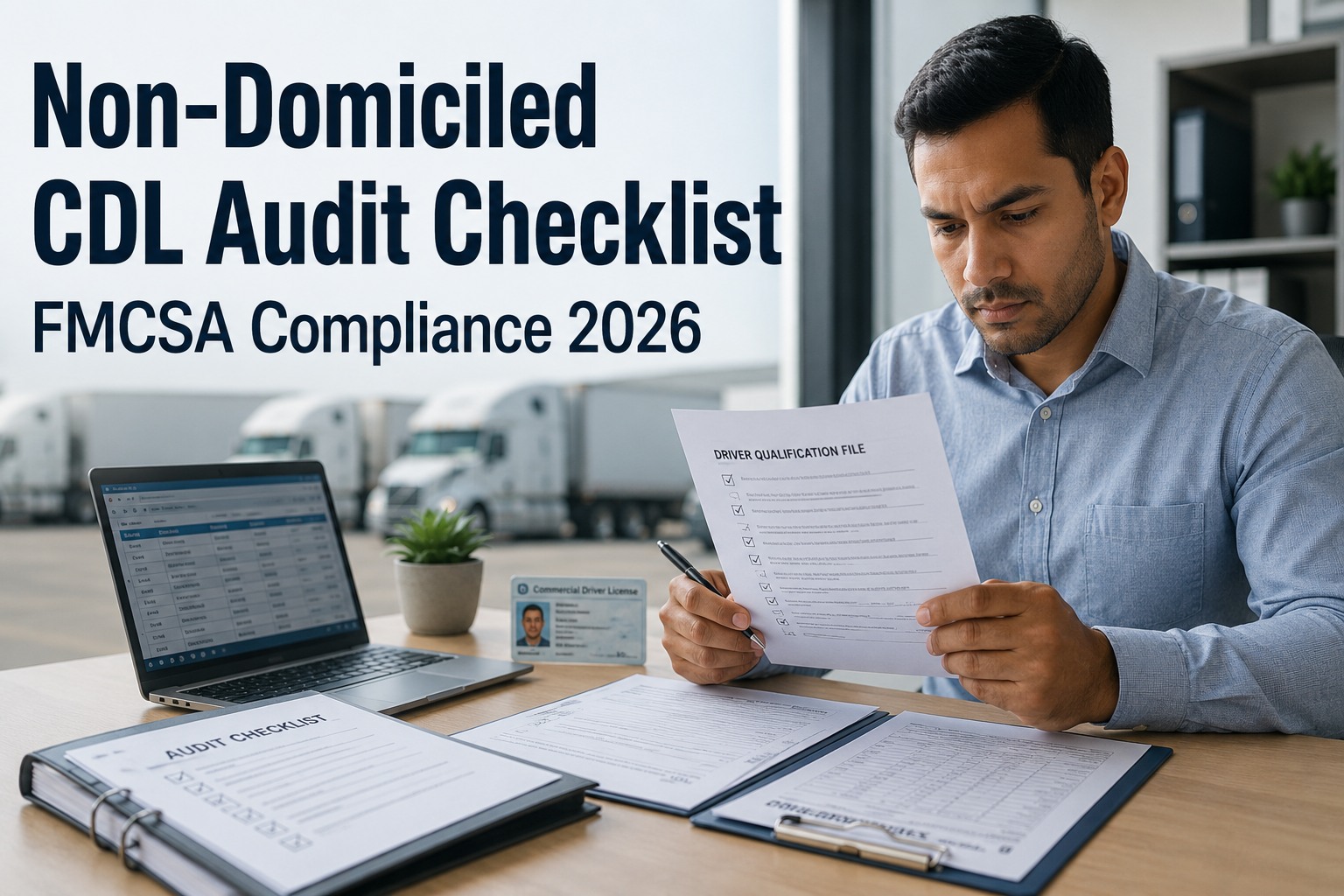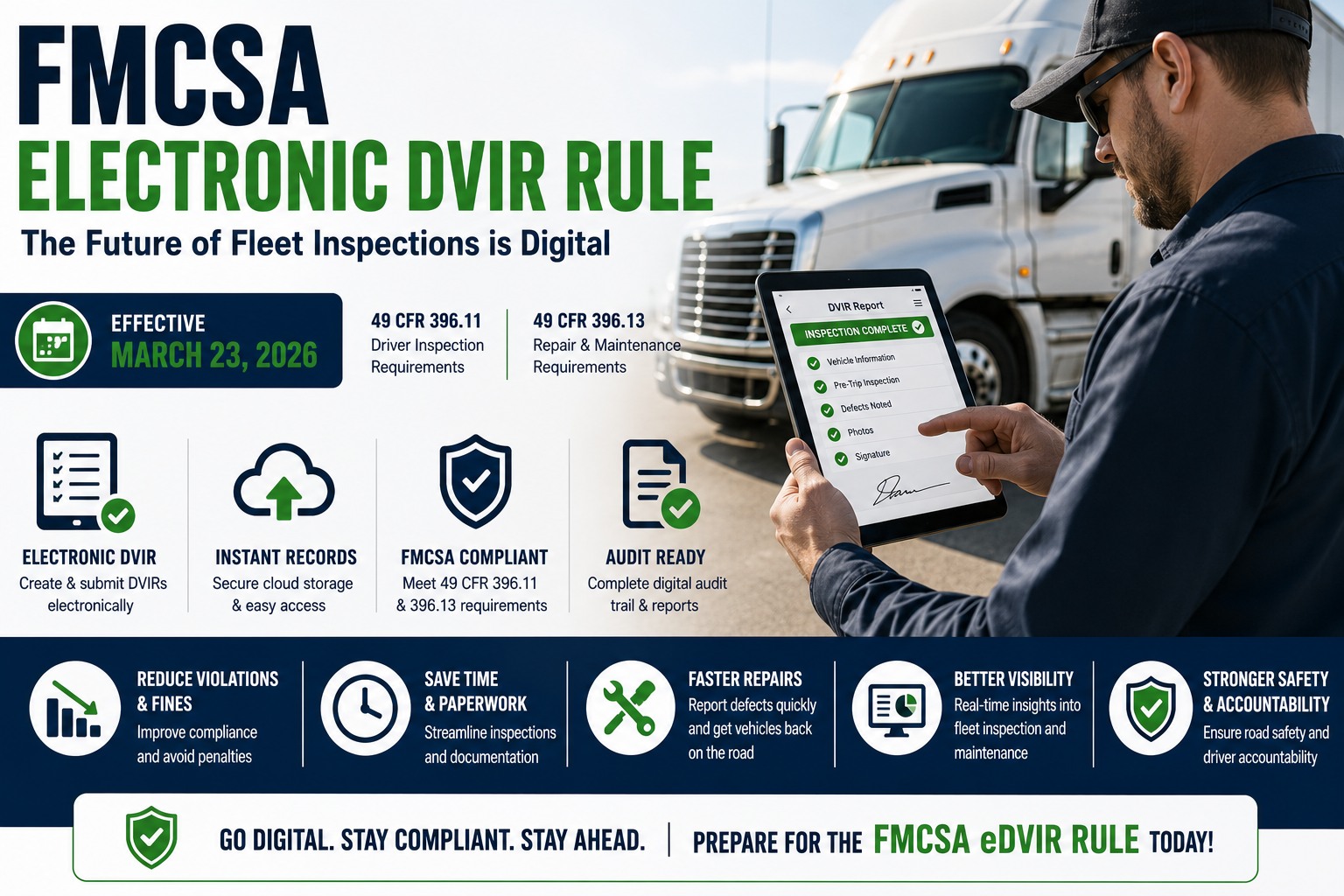
On March 16, 2026, FMCSA's Final Rule on non-domiciled commercial driver's licenses took effect — and the compliance work for motor carriers didn't stop at "know the rule." It shifted into pre-hire screening, tighter document verification, refreshed driver qualification files, and audit readiness. The CDL non-domiciled rule doesn't affect your U.S.-citizen drivers, but for every foreign-domiciled applicant — and every carrier hiring them — the workflow changed. Here's what your HR, safety, and compliance teams need to run cleanly from day one. Book a demo
The rule at a glance — what changed, who's affected, when
Two things about this rule matter more than the eligibility list itself. First: it applies only to foreign-domiciled applicants — not U.S. citizens, not permanent residents domiciled in the state that licenses them. Most fleets discover on closer inspection that their exposure is smaller than the headlines suggest. Second: the compliance burden is real and it's on the employer — carriers now have to verify visa category, collect the correct documents, and maintain audit-ready driver qualification files that stand up to FMCSA inspection. That's where the operational work sits.
Who qualifies now — and who doesn't
The eligibility change is the sharpest part of the rule. Before the March 16 effective date, a wide range of work-authorized immigrants could obtain a non-domiciled CDL. After it, foreign-domiciled applicants must hold one of three specific employment-based visa categories — and Employment Authorization Documents (EADs) on their own are no longer sufficient.
- H-2A — Temporary agricultural workers
- H-2B — Temporary non-agricultural workers
- E-2 — Treaty investors
- DACA recipients
- Asylum seekers & refugees
- TPS (Temporary Protected Status) holders
- EAD-only holders without qualifying visa
- Most other immigration categories
The rule does not touch U.S. citizens or drivers domiciled in the state that licenses them — the vast majority of the fleet workforce. It also does not immediately invalidate existing non-domiciled CDLs held by drivers outside the three eligible categories; those licenses stay valid until they expire, at which point the holder must exit the CDL pipeline. Roughly 194,000 current non-domiciled CDL holders could be affected as their licenses come up for renewal. Book a demo to see per-driver visa status tracked in the DQ file
The three documents that matter now
The document collection workflow changed materially. What used to be a straightforward EAD-plus-license check is now a three-document verification with state-side SAVE-system confirmation running underneath.
Unexpired foreign passport
Original document, matching the applicant's identity and current status. Required at every issuance, transfer, renewal, restoration, reinstatement and upgrade.
Form I-94 or I-94A
Must show approved employment-based nonimmigrant status — H-2A, H-2B, or E-2. This is where states verify the visa category qualifies under the new rule.
SAVE-system verification
State Driver's Licensing Agency (SDLA) confirms immigration status through the Systematic Alien Verification for Entitlements system. If SAVE doesn't confirm, the state initiates downgrade procedures.
Two changes from the previous workflow are especially worth flagging. First: EAD alone is no longer sufficient — the visa category itself is now what determines eligibility. Second: the credential must display the word "non-domiciled" on its face; previous guidance permitting "limited term" as a substitute was rescinded effective March 16, 2026. Book a demo to see all three documents attached to the driver record automatically
The 5-step pre-hire workflow for non-domiciled applicants
Recruiting and onboarding under the new rule requires a tighter, earlier document check. The following workflow is what HR, safety, and operations teams at compliant carriers now run for every foreign-domiciled applicant — before spending recruiting effort on someone who won't qualify.
-
01Screen visa category upfront — before testing spend
At initial application, confirm whether the applicant is foreign-domiciled and, if yes, whether they hold H-2A, H-2B, or E-2 status. An EAD without one of these categories no longer qualifies. Screen this before any DOT physical, drug test, or road-test cost.
-
02Collect the three-document set
Unexpired foreign passport, Form I-94 or I-94A showing qualifying employment-based status, and the credential itself (with "non-domiciled" on the face). All three go into the driver qualification file with expiration dates flagged.
-
03Sync CDL expiration to visa expiration
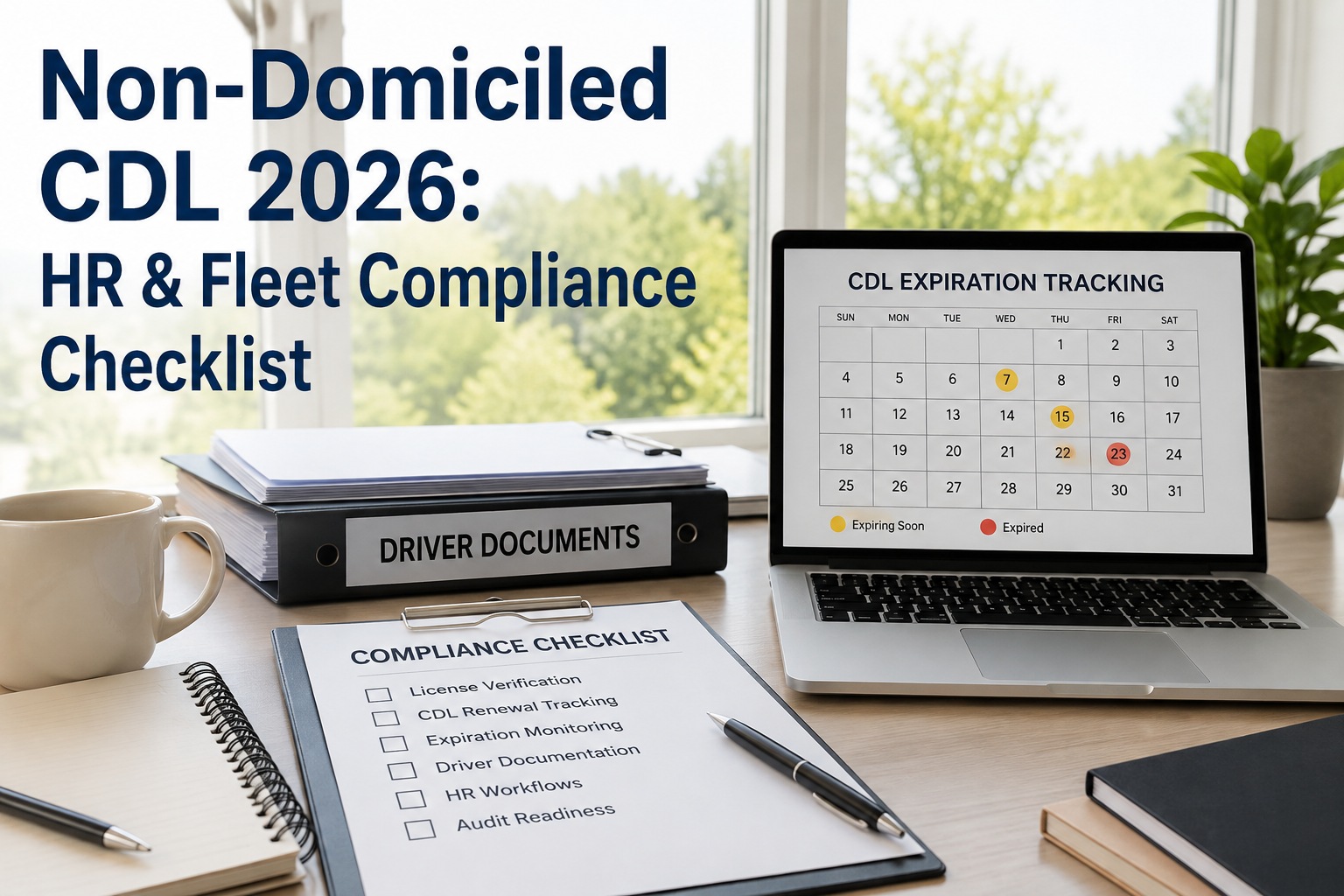
Non-domiciled CDLs are strictly tied to the underlying visa expiration. A CDL cannot outlast the immigration status supporting it. Track both dates in the DQ file with alerts 60 and 30 days out.
-
04Confirm SAVE-system verification through the SDLA
State Driver's Licensing Agencies now verify status via SAVE at every issuance and renewal. If SAVE fails, the state initiates downgrade procedures — and the carrier needs to know before the driver next dispatches.
-
05Refresh DQ file annually & before renewal
Because visa status can change, DQ file review isn't a one-time event. Annual refresh + trigger-based re-verification (before renewal, transfer, or reinstatement) keeps the file audit-ready. All alerts, timestamps and check history retained per driver.
The workflow doesn't add radically new steps for most well-run compliance operations — but every step now has less margin for error, and the document threshold is higher. Fleets that were running this on spreadsheets before will find the volume of dates, alerts, and per-driver documentation checks is what breaks — not the individual rule change. Book a demo to see the full pre-hire workflow automated per driver
The 4 risks of getting non-domiciled CDL compliance wrong
The reason to run this cleanly isn't just avoiding fines. The exposure stack for a non-compliant fleet touches operational safety, insurance underwriting, contract eligibility, and civil liability. Here's what's actually at risk.
Driver disqualification mid-dispatch
If a driver's non-domiciled CDL is downgraded by the state (SAVE verification fails, visa status change, expiration missed), the driver becomes non-CDL — often without immediate notice to the carrier. A dispatch after downgrade is an unqualified-driver violation on your operating record.
FMCSA audit findings & safety rating impact
Missing or incomplete DQ file records for non-domiciled drivers are cited as acute or critical violations during compliance reviews. Repeated findings affect your safety rating, insurance premiums, and eligibility for certain freight contracts.
Wasted recruiting spend on ineligible applicants
DOT physical, hair-follicle drug test, driving records fees, road test time — the cost of a full application cycle runs into hundreds of dollars per candidate. Screening visa category upfront prevents that spend on candidates who won't qualify.
Insurance & contract compliance exposure
Many freight contracts and commercial auto policies now include specific driver-eligibility clauses that reference federal CDL compliance. A gap in your DQ file may not just trigger FMCSA scrutiny — it may breach a customer contract or invalidate a policy provision.
None of these risks disappears with the pending Rivera Lujan v. FMCSA (II) litigation. The Final Rule is in effect, enforcement is live, and the court did not stay the March 16 effective date. Fleets that treat this as "wait and see" are running exposed against a rule that's already being enforced. Start free and get DQ file automation on day one
From a Compliance Officer running DQ files on 340 drivers post-rule
When the rule dropped in February, we ran a report on every driver and got a list of 22 non-domiciled CDL holders. Nine were on H-2A visas and stayed eligible. Thirteen were on other statuses — DACA, TPS, EAD-only — and we needed a plan for what happens at their next renewal. That triage took us three weeks with spreadsheets.
What actually changed our operation wasn't the rule itself — it was moving DQ files onto a platform that flagged visa expiration, CDL expiration, and medical card expiration on the same alert cycle. We caught two license-visa mismatch cases before they hit downgrade. That would have been unqualified-driver violations under the old workflow. This isn't a rule you can run on a paper file anymore.
Frequently asked questions
What is the CDL non-domiciled rule and when did it take effect?
The CDL non-domiciled rule is FMCSA's 2026 Final Rule titled "Restoring Integrity to the Issuance of Non-Domiciled Commercial Driver's Licenses," published in the Federal Register on February 13, 2026 and effective March 16, 2026. It reaffirmed, with minor changes, the provisions of the Interim Final Rule (IFR) published on September 29, 2025. The rule narrows eligibility for non-domiciled Commercial Learner's Permits (CLPs) and Commercial Driver's Licenses (CDLs) issued to foreign-domiciled applicants. Under the new rule, only foreign-domiciled applicants who hold one of three specific employment-based nonimmigrant visa categories — H-2A (temporary agricultural workers), H-2B (temporary non-agricultural workers), or E-2 (treaty investors) — can qualify for a non-domiciled CDL. FMCSA cited a "critical safety gap" as the basis: domestic CDL applicants face rigorous history checks through CDLIS and PDPS databases, while non-domiciled applicants had no equivalent foreign driving history verification. The agency also cited 17 fatal crashes in 2025 resulting in 30 deaths involving non-domiciled CDL holders who would not have qualified under the new standards. The rule does not affect U.S. citizens or drivers domiciled in the state that licenses them — it applies specifically to foreign-domiciled CDL applicants.
Which visa categories qualify a foreign-domiciled applicant for a non-domiciled CDL?
Only three employment-based nonimmigrant visa categories now qualify a foreign-domiciled applicant to obtain a non-domiciled CDL: H-2A (temporary agricultural workers), H-2B (temporary non-agricultural workers), and E-2 (treaty investors). FMCSA selected these categories specifically because they are subject to enhanced consular vetting and interagency screening, which the agency cites as the basis for maintaining CDL eligibility. Notably excluded from new non-domiciled CDL issuance are DACA recipients, asylum seekers, refugees, Temporary Protected Status (TPS) holders, and holders of Employment Authorization Documents (EADs) without one of the qualifying visa categories. Under the previous framework, EADs alone were often accepted as sufficient proof of eligibility — that is no longer the case under the 2026 rule. Applicants must now present an unexpired foreign passport plus Form I-94 or I-94A showing approved H-2A, H-2B, or E-2 employment-based status. State Driver's Licensing Agencies (SDLAs) verify the applicant's status through the Systematic Alien Verification for Entitlements (SAVE) system at every issuance, renewal, transfer, restoration, reinstatement, and upgrade. If SAVE does not confirm lawful immigration status, the state is required to initiate downgrade procedures for any unexpired non-domiciled CLP or CDL held by the applicant.
What happens to non-domiciled CDL holders whose visa category is now excluded?
Drivers who currently hold a valid non-domiciled CDL and remain in valid work authorization — even if their visa category is now excluded from new issuance under the 2026 rule — can continue operating a commercial motor vehicle until the expiration of their current license. The rule did not immediately invalidate existing non-domiciled CDLs. However, at renewal, transfer, restoration, reinstatement, or upgrade, the applicant will need to meet the new eligibility requirements — which for foreign-domiciled applicants means holding H-2A, H-2B, or E-2 status. Applicants in excluded categories (DACA, TPS, asylum, refugee, EAD-only) cannot obtain a renewed or new non-domiciled CDL under the rule as written. FMCSA estimates approximately 194,000 current non-domiciled CDL holders could eventually be affected as licenses come up for renewal. For carriers, this creates a workforce planning question: which drivers in your current pool will not be able to renew under the new rule, and on what timeline? The practical response is to run a report on all non-domiciled CDL holders in your fleet, identify each driver's visa category and CDL expiration date, and build a plan for what happens at their next renewal cycle. Litigation (Rivera Lujan v. FMCSA (II), filed February 12, 2026) is ongoing but did not block the March 16 effective date, and the rule remains enforceable.
What are motor carriers' compliance obligations under the new rule?
Motor carriers remain responsible for verifying that every driver they employ or dispatch holds a valid CDL appropriate to the vehicle and route. Under the 2026 rule, that verification now includes confirming that foreign-domiciled drivers hold a qualifying visa (H-2A, H-2B, or E-2), that their non-domiciled CDL is properly marked (the word "non-domiciled" must appear on the face of the credential — previous guidance permitting "limited term" was rescinded effective March 16, 2026), and that the underlying immigration status has not expired or been downgraded by the state. Practically, carriers should build a pre-hire screening workflow that confirms visa category before spending on DOT physicals, drug tests, and road tests; collect and retain the three-document set (foreign passport, I-94 or I-94A showing qualifying status, and the credential itself) in the driver qualification file; sync CDL expiration tracking to visa expiration in the DQ file with 60- and 30-day alerts; check for SAVE-system downgrade notifications through the SDLA; and refresh DQ file review annually plus at any trigger event (renewal, transfer, reinstatement). Missing or incomplete DQ file records for non-domiciled drivers are cited as acute or critical violations during FMCSA compliance reviews, with cascading impact on safety rating, insurance premiums, and contract eligibility.
How does HVI help fleets manage CDL non-domiciled rule compliance?
HVI manages the complete driver qualification file on the same platform running your DVIRs, inspections, and preventive maintenance — so compliance data lives alongside the operational data it depends on rather than in a separate HR system that never quite reconciles. For CDL non-domiciled rule compliance specifically, HVI tracks per-driver CDL type and expiration date, visa category and expiration date, Form I-94 status, medical certification status, MVR history, Clearinghouse query status, and employment verification records — with automated alerts at 60 and 30 days before any expiration event. Pre-hire screening workflows can be configured to flag ineligible visa categories before recruiting spend commits, so DOT physicals and drug-test costs don't happen for applicants who won't qualify. During FMCSA compliance reviews, the audit dashboard produces the complete DQ file per driver on demand — every document, every check timestamp, every alert response — ready for inspection. Published customer data shows fleets on HVI report ~25% lower annual maintenance cost and typical payback around 3 months, with the compliance module extending the same operational discipline into the driver-side workflow. The rule change is real, the enforcement is live, and the compliance load is manageable when the DQ file lives on a system built for it.
Run the new rule cleanly on the same platform running your fleet
HVI tracks CDL, visa, medical, MVR, and Clearinghouse status per driver, flags ineligible applicants before recruiting spend, and produces the complete DQ file per driver on demand for FMCSA compliance reviews. Live in under two weeks.
No credit card · No hardware · DQ file dashboard on day one