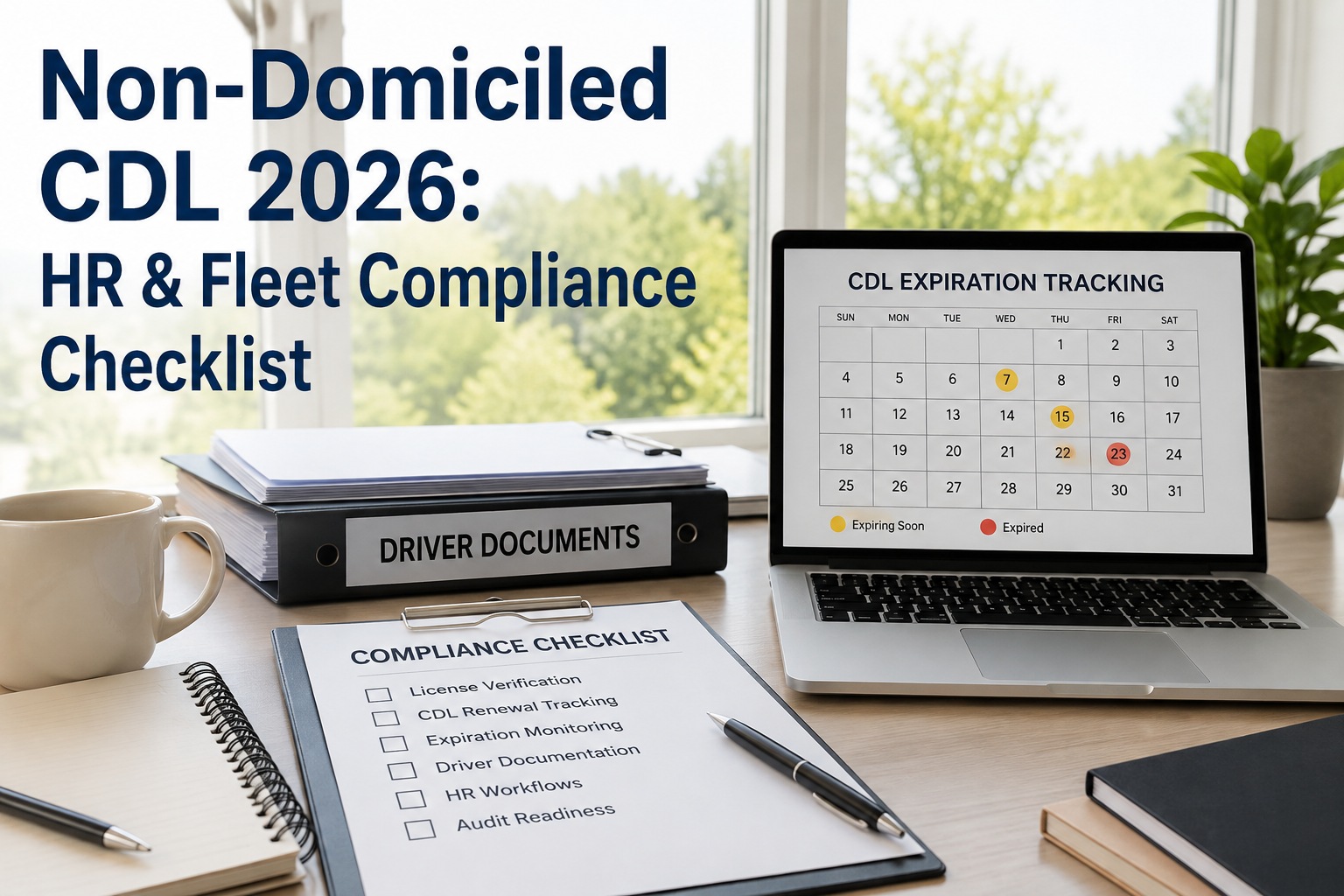
The FMCSA non-domiciled CDL rule that took effect March 16, 2026 isn't a regulatory update HR can process at renewal time. It's a driver-qualification workflow overhaul that reshapes how fleets track five different expiration dates per driver — CDL, passport, I-94, visa status, and medical card — and how those dates interlock at every renewal event. Missing one triggers an unqualified-driver violation and roadside OOS. This non-domiciled CDL rule 2026 HR compliance checklist walks the roster audit, documentation vault, and audit-ready workflow. Book a demo
The 4-workflow model that keeps a non-domiciled driver roster compliant
Roster audit, documentation vault, expiration alerts, audit-ready records. Each system covers a specific failure mode the rule now enforces.
The rule doesn't invalidate existing non-domiciled CDLs. It changes what happens at every renewal, transfer, restoration, reinstatement, or upgrade event — and it caps license validity at 1 year matching the driver's immigration document. That single change turns a compliance task that used to happen every 4–8 years per driver into an annual event, and the HR/compliance team has to build the workflow to manage it at that cadence. The four systems above are the minimum. Fleets running any one of them on spreadsheets are one compliance review away from a finding.
Eligibility triage — which drivers renew, which need transition planning
The first step in every non-domiciled CDL 2026 compliance workflow is roster classification. Every driver falls into one of three tiers based on current immigration status, and each tier has a different HR action pathway.
Fully eligible — renewal path clear
Grandfathered until expiration
Non-compliant / high risk
The triage isn't optional and it isn't spreadsheet-friendly. Every non-domiciled driver on the roster needs to be classified into one of these three tiers within the first 30 days of a compliance program — and the classification updates every time an underlying document changes. A driver on H-2B who transitions to EAD-only becomes a Tier 2 case that day; the HR system either catches that or it doesn't. Book a demo to see driver-tier classification tracked automatically per status change
The five-expiration cascade — why one calendar isn't enough
Every non-domiciled driver now has five interlocking expiration dates that HR/compliance must track together. Miss one and the driver is legally unqualified — even if the other four are current. The rule's 1-year CDL validity cap is what forces the whole cascade to align.
Passport
Typically 5–10 year validity. Must be unexpired at every CDL renewal event. Renewal cycle depends on origin country, not fleet control.
I-94 (admit-until date)
Sets the maximum lawful presence date. Any CDL issued beyond this date is improperly issued. Verified via DHS I-94 lookup system.
Visa status (H-2A / H-2B / E-2)
Only these three categories qualify for new non-domiciled CDL issuance under the 2026 rule. Any status change downgrades eligibility.
Non-domiciled CDL
Max 1-year validity, matches immigration document expiration. Marked "non-domiciled" on face. Renewable annually only if underlying documents remain valid.
Medical certificate
Max 2-year validity per DOT rules. Some conditions require shorter cycles. Separate from CDL but required for CDL activity.
Each of the five expires on a different cycle. A driver can have a valid CDL, valid medical card, valid passport, and valid visa — but if the I-94 admit-until date passed last week, the CDL was improperly issued from that date forward and the driver is unqualified. The HR system that catches this is the one that tracks all five dates together with tiered alerts at 90, 60, and 30 days before each. Anything less and the fleet is running blind on driver qualification. Book a demo to see the 5-date expiration cascade tracked per driver with tiered alerts
The 6-step roster audit workflow — running it the first time
The first pass through a driver roster after the March 16 effective date is the highest-leverage compliance investment a fleet can make. Done thoroughly, it identifies every at-risk driver before the first renewal cycle triggers under new rules. Done in a hurry, it misses the drivers who become OOS violations 90 days later.
Pull the driver roster and mark every non-domiciled CDL
Cross-check state CDL records against the DQ file. Any driver whose CDL is marked "non-domiciled" on the face gets flagged for triage. This is the population being audited.
Classify each driver by current visa status
H-2A, H-2B, E-2 → Tier 1. DACA, TPS, asylum, refugee, EAD-only → Tier 2. Unknown or documentation gap → Tier 2 pending verification. Any mismatch between CDL expiration and I-94 admit-until date → Tier 3.
Verify all five expiration dates per driver
Passport, I-94, visa, CDL, medical certificate. Record each date. Flag the earliest — that's the driver's next compliance action window.
Build the renewal calendar per driver
90/60/30-day alerts before each of the five dates. Alerts routed to HR (owner), compliance (backup), and driver (self-tracking). Missing an alert route is a system failure, not a driver failure.
Plan replacement for Tier 2 drivers
Every Tier 2 driver's CDL expiration is a hire-by date. Recruitment cycle for a qualified CDL replacement typically runs 60–120 days. Start when the driver is 6–12 months from expiration — not 90 days.
Document the audit itself
Audit date, driver-by-driver findings, tier assignments, corrective actions taken. This is what an FMCSA compliance reviewer wants to see: proof the fleet ran a proactive audit, not just a reactive one.
The whole workflow runs in a few days for a small fleet, a week or two for a mid-sized fleet, and it's the single most important preparatory action HR/compliance can take before the first renewal cycle hits. Fleets that skip it discover the exposure at the roadside — which is where OOS and unqualified-driver violations get logged permanently in CSA data. Start free and get the 6-step audit workflow built into your DQ file management on day one
HR compliance checklist — the 8 items every non-domiciled CDL file needs
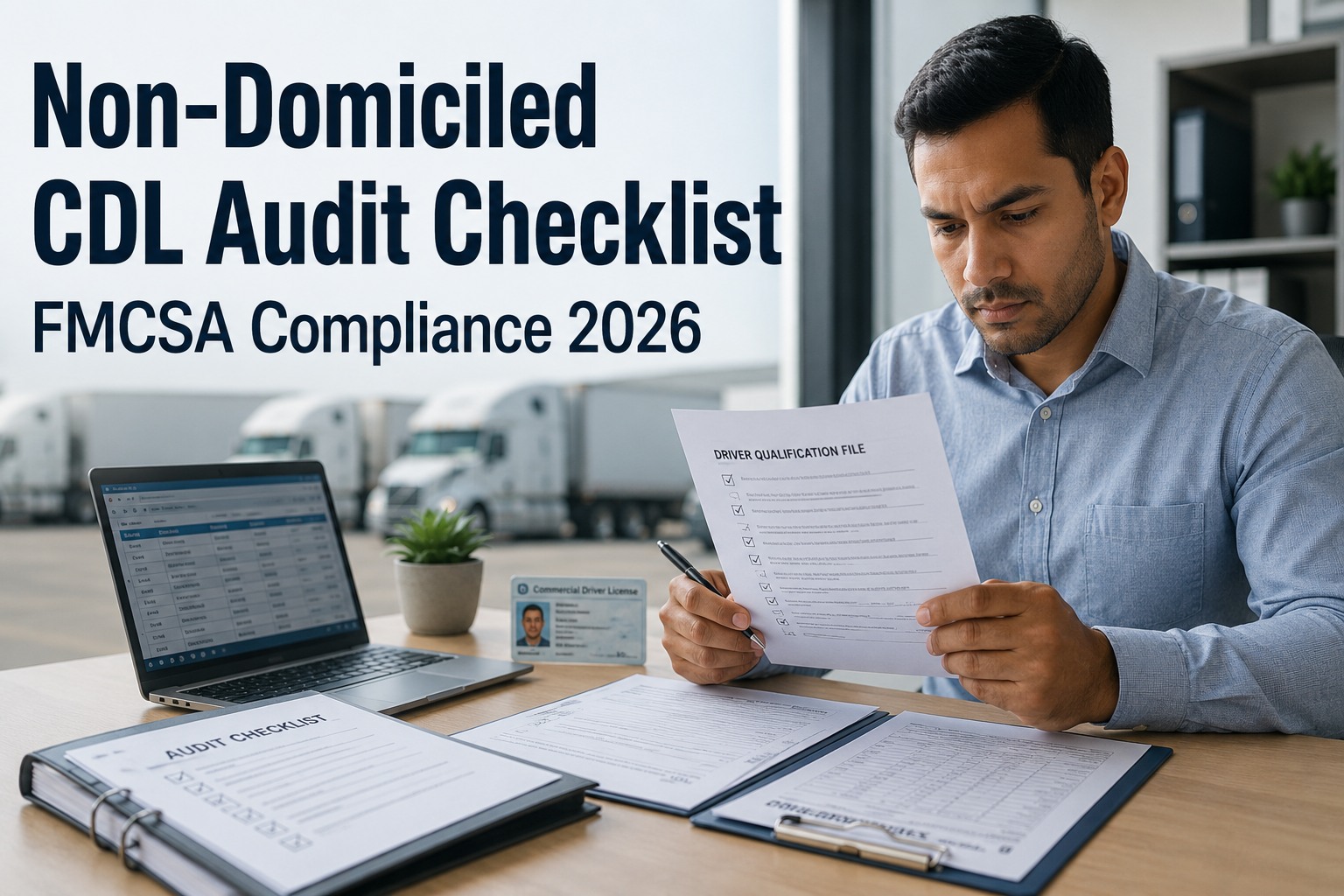
Whether you're building this from scratch or upgrading an existing DQ file system, these are the 8 items that constitute a compliant non-domiciled CDL record under the 2026 rule.
Unexpired passport
Photo copy on file. Expiration date logged. Alert at 90 days before expiration.
Current I-94 with admit-until date
Verified via DHS I-94 lookup. Admit-until date logged. This date caps CDL validity.
Visa category verification
H-2A / H-2B / E-2 confirmed. Copy of visa or approval notice on file. Category flagged per driver.
Non-domiciled CDL (with marking)
Physical CDL shows "non-domiciled" marking on face. Front + back copies on file. Expiration date logged.
DOT medical certificate
Current, dated, and signed by certified examiner. Expiration date logged.
Clearinghouse query results
Annual query completed and documented. Pre-employment query for new hires. Positive findings addressed per rule.
MVR (Motor Vehicle Record)
Pulled at hire and annually. Reviewed against fleet acceptance criteria. Findings documented.
Audit-ready index
All 7 items above searchable per driver, exportable per FMCSA request, retained per DOT rules (typically 3 years past employment end).
The 8 items constitute the audit-ready DQ file for a non-domiciled driver. Every FMCSA compliance review will look for them; every insurance underwriter will ask about them; every plaintiff's attorney in an accident case will subpoena them. Building the file right the first time is the difference between a routine compliance review and a chase-the-paperwork nightmare. Book a demo to see the 8-item DQ file template configured in HVI
From an HR Director who moved 340 drivers onto digital DQ files in 60 days
When the final rule dropped in February, our compliance officer and I spent the first weekend triaging our roster. Of 340 drivers, 22 held non-domiciled CDLs. Nine were on H-2B, so their pathway was clear. Thirteen were on other statuses — DACA, TPS, and a couple on EAD-only. Three of those thirteen had CDL expiration dates that ran past their I-94 admit-until date. Under the old workflow, nobody would have noticed until the state caught it or an inspector did.
We moved every non-domiciled DQ file onto the digital platform inside 60 days. What actually changed the operation wasn't the rule itself — it was having all five expiration dates on one alert cycle per driver. We've caught two more license-visa mismatches since then, both before roadside. Under the old paper system those would have been unqualified-driver violations. The 22 drivers are 6.5% of our roster; the compliance load they add is close to 40% of our HR-compliance calendar. The workflow has to match that reality.
Frequently asked questions
What are the HR compliance requirements under the non-domiciled CDL rule 2026?
HR compliance under the FMCSA non-domiciled CDL rule 2026 (effective March 16, 2026, Docket FMCSA-2025-0622) covers four parallel workflows. (1) Driver roster audit: identify every current non-domiciled CDL holder on the roster, classify by visa category, and flag drivers whose category is now excluded (DACA, TPS, asylum, refugee, EAD-only) from renewal eligibility. Only H-2A, H-2B, and E-2 visa holders can obtain a renewed or new non-domiciled CDL under the rule. (2) Documentation vault: maintain digital records of passport, I-94, visa, CDL, and medical certificate per driver, with FMCSA requiring 2-year retention for SDLAs and DOT DQ file retention typically requiring 3 years past employment end. (3) Expiration alert model: tiered alerts at 90, 60, and 30 days before each of the five expiration dates per non-domiciled driver, routed to HR, compliance, and the driver simultaneously. This is critical because the 2026 rule caps non-domiciled CDL validity at 1 year matching immigration document expiration — annual renewal cycles are the new normal. (4) Audit-ready records: every document verified, dated, indexed, and exportable within 48 hours for FMCSA compliance reviews. HR teams that continue running non-domiciled DQ files on spreadsheets face the compounding risk that any one missed expiration date creates an unqualified-driver situation with immediate roadside OOS consequences, permanent CSA-scoring impact, and potential insurance implications. The rule doesn't just add paperwork; it fundamentally changes the cadence and interlock structure of driver qualification management.
Which drivers need to be transitioned out under the 2026 rule?
Under the FMCSA 2026 Final Rule, drivers holding non-domiciled CDLs whose immigration status is in an excluded category cannot renew, transfer, restore, reinstate, or upgrade their CDL after March 16, 2026. Excluded categories include DACA (Deferred Action for Childhood Arrivals), TPS (Temporary Protected Status), asylum, refugee status, and EAD-only status (Employment Authorization Document without underlying qualifying visa). Their current CDL remains valid through its stated expiration date, but they cannot obtain a renewed CDL under the rule as written. Qualifying visa categories under the rule are limited to H-2A (temporary agricultural), H-2B (temporary non-agricultural), and E-2 (treaty investor). FMCSA estimates approximately 194,000 non-domiciled CDL holders currently in the system, with approximately 40,000 drivers per year transitioning as their credentials expire over a 5-year phase-in period. For fleets, this means every non-domiciled driver on the roster needs classification into one of three tiers: Tier 1 (H-2A/H-2B/E-2 — renewal path clear); Tier 2 (excluded category, grandfathered until CDL expiration but not renewable); Tier 3 (improperly issued CDL where the expiration date exceeds lawful presence, which FMCSA strongly encourages states to revoke immediately). Tier 2 drivers need replacement planning starting 6-12 months before their CDL expiration date — not 90 days — because the recruitment cycle for a qualified CDL replacement typically runs 60-120 days. Tier 3 drivers need immediate verification against I-94 admit-until date; if mismatch is found, the driver should be sidelined until state action clarifies status.
How often does a non-domiciled CDL need to be renewed under the 2026 rule?
Under the 2026 Final Rule, non-domiciled CDLs are capped at 1-year maximum validity, matching the driver's immigration document expiration. This is a significant change from the prior rule structure where non-domiciled CDLs could be issued for validity periods matching the standard state CDL cycle (typically 4-8 years). The 1-year cap means every non-domiciled driver on the roster is now in an annual renewal cycle, and the CDL cannot be issued for longer than the underlying immigration document permits. If a driver's visa or I-94 admit-until date has only 8 months of validity remaining, the CDL issued at that point cannot exceed 8 months of validity. This creates a workflow burden that spreadsheet-based DQ file management cannot sustain reliably. Each renewal event requires: verification of unexpired passport, current I-94 with valid admit-until date, valid visa category (H-2A / H-2B / E-2), and updated medical certificate as applicable. States must use the SAVE (Systematic Alien Verification for Entitlements) system for verification, retain documents and SAVE queries for 2 years, and respond to FMCSA record requests within 48 hours. For carriers, the practical implication is that HR/compliance workflow now needs annual renewal tracking per non-domiciled driver, with 90/60/30-day alerts routed to the people who can act. If the CDL was issued to expire beyond the driver's lawful presence at issuance, the state is strongly encouraged by FMCSA to revoke immediately — and roadside inspection will catch the mismatch.
What documentation must HR keep for non-domiciled CDL drivers?
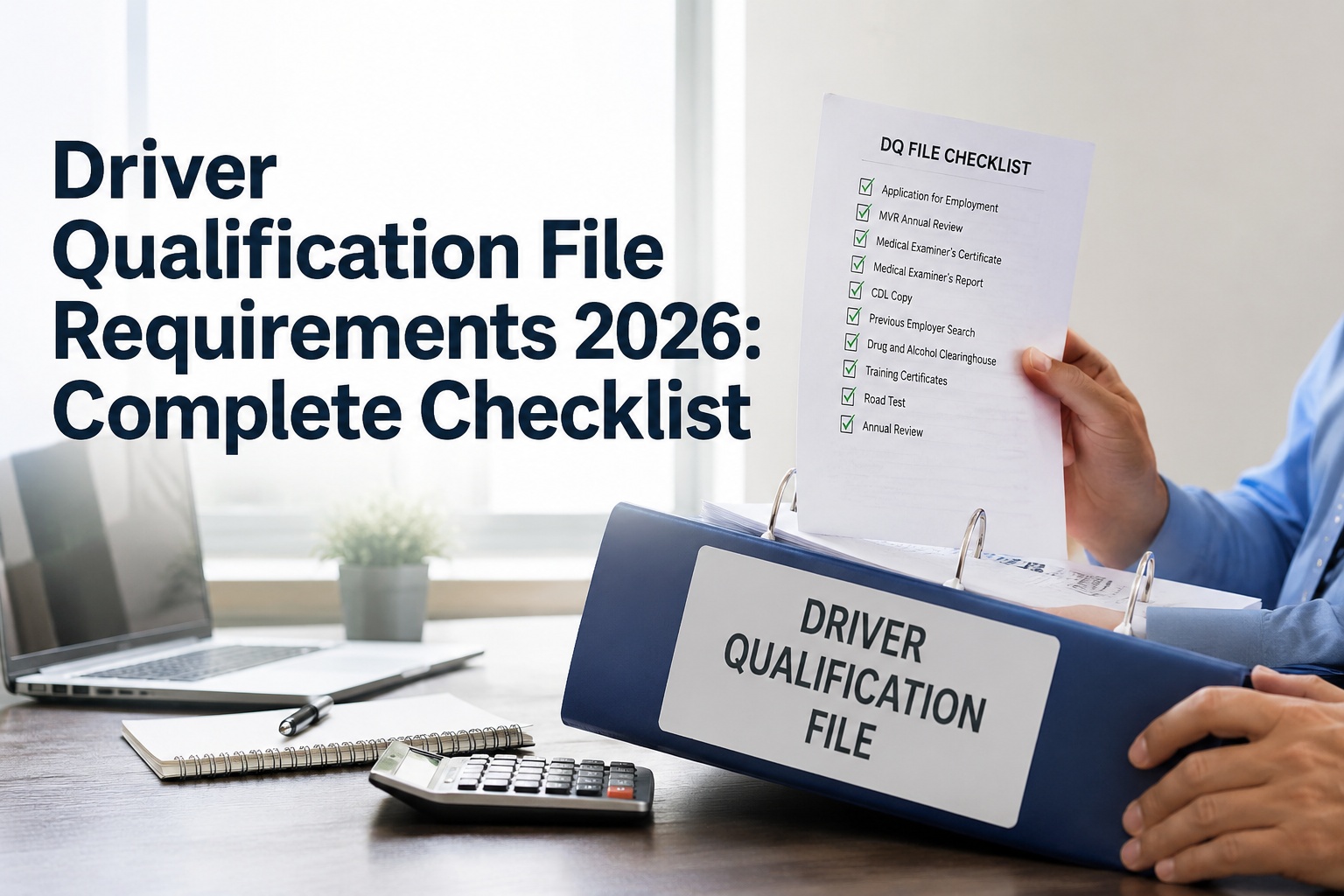
The audit-ready DQ file for a non-domiciled CDL driver under the 2026 rule includes 8 items minimum. (1) Unexpired passport — photo copy on file with expiration date logged. (2) Current I-94 with admit-until date — verified via DHS I-94 lookup system, admit-until date logged as it caps CDL validity. (3) Visa category verification — H-2A, H-2B, or E-2 confirmed, copy of visa or approval notice on file. (4) Non-domiciled CDL with proper "non-domiciled" marking on face — front and back copies on file with expiration date logged. (5) DOT medical certificate — current, dated, signed by certified examiner with expiration date logged. (6) Clearinghouse query results — annual query completed and documented, pre-employment query for new hires, positive findings addressed per Clearinghouse rules. (7) MVR (Motor Vehicle Record) — pulled at hire and annually, reviewed against fleet acceptance criteria, findings documented. (8) Audit-ready index — all items above searchable per driver, exportable per FMCSA request, retained per DOT rules (typically 3 years past employment end for the DQ file; SDLA retention requirement is 2 years for SAVE queries and supporting documents). This documentation is what every FMCSA compliance review will look for during a company audit, what every insurance underwriter asks about at renewal, and what every plaintiff's attorney will subpoena in an accident case involving the driver. Building the file digitally with automatic expiration tracking is not just a compliance improvement — it's the shift from reactive DQ file management to a workflow that catches problems before they become findings.
How does HVI support non-domiciled CDL HR compliance?
HVI runs driver qualification file management with all five expiration dates tracked per non-domiciled driver — passport, I-94, visa, CDL, and medical certificate — on a single alert cycle. Visa-tier classification (Tier 1 fully eligible / Tier 2 grandfathered until expiration / Tier 3 non-compliant) is tracked per driver and updates automatically when underlying documents change. Tiered alerts at 90, 60, and 30 days before each expiration date route simultaneously to HR, compliance, and the driver, eliminating the "someone was supposed to be watching that" failure mode that produces most missed-renewal violations. Documentation is stored digitally with expiration metadata and full-text search per driver, and every record includes date-of-verification, verifier name, and audit trail for FMCSA compliance reviews. When FMCSA requests DQ files during a company audit, export is a click — and the response satisfies the 48-hour SDLA record-request expectation that mirrors carrier expectations during compliance reviews. Roster audit workflow guides the initial classification for existing non-domiciled drivers, tier by tier, and produces the documented proof of audit that a compliance reviewer expects to see. For HR Directors like Diane A., moving 340 drivers with 22 non-domiciled CDLs onto digital DQ files in 60 days meant catching two license-visa mismatches before roadside violations — both of which would have been unqualified-driver findings under a paper workflow. Published customer data shows fleets on HVI report approximately 25% lower annual maintenance cost with typical payback around 3 months; for compliance-heavy operations, the cost avoidance from prevented violations often pays back the software within the first renewal cycle.
Five expiration dates per driver. Three eligibility tiers. Annual renewal cycles. Turn the 2026 rule into a workflow.
HVI runs non-domiciled DQ file management with tier classification, 5-date expiration tracking, 90/60/30-day alerts, and FMCSA-ready audit export. Live in under two weeks. Typically catches at least one at-risk driver before the first renewal cycle.
No credit card · DQ file templates ready on day one