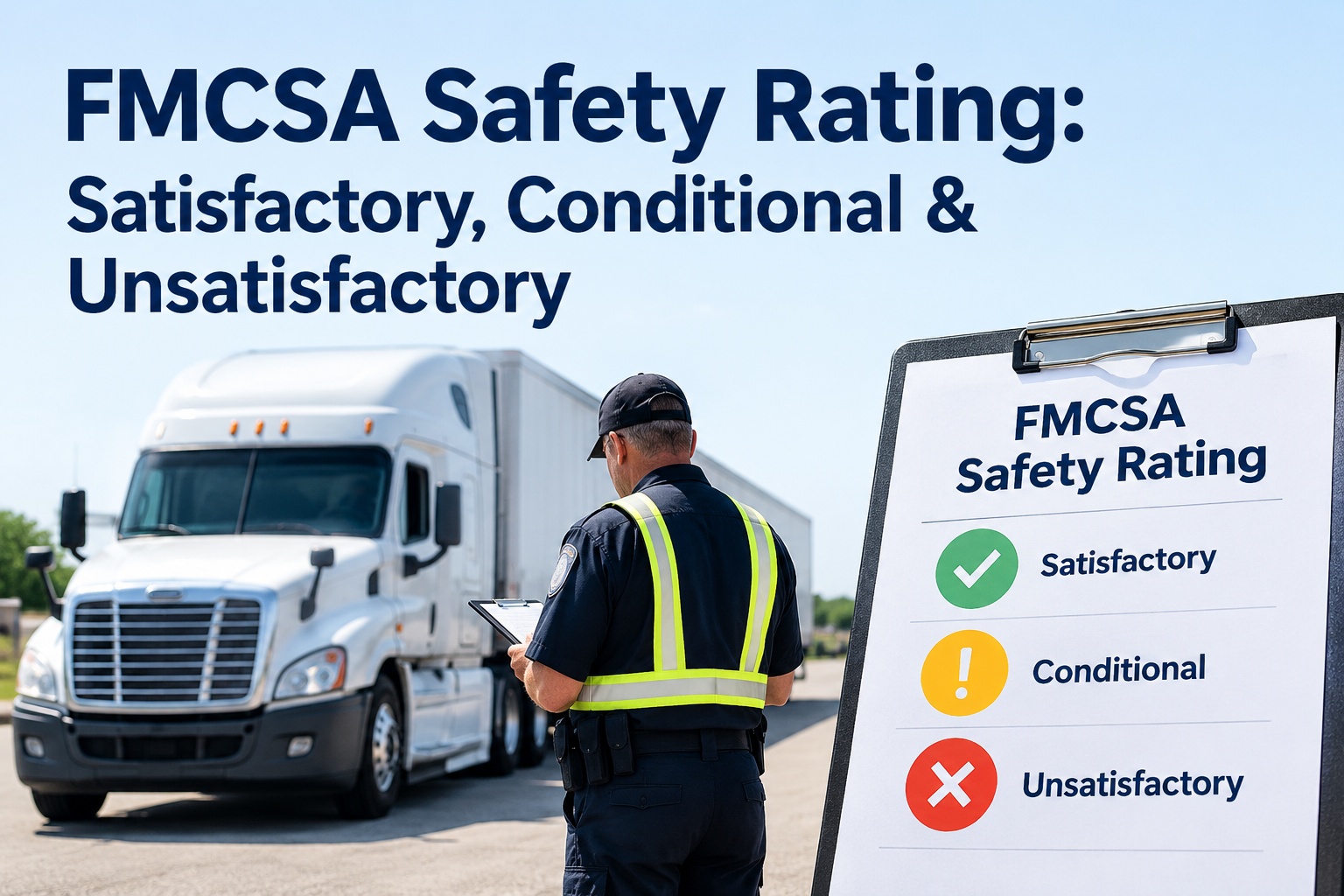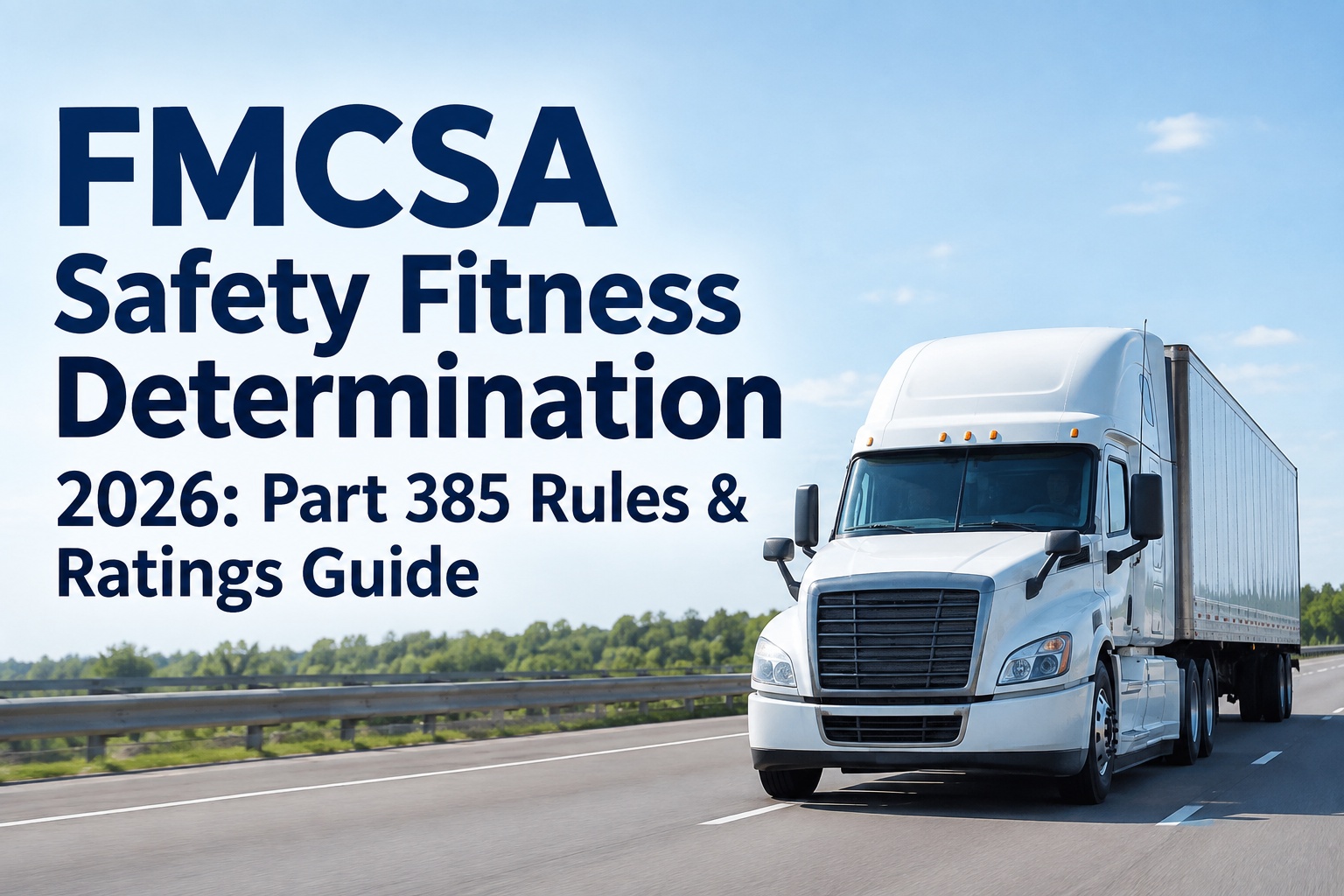
One letter from FMCSA can reshape a carrier's future. After a compliance review, the agency issues a Safety Fitness Determination under 49 CFR Part 385 — and the safety rating that comes with it, Satisfactory, Conditional, or Unsatisfactory, follows your USDOT number into every insurance quote and broker check. But the process is widely misunderstood: the determination isn't the rating, an Unsatisfactory isn't an instant shutdown, and not every investigation produces a rating. This guide explains how the FMCSA Safety Fitness Determination actually works. Book a demo to see the records behind a clean rating.
Three Ratings, One Question: Do Your Controls Work?
FMCSA isn't grading your paperwork — it's judging whether your safety management controls actually function. The rating is the shorthand everyone else reads.
If you're a safety director, compliance manager, or fleet owner, this is the regulation that turns your day-to-day inspection and maintenance discipline into a public score. The distinction that trips up most people is subtle but important: the Safety Fitness Determination is FMCSA's final call on whether you meet the standard, while the safety rating is the label — Satisfactory, Conditional, or Unsatisfactory — that carries that call out into the world.
What Is an FMCSA Safety Fitness Determination?the standard behind the rating — 49 CFR Part 385
A Safety Fitness Determination (SFD) is FMCSA's final determination that a motor carrier meets — or fails to meet — the safety fitness standard in 49 CFR 385.5. That standard asks one core question: does the carrier have adequate safety management controls in place that function effectively to ensure compliance with the Federal Motor Carrier Safety Regulations and Hazardous Materials Regulations? Controls are judged "adequate" relative to the size and type of your operation — a five-truck local fleet and a 500-truck interstate carrier aren't held to identical paperwork, but both must show their systems work.
FMCSA's official finding on whether your operation meets the safety fitness standard under § 385.5. It's the conclusion.
The Satisfactory, Conditional, or Unsatisfactory designation assigned using the § 385.7 factors. It's how the determination is communicated and published.
Why the distinction matters: a Satisfactory or Conditional rating is described in the regulation as "necessary, but not sufficient" to meet the overall standard. The rating is a signal, not the whole story — but it's the signal insurers, brokers, and shippers actually see. Book a demo to see the inspection and maintenance records that back a Satisfactory rating
The Three Safety Ratings in Plain Englishwhat Satisfactory, Conditional, and Unsatisfactory actually mean
The three ratings under § 385.3 turn on a single hinge word: whether inadequate controls could lead to problems (Conditional) or have led to them (Unsatisfactory). Getting that hinge right is the difference between a manageable warning and an existential threat.
The carrier has adequate safety management controls in place and functioning to meet the safety fitness standard. This is the clean rating — and, importantly, the only one accepted for federal government freight, which has no workaround.
Controls are not adequate to ensure compliance with the standard — deficiencies that could result in the safety problems listed in § 385.5. The carrier can keep operating in interstate commerce, but the rating is a documented warning that something in the safety system needs fixing.
Controls are inadequate and have already resulted in serious safety problems. A proposed Unsatisfactory is FMCSA's preliminary determination that the carrier is "unfit" to operate — but it is a proposed finding with a correction window, not an instant shutdown. Prohibitions under § 385.13 apply only if improvements aren't made in time.
One accuracy note worth stating plainly, because the internet muddies it: a Conditional rating does not automatically raise your insurance premium, and an Unsatisfactory rating does not mean your doors close the same day. Both are serious, both should be addressed fast — but the process has defined steps, and this guide walks them.
What Factors Drive the Rating?the six areas FMCSA scores — § 385.7 & Appendix B
FMCSA doesn't rate on a vibe. During a compliance review, it scores the carrier across six factors using the Safety Fitness Rating Methodology in Appendix B, drawing on review findings and roadside inspection data. Two kinds of violations carry the weight: acute violations (severe enough to require immediate correction) and patterns of critical violations (which reveal a breakdown in management controls).
The Vehicle factor is highlighted for a reason: it's the one most directly shaped by daily inspection and maintenance discipline. A clean DVIR trail, documented repairs, and a low out-of-service rate are exactly what an investigator looks for — and exactly where paper-based fleets fall apart under scrutiny. Start free and build the vehicle-factor records an investigator wants to see
How the Compliance Review Worksfrom investigation to determination to consequences
A safety rating comes out of a compliance review — an in-depth examination FMCSA conducts remotely or on-site, typically triggered by a serious complaint, a high-profile crash, or CSA BASIC scores above threshold. One thing to keep in mind: not every investigation produces a rating. A focused investigation may be left unrated, or may result in a Conditional or Unsatisfactory rating if enough violations surface. Here's the path a rated review follows.
- 1Compliance reviewFMCSA examines safety management controls against the six factors, using review findings and roadside data.
- 2Written notice within 30 daysThe carrier receives a letter with the rating and a list of FMCSR/HMR deficiencies to correct.
- 3Satisfactory is final immediatelyA Satisfactory rating (or one that improves a prior Unsatisfactory) takes effect on the date of the notice.
- 4Proposed Unsatisfactory starts a clockProhibitions under § 385.13 take effect after 45 days (hazmat/passenger carriers) or 60 days (others) unless improvements are made.
That 45-or-60-day window is the critical detail. A proposed Unsatisfactory is not the end — it's a starting gun. What the carrier does inside that window determines whether the rating ever becomes a business-ending problem.
How to Fix a Conditional or Unsatisfactory Ratingtwo different doors — corrective action vs administrative review
There are two distinct ways to challenge or change a rating, and confusing them costs carriers precious days. One is about proving you fixed the problem; the other is about proving FMCSA got it wrong. They have different rules, different deadlines, and different burdens.
The path when the rating was correct but you've fixed the deficiencies. Submit a written request — at any time for a Conditional or Unsatisfactory — with a description of the corrective actions taken and documentation showing your operations now meet the standard. FMCSA reviews the evidence and can upgrade the rating.
The path when you believe FMCSA made an error in assigning the rating. File a petition — generally within 90 days of the proposed or final rating — explaining the mistake. For a proposed Unsatisfactory, requesting within about 15 days gives FMCSA time to decide before prohibitions take effect.
The practical takeaway: for most carriers, the answer to a Conditional or Unsatisfactory rating is corrective action under § 385.17 — genuinely fix the safety-management gaps, document what changed, and show the results. And the single strongest piece of documentation you can bring is a clean, consistent inspection and maintenance record that proves the vehicle-factor problems are behind you. Start free and generate the corrective-action evidence trail from day one
The Records That Decide the Vehicle Factorwhat an investigator asks for — and what wins
When a compliance review touches the Vehicle factor, the investigator is looking for proof that your inspection, repair, and maintenance controls actually function. These are the records that make that case — or expose the gap.
The pattern in high-violation fleets is rarely ignorance of the rules — it's a broken system for capturing and closing defect reports before the vehicle rolls again. That's a documentation problem, and documentation problems are exactly what digital systems solve. Book a demo to see per-unit records an investigator can verify instantly
How Digital Inspections Support Your Ratingturning daily discipline into a defensible record
A safety rating rewards controls that function and can be proven. Paper does neither well — forms get lost, defects sit uncertified, and audit prep becomes an archaeology project. Digital inspection software is built for exactly the evidence a compliance review demands.
- DVIRs scattered across cabs and drawers
- No proof defects were closed before dispatch
- Vehicle-factor gaps surface during the review
- Corrective-action evidence rebuilt from scratch
- Controls exist but can't be demonstrated
- Every DVIR time-stamped and searchable
- Defect-to-repair loop enforced and certified
- Vehicle-factor records provable on demand
- Corrective-action trail generated automatically
- Functioning controls, documented
This is where compliance strategy becomes concrete. A digital fleet inspection and compliance platform doesn't just store DVIRs — it enforces the defect-to-repair loop, tracks corrective actions, and produces the auditable history that turns "we have controls" into "here's the proof they work." That's the difference an investigator, and a rating, respond to.
From a compliance director who upgraded a Conditional rating
We caught a Conditional coming out of a compliance review, and it was almost entirely the vehicle factor — our maintenance controls were real, but we couldn't prove them. The investigator didn't doubt we did the work; he doubted we could show it. On paper, that's a losing argument.
For the corrective-action request, digital records were the whole case. I pulled a clean per-unit history of every DVIR, every defect, every certified repair, and packaged it as evidence the controls now function. We upgraded. The lesson stuck: a safety rating isn't about doing the work, it's about proving the work.
FMCSA Safety Fitness Determination: the takeaway
The FMCSA Safety Fitness Determination comes down to one honest question: can you prove your safety controls work? A Satisfactory rating says yes; a Conditional or Unsatisfactory says the proof is missing or the controls have failed. Either way, the fastest route to a clean rating — and the strongest corrective-action evidence — is a consistent, auditable record of the inspection and maintenance work your fleet already does. Handling that on paper is where good carriers get bad ratings. Book a demo to see FMCSA-ready compliance records run end-to-end in HVI
Frequently asked questions
What is an FMCSA Safety Fitness Determination?
A Safety Fitness Determination (SFD) is FMCSA's final determination that a motor carrier meets, or fails to meet, the safety fitness standard set out in 49 CFR 385.5. That standard requires a carrier to have adequate safety management controls in place that function effectively to ensure compliance with the Federal Motor Carrier Safety Regulations and Hazardous Materials Regulations. The SFD is the conclusion; the safety rating — Satisfactory, Conditional, or Unsatisfactory — is the designation FMCSA assigns to communicate that conclusion, using the six factors in § 385.7 as computed under the Safety Fitness Rating Methodology in Appendix B. The determination is based on whether the carrier's controls are appropriate for the size and type of its operation, not on a fixed paperwork checklist. Importantly, a Satisfactory or Conditional rating is described in the rule as necessary but not by itself sufficient to meet the overall safety fitness standard.
What are the three FMCSA safety ratings?
FMCSA assigns one of three safety ratings under 49 CFR 385.3. A Satisfactory rating means the carrier has adequate safety management controls in place and functioning to meet the safety fitness standard. A Conditional rating means the carrier does not have adequate controls to ensure compliance — deficiencies that could result in the safety problems listed in § 385.5, though the carrier may continue operating. An Unsatisfactory rating means inadequate controls that have actually resulted in serious safety problems; a proposed Unsatisfactory is FMCSA's preliminary determination that the carrier is unfit to operate in interstate commerce. The key distinction between Conditional and Unsatisfactory is whether the control failures could lead to problems versus have already led to them. Only a Satisfactory rating is accepted for federal government freight.
What happens after an Unsatisfactory safety rating?
A proposed Unsatisfactory rating is a notice that FMCSA has preliminarily determined the carrier is unfit, not an immediate shutdown. It starts a correction window: the operating prohibitions in 49 CFR 385.13 take effect after 45 days for carriers transporting passengers or placardable hazardous materials, or after 60 days for other carriers, unless the necessary safety improvements are made. During that window the carrier can take corrective action and request a change to the rating under § 385.17, or request an administrative review under § 385.15 if it believes FMCSA made an error. FMCSA may also allow certain non-hazmat, non-passenger carriers additional time if they are making a good-faith effort to improve. The prohibition is serious — it bars operating a commercial motor vehicle in interstate commerce — but the process is designed to give a carrier the chance to fix the underlying problems first.
How can a carrier improve or upgrade its safety rating?
There are two separate paths. If the rating was correct but the carrier has fixed the deficiencies, it can request a change based on corrective action under 49 CFR 385.17 — at any time for a Conditional or Unsatisfactory rating — by submitting a written description of the corrective actions taken plus documentation showing its operations now meet the safety standard and factors in §§ 385.5 and 385.7. If instead the carrier believes FMCSA made an error in assigning the rating, it can request an administrative review under § 385.15, generally within 90 days of the proposed or final rating. For a proposed Unsatisfactory, filing an administrative-review request within about 15 days gives FMCSA time to decide before prohibitions take effect. For most carriers, corrective action under § 385.17 is the practical route, and strong inspection and maintenance records are the most persuasive evidence that controls now function.
Does every FMCSA investigation result in a safety rating?
No. A full safety rating is the outcome of a compliance review, but FMCSA also conducts focused investigations that examine only certain areas rather than all factors in the Safety Fitness Rating Methodology. A focused investigation may be left unrated, or it may result in a Conditional or Unsatisfactory rating if enough violations are found. Investigations are typically triggered by a serious complaint, involvement in a high-profile crash, or CSA BASIC scores above a reasonable threshold, and they can be conducted remotely or on-site. Because a rating is not guaranteed from every contact with FMCSA — and because the vehicle factor is heavily influenced by inspection and maintenance records — carriers benefit most from maintaining consistent, auditable documentation at all times rather than scrambling when an investigation is announced.
Make your safety rating a record you can prove
HVI turns daily inspection and maintenance work into the auditable, per-unit evidence a compliance review is judged on — signed DVIRs, closed defect loops, certified repairs, and a searchable history that answers an investigator's questions on the spot. Whether you're defending a Satisfactory rating or building a corrective-action case, the proof is ready before FMCSA asks.
No credit card · No hardware · Compliance records ready on day one