A broker pulls up your carrier profile, sees the word "Conditional," and quietly routes the load to someone else. You never even get the call. That single word — your FMCSA safety rating — is a public verdict on whether your safety management controls actually work, and it follows you into every shipper questionnaire, insurance renewal, and broker panel. There are three possible ratings: Satisfactory, Conditional, and Unsatisfactory. This guide explains what each one means, exactly how FMCSA arrives at it, and the path back to a clean rating. Book a demo to protect the rating you have.
Three Words That Decide Who You Can Haul For
An FMCSA safety rating is the formal verdict issued after a compliance review. It's public, it's durable, and it decides more of your business than most carriers realize.
Your FMCSA safety rating comes out of a compliance review under 49 CFR Part 385 — an auditor examining whether your safety management controls meet the federal safety fitness standard. It is not your CSA score, and confusing the two is one of the most common and expensive mistakes carriers make. Below is what each rating means, the exact math FMCSA uses to land on it, what it does to your business, and how to climb back.
What each rating meansthe plain-English version of 49 CFR 385.5
All three ratings describe one thing: whether your safety management controls — the systems, policies, and records that keep your operation compliant — are adequate. FMCSA isn't grading a single truck or trip; it's grading whether your organization has functioning controls in place. Here's what each verdict actually says about you.
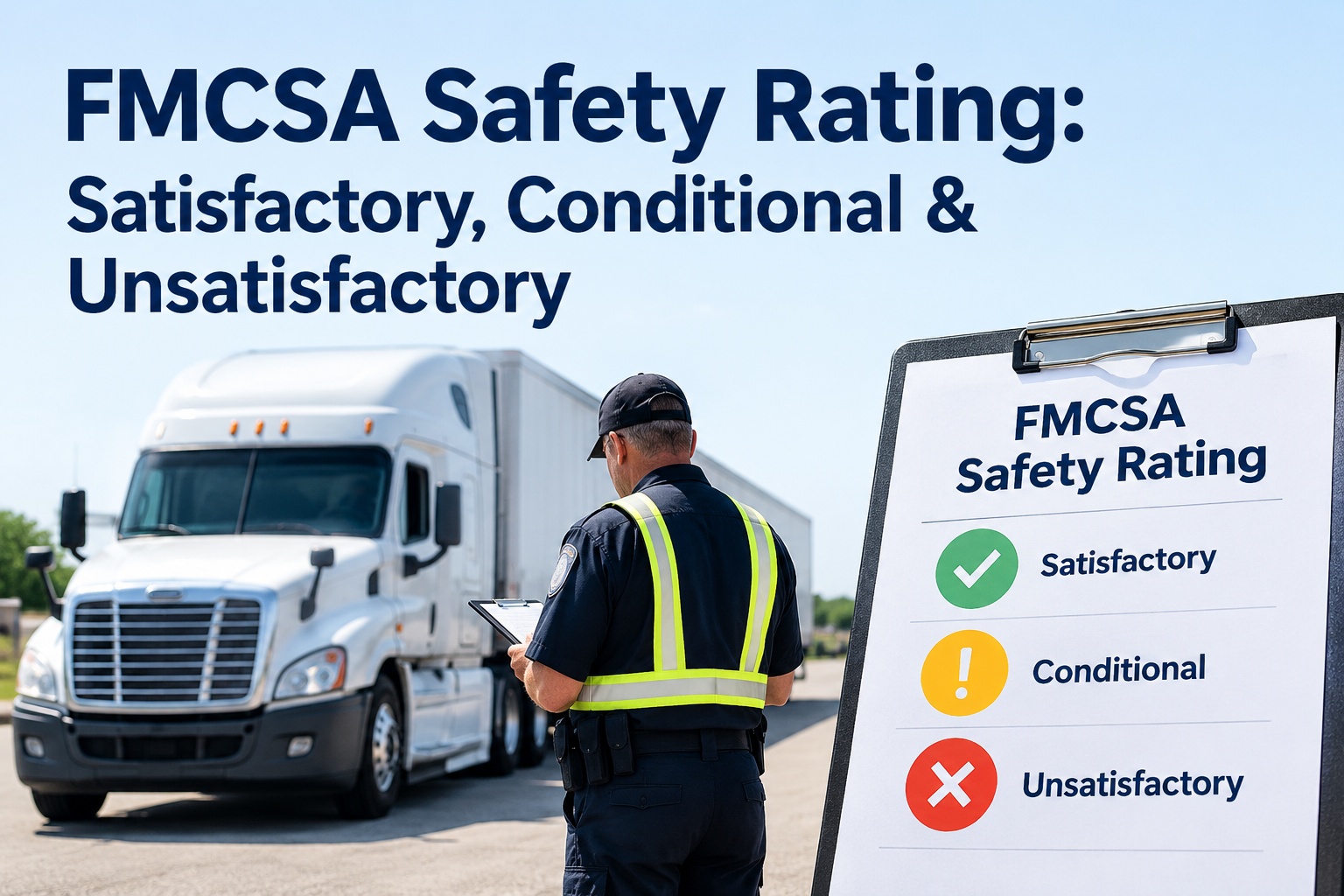
The carrier has functional, adequate safety management controls that meet the safety fitness standard. In plain terms: your systems work. This is the rating shippers, brokers, and insurers want to see, and the only one that qualifies you for federal government freight.
The carrier does not have adequate safety management controls to ensure compliance with the safety fitness standard. You can keep operating, but the rating is a public flag that something's wrong — and it's enough to get you screened out by risk-conscious brokers and shippers.
The carrier's inadequate controls have resulted in the serious problems the standard is designed to prevent. If a proposed Unsatisfactory rating becomes final, FMCSA issues an order placing interstate operations out of service — effectively shutting the operation down.
One nuance worth knowing: FMCSA issues safety ratings to motor carriers, not to individual drivers, and a carrier that has never been reviewed shows as "Unrated" rather than any of the three. Unrated isn't a failing grade — it just means no compliance review has assigned a rating yet. Book a demo to see how strong records support a Satisfactory rating
The math behind ithow a compliance review turns into a rating
The rating isn't a gut call by an auditor — it's a defined calculation under Part 385, Appendix B. During a compliance review, FMCSA evaluates the carrier across a set of safety factors and looks for two categories of violation: acute (so severe that a single instance signals a breakdown) and critical (a pattern of non-compliance). Those violations translate into points on each factor, and the points decide the rating.
Those per-factor ratings then roll up into the overall rating. Two or more factors rated Unsatisfactory produces an overall Unsatisfactory. One Unsatisfactory factor combined with more than two Conditional factors also lands you at Unsatisfactory overall. The factors themselves cover the whole operation: General (management and records), Driver (qualification and hours), Operational (driving compliance), Vehicle (inspection and maintenance), Hazardous Materials where applicable, and an Accident factor. Book a demo to see the Vehicle and Driver factors covered by clean records
The takeaway for a fleet manager: acute and critical violations are what move the needle, and most of them are documentation and process failures an auditor can find in your files — not dramatic events. Miss the records, and you can earn a Conditional without ever having a crash. Start free and keep the records an auditor asks for
Rating vs CSA scoretwo different systems people constantly confuse
This is the confusion that trips up nearly every carrier: your FMCSA safety rating and your CSA score are not the same thing, and one does not set the other. They come from different processes, update on different schedules, and mean different things to the people looking at them. Getting this straight is half of understanding your compliance standing.
- Comes from a compliance review (an audit)
- One of three labels: Satisfactory, Conditional, Unsatisfactory
- Based on acute/critical violations in your records
- Changes only when a review reassigns it
- A formal fitness determination under Part 385
- Comes from roadside inspections and crash data
- Percentile rankings across the seven BASICs
- Based on your performance versus similar carriers
- Updates monthly as new data comes in
- A continuous risk-monitoring signal, not a verdict
Here's how they connect without being the same: a poor CSA score raises your odds of being selected for a compliance review, and that review is what can produce a Conditional or Unsatisfactory rating. So CSA is the early-warning signal; the safety rating is the formal judgment that can follow. Manage the first to avoid ever facing the second. Book a demo to track both in one compliance dashboard
Improving your ratingthe path from Conditional back to Satisfactory
A Conditional or Unsatisfactory rating isn't permanent. FMCSA gives carriers a defined path to fix the underlying problems and request an upgrade — but the clock matters, and so does knowing which lever to pull. There are two distinct actions, and carriers often confuse them.
Fix the deficiencies the review found, document the corrections, and submit a safety fitness upgrade request showing your controls now work. This is the route when the rating was correct but you've since fixed the problems.
Challenge the rating itself as a factual or procedural error made at the time of the audit. This route argues you should have received a different rating — not that you've since improved. Different argument, different deadline.
Timing is unforgiving. A proposed Conditional or Unsatisfactory rating generally becomes final after 45 days for passenger and placardable-hazmat carriers and 60 days for other carriers, so corrective action has to move fast — and an Unsatisfactory that goes final brings an out-of-service order. The strongest position, though, is never needing either route: a fleet whose records are complete and current walks into a compliance review with the evidence already in hand. Start free and build a review-ready compliance record
From a compliance officer who's sat through the audits
The carriers that get downgraded almost never fail because their trucks are dangerous. They fail because they can't produce the paperwork. The auditor asks for driver qualification files, DVIRs, maintenance records, drug-and-alcohol testing documentation — and there are gaps. Every gap is a potential acute or critical violation.
I've watched a clean-running fleet take a Conditional purely on records they'd actually done but couldn't find. The lesson I give everyone now: your rating is decided by what you can hand the auditor, not by how well you actually operate. Get the records organized before the review, not during it.
Frequently asked questions
What is an FMCSA safety rating?
An FMCSA safety rating is the formal evaluation of a motor carrier's compliance with the federal safety fitness standard, assigned after a compliance review (an audit) under 49 CFR Part 385. It's a verdict on whether the carrier's safety management controls — the systems, policies, and records that keep the operation compliant — are adequate. There are three possible ratings: Satisfactory (controls are adequate), Conditional (controls are not adequate), and Unsatisfactory (inadequate controls have led to serious problems). A carrier that has never been reviewed is listed as "Unrated," which is not a failing grade but simply means no rating has been assigned. Ratings are issued to motor carriers, not individual drivers, and final ratings are publicly available through FMCSA's SAFER website, where brokers, shippers, and insurers can see them. Because it's public and durable, the rating influences far more than regulatory standing — it affects insurance, broker relationships, and eligibility for freight.
What is the difference between Satisfactory, Conditional, and Unsatisfactory?
All three describe whether a carrier's safety management controls meet the safety fitness standard. Satisfactory means the carrier has functional, adequate controls in place — the rating shippers, brokers, and insurers want to see, and the only one that qualifies a carrier for federal government freight. Conditional means the carrier does not have adequate controls to ensure compliance; the carrier can keep operating, but the rating is a public flag that can get it screened out by risk-conscious brokers and shippers and can raise insurance costs. Unsatisfactory means inadequate controls have resulted in the serious safety problems the standard is designed to prevent; if a proposed Unsatisfactory rating becomes final, FMCSA issues an order placing the carrier's interstate operations out of service, which effectively shuts the operation down. In short: Satisfactory is a pass, Conditional is a warning with real commercial consequences, and Unsatisfactory is an existential threat to the business.
How does FMCSA calculate a safety rating?
The rating follows a defined calculation under Part 385, Appendix B rather than an auditor's judgment call. During a compliance review, FMCSA evaluates the carrier across safety factors — General, Driver, Operational, Vehicle, Hazardous Materials where applicable, and an Accident factor — and looks for two categories of violation: acute violations (so severe a single instance signals a breakdown) and critical violations (a pattern of non-compliance). These translate into points on each factor: no acute or critical violations rates a factor Satisfactory, violations assessed at one point rate it Conditional, and violations assessed at two points rate it Unsatisfactory. The per-factor ratings then roll up: two or more factors rated Unsatisfactory produces an overall Unsatisfactory, and one Unsatisfactory factor combined with more than two Conditional factors also results in an overall Unsatisfactory. Critically, most acute and critical violations are documentation and process failures found in a carrier's records, which means a fleet can earn a Conditional rating without ever having been in a crash.
Is an FMCSA safety rating the same as a CSA score?
No, and confusing the two is a common and costly mistake. An FMCSA safety rating is a formal verdict — Satisfactory, Conditional, or Unsatisfactory — assigned only after a compliance review, based on acute and critical violations found in the carrier's records, and it changes only when a review reassigns it. A CSA score is a set of percentile rankings across the seven BASIC categories, calculated from roadside inspection and crash data, updated monthly, and measured against similar carriers; it's a continuous risk-monitoring signal rather than a verdict. The two are connected but distinct: a poor CSA score raises the likelihood that FMCSA selects the carrier for a compliance review, and that review is what can produce a Conditional or Unsatisfactory rating. So the CSA score functions as an early-warning system, while the safety rating is the formal fitness determination that can follow. Managing CSA performance is the best way to avoid ever facing a rating downgrade in the first place.
How can a carrier improve a Conditional or Unsatisfactory rating?
A Conditional or Unsatisfactory rating is not permanent, and there are two distinct routes to address it. The first is a corrective action and safety fitness upgrade request: the carrier fixes the deficiencies the review identified, documents the corrections, and submits a request demonstrating that its safety management controls now meet the standard — the right route when the rating was accurate but the problems have since been fixed. The second is an administrative review, or appeal, which challenges the rating itself as a factual or procedural error made at the time of the audit; this route argues the carrier should have received a different rating, not that it has since improved. Timing is critical: a proposed Conditional or Unsatisfactory rating generally becomes final after 45 days for passenger and placardable-hazmat carriers and 60 days for other carriers, and an Unsatisfactory that goes final triggers an out-of-service order. The strongest position is to never need either route — a fleet with complete, current, well-organized records walks into a compliance review with the evidence already in hand.
Walk into your next compliance review already prepared
HVI keeps the records that decide your FMCSA safety rating — inspections, DVIRs, work orders, driver files, maintenance history — organized, complete, and instantly retrievable. When an auditor asks, you produce a full file instead of a gap that becomes an acute or critical violation. It's the difference between a Satisfactory rating you can defend and a Conditional you have to fight. Live in under two weeks.
No credit card · Audit-ready records from day one · Compliance history in one place