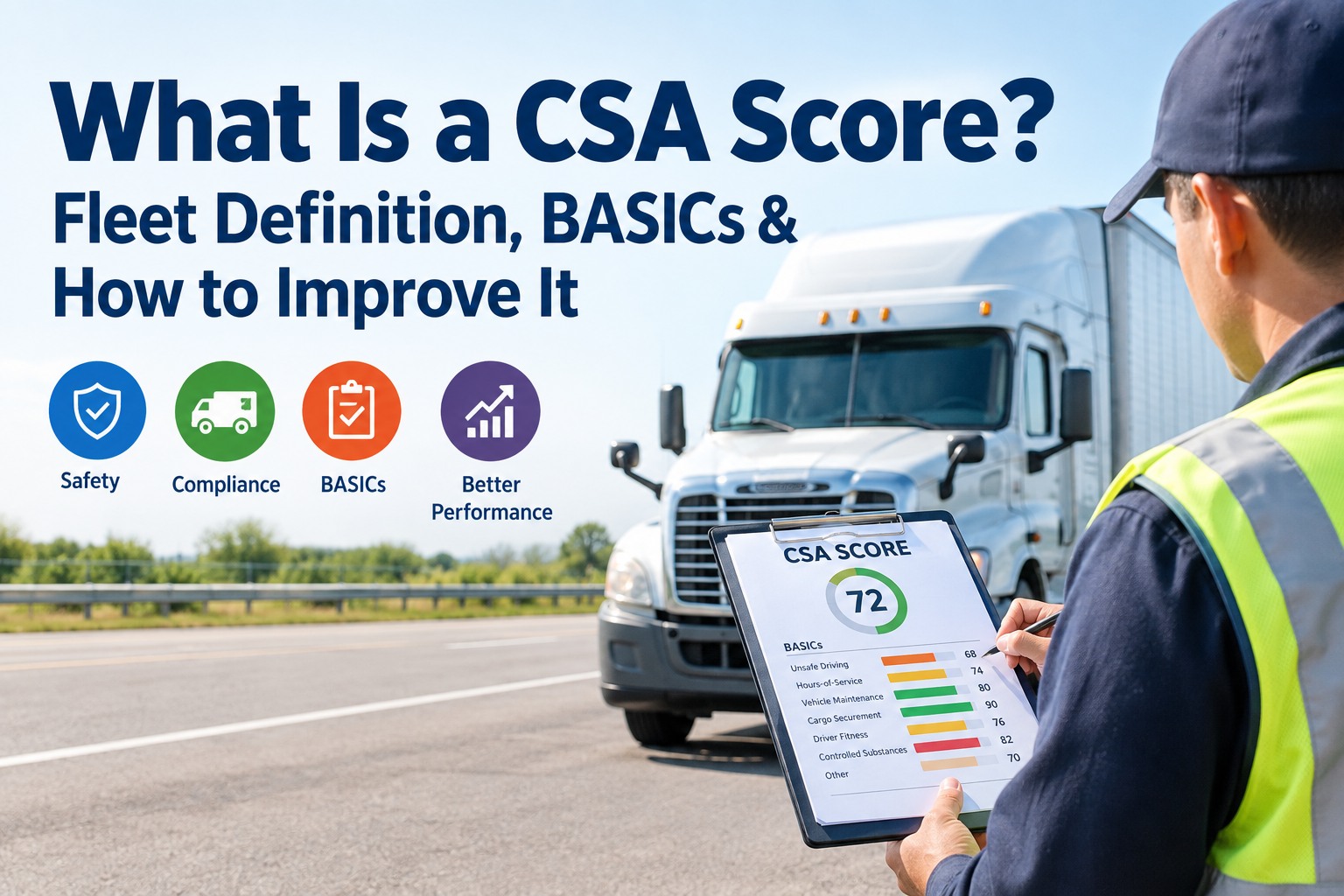
Fleet safety score improvement is one of those problems every safety manager is told to fix but nobody hands a plan for. The FMCSA publishes the rules, insurance carriers publish the consequences, and shippers publish the acceptance thresholds — but no regulator explains what to do on Monday morning. This guide is that plan. Ninety days, three phases, weekly actions with measurable outcomes, and the exact documentation your CSA percentile responds to. Book an HVI demo → to execute it.
Move your fleet from CSA alert territory to preferred tier in 90 days — with a plan you can actually execute.
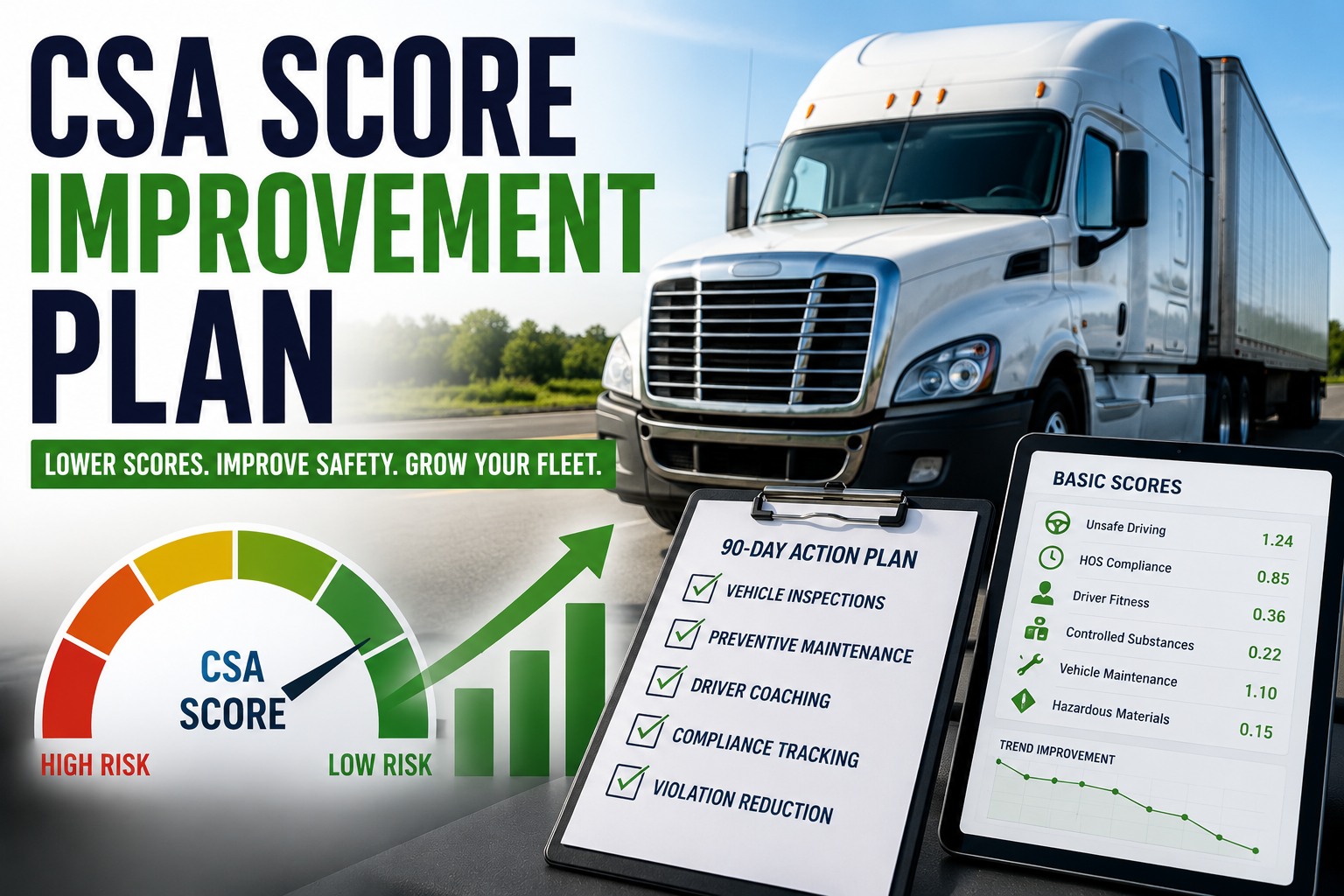
Most fleets stuck in the 70th-percentile range didn't get there overnight and won't fix it overnight. But 90 days of disciplined execution consistently produces a 20-30 percentile point improvement across the Vehicle Maintenance BASIC. Here's the plan.
What actually moves your fleet safety score
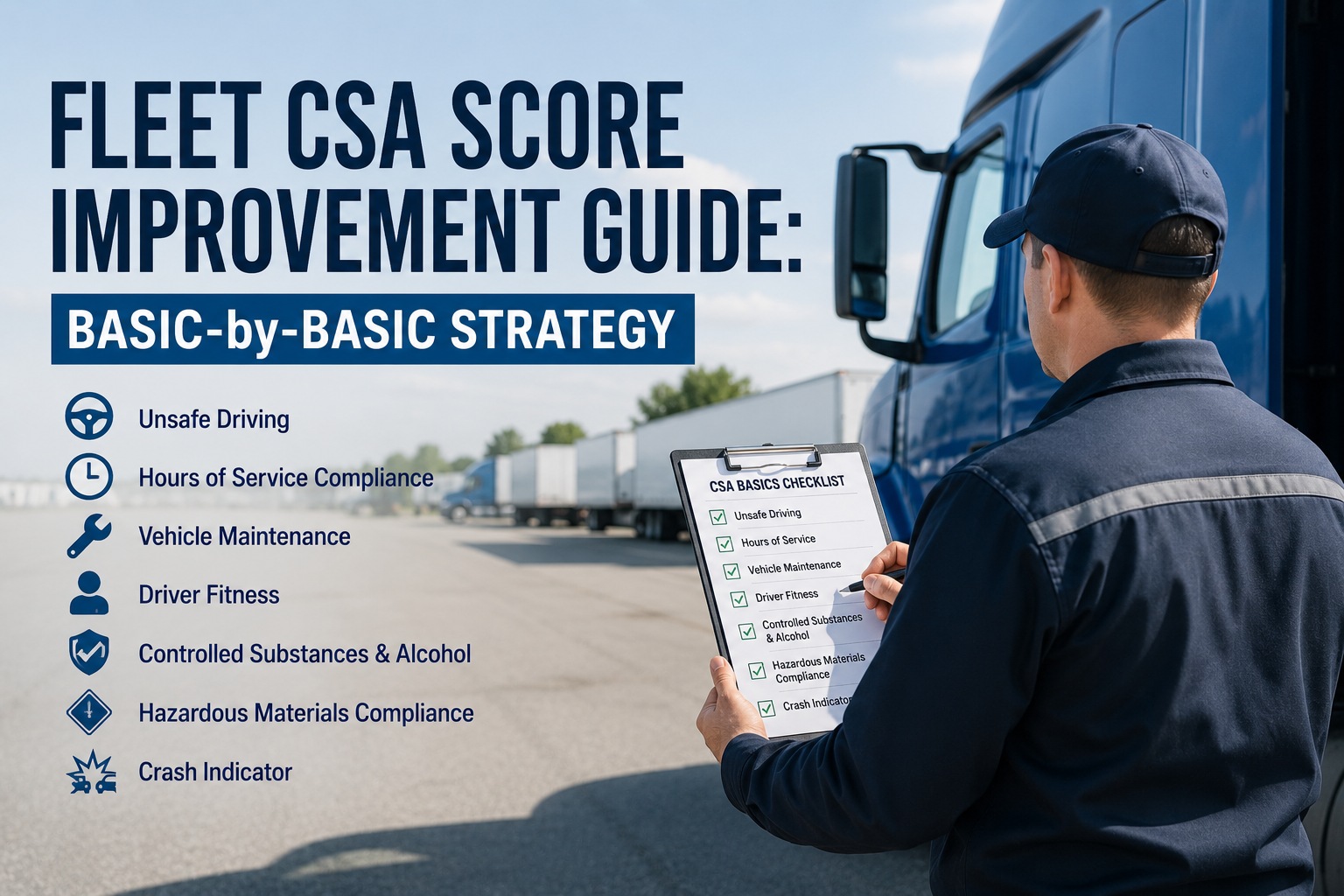
FMCSA's Safety Measurement System looks at seven Behavior Analysis and Safety Improvement Categories (BASICs), but the four listed below produce roughly 85% of enforcement attention and insurance-underwriter concern. Fixing these four fixes almost everything the CSA score can be fixed by.
Vehicle Maintenance is the biggest and most controllable lever — and the one that responds fastest to a documented program. The 90-day plan below focuses roughly 60% of effort on Vehicle Maintenance, 25% on Unsafe Driving, 10% on HOS, and 5% on Driver Fitness — matching the proportional impact each has on the overall score. Book an HVI demo to see the BASIC-by-BASIC trend chart applied to your fleet.
Days 1-30 — Foundation phase
The first 30 days are entirely about visibility and documentation. Nobody improves what they can't measure, and no CSA improvement holds up under audit without a documented paper trail. This month rebuilds both.
By the end of Week 4, three things should be true: leadership knows exactly where each BASIC sits, every truck is on a documented PM schedule, and every DVIR is being captured digitally with photo evidence. If any of those isn't done, don't move to Phase 2 — extend Phase 1. Building on an incomplete foundation is the reason 90-day plans fail. Try HVI free to run Foundation-phase templates in the first week.
Days 31-60 — Action phase
Month two is where behavior changes. The documentation infrastructure exists (built in Month 1); now the drivers and technicians actually use it. This is where CSA percentiles start moving.
Week 5-8 is where operational discipline collides with cultural resistance. Drivers who worked at prior fleets that "let stuff slide" test whether the new rules hold. Coaching, consistency, and visible enforcement matter more this month than any technology deployment. Book an HVI demo to see how coaching workflows integrate with the DVIR + PM data.
Days 61-90 — Refine phase
Month three is measurement and audit-readiness. The BASICs should be visibly moving by now, but the CSA system reports on a 24-month rolling window — so the raw percentile drops are just starting to show. This month is about ensuring the improvement holds and the fleet can defend every claim of it.
By Day 90 the Vehicle Maintenance BASIC should be visibly trending down (percentile-wise), unplanned downtime should be 30-50% lower than the Week 1 baseline, and the fleet should have a documented portfolio ready to defend the improvement to any auditor, underwriter, or shipper procurement team. That's the deliverable of the ninety days. Book an HVI demo to auto-generate the Day-90 audit portfolio.
The Day-90 audit-readiness checklist
What "audit-ready" actually means depends on the auditor. The list below covers what FMCSA compliance reviews, insurance underwriter renewals, and shipper procurement reviews all consistently ask for. If every item can be produced in under five minutes with documented backup, the fleet is ready.
Any auditor or underwriter who asks for something not on this list is asking for edge cases. Any fleet that can produce all eight items on demand has already won the audit before it starts. Try HVI free to build the 8-item audit portfolio automatically as the plan executes.
From a safety manager who executed the 90-day plan on 54 tractors
We were sitting at 76th percentile on Vehicle Maintenance in April 2024 — one bad roadside inspection away from a compliance review. Our insurance renewal was 90 days out and our broker had already told us we'd be looking at surplus lines quotes.
Executed the 90-day plan starting May 1 with HVI. Foundation weeks were painful. Action weeks were harder. By August 1 our Vehicle Maintenance BASIC was at 41st percentile — a 35 percentile point drop. The insurance renewal came in at standard-market pricing instead of surplus, saving us roughly $190,000 on the year. The plan works, but only if you actually run it.
MPMarcus P.Safety Manager · Regional flatbed carrier · 54 Kenworth + Peterbilt tractors
Frequently asked questions
How long does it take to improve a fleet safety score?
A CSA BASIC percentile can move meaningfully in 60-120 days with a disciplined program, though the FMCSA Safety Measurement System uses a 24-month rolling window so the full effect of improvement doesn't show up until older violations age out. Fleets executing a structured 90-day plan typically see the Vehicle Maintenance BASIC drop 20-30 percentile points and Unsafe Driving BASIC drop 10-15 percentile points within one quarter. The improvement continues compounding over months 4-12 as older violations from the pre-improvement period leave the 24-month window. Nothing improves at all without executed changes to DVIR, PM, and driver coaching — the score reflects what actually happens on the road, not what the fleet intends to happen.
Which CSA BASIC should we focus on first?
Vehicle Maintenance BASIC almost always. Three reasons. First: it accounts for 34-48% of all CSA points across most fleet categories, making it the biggest single lever. Second: 73% of vehicle maintenance violations are PM-preventable, meaning improvement is entirely under the fleet's control. Third: it responds fastest to documented change because the FMCSA can see immediately when roadside violations stop appearing. Unsafe Driving is the second priority because it's the second-largest weight and directly correlates with crash rates that drive insurance premiums. HOS Compliance and Driver Fitness come third and fourth — important but slower to move and lower proportional impact on the overall safety score.
Do DataQ challenges actually work for improving CSA scores?
Yes, when used strategically. DataQ is FMCSA's process for challenging inaccurate roadside inspection data. Successful challenges result in the violation being removed from the CSA record, which recalculates the affected BASIC percentile. The realistic win rate depends on documentation quality: fleets with photo-verified pre-trip inspections showing the challenged item was working at pre-trip achieve DataQ success rates of 40-60%. Fleets without documentation succeed on maybe 10-15% of challenges. The trap is treating DataQ as the primary strategy: it can move a percentile a few points if used well, but it cannot compensate for a broken operational program. Fix the operation first, then use DataQ to clean up the edge cases.
What documentation do FMCSA compliance reviews actually require?
FMCSA compliance reviews (particularly Compliance Investigations and New Entrant audits) ask for eight core document categories: driver qualification files including MVR, medical certificates, and licenses; complete DVIR records for a sample period; PM maintenance records with parts and technician sign-offs; drug and alcohol testing program documentation; HOS records including ELD backup data; accident register with photo and report attachments; hazmat records if applicable; and financial responsibility (insurance) documentation. Any fleet that can produce these eight categories on demand with photo evidence and timestamps satisfies roughly 95% of what auditors ask for. Fleets running paper records typically fail the timeliness requirement even when the underlying documentation exists.
Can a fleet safety program be built without a full-time safety manager?
Yes, and increasingly common for fleets under 50 units. The role scales with fleet size: solo owner-operators and fleets of 5-15 typically handle safety through a combination of the owner and the primary dispatcher; 15-40 unit fleets often designate a shop foreman or operations manager as the safety point of contact; 40+ unit fleets typically justify a dedicated safety manager. What matters more than the title is the underlying system. A 30-unit fleet running HVI with disciplined DVIR, PM, and driver-file workflows produces better BASIC scores than a 100-unit fleet with a dedicated safety manager but paper records. Software cannot replace judgment, but it can replace the administrative overhead that consumes 70% of a safety manager's day.
Improve fleet safety and compliance with Heavy Vehicle Inspection.
HVI ships with pre-built templates for every phase of the 90-day plan: digital DVIR with photo verification, PM triggers by meter and calendar, corrective-action workflows, DataQ documentation, and CSA trend tracking per BASIC. The audit portfolio assembles automatically as the plan executes. Live for your fleet in 5-7 days.
DVIR photo evidence · PM audit trail · CSA trend charts · DataQ support · SOC 2 Type II