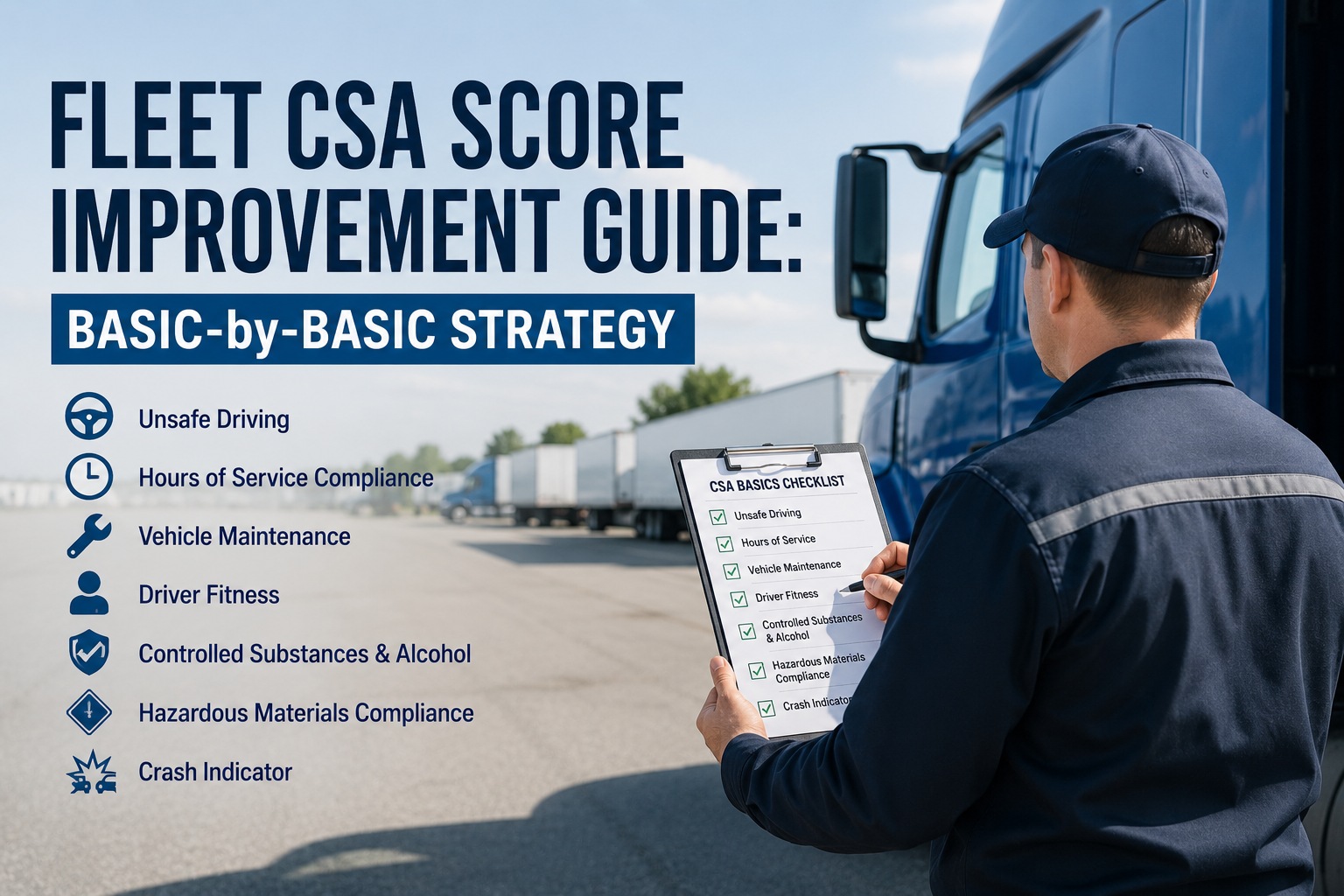
A CSA score doesn't crash your business overnight. It drifts up quietly for six or nine months, and then one Friday the SMS refresh crosses a threshold, the warning letter arrives, and the insurance underwriter starts asking questions. The good news is the fix works the same way in reverse — disciplined, boring, and gradual. This CSA score improvement plan is a 90-day action sequence built for a real fleet: three 30-day phases moving from stabilizing bad numbers, to fixing the systems that cause them, to locking in the improvement. Every step maps to a specific BASIC and a specific FMCSA data source, so the work you do actually shows up in next month's percentiles. Book a demo to see a clean inspection record build in real time.
The 90-Day CSA Score Improvement Plan for Fleets
A step-by-step action plan for the 7 BASICs, the 65% and 80% intervention thresholds, and the 2026 SMS changes — laid out as three 30-day phases you can start Monday. Interactive, checkable, and built around what actually moves percentiles.
-
Unsafe Driving
7465
-
HOS Compliance
5265
-
Veh. Maintenance
8580
-
Veh. Maint: Driver Obs.
3880
-
Driver Fitness
2280
-
Crash Indicator
4465
2 BASICs over threshold. Interventions imminent.
The math of CSA is unforgiving in one direction and helpful in the other. A violation from six months ago weighs three times more than one from eighteen months ago. Cross an intervention threshold in one BASIC and FMCSA prioritizes you for warning letters, targeted roadside inspections, and possibly a full compliance review. But that same time-weighting means that ninety days of clean, well-documented performance moves the needle visibly — and it's what the plan below is built around.
The 7 BASICs and where the lines are
Every BASIC has its own intervention threshold, and they're not the same. Cross the wrong one and FMCSA starts paying attention. Here's the current landscape under the 2026 SMS overhaul.
Unsafe Driving
Now includes all out-of-service and drug/alcohol violations. Strongest crash correlation, strictest threshold.
HOS Compliance
Hours of service violations, ELD tampering, driving fatigued. Direct safety risk = same strict threshold.
Crash Indicator
Trailing 24-month crash history and severity. Not preventable crashes can be excluded through the CPDP.
Vehicle Maintenance
Brakes, tires, lights, steering, defects. The single most inspection-controllable BASIC.
Veh. Maint: Driver Observed
NEW 2026 category — scores defects a driver walk-around should catch. DVIR quality directly matters.
Driver Fitness
Driver qualification file gaps, expired medical certificates, invalid licenses. Slow to build, easy to fix.
Controlled Substances
Drug and alcohol testing violations, Clearinghouse gaps. Compliance-heavy, program-driven.
Brakes, tires, and lights alone account for more than 60% of all out-of-service violations — which is why the two Vehicle Maintenance categories are usually where the biggest, fastest gains live. See how a disciplined inspection program moves both
The 90-day action plan — interactive
Tap a phase below to see the actions for that 30-day window. Tick each item as you complete it — the plan is designed to be worked in order, because each phase builds on the last. Days 1-30 stabilize the bleed, 31-60 fix the systems, 61-90 lock in improvement.
Phase 1: Stabilize — find out where you actually stand
Phase 2: Fix the systems that produce the violations
Phase 3: Lock in the improvement so it doesn't drift back
Ninety days is enough to move two BASICs materially and put the third on the right trajectory. Each phase depends on the one before — skip Phase 1 and you're solving for the wrong BASIC in Phase 2. Book a demo to see the plan running on a live dashboard
How the 24-month window rewards patience
The best-kept secret of CSA scoring is that every violation loses weight over time and then falls off the score entirely at 24 months. Which means the math is on your side — if you're not adding new violations.
-
0–6 months
3× weightRecent violations count triple. This is why a single bad month can spike your percentile even in an otherwise clean quarter.
-
6–12 months
2× weightStill significant. This band is where your 90-day plan starts showing up as an improving trend, not the absolute number.
-
12–24 months
1× weightOld violations get quieter but still count. Consistency across two years is what moves a percentile durably.
-
24+ months
Falls offViolations older than 24 months are no longer used in the score calculation. Under the 2026 SMS update, some BASICs use only the last 12 months for prioritization.
The corollary: the fleet that goes 90 days without a new violation isn't just "not getting worse" — the older violations still on the record are quietly losing weight the whole time. Improvement compounds. Start free and put the time-weight math to work
Why a high CSA score costs more than an intervention
FMCSA warning letters and compliance reviews are the visible consequence. The invisible ones — insurance, shipper relationships, driver hiring — usually cost more.
- 65% / 80% Intervention thresholds — cross either and FMCSA prioritizes you FMCSA SMS
- ~25% Recent commercial auto premium increases — elevated CSA scores land in the top of that range Insurance industry
- 60%+ Of OOS violations come from brakes, tires, and lights — all catchable pre-trip FMCSA data
- 3× Weighting of a recent violation vs. one 12–24 months old SMS methodology
Two BASICs above threshold typically means warning letters within a month, more roadside targeting within a quarter, and questions from shippers and underwriters within two. The 90-day plan above exists to get ahead of all three. Book a demo — before the next renewal
From a safety director who did the 90 days
We got the warning letter in February. Vehicle Maintenance was at 84, Unsafe Driving was climbing. My CFO looked at the insurance renewal quote and asked what I was going to do about it. That was the day I actually sat down and mapped out ninety days.
What surprised me was how much of it was just discipline. Move DVIRs off paper. Fix every defect same-day. Meet the monthly SMS refresh. Nothing exotic. By June the two BASICs I was worried about were both under threshold, and the renewal came in flat instead of the 25% hike we were bracing for. The plan works because CSA math actually rewards consistency.
Frequently asked questions
How can a fleet lower its CSA score?
The mechanism that lowers a CSA score is a combination of not accumulating new violations and letting time weight erode existing ones. The 24-month rolling window means a violation older than 24 months is no longer used in the score, and a violation between 12 and 24 months old counts a third as much as one from the past six months. So a fleet that runs 90 days clean actually sees older violations quietly losing weight in the calculation, which shows up as an improving percentile. Beyond that passive improvement, three active levers move scores faster: submitting DataQs challenges on legitimately erroneous violations to get them removed; earning clean roadside inspections, which are positive data points that improve the percentile directly; and closing off the causes of new violations — which typically means better pre-trip inspections, digital DVIRs that satisfy the 2026 Driver Observed category, same-day defect-to-work-order routing, and disciplined preventive maintenance. Insurance underwriters use CSA scores in pricing, so score improvement often translates to premium impact at the next renewal.
What are the 7 CSA BASIC categories?
FMCSA evaluates every motor carrier across seven Behavior Analysis and Safety Improvement Categories, each scored independently as a percentile from 0 to 100. The three high-crash-risk categories have the strictest thresholds at 65 percent: Unsafe Driving (which under the 2026 SMS overhaul now includes all out-of-service and drug and alcohol violations), Hours of Service Compliance (HOS violations and ELD issues), and Crash Indicator (24-month crash history with severity weighting). The four remaining categories share the 80 percent threshold: Vehicle Maintenance (brakes, tires, lights, steering, and other maintenance violations found at roadside); Vehicle Maintenance: Driver Observed (a new 2026 category that scores defects a driver walk-around should have caught, making DVIR quality directly visible in the score); Driver Fitness (qualification file gaps, expired medical cards, invalid licenses); and Controlled Substances/Alcohol (drug and alcohol testing violations and Clearinghouse gaps). The Hazardous Materials Compliance category applies only to fleets carrying hazmat and has its own threshold, which the 2026 update raised from 80 to 90 percent.
How long do CSA violations stay on your record?
In the Safety Measurement System, violations remain in the score calculation for 24 months from the date of the inspection, with time-weighted severity so that recent violations count much more heavily than older ones. Violations in the past six months carry approximately three times the weight of violations 12 to 24 months old, and a violation more than 24 months old falls out of the calculation entirely. Under the 2026 SMS update, for several BASICs including Hours of Service, Vehicle Maintenance, Vehicle Maintenance Driver Observed, Hazardous Materials, and Driver Fitness, only violations from the past 12 months are used to determine whether a carrier is prioritized for intervention, though the SMS still calculates measures using the full 24-month history. Separately, violations remain in the FMCSA Motor Carrier Management Information System (MCMIS) and the Pre-employment Screening Program (PSP) databases for longer periods — three years for driver PSP inspection records and five years for crashes — even after they no longer affect the CSA percentile.
Do clean roadside inspections actually improve a CSA score?
Yes, and this is one of the most under-appreciated levers in CSA improvement. The Safety Measurement System calculates each BASIC as a normalized measure that accounts for inspection volume — the more clean inspections a fleet has, the more the math dilutes any individual violation. In practical terms, a clean Level 1 roadside inspection is a positive data point that measurably improves the percentile, not just an absence of a bad one. So a fleet that prepares its trucks so they routinely pass Level 1 inspections without violations builds a rising floor of clean data that offsets older violations still in the calculation. This is why disciplined pre-trip inspection programs improve scores in two directions at once: they prevent the bad marks that would push the percentile up, and they generate the good marks that pull the percentile down. Under the 2026 Vehicle Maintenance: Driver Observed category, the quality of driver-conducted inspections is now directly measured in the score, which makes photo-verified digital DVIRs an even more direct lever than they were before.
What is DataQs and can it remove CSA violations?
DataQs is FMCSA's online system for challenging the accuracy of information used in its data programs, including violations that appear on a carrier's CSA record. Legitimate grounds for a DataQs challenge include a violation attributed to the wrong VIN or DOT number, a violation cited under the wrong regulation, a severity weight that was mis-scored, a violation for a defect that was already repaired and documented before the inspection, and a crash that was later determined to be not preventable through the FMCSA Crash Preventability Determination Program. If a challenge is successful, the violation is corrected or removed from the SMS calculation, which can produce a measurable percentile improvement almost immediately. DataQs is not a way to challenge violations that were properly issued, and frivolous challenges waste time on both sides. The most productive first move in any 90-day CSA improvement plan is to pull the last 24 months of violations, identify anything with a defensible data-quality issue, and file the challenges promptly — the older the challenge, the less impact it has, because the violation is already losing weight naturally.
Turn the CSA plan into a workflow, not a spreadsheet
HVI runs the inspection and maintenance half of the 90-day plan as one connected system: guided pre-trip DVIRs, photo-verified defects, automatic work orders, meter-based preventive maintenance, and a timestamped 24-month record that shows up as clean roadside inspections and quiet SMS refreshes. The math starts working in your favor from month one.
No credit card · No hardware · Live on your fleet in under two weeks