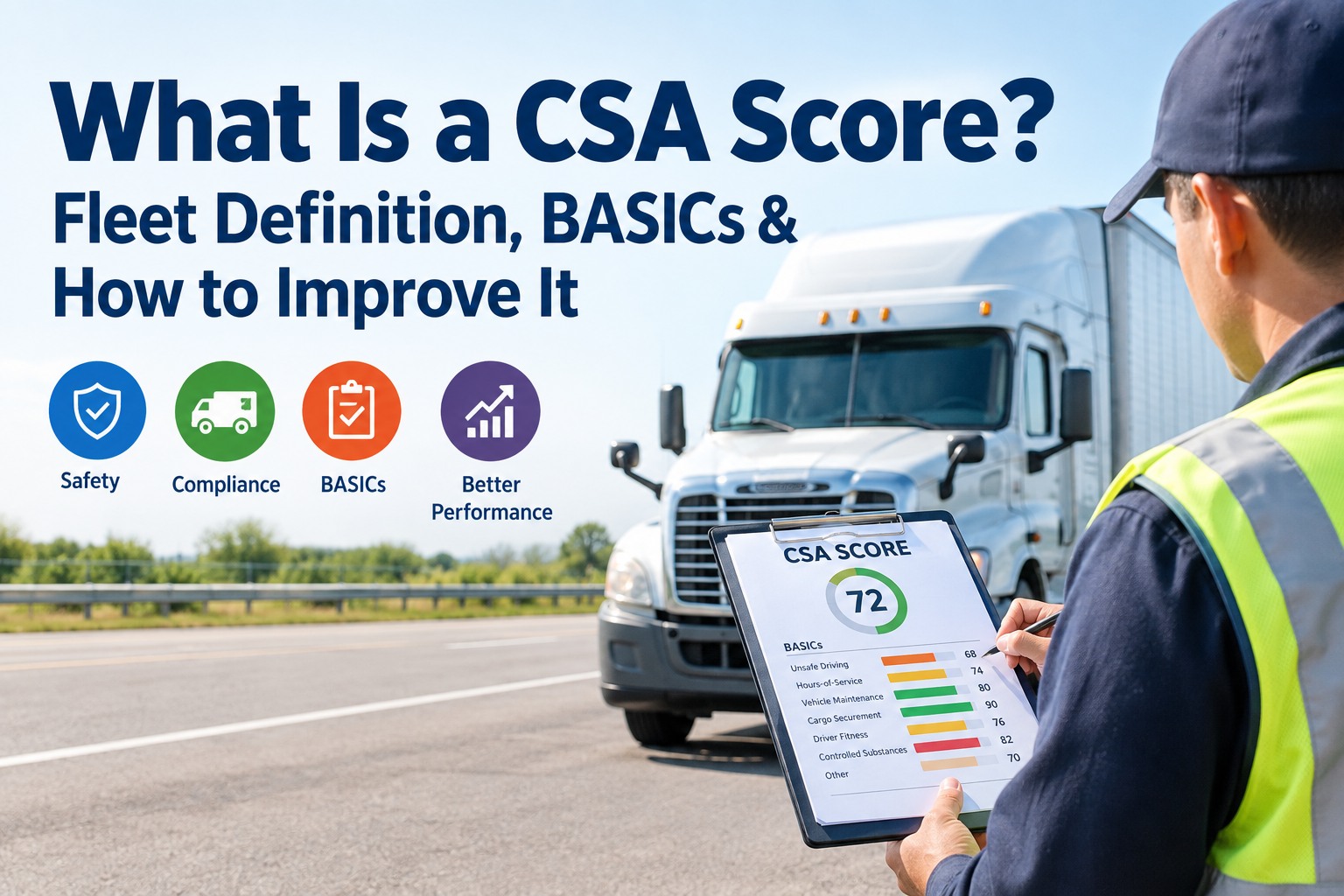
A broker just told you they can't book your truck because your CSA score is "too high" — and you're staring at the FMCSA site with seven percentages, none of which is the single number you expected. So what is a CSA score, really? It's not one grade. It's the FMCSA's way of ranking how your fleet's safety stacks up against similar carriers, built from roadside inspections and crashes over the last two years. This page decodes it plainly — the acronym, the seven categories, what counts as good or bad, and the path to a lower number. Book a demo once you know your number.
Your CSA Score Isn't One Number. It's Seven.
Most fleet managers look for a single grade. The FMCSA doesn't give you one. It ranks you as a percentile in seven separate safety categories — and any one of them crossing the line can put enforcement on your doorstep.
An FMCSA program to cut large-truck and bus crashes by spotting risky carriers early — the "score" is where you rank versus your peers.
Here's the part nobody explains up front: a CSA score is a percentile, not a report-card grade. Lower is better. A 20 means you're safer than 80% of comparable carriers. A 75 means only 25% of your peers are worse. And you get one of these rankings in each of seven categories, so "my CSA score" is really shorthand for a whole dashboard. Below is what each piece means and how to move it.
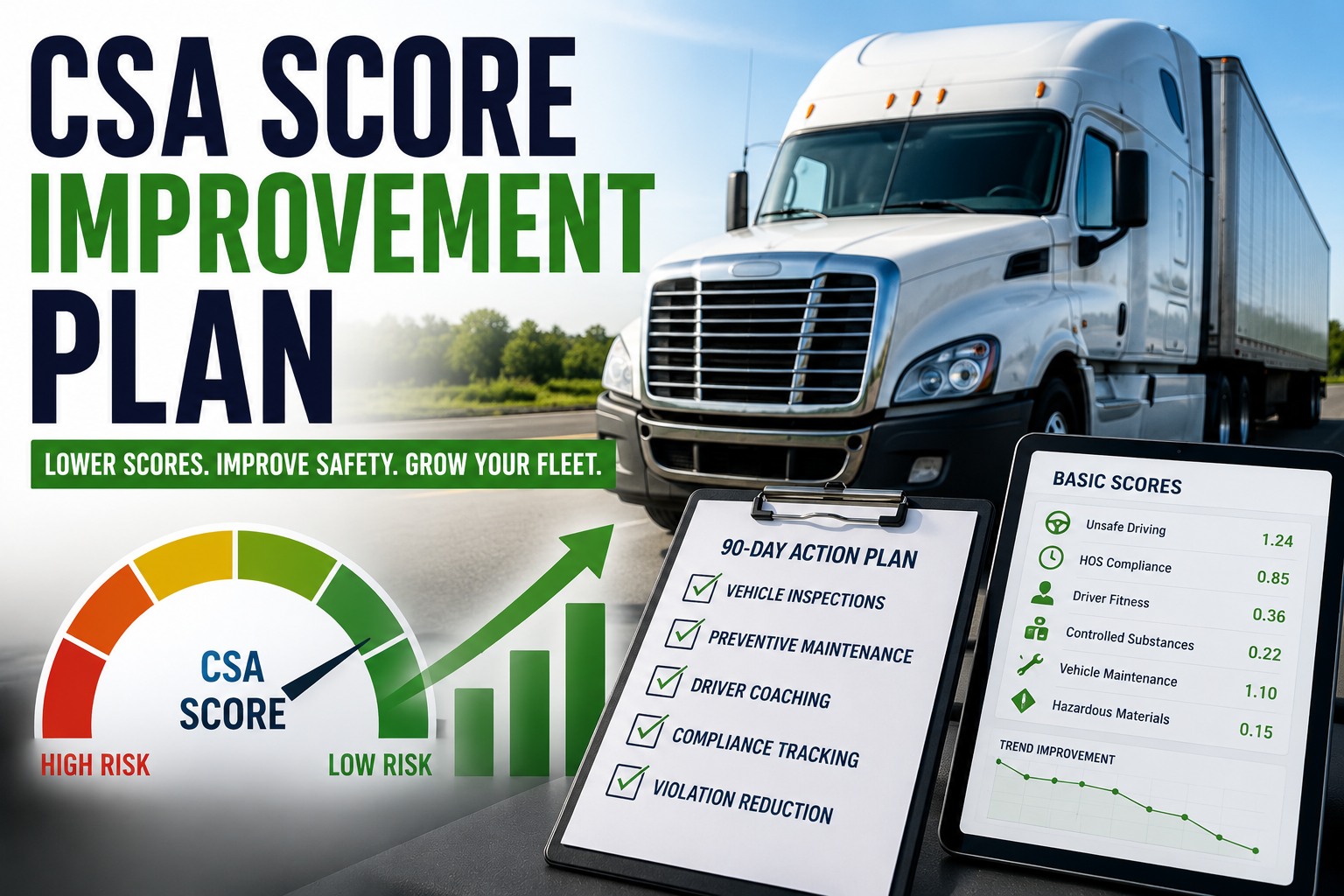
0 to 100how the percentile actually reads — lower is safer
The FMCSA's Safety Measurement System (SMS) pulls every roadside inspection, crash report, and investigation result from the trailing 24 months, groups the violations, weights them by severity and how recently they happened, then ranks you against carriers with a similar number of safety events. The output is a percentile from 0 to 100. That direction trips people up constantly, so anchor it once and never forget it: high is bad, low is good.
Thresholds vary by category and carrier type — high-crash-risk BASICs like Unsafe Driving and HOS flag at a lower percentile than the rest. Cross any threshold and the FMCSA prioritizes you for warning letters, targeted roadside inspections, or a full compliance review.
The best-run carriers don't aim for "under the threshold." They aim for the low end of healthy and stay there, because the closer you sit to a threshold, the less room a single bad inspection gives you. Book a demo to see your seven percentiles trended in one view
The 7 BASICsthe categories your score is actually built from
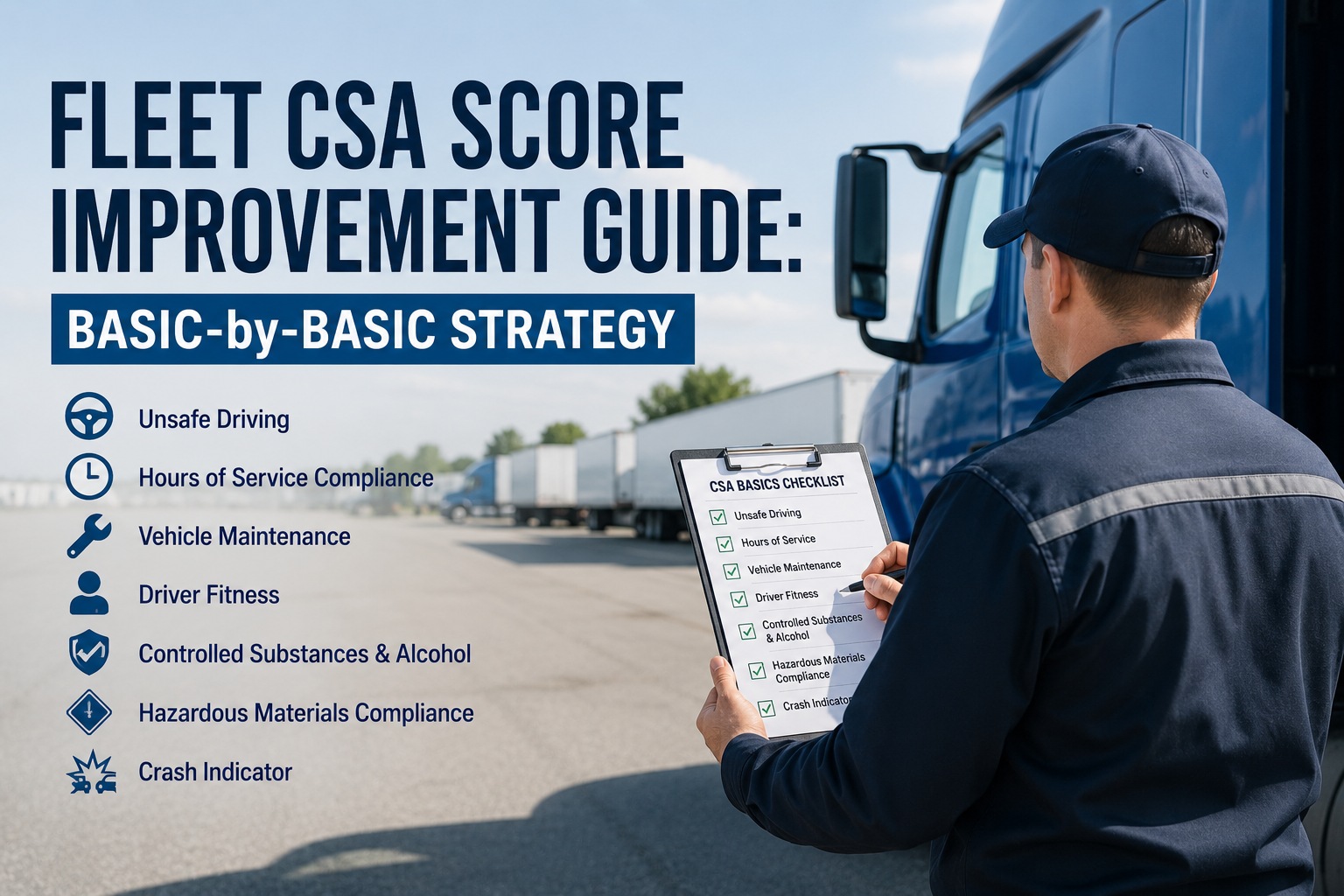
BASIC stands for Behavior Analysis and Safety Improvement Category. Instead of treating every violation as random noise, the SMS sorts them into seven buckets so patterns show up. Five are public in the SMS; two — Crash Indicator and Hazardous Materials — are visible only to you and to enforcement. Here's what each one measures and the kind of violation that feeds it.
Dangerous or careless operation — speeding, texting, improper lane changes, no seatbelt, reckless driving. Strongest link to future crashes, so it flags early.
Driving tired or over the legal limit — false logs, ELD paperwork errors, missed rest breaks, on-duty overages. Fatigue is a top crash factor, so it carries weight.
Mechanical defects and skipped repairs — brakes, lights, tires, leaks. The biggest source of violations, and the one a solid pre-trip controls best.
Unqualified drivers — expired or wrong-class CDL, missing medical certificate, incomplete driver qualification file. Paperwork gaps, not road behavior.
Impairment or possession — driving under the influence, or violations tied to drug and alcohol testing rules. Low frequency, but severe when it hits.
Unsafe handling, labeling, or packaging of hazmat loads. Only applies if you haul it — and it's visible only to you and enforcement, not the public.
Your state-reported crash history and patterns — not a behavior you commit, but a signal FMCSA uses to predict future risk. Also private.
Two things matter here. First, each BASIC is scored independently — six clean categories won't save you if the seventh crosses its threshold. Second, Vehicle Maintenance is both the largest category by violation volume and the one you control most directly through disciplined inspections. That's the fastest lever most fleets have. Start free and log inspections that build clean records
What's a good CSA score?the honest answer, without the hand-waving
People want a single "pass" number, and the honest answer is that a good CSA score depends on the category. Because it's a percentile, "good" always means "well below the intervention threshold, with room to absorb a bad month." Here's the practical read fleet managers actually use.
The thresholds themselves aren't uniform — the high-crash-risk BASICs flag at a lower percentile than the rest, and passenger and hazmat carriers face tighter lines because the consequences of their crashes are worse. So don't chase one blended number. Watch all seven, monthly, and react to trajectory. A category drifting from the low 50s toward 60 over three months needs attention before it ever flags. Book a demo to catch rising categories before they cross
How to improve itfour moves that actually move the number
A CSA score improves exactly one way: stack up recent, violation-free inspections while cutting the behaviors that generate violations. Old violations lose weight and eventually age out of the 24-month window, so consistency compounds. Here's how to improve a CSA score in the order that produces results.
-
1Run disciplined, documented pre-trips
Brakes, tires, and lights drive the majority of out-of-service violations. A thorough, signed pre-trip catches them in the yard, where they're a repair — not at roadside, where they're a permanent score hit. This is the single highest-leverage habit a fleet has.
-
2Keep maintenance and driver files current
Preventive maintenance on schedule kills Vehicle Maintenance violations; up-to-date CDLs, medical cards, and qualification files kill Driver Fitness violations. Both are paperwork problems with paperwork solutions — and both are entirely preventable.
-
3Coach the behaviors behind the worst BASICs
Speeding and distraction dominate Unsafe Driving; fatigue and log errors drive HOS. These are the highest-weighted, fastest-to-flag categories. Target coaching at the drivers and habits producing them, and reward the clean records.
-
4Dispute bad data through DataQs
Violations get miscoded, or attributed to the wrong carrier, more often than you'd think. FMCSA's DataQs system lets you challenge them, and a successful challenge removes the violation from your score entirely. Review your record; don't just accept it.
None of this requires new trucks or new lanes — it requires a repeatable inspection habit and clean records, applied every day. That's the part software carries for you: capturing each inspection, flagging defects into work orders, and keeping the audit trail that proves the pattern. Start free and build the clean-inspection streak this week
From a safety manager who watched all seven
For two years I treated CSA like one number and only looked when a broker complained. The month our Vehicle Maintenance BASIC jumped, I realized I'd been ignoring six categories that were quietly trending up the whole time.
What fixed it wasn't a big project — it was making the pre-trip non-negotiable and actually logged. Clean inspections started stacking, the old violations aged off, and within a few months every BASIC was back under 40. I check all seven the first Monday of every month now. Takes ten minutes.
Frequently asked questions
What is a CSA score in simple terms?
A CSA score is the FMCSA's measurement of how safe your fleet is compared to similar carriers. CSA stands for Compliance, Safety, Accountability — a federal program aimed at reducing large-truck and bus crashes by identifying risky carriers early. The "score" isn't a single grade; it's a set of percentile rankings (0 to 100) across seven safety categories called BASICs, calculated by the Safety Measurement System from your roadside inspection and crash data over the past 24 months. Lower is better: a score of 20 in a category means you're safer than 80% of comparable carriers. Because it's a percentile against peers rather than a fixed grade, your score can move even when your own behavior stays the same, as other carriers' data shifts and as your old violations age out of the two-year window.
What are the 7 CSA BASIC categories?
The seven Behavior Analysis and Safety Improvement Categories (BASICs) are: Unsafe Driving (speeding, distraction, reckless operation), Hours-of-Service Compliance (fatigue, log and ELD violations), Vehicle Maintenance (mechanical defects like brakes, lights, and tires), Driver Fitness (CDL, medical certificate, and qualification-file issues), Controlled Substances/Alcohol (impairment or testing violations), Hazardous Materials Compliance (unsafe hazmat handling), and Crash Indicator (your state-reported crash history and patterns). Five of these — Unsafe Driving, HOS, Vehicle Maintenance, Driver Fitness, and Controlled Substances/Alcohol — are publicly visible in the SMS. The other two, Hazardous Materials and Crash Indicator, are visible only to you as the carrier and to enforcement personnel. Each BASIC is scored independently, so a clean record in six categories won't offset a threshold breach in the seventh.
What is a good CSA score for a fleet?
Because CSA scores are percentiles where lower is better, a good score means sitting well below the intervention threshold in every category. As a working rule, staying under 50 keeps you clear of trouble in most BASICs, and the best-run carriers push well under 30 and treat that as their normal baseline. Scores climbing into the 50–64 range aren't flagged yet but signal that a fix is due before the category crosses the line. Crossing into 65 and above puts you in intervention territory in most categories — triggering warning letters, targeted inspections, higher insurance costs, and shipper scrutiny. Thresholds aren't identical across categories: the high-crash-risk BASICs like Unsafe Driving and HOS flag at a lower percentile, and passenger and hazmat carriers face tighter thresholds. The right target is the low end of healthy, with enough margin to absorb one bad inspection without crossing a line.
How can I lower my CSA score?
There's only one real mechanism: accumulate recent, violation-free inspections while eliminating the behaviors that produce violations. Because the SMS weights recent events most heavily and drops violations after 24 months, consistency compounds in your favor over time. The fastest lever is a disciplined, documented pre-trip inspection — brakes, tires, and lights account for the bulk of out-of-service violations, and catching them in the yard prevents a roadside score hit. Keep preventive maintenance on schedule to control the Vehicle Maintenance BASIC, and keep CDLs, medical cards, and driver qualification files current to control Driver Fitness. Coach drivers on speeding, distraction, and fatigue, since those feed the highest-weighted categories. Finally, review your FMCSA record and dispute miscoded or misattributed violations through the DataQs system — a successful challenge removes the violation entirely. A digital inspection and maintenance platform makes the clean-record streak far easier to build and prove.
How do I check my CSA score, and how often does it update?
You check your CSA scores through the FMCSA's Safety Measurement System website, logging in with your USDOT number and PIN to see your percentile in each BASIC along with the underlying inspection and violation data. Five BASICs are publicly viewable; Crash Indicator and Hazardous Materials require your carrier login. The SMS refreshes monthly, pulling updated roadside inspection results, crash reports, and investigation data from state and federal enforcement sources. That monthly cadence is why watching all seven categories on a regular schedule matters — a category can drift upward for weeks before it crosses a threshold, and spotting the trend early gives you time to correct it with clean inspections rather than reacting after enforcement flags you. Many fleets set a fixed monthly check so no category surprises them.
Turn clean inspections into a lower CSA score
HVI captures every pre-trip and periodic inspection as a signed digital record, turns defects into work orders on the spot, keeps preventive maintenance on schedule, and holds the audit trail that proves your compliance. The categories you control most — Vehicle Maintenance and driver-observed defects — are exactly where a disciplined inspection habit shows up in your score. Live in under two weeks.
No credit card · Works on mobile in the field · Digital inspection records from day one