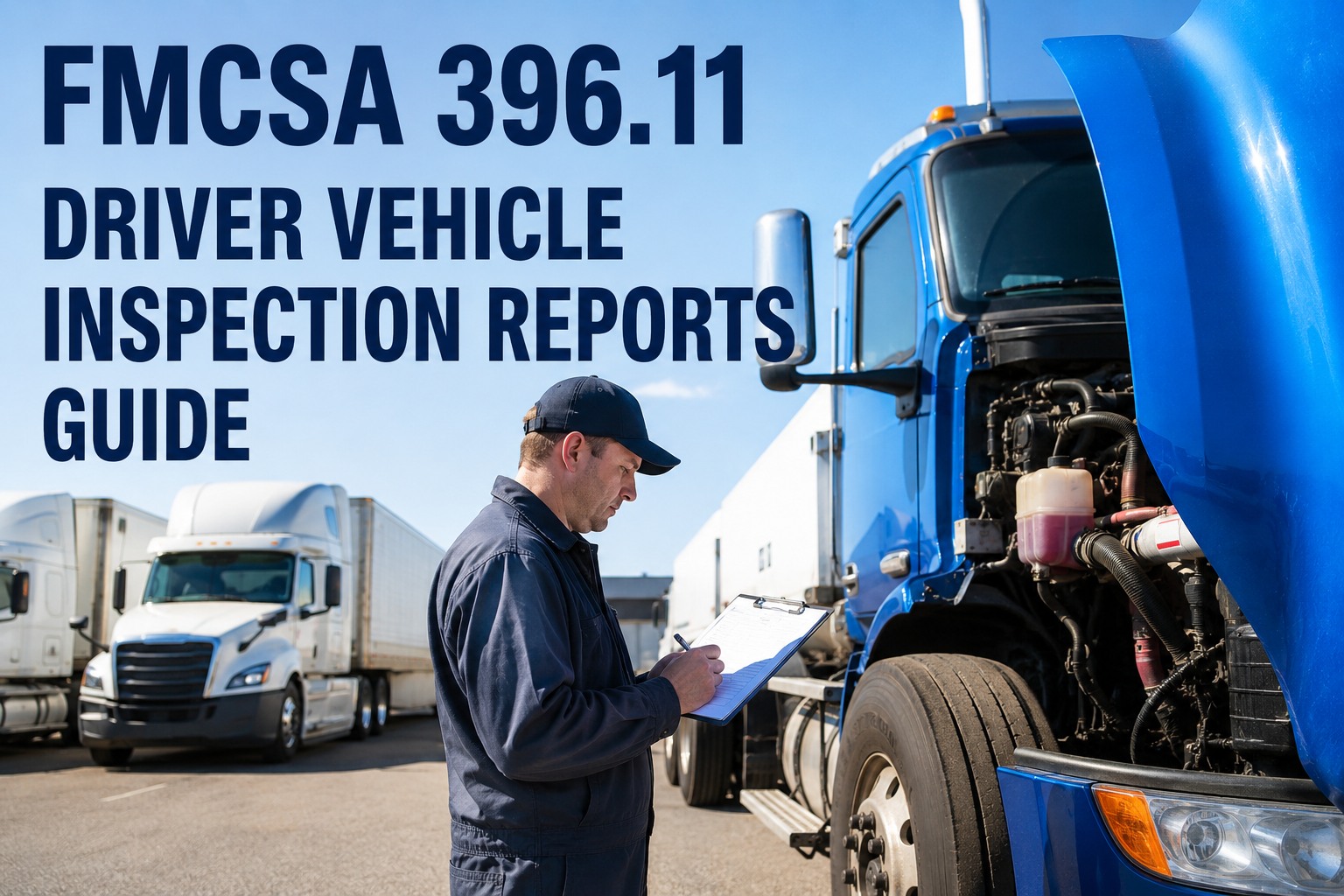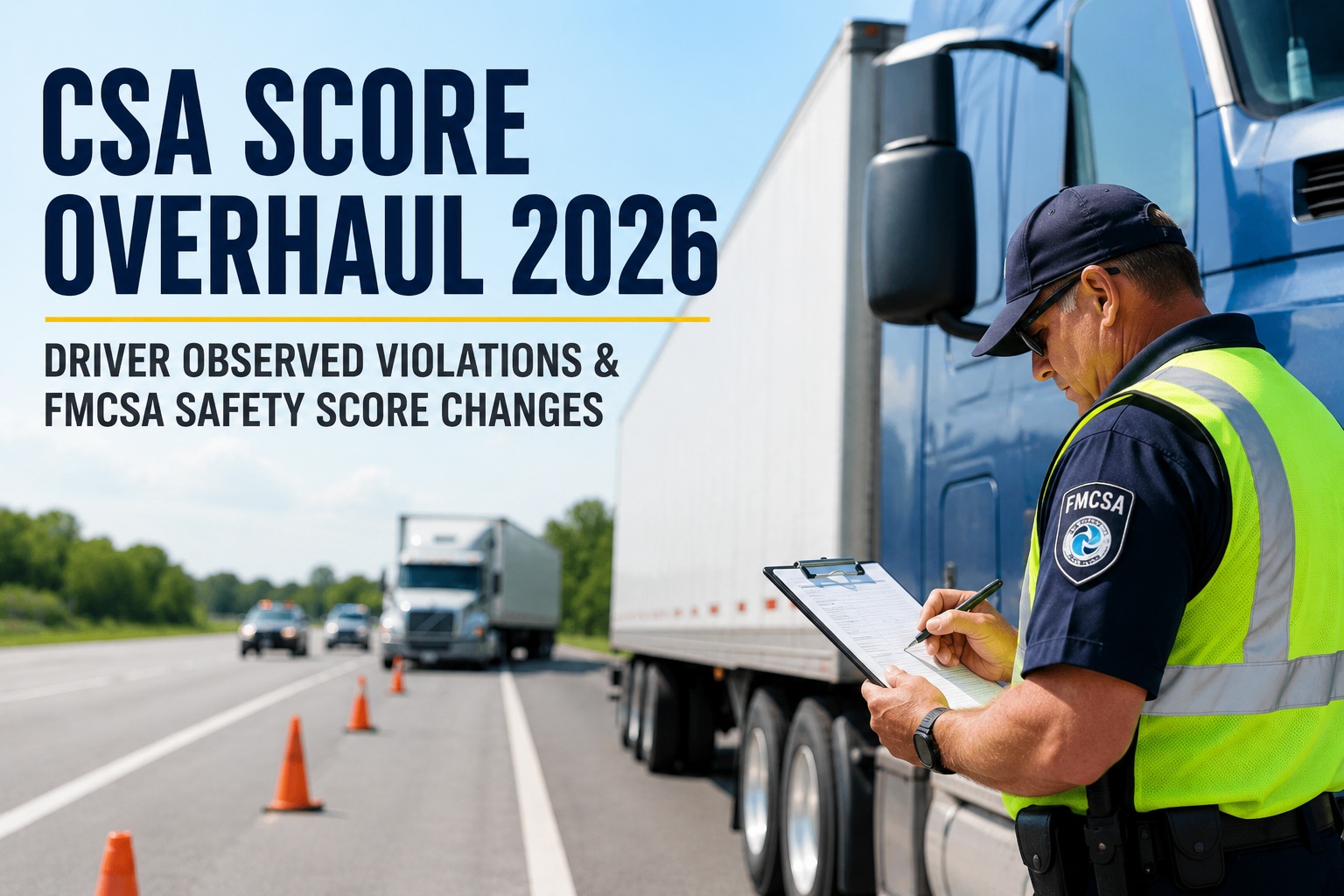
You passed your last audit. Your trucks are in good shape. And then you log into the FMCSA portal and your percentile has jumped ten points overnight — for a defect a driver should have caught on a pre-trip. That's the 2026 CSA score overhaul at work. FMCSA rebuilt the Safety Measurement System from the ground up, and the single biggest change for fleets is a new category that scores the quality of your drivers' own inspections. This guide breaks down what changed, why a clean pre-trip now protects your score directly and what to do about it. Book a 30-minute walkthrough to see it on your own fleet data.
The 2026 CSA Score Overhaul & the New Driver Observed Category
FMCSA's SMS just had its biggest rebuild since 2010 — 950+ violations consolidated, recency weighted harder, and a brand-new category that scores how well your drivers inspect.
Under recency weighting, one fresh roadside defect can push a comfortable percentile toward the threshold that triggers an FMCSA investigation.
-
950+ → 116
roadside violations consolidated into roughly 116 grouped categories
FMCSA SMS overhaul -
3×
weight a violation from the last 6 months now carries vs. one 12–24 months old
SMS time-decay tiers -
24 mo
scoring window — violations fall off entirely after two years
FMCSA SMS methodology -
1 defect
a single roadside find on a recent inspection can now move your percentile
2026 SMS recency weighting
What actually changed in the 2026 CSA score
The old system had rigid safety-event groups and 950-plus individual violations, each with its own severity weight from 1 to 10. It was opaque, and moving between groups could swing your percentile for no real reason. The 2026 rebuild fixes that — but it also raises the stakes on everyday inspection quality. Three shifts matter most for a fleet manager.
-
1
Violations consolidated and clarified
The 950+ violations are grouped into roughly 116 categories, and the old BASICs were renamed into clearer compliance categories. Patterns are easier to spot — and harder to dismiss as one-off flukes.
-
2
Recency weighted much harder
Your newest inspections carry maximum weight. A violation from the last six months hits 3× harder than one 12–24 months old, so a clean recent record recovers your score faster than ever — and a fresh defect hurts more.
-
3
A new "Driver Observed" maintenance category
This is the big one. FMCSA split Vehicle Maintenance and added a category that scores defects a driver should have caught on a pre-trip — so the quality of your drivers' own inspections now shows up directly in your score.
The Driver Observed category, explained simply
Here's the distinction that trips people up. Vehicle Maintenance violations are now scored in two buckets, and understanding which is which tells you exactly where a clean pre-trip protects you.
-
Standard Vehicle Maintenance
Component-condition defects
Things that fail over time and aren't obvious on a walkaround — a cracked brake drum, an internal air leak, a worn component behind a panel. These land in the standard maintenance category as they always did.
-
Driver Observed — NEW
Defects a pre-trip should catch
Bald tires, an inoperative lamp, a missing reflector, a loose load — the visible stuff a driver is expected to catch before rolling. Cited roadside, these now hit a separate score that flags sloppy pre-trip habits.
The message from FMCSA is blunt: a defect an inspector finds that your driver walked past is now evidence of a weak inspection culture, and it's scored as such. That's a problem if your pre-trips are a signature on a paper pad — and an opportunity if they're documented, photo-verified, and provably done. See how HVI documents every pre-trip so the walkaround is defensible.
Why recency weighting changes your whole strategy
The time-decay mechanic is the part fleets underestimate. Every violation in the 24-month window is multiplied by how recent it is — so where your violations sit on the calendar matters as much as how many you have.
-
0–6 months old
3× weight
-
6–12 months old
2× weight
-
12–24 months old
1× weight
The upside: a fleet that cleans up its act sees results fast, because the freshest inspections dominate. The risk: one bad month of roadside defects can spike your percentile hard while it's fresh. Either way, the play is the same — keep recent inspections clean, and catch the driver-observable defects before the truck reaches a scale house. A high score doesn't put you out of service on its own, but it's the trigger that invites the investigation that can.
What a high CSA score actually costs you
The score isn't just a compliance number — it flows straight into the commercial side of your business. Here's where it lands.
-
Investigations & audits
A high percentile is what triggers the FMCSA interventions that lead to compliance reviews and out-of-service exposure.
-
Insurance premiums
Underwriters pull your SMS data. A worsening safety profile shows up as higher premiums at renewal.
-
Lost freight & contracts
Shippers now have more visibility into carrier scores. A poor profile means fewer loads and lost contracts.
-
Litigation exposure
The rebuilt, centralized record is harder to dispute in court — a documented pattern of defects works against you.
Five moves that protect your score in 2026
You can't argue your way out of most violations — DataQs challenges only succeed for a narrow band of factual errors. The reliable strategy is prevention. Here's where to focus.
-
1
Preview your score under the new methodology
FMCSA's Prioritization Preview shows your ranking under the rebuilt system before it fully launches. Start there — your plan depends on which categories are elevated.
-
2
Make every pre-trip documented and provable
Driver Observed scoring rewards inspections that are recorded, not remembered. A photo-verified digital DVIR is the difference between a defensible walkaround and a checkmark.
-
3
Fix visible defects before the truck rolls
Bald tires, dead lamps, missing reflectors — the driver-observable defects are the cheapest violations to prevent and the most damaging to leave. Catch them at the yard.
-
4
Chase clean inspections, not just zero violations
A clean Level I roadside inspection actively improves your percentile. Because recency dominates, a run of clean recent inspections pulls your score down faster than ever.
-
5
Feed driver findings into the maintenance queue
When a driver flags a defect, it should auto-raise a work order and get fixed and logged. That closed loop is exactly the inspection culture the new category measures.
Expert view
The Driver Observed category caught a lot of fleets off guard. Under the old system, a dead marker lamp found at a scale house was just a maintenance ding. Now it's a flag that our pre-trip process let it through — and with recency weighted the way it is, that fresh violation stings.
What changed for us was making the walkaround leave a trail. Every driver's inspection is time-stamped with a photo now, so we catch the visible stuff in the yard, and when we do get inspected, our record shows the process is real. Our percentile has been trending down every month since.
— Marcus T., Director of Safety & Compliance, regional carrier
How HVI turns the new rules into an advantage
The 2026 changes reward exactly what a digital inspection platform does well: documented, recent, defensible inspections. Here's the direct mapping.
-
New rule
Driver Observed defects are scored separately
HVI solves it
Guided digital pre-trips with photo proof, so the walkaround is provably done and visible defects get caught first.
-
New rule
Recent inspections carry maximum weight
HVI solves it
Every inspection logged and timestamped, so a clean recent record is documented and working in your favor.
-
New rule
eDVIRs formally legalized in 2026
HVI solves it
GPS-stamped electronic DVIRs, compliant with 49 CFR 396.11 and producible for an auditor in seconds.
-
New rule
Driver findings must close the loop
HVI solves it
A flagged defect auto-raises a work order, tracks the repair, and logs it — the closed loop the score rewards.
It's the same idea behind our 2026 FMCSA rule-change guide and our full CSA score guide: the fleets that win under the new system act at the pre-trip, not after a roadside violation. Sign up free and put a documented pre-trip on every driver's phone.
Frequently asked questions
What is the Driver Observed category in the 2026 CSA score?
It's a new Vehicle Maintenance scoring category introduced in the 2026 SMS overhaul that specifically tracks defects a driver should have caught during a pre-trip inspection — things like bald tires, inoperative lamps, missing reflectors, or an unsecured load. When one of these is cited at a roadside inspection, it counts toward a separate score that reflects the quality of your drivers' own inspections, not just the mechanical condition of the vehicle. The effect is that sloppy or undocumented pre-trips now leave a distinct mark on your carrier profile, while a documented, photo-verified pre-trip process helps protect it.
How did the 2026 CSA score overhaul change the Safety Measurement System?
FMCSA carried out the biggest rebuild of the SMS since CSA launched in 2010. More than 950 individual violations were consolidated into roughly 116 grouped categories, the old BASIC categories were renamed into clearer compliance categories, and the rigid safety-event groups were replaced with a proportionate percentile that compares carriers to true peers based on inspection volume. The system also leans much harder on recency, weighting your most recent inspections and violations most heavily. Together these changes make patterns easier to see and give recent behavior far more influence over your score.
How does recency weighting affect my CSA score?
Every violation in the 24-month scoring window is multiplied by how recent it is. A violation from the last six months carries roughly 3× the weight of one that's 12–24 months old, with a 2× tier in between. Violations drop out of the calculation entirely after 24 months. In practice this means a fleet that improves sees results quickly because the freshest inspections dominate the score, but a recent cluster of violations can spike your percentile sharply while it's still new. It shifts the focus toward keeping current inspections clean rather than just waiting out old violations.
Can a bad CSA score put my carrier out of service?
Not on its own. CSA SMS scores alone cannot place a carrier out of service — an out-of-service order requires the results of a comprehensive compliance review. However, a high SMS score in one or more categories is exactly what triggers the FMCSA investigations and interventions that lead to those reviews. So while the score isn't a direct penalty, managing it is a critical prevention tool: keeping your percentiles below the intervention thresholds is how you avoid the audit in the first place.
Do digital inspections actually help my CSA score?
They help in two concrete ways. First, a guided digital pre-trip surfaces the visible, driver-observable defects — bald tires, dead lamps, missing reflectors — so they get fixed in the yard instead of cited at a roadside inspection, which directly protects the new Driver Observed category. Second, a photo-verified, timestamped electronic DVIR documents that the inspection was actually performed, giving you a defensible record if the process is ever questioned. Because the 2026 system weights recent inspections most heavily and formally recognizes electronic DVIRs under 49 CFR 396.11, a consistent digital inspection habit is one of the most direct ways to keep your recent record clean and your score trending down.
Turn every pre-trip into a CSA score advantage
HVI puts a guided, photo-verified digital inspection on every driver's phone — catching the driver-observable defects before they're ever cited, documenting a clean recent record, and closing the loop from defect to work order to repair. Exactly what the 2026 CSA score rewards.
No credit card · No hardware · Live on your fleet in under two weeks