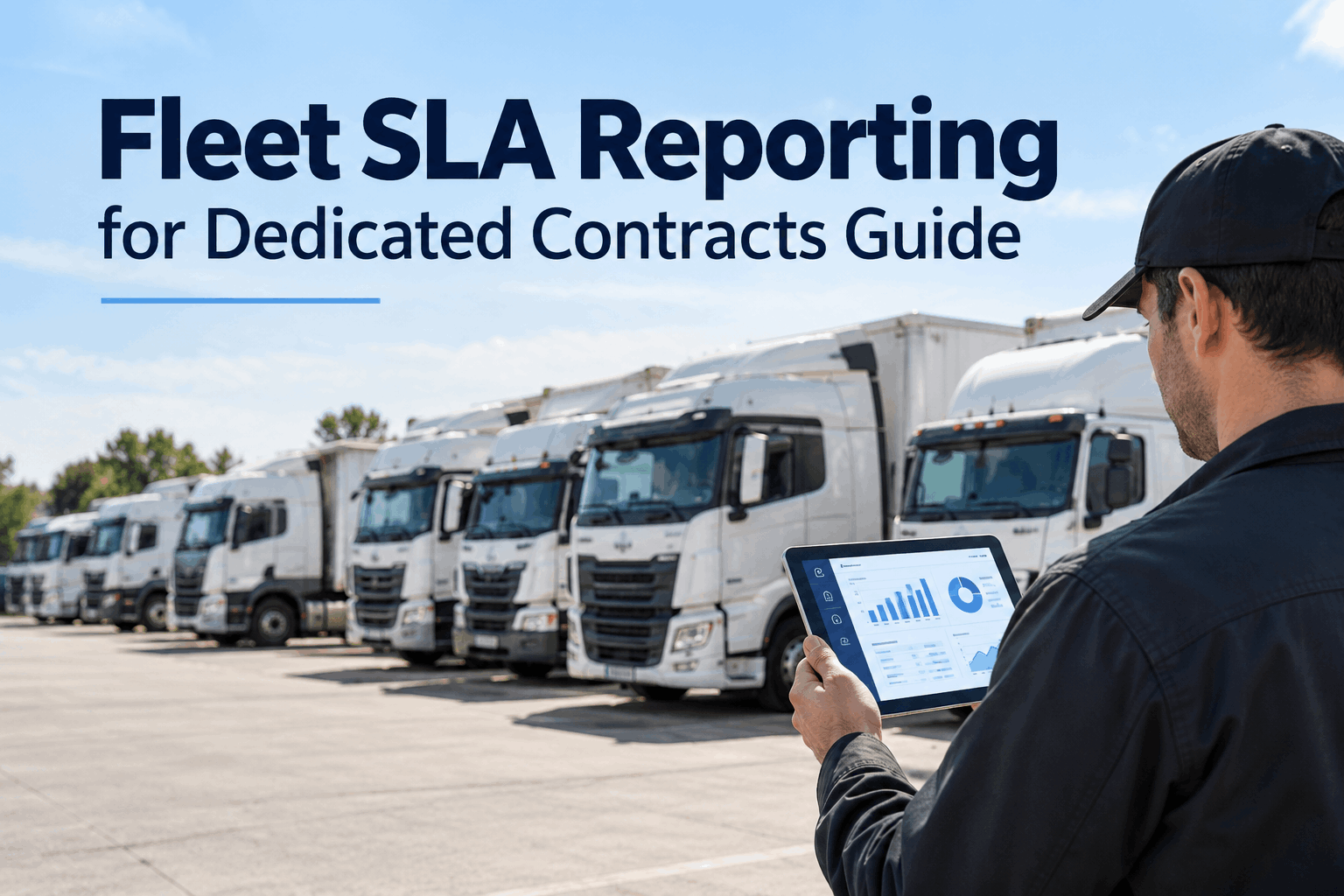
The customer's ops manager asks a simple question on the monthly call: "What was our vehicle availability last month?" The honest answer takes three systems, two phone calls, and a spreadsheet nobody fully trusts. Fleet SLA reporting shouldn't be this hard — the operators who win renewals aren't the ones with the best uptime, they're the ones who can prove it on demand.
Fleet SLA Reporting for Dedicated Contracts: Turning Operational Data Into Customer-Ready Evidence
Availability, compliance, and performance data that holds up in a contract review — not a spreadsheet assembled the night before.
Why SLA Reporting Breaks Down Before It Reaches the Customer
The promise behind a dedicated contract is simple. The data proving it, usually, isn't.
Platform
System
Spreadsheet
Threads
Book a demo to see a report your team can defend live, not one that needs a follow-up email the next day.
The KPIs That Actually Belong in a Dedicated Contract SLA
Six metrics, consistently defined, tell a customer more than twenty pulled together differently every month.
Vehicle availability
Contracted vehicles ready for service vs. total fleet — the number customers ask for first.
Inspection completion
Share of required inspections completed on schedule, not just eventually.
PM compliance
Scheduled maintenance completed on time — the leading indicator for next quarter's uptime.
Safety & compliance
Documented proof, not a verbal assurance that standards are being met.
Planned vs. unplanned downtime
The split matters as much as the total — managed reads differently than reactive.
Service exceptions
Logged with cause and resolution — not a footnote discovered at review time.
Book a demo to see these six KPIs generated automatically from data your crews already capture.
Same Word, Different Number
Most SLA disputes don't start with bad performance — they start with two parties measuring the same word differently.
Same fleet. Same month. Two correct numbers — and a monthly review that turns into a definitions argument instead of a performance conversation.
The fix: write the exact formula into the contract appendix before day one — for availability, for "on time," for what counts as an exception. Once it's settled, the report stops being a debate.
Two Ways the Same Miss Gets Discovered
Every fleet misses an SLA target occasionally. How it surfaces decides whether it reads as managed or hidden.
- Missed inspection window flagged same week
- Cause logged — part on backorder
- Resolution date shared before asked
- Customer reads: a managed exception
- Gap sits quietly in monthly data
- Customer notices the completion % drop
- Explanation requested after the fact
- Customer reads: something being hidden
Book a demo to see exceptions logged with cause and resolution attached automatically as part of the inspection record itself.
Who Should See What
A dedicated contract usually has more people touching the data than it should — role-based access fixes that at the source, not at the export step.
Start a free trial to set up role-based views for your team and your customer contact before the next review.
From Operational Data to Customer-Ready Evidence
One system behind every number — not a reporting layer bolted on top of the real data.
Records
History
Data
Records
Role-based access · Audit-ready retrieval
Start a free trial to export your data in customer-report format instead of copying it manually into a deck.
What a Commercial Manager Actually Deals With
Our biggest customer renews annually, and every renewal used to start with them questioning our availability numbers because their tracking showed something slightly different. We were both right — we just weren't measuring the same thing.
Once we agreed the exact formula in writing and started pulling every report from one system, the conversation changed completely. We're not defending a number anymore. We're just showing it.
Frequently Asked Questions
What is fleet SLA reporting?
Fleet SLA reporting is the process of measuring and communicating a fleet operator's performance against the service levels agreed with a customer under a dedicated contract — typically covering vehicle availability, inspection and maintenance compliance, safety records, downtime, and service exceptions. Reliable SLA reporting depends on pulling these metrics from a single, consistent source of operational data rather than reconciling multiple disconnected systems each reporting period.
What KPIs should be included in a dedicated fleet contract SLA?
Effective dedicated contract SLAs generally focus on a small set of metrics the customer directly experiences: vehicle availability, inspection completion rate, preventive maintenance compliance, safety and compliance records, the split between planned and unplanned downtime, and service exceptions with documented cause and resolution. A focused set of consistently defined metrics tends to build more customer trust than a longer list reported inconsistently.
How do you calculate vehicle availability for SLA reporting?
Vehicle availability is commonly calculated as the number of vehicles ready for service divided by total fleet size, expressed as a percentage, though the exact definition should be agreed with the customer in writing before the contract begins — for example, whether the denominator is the full fleet or only vehicles actively assigned to routes that day. Industry benchmarks generally place well-managed fleets in the 90 to 95 percent range, with top-performing fleets exceeding 95 percent.
How often should SLA reports be shared with a customer?
Most dedicated contracts use a monthly formal SLA report as the primary cadence, but pairing it with more frequent informal exception reporting — weekly or bi-weekly — tends to build more trust than the monthly report alone. Flagging a missed target proactively, with cause and corrective action attached, reads very differently to a customer than having that same miss surface for the first time during a scheduled review.
Why does SLA data need a single source of truth?
When inspection, maintenance, availability, and compliance data live in separate systems, each reporting cycle requires manually reconciling numbers that often don't match exactly, which introduces errors and slows down reporting. A single source of truth means every SLA metric is generated from the same underlying operational records the fleet already uses to run day to day, so the customer-facing report and the internal operational view are always consistent and can be defended with the same evidence.
Book a demo to see fleet SLA reporting built from data you already trust
HVI keeps inspection, maintenance, availability, and compliance records in one system, with role-based access and export, so your next customer review is a retrieval exercise, not a reconstruction project.
No credit card · No hardware · Contract reporting ready on day one