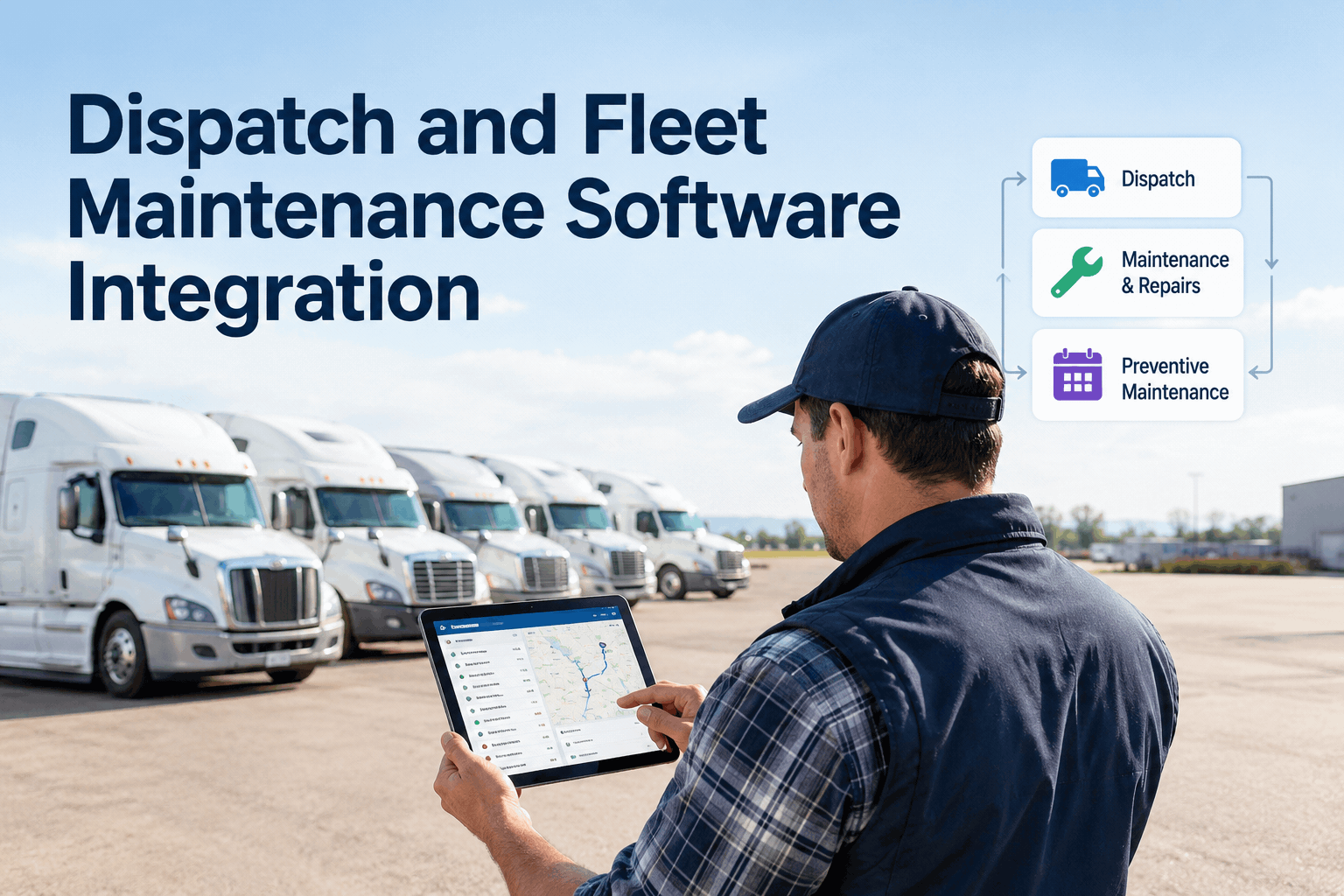
Dispatch assigns Truck 12 to a 500-mile run at 6am. Nobody tells the dispatcher that Truck 12 was flagged yesterday for a brake pad at 20% remaining — because that flag is sitting in a maintenance app the dispatch desk never opens. The load leaves on time, the truck goes out of service at mile 240, and now it's not a repair bill, it's a missed delivery and a second truck sent to recover the freight. Dispatch and fleet maintenance software integration exists to close that exact gap — so "available" on the board actually means ready to run. See it connected to your fleet
Stop Dispatching Trucks Your Shop Already Flagged
HVI turns every inspection, open work order, and PM due date into one live status per truck — so dispatch sees "down" before the load does, not after.
That board is the whole point. A dispatcher doesn't need the shop's full repair history — they need one answer in two seconds: can this truck safely take this load today? Right now, most fleets answer that question with a phone call to the shop, a guess, or nothing at all, and the cost of guessing wrong lands on the load, not just the truck.
What a maintenance blind spot costs dispatchthe numbers behind a load assigned to the wrong truck
That last line is the cost dispatch feels directly and a maintenance report never shows: when a loaded truck goes down away from the yard, someone has to send another truck and driver to transfer the freight, on top of the tow and the repair. A status check that takes two seconds before dispatch is a lot cheaper than a load recovery that takes half a day. Book a demo to see live truck status before your next load goes out.
Dispatching blind vs. dispatching on statusthe same morning, run two different ways
- Dispatcher assumes any truck in the yard is available
- Yesterday's DVIR defect is still on a clipboard in the shop
- PM due dates live in a spreadsheet nobody checks before assigning
- First sign of trouble is a driver's call from the shoulder
- Load recovery gets arranged after the truck is already stopped
- Every truck shows Ready, PM Due, Flagged, or Down — updated live
- A DVIR defect from this morning's inspection flips the status before the yard opens
- PM due dates surface on the same screen dispatch already checks
- A flagged truck gets reassigned to a lighter job or held, before it rolls
- Dispatch picks the next-best truck in the same two seconds, not after a breakdown
Neither version changes how hard the shop works — it changes whether dispatch finds out about a problem before or after it costs a load. Start free and see your own fleet's status board today.
How a flagged defect reaches dispatchfrom the driver's pre-trip to the dispatch screen, in four steps
-
1
Driver runs the pre-trip DVIR
A defect — worn brake pad, a leaking air line, a cracked light lens — gets flagged with a photo before the truck leaves the yard.
-
2
The flag opens a work order
The defect becomes a work order automatically — no one has to notice it, remember it, or retype it.
-
3
The truck's status updates in real time
That truck flips from Ready to Flagged or Down the moment the work order opens — not at end of shift, not after a shop call.
-
4
Dispatch sees it before assigning
The status feeds live fleet reporting and exports to the systems dispatch already works from, so the next load goes to a truck that's actually ready.
What a truck's status connects intogetting maintenance data where dispatch already works
Live status only helps dispatch if it shows up where dispatch already looks, not buried in a separate maintenance login. HVI's integration layer is built to carry that status outward, not keep it locked inside the shop's app. Book a demo to see which of your existing systems it connects to.
GPS & telematics
Fault codes and location data feed truck condition alongside manual inspections, for a fuller status picture.
OEM telematics
Engine and component data from the manufacturer's own system feeds the same status board as a driver's DVIR.
SAP & accounting
Repair and parts cost sync to your books automatically, so a status update doesn't mean double data entry.
Fleet reporting export
Status and cost data export cleanly for whatever board or spreadsheet your dispatch team already lives in day to day.
What to check before buying dispatch-maintenance integration softwarea short list that saves a long argument between dispatch and the shop
Status updates in real time, not end of day
A flag that posts at 5pm doesn't stop a 6am dispatch.One status per truck, not three separate apps
DVIR, work orders, and PM should all roll into a single truck status.Trailers get their own status
A tractor can be Ready while the trailer behind it is flagged — both need to show.Data exports to where dispatch already works
If dispatch has to log into a separate maintenance app, they won't.A dispatcher can see why a truck is flagged
"Down" with no reason just gets overridden under deadline pressure.PM due dates show before they're overdue
A truck shouldn't flip to Flagged only after it's already late for service.It's quick enough that dispatch actually checks it
If pulling up status takes longer than a phone call to the shop, it won't get used.HVI's fleet status board is built to pass every item on that list — start free and put your own trucks on it this week.
From an ops manager who used to run dispatch blind
For years, dispatch and maintenance were two different conversations that happened in two different rooms. The shop knew which trucks were in trouble. Dispatch found out when a driver called in from the side of the road, usually loaded, usually three hours from home.
Now dispatch pulls up the same board the shop sees. A truck that's flagged shows flagged, right there next to the load list, before anyone assigns it. We still have breakdowns — nothing stops all of them — but we've stopped sending trucks out that we already knew had a problem. That one change alone cut our load-recovery calls by more than half.
Want dispatch and the shop looking at the same board? Book a 20-minute demo walked through your own fleet.
Frequently asked questions
What is dispatch and fleet maintenance software integration?
It's connecting inspection, work order, and PM data into one live truck status that dispatch can check before assigning a load, instead of maintenance and dispatch working from separate, disconnected systems.
Does HVI replace our dispatch or TMS software?
No. HVI isn't a load board or dispatch system — it's the maintenance status layer that feeds real truck readiness into the systems your dispatch team already uses, via reporting and data export.
How fast does a flagged defect show up as a status change?
In real time. The moment a driver's DVIR flags a defect or a work order opens, that truck's status updates immediately — not at the end of the shift.
Can trailers show a separate status from the tractor pulling them?
Yes. Trailers and reefer units carry their own inspection and PM schedule in HVI, so a flagged trailer shows up even when the tractor pulling it is fully ready.
What systems does the maintenance status connect to?
HVI integrates with GPS and telematics providers, OEM telematics data, SAP, accounting software, and fuel cards, and exports fleet status and cost reporting for use wherever your team already works.
Let dispatch see what the shop already knows
HVI turns every DVIR, work order, and PM due date into one live status per truck and trailer — so the next load gets assigned to a truck that's actually ready, not one that just hasn't broken down yet. Live on your fleet this week.