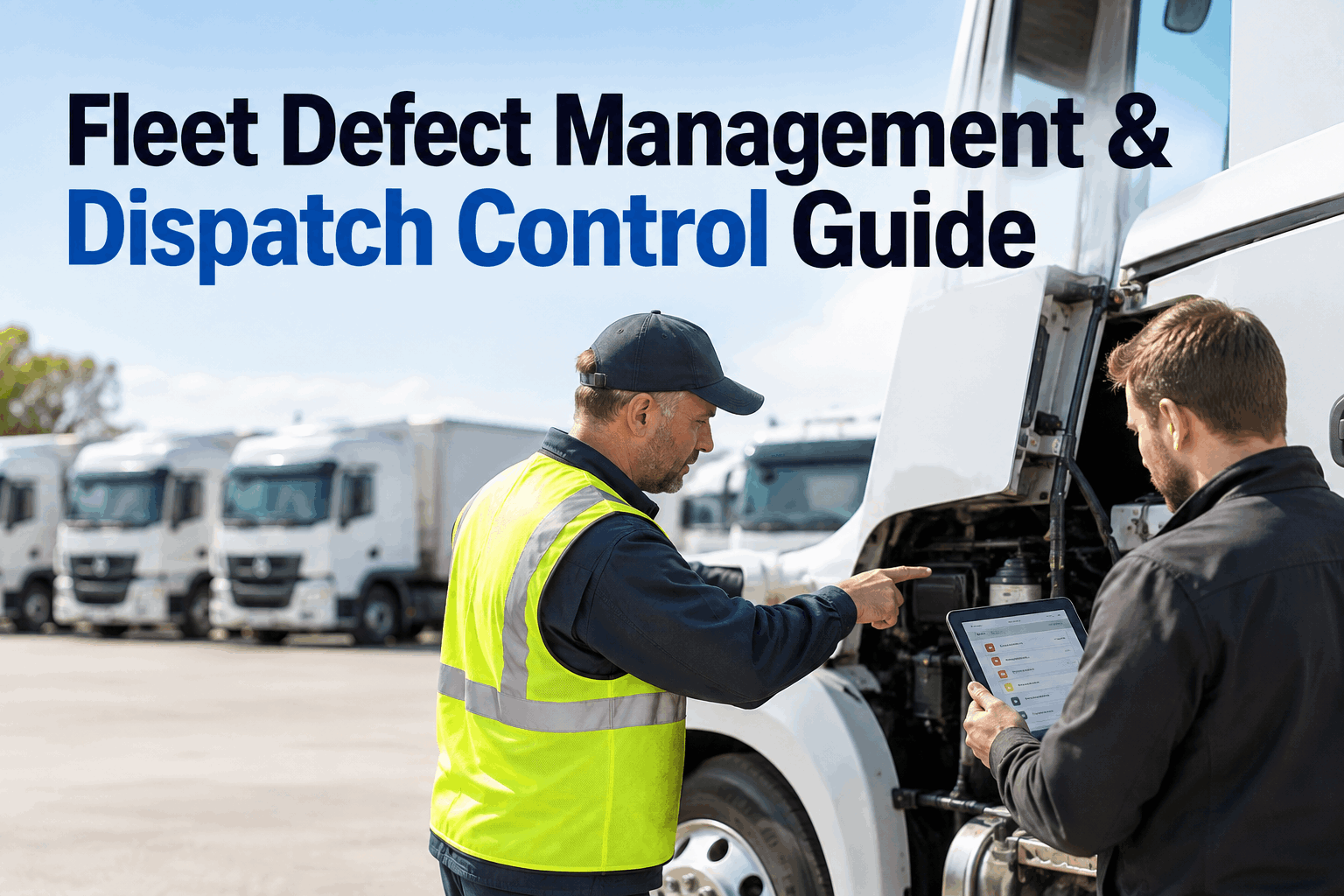
Finding a defect is the easy part. What keeps an unsafe truck off the road is what happens between the inspection and the next dispatch — and on most fleets that gap is a sticky note, or nothing, so the truck rolls anyway. Real fleet defect management closes it: a safety-critical defect holds the vehicle until the repair is verified and the release is authorized. Book a demo to see dispatch control in action.
A found defect means nothing if the truck still rolls
The inspection catches it. The dispatch lock holds it. Repair verification and release authorization let it back out. That closed loop — not the inspection alone — is what fleet defect management actually is.
Every fleet finds defects. The ones that get hurt are the ones where a found defect and a dispatched truck aren't connected — the inspection says "brake out of adjustment," but the dispatch board doesn't know, so the truck leaves on schedule. Under US rules this isn't optional: FMCSA §396.13 requires that a defect listed on a driver vehicle inspection report that would affect safe operation be certified as repaired or not needing repair before the vehicle is operated again. Fleet defect management software is how you enforce that automatically instead of hoping a paper trail holds.
Every defect runs one gated path to closure
A controlled defect moves through seven stages — and the dispatch lock is the gate in the middle that a found-but-forgotten defect never passes.
Driver or tech flags it on the digital check.
Captured with a photo against that unit.
Safety-critical vs monitor is decided.
Safety-critical → dispatch locked.
Work order closed with proof.
An authorized role signs it off.
Unit returns to dispatch.
Lose any stage and the loop breaks — the defect that stays at stage two is the one that rolls. Book a demo to see the full lifecycle enforced.
Finding a defect is not controlling it
Most fleets are good at detection and weak at control. That gap — between knowing and stopping — is exactly where the liability lives.
- Defect noted on paper, dispatch never sees it
- Truck leaves on schedule with an open fault
- Repair "happens eventually," unverified
- No record of who released the vehicle
- In an audit or incident, nothing to show
- Safety-critical defect locks the unit
- Dispatch physically can't release it
- Repair closed with photo evidence
- Named role authorizes the release
- Full dated trail for audit and defense
The difference isn't more inspections — it's connecting the defect to the dispatch decision. Start free and close the control gap.
Not every defect grounds a truck — severity triage
A dispatch lock only works if it fires on the right defects. Severity triage is what separates a grounding fault from a monitor, so you hold what's dangerous without parking the whole fleet.
Brakes, steering, tires, coupling, lights required for operation — anything that makes the vehicle unsafe. The unit is held until repaired and released.
A real defect that isn't immediately unsafe. It opens a work order with a deadline and is tracked, but the unit can run in the meantime.
Cosmetic or wear items logged against the unit's history so a small issue trending worse is caught before it becomes safety-critical.
You set the rules for what locks a unit; HVI enforces them the same way every time, for every truck. Book a demo to configure your severity rules.
A vehicle comes back only when it's authorized
The release is the moment that matters most — and the one paper systems document worst. In HVI it's an explicit, signed step, not an assumption.
Why the sign-off is the whole point
A defect isn't closed because time passed — it's closed because someone with authority confirmed the repair and signed the release. That one accountable step is what turns a pile of inspections into real defect control.
No release, no roll — and every release leaves a signed, dated trail behind it. Start free and require authorized releases.
The defect-control toolkit in HVI
Defect management
Every defect captured against its unit with photos and severity, from the digital inspection straight into the workflow.
Dispatch lock
A safety-critical defect holds the unit so it can't be dispatched until the fault is cleared — the control most fleets are missing.
Repair verification
Work orders close with evidence in maintenance management, so a repair is proven, not assumed.
Release authorization
An authorized role signs off every return to service, leaving a dated, defensible record on the vehicle.
It layers onto the inspections you already run — see how it connects to defect detection and resolution, and routes every fault through maintenance management.
Does your defect process actually control risk?
Not an inspection checklist — a control checklist. Run your current process against these eight. Every box you can't tick is a place a safety-critical defect can slip through to the road.
If you hesitated on even one, that's the gap between finding defects and controlling them — and it's exactly what dispatch control closes. Book a demo to tick every box.
A fleet director on closing the gap
We never had a detection problem — our inspections found plenty. What we had was a control problem: a truck would get flagged at 6am and still leave at 7, because dispatch and maintenance were two different worlds. The dispatch lock forced them together. Now a safety-critical defect holds the unit, period, and it doesn't move until someone authorizes it. The first month it caught three trucks that would have rolled on open brake defects. That's the kind of thing that ends careers if it goes the other way.
Lauren A.Fleet Director · National LTL carrier · 600+ power units
Fleet defect management questions
Q1What is fleet defect management?
It's the end-to-end control of a vehicle defect from the moment it's found to the moment it's closed: logging it against the unit, triaging severity, holding the vehicle if it's safety-critical, verifying the repair with evidence, and authorizing the release. The goal isn't just finding defects — it's making sure a dangerous one can't reach the road.
Q2What is a dispatch lock?
A dispatch lock is a hold placed on a vehicle with an open safety-critical defect so it can't be assigned or released for a trip until the defect is repaired and signed off. It connects the defect record to the dispatch decision, so a flagged truck physically can't leave on schedule the way it can when the two systems are separate.
Q3Does this help with FMCSA compliance?
It supports it. FMCSA §396.13 requires that a defect affecting safe operation listed on a DVIR be certified as repaired or not needing repair before the vehicle is operated again. A dispatch lock plus authorized release enforces that certification step and leaves a dated record, rather than relying on paper. It's a compliance aid, not a substitute for your own compliance program.
Q4Won't locking vehicles slow down dispatch?
Only for genuinely unsafe defects, because severity triage decides what locks. Safety-critical faults hold the unit; major defects open a timed work order while the truck keeps running; minor items are just logged. You configure the rules, so you hold what's dangerous without grounding the fleet over cosmetic issues.
Q5How does HVI handle defect and dispatch control?
HVI connects digital inspections, defect severity, vehicle holds, repair evidence and release authorization into one enforced loop. A safety-critical defect locks the unit, the repair closes with proof, and an authorized role clears it before it rolls — all recorded per vehicle. It's an inspection and defect-control layer, not a replacement for your compliance program or OEM guidance.
See defect & dispatch control in HVI
Connect inspections, defect severity, vehicle holds, repair evidence and release authorization into one loop — so a safety-critical defect is controlled before a vehicle returns to service, not just noticed. Live in weeks, not quarters.
Defect holds · Repair evidence · Authorized releases · Full audit trail