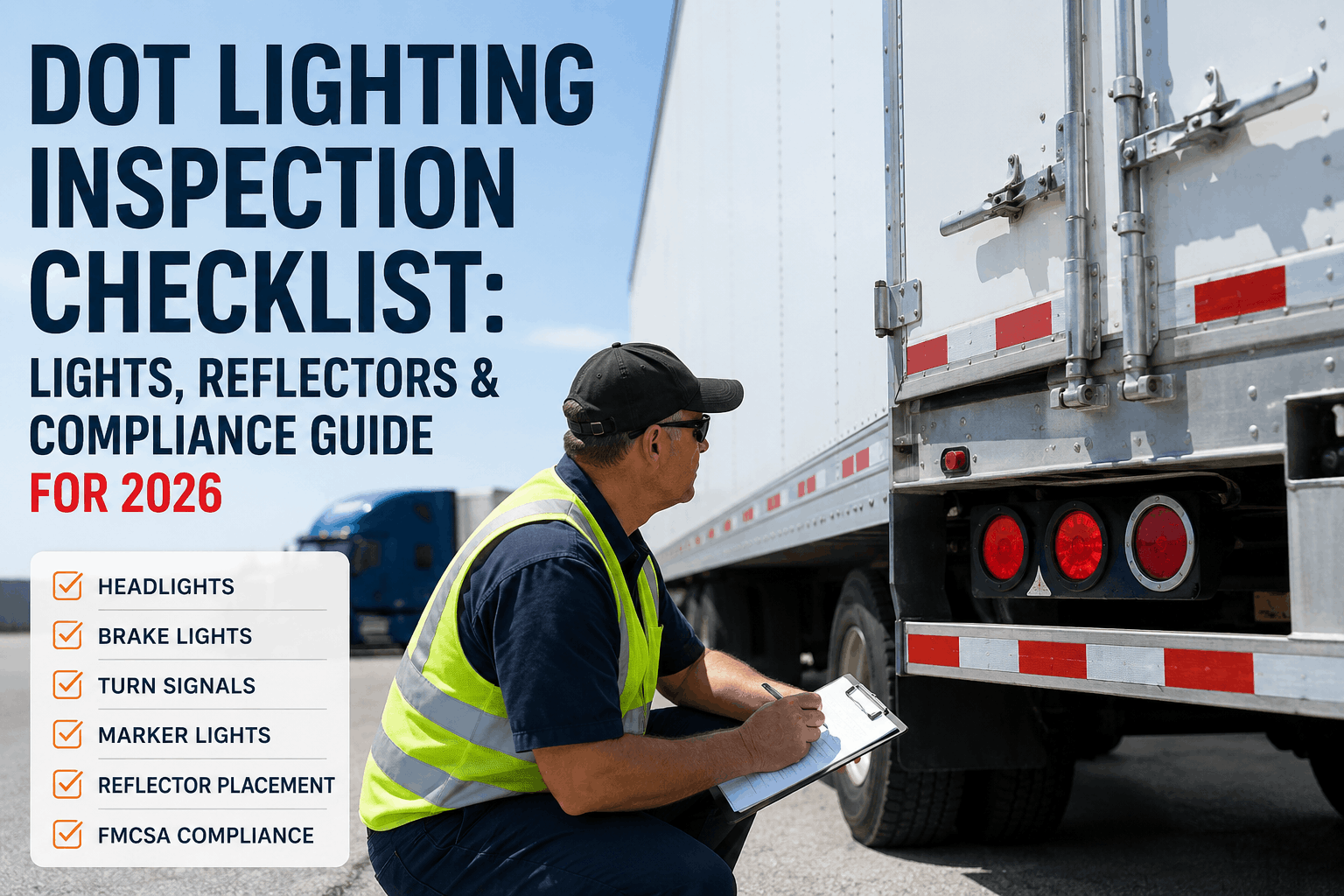
Lighting and reflector defects are the #3 cause of vehicle out-of-service orders in North America — 14% of all OOS findings in 2025 — but they're also the most preventable category on the entire FMCSA violation list. A $5 bulb caught at pre-trip becomes a $0 problem; the same bulb missed at pre-trip can trigger a full Level I roadside inspection ("gateway violation"), an OOS order, and a CSA score hit that haunts your record for 24 months. The regulatory framework hasn't softened either — 49 CFR 393.11 was amended again on Feb 19, 2026 (91 FR 7873), and the current Subpart B requirements continue to reference FMVSS No. 108 for every lamp, reflector, and conspicuity strip on a commercial vehicle. This checklist walks CDL drivers, fleet technicians, and maintenance managers through a complete DOT lighting and reflector inspection — by vehicle section, with the required lamp categories, color rules, placement specs, and the top 8 violations roadside inspectors cite most. For fleets that need a defensible record of every pre-trip light check, HVI's inspection and maintenance software turns this checklist into a guided, photo-verified, audit-ready eDVIR for every driver and every vehicle. Start your free HVI trial to put guided DOT lighting inspections on every driver's smartphone, or book a demo to see how HVI inspection and maintenance software automates lighting compliance across your fleet.
The 8 required lamp & reflector categories on every CMV
Before the inspection, know what you're inspecting. Under 49 CFR 393.11 Table 1, every commercial motor vehicle requires these eight lamp and reflector categories. Missing hardware is the easiest defect for an inspector to spot — and the first thing that triggers a deeper Level I inspection.
2× high/low beam, both functional, lenses clean and uncracked, properly aimed.
2× red lamps, active when headlights on, visible from 500 feet minimum.
2× red lamps, brighter than tail lamps. Must NOT be amber (393.11(c) prohibition).
Front and rear, both sides functional. Proper flash rate (60–120 per minute).
Required on vehicles >80" wide. Side markers between 15" and 83" mounting height.
1× white, illuminates plate so it's readable from 50 feet at night.
Required on each side and rear corners. Position per FMVSS No. 108 specs.
All 4-way flashers functional on power unit AND trailer simultaneously.
Front-of-vehicle lighting checklist
Start at the front. Lights on, ignition on, hazards activated, walk the entire front face from one corner to the other. Have a helper press the brake pedal when you reach the rear — or use a reflection (glass door, mirror, fuel station window) to verify yourself.
Side-of-vehicle (driver & passenger) lighting checklist
Walk down the driver's side first, then the passenger side. Side marker lamps and reflectors are checked symmetrically — what's required on one side is required on the other. Pay attention to mounting height (15" to 83" per 393.11 Table 1).
Rear-of-vehicle lighting checklist — where most violations live
The rear of the vehicle is where roadside inspectors catch the most lighting defects. This section needs the most attention. Use a helper to press the brake pedal, or position the vehicle so you can see the rear in a glass reflection. Don't skip the license plate light — it's the most-cited missed lamp.
Conspicuity tape & reflector placement — the 393.11(b) specifics
Conspicuity tape and reflex reflectors have specific placement rules that inspectors check closely. The Feb 19, 2026 amendment to 393.11 didn't change the core placement requirements — they still reference FMVSS No. 108 — but inspectors are increasingly trained to verify exact placement, not just presence.
Color reference chart — quick verification
Inspectors verify color as fast as they verify function. A red light where amber should be (or vice versa) is the same violation as a missing lamp. Use this chart for quick mental verification during the walk-around.
| Location | Lamp / device | Required color | Notes |
|---|---|---|---|
| Front | Headlights | White | High and low beam, both functional |
| Front | Turn signals | Amber | Both sides, proper flash rate |
| Front | Clearance / ID lights | Amber | Vehicles >80" wide only |
| Front | Side markers | Amber | 15"–83" mounting height |
| Side | Marker lamps | Amber front / Red rear | Color transitions at trailer midpoint |
| Side | Reflex reflectors | Amber front / Red rear | Pair with marker lamps |
| Side | Conspicuity tape | Red & white alternating | 50% of trailer length minimum |
| Rear | Tail lamps | Red | 2 lamps, visible from 500 feet |
| Rear | Stop / brake lamps | Red | NEVER amber (393.11(c)) |
| Rear | Turn signals | Red or amber | Both sides functional |
| Rear | Backup lamps | White | Active only in reverse |
| Rear | License plate lamp | White | Readable at 50 feet |
| Rear | ABS warning light | Amber | Driver-side near rear of trailer |
Top 8 lighting violations roadside inspectors cite
These are the eight defects that drive the bulk of the 14% lighting OOS share. Memorize them — they're what an inspector's eyes go to first during a roadside encounter.
The most common single lighting OOS. Brake lights work in stop-and-go traffic but burned out at pre-trip. Test every shift with a helper or reflection.
Vehicles >80" wide require clearance and identification lamps. Missing ones are visible from 100 feet — easy roadside catch.
Signal still on but flashing too fast (60+ per minute too high), or one side dead. Both indicate failed bulb, ballast, or relay.
The most-forgotten lamp. White lamp must illuminate the plate so it's readable at 50 feet. Easy to miss because the driver never looks at it.
Peeling tape, missing strips at upper rear corners, fading red/white squares. The 50% trailer-length coverage rule is heavily enforced.
A working lamp behind a cracked lens corrodes within weeks. Inspectors cite cracked lenses as a defect even when the lamp still works.
Aftermarket bulb upgrades or LED replacements in the wrong color spectrum. Brake lamps in amber are an automatic 393.11(c) violation.
Lights blocked by mud flaps, load straps, dirt accumulation, or part of the cargo. 393.11(b) explicitly prohibits any obstruction of required devices.
The 60-second lighting walk-around method
The full inspection takes 5–10 minutes, but the practical execution is a 60-second perimeter walk with lights energized. Here's the exact sequence that catches 95%+ of lighting defects without slowing dispatch.
Headlights on (high beam first, then low). Hazards on. Have helper press brake pedal or use vehicle reflection. Turn signals will be tested individually next.
Headlights both on. Front turn signals (toggle left, then right). Front 4-way flashers. Clearance/ID lamps. Lens condition. ~10 seconds.
Front side marker (amber). Intermediate marker (long trailers). Rear side marker (red). Side conspicuity tape (50% coverage). Reflectors at each marker. ~15 seconds.
Tail lamps (red). Brake lamps (helper pushes pedal — verify both red). Rear turn signals. License plate lamp. Conspicuity tape at upper corners. ABS warning extinguished. ~20 seconds.
Mirror of driver side check. Front, intermediate, rear side markers and reflectors. Side conspicuity tape continuous. ~15 seconds.
How HVI inspection & maintenance software turns this checklist into a daily habit
A paper checklist works once. The challenge is making the inspection happen every shift, on every vehicle, with photo-verified evidence the FMCSA accepts. HVI is purpose-built inspection and maintenance software that converts this 11-section lighting checklist into a guided digital workflow drivers complete on their smartphones — eliminating missed checks, paper losses, and the "pencil-whipping" pattern auditors hunt for.
Every lamp category from this checklist becomes a required field in the HVI mobile inspection — no driver can submit a DVIR with lighting marked "OK" without actually checking each lamp. Photo-verified, GPS-timestamped, archived per VIN.
Any "Fail" on a lamp instantly creates a maintenance work order with photo and vehicle ID — routing the defect to the shop before dispatch. The "burned-out bulb that nobody fixed" scenario disappears.
Marginal bulbs (visibly dim, intermittent) flagged as "Marginal" in HVI auto-create scheduled maintenance work orders before the lamp fails completely. Cheaper than reactive fixes, prevents the OOS event entirely.
HVI's inspection templates pre-map to the 2026 CSA "Driver Observed" BASIC for lighting — the category that scores separately under the recent BASIC split. Audit-defensible records by VIN, by date.
Photo records of conspicuity tape condition logged against each trailer. Peeling or fading tape captured before it triggers a roadside violation — and the maintenance work order routes the trailer to the shop for fresh tape.
Every lighting inspection, every photo, every work order indexed per VIN. The auditor's "show me your last 90 days of lighting DVIRs" request becomes a one-click export — not a fire drill.
Lighting is the easiest OOS category to prevent — but only if the inspection actually happens, on every vehicle, every shift, with proof. Start your free HVI trial to put guided lighting eDVIRs on every driver's smartphone in under an hour, or schedule a 30-minute walkthrough to see how HVI inspection and maintenance software automates lighting compliance across your fleet.
Frequently asked questions
Q: What lights are required on a commercial vehicle for DOT compliance?
Q: How often should I do a DOT lighting inspection?
Q: What color should brake lights be on a commercial truck?
Q: What are conspicuity tape requirements for trailers?
Q: What's the penalty for a DOT lighting violation in 2026?
Q: Why is the license plate light cited so often?
Q: Can a single lighting defect put my truck out of service?
Lighting defects are 14% of vehicle OOS orders — and 95% of them are preventable with a real walk-around. The fleets that win automate the walk-around.
HVI is purpose-built inspection and maintenance software for heavy equipment and commercial fleets. Guided lighting eDVIRs, photo-verified defects, defect-to-work-order automation, and audit-ready records per VIN — the operational platform that turns this checklist into a daily habit your fleet can prove.
No credit card required · Inspection & maintenance software for commercial & heavy fleets · 49 CFR 393.11 & 396.13 audit-ready