Drilling equipment maintenance is where oilfield margins are won or lost: every hour a rig isn't turning is non-productive time someone pays for. The rig burns its day rate, a full crew stands on location, and the schedule slips downhole. And it's never just the rig — it's the workover units, pump and winch trucks, and power and mud equipment spread across sites you can't see. Run all of it on paper and the surprises run you. There's a tighter way — see how it cuts non-productive time.
Keep the whole fleet turning, not just the rig.
Put every rig, workover unit and support truck on scheduled preventive maintenance, critical-equipment inspections and one digital service record — so maintenance stops showing up as non-productive time on the morning report.
If you run maintenance for a drilling or well-service company, you already know the equipment and the intervals cold. What you're fighting is scale and distance: dozens of assets — rigs, workover units, pump trucks, mud and power equipment — scattered across locations, running hard, inspected by whoever's on tour, and logged on forms that live in a truck. This isn't another inspection checklist to print. It's the case for running your entire oilfield fleet's maintenance on one platform, and why the operators who do it quietly take maintenance off the NPT line. HVI's existing oilfield fleet software and the inspections saving millions write-up pair with this one.
NPT is the most expensive number in the oilfieldwhy drilling equipment downtime costs more than the repair
Maintenance-driven non-productive time rarely shows up as one bill. It shows up as three meters running at once while nothing gets drilled — and that's before the schedule ripples downstream.
A stacked rig costs the same whether it's turning or waiting on a part. Idle hours are pure loss.
A full crew on location doesn't go home when a pump goes down — they wait, on the clock.
Every lost hour pushes the program, the next move, and the operator's confidence in you.
A huge share of maintenance NPT is avoidable — it traces back to a missed service or a defect nobody flagged in time. Planned always beats reactive here, and the gap is measured in day rates, not dollars. See the NPT math on your fleet in a quick walkthrough.
It's one fleet — many critical assetsdrilling and well service equipment maintenance across every unit
A rig-only view misses most of what strands a job. Real oilfield fleet management tracks every asset that has to run — on one list, each with its own hours, inspections and service history.
Drilling rigs
Mast, drawworks, top drive and controls — the core asset, and the costliest to idle.
Workover & well-service rigs
Mobile units that live on the road and the wellsite, with their own PM rhythm.
Pump & winch trucks
Cementing, pump, vacuum and winch units — the support fleet the job runs on.
Mud & circulating gear
Mud pumps, tanks and shakers — keep them serviced or circulation stops cold.
Power & generation
Gensets, light plants and engines running around the clock on hour-based service.
Support & camp
Trailers, tanks and auxiliary units — tracked like any other asset, not forgotten.
With asset management built for mixed, dispersed fleets, every unit carries its own profile, meter and history — wherever it's working. Start a free equipment list and add your rigs and units.
Inspections on the equipment that can't faildigital drilling equipment inspections for critical systems
Some failures are expensive; others are dangerous. The systems below are the ones that have to be inspected on schedule, every time — and the ones where a lost paper form is a real problem. HVI gives crews a consistent digital check for each and keeps the record against the asset.
Mast, crown and structure — the inspections that keep loads overhead safe.
Drilling line, traveling and crown blocks — wear and condition, logged every time.
Inspection and maintenance records for well-control equipment, kept audit-ready.
Fluid ends, liners and valves — the service that keeps circulation reliable.
Gensets and prime movers on hour-based service, checked before every tour.
Elevators, slips and tongs — condition checks that protect the crew and the string.
Scope, kept honest: HVI digitizes and schedules these inspections and keeps the service records — it does not perform API certification, NDT, or act as a well-control system. Certified inspection of critical lifting and pressure equipment stays with your qualified people and third parties; HVI makes sure it happens on time and is documented. See critical-equipment inspections in HVI.
From reactive NPT to planned uptimewhat drilling equipment maintenance software actually changes
The shift isn't about working harder — it's about trading surprise failures for planned work. Here's the before and after that shows up on the morning report.
- Services remembered after a failure, not before
- A mud pump quits mid-job; the rig waits on parts
- Inspection forms stranded in a truck on location
- No history when an operator or auditor asks
- Maintenance lands on the NPT report
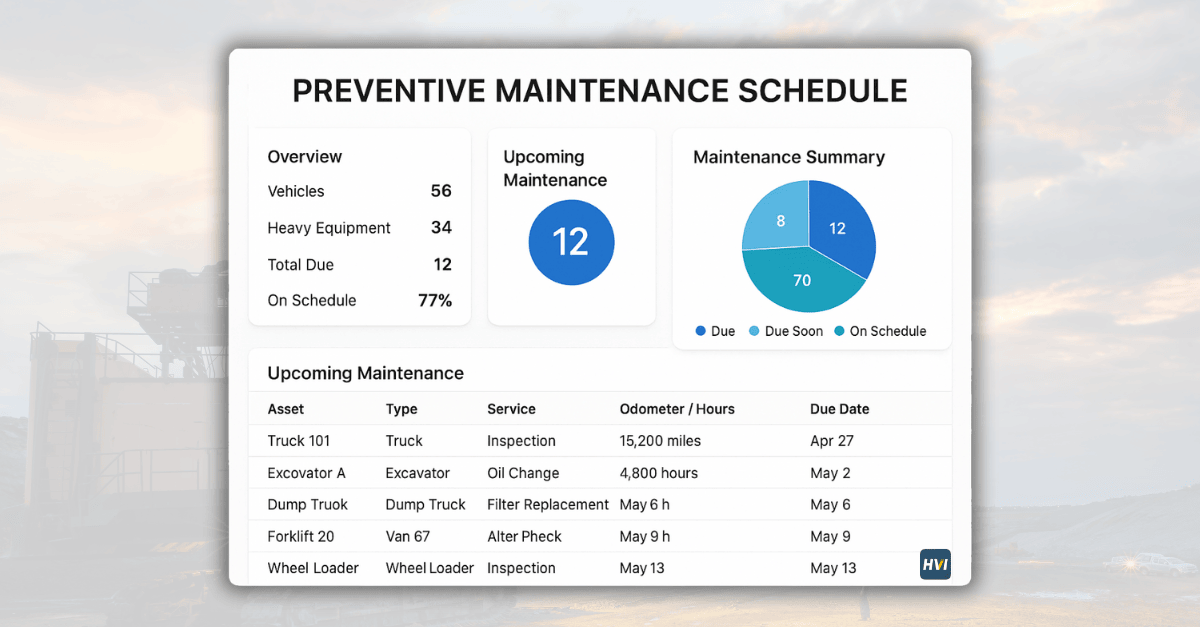
- PM triggers by hours before a unit is due
- Defects flagged at inspection, fixed between jobs
- Every check synced off the wellsite in real time
- A complete digital service record on every asset
- Maintenance is planned work, off the NPT line
That complete record is its own payoff: a full inspection and service history on each asset backs warranty claims, HSE audits and operator qualification — without anyone rebuilding it from memory. Watch a defect become a work order on a rig asset.
What it changes for your operation
Less maintenance NPT
Planned service in the yard or between jobs, instead of a rig waiting on a surprise failure.
Audit & HSE ready
Inspection and service records on demand for operators, auditors and safety reviews.
Visibility across sites
One screen for the whole dispersed fleet — what's due, what's down, what it costs.
The teams that run this way stop being surprised — and start winning work on reliability. Add your rigs and units free and build the history from today's tour.
From a drilling maintenance manager
Our NPT reports always had a maintenance column, and it was never zero. The killer wasn't the big stuff — it was the avoidable stuff. A mud pump that skipped a service because the unit was three hundred miles out, a wire-rope check that got logged on a form that never made it back. Small misses, big day-rate consequences.
Getting every asset on hour-based PM with inspections syncing off the wellsite changed what shows up on the morning call. The system tells me what's due before it's overdue, the records are there when an operator audits us, and maintenance stopped being the reason we lost hours. That reliability is what gets us the next contract.
Drilling equipment maintenance — FAQs
Does HVI cover drilling rigs and the support fleet?
Yes — the whole fleet on one platform. Drilling rigs, workover and well-service units, pump and winch trucks, mud and power equipment, and support assets each get their own profile, hour meter, PM schedule and inspection templates. You see the entire dispersed operation in one place instead of tracking rigs and trucks in separate systems.
Is HVI a well-control system or an API certification tool?
No, and it's important to be clear. HVI is a maintenance, inspection and records platform — it schedules and documents the inspections and services your equipment needs and keeps them audit-ready. It does not perform API certification, non-destructive testing, or act as a well-control or pressure-control system. Certified inspection of critical lifting and pressure equipment stays with your qualified personnel and third-party providers; HVI makes sure that work is scheduled, happens on time, and is recorded.
How does it reduce non-productive time?
By replacing surprise failures with planned work. Hour-based PM triggers services before a unit is due, and digital inspections catch defects early so they're fixed between jobs instead of mid-tour. Most maintenance NPT traces back to a missed service or an un-flagged defect — close those gaps and the maintenance column on the NPT report shrinks.
Can crews use it on remote wellsites?
Yes — it's mobile-first and built for the field. Crews run inspections and log hours from a phone or tablet at the wellsite, flag defects with photos, and the records sync so the shop and managers see them without waiting for paper to come off location. That's what makes a dispersed fleet manageable from one screen.
How fast can we roll it out?
Days, not weeks. You build the asset list once, set PM intervals and inspection templates per equipment type, and crews can be inspecting and logging hours on the next tour — across every site, since it's cloud-based. Start free to get your equipment in and try the workflow, then book a demo to configure schedules and roll it out across the fleet.
Make maintenance the thing that never stops the rig
One platform for every rig, workover unit and support truck. Hour-based PM that fires on the meter, critical-equipment inspections that sync off the wellsite, and a complete service record on every asset — so maintenance becomes planned work instead of a line on the NPT report. See it mapped to your fleet in 30 minutes.
Every asset on one list · PM by the hour · Inspect → work order → record