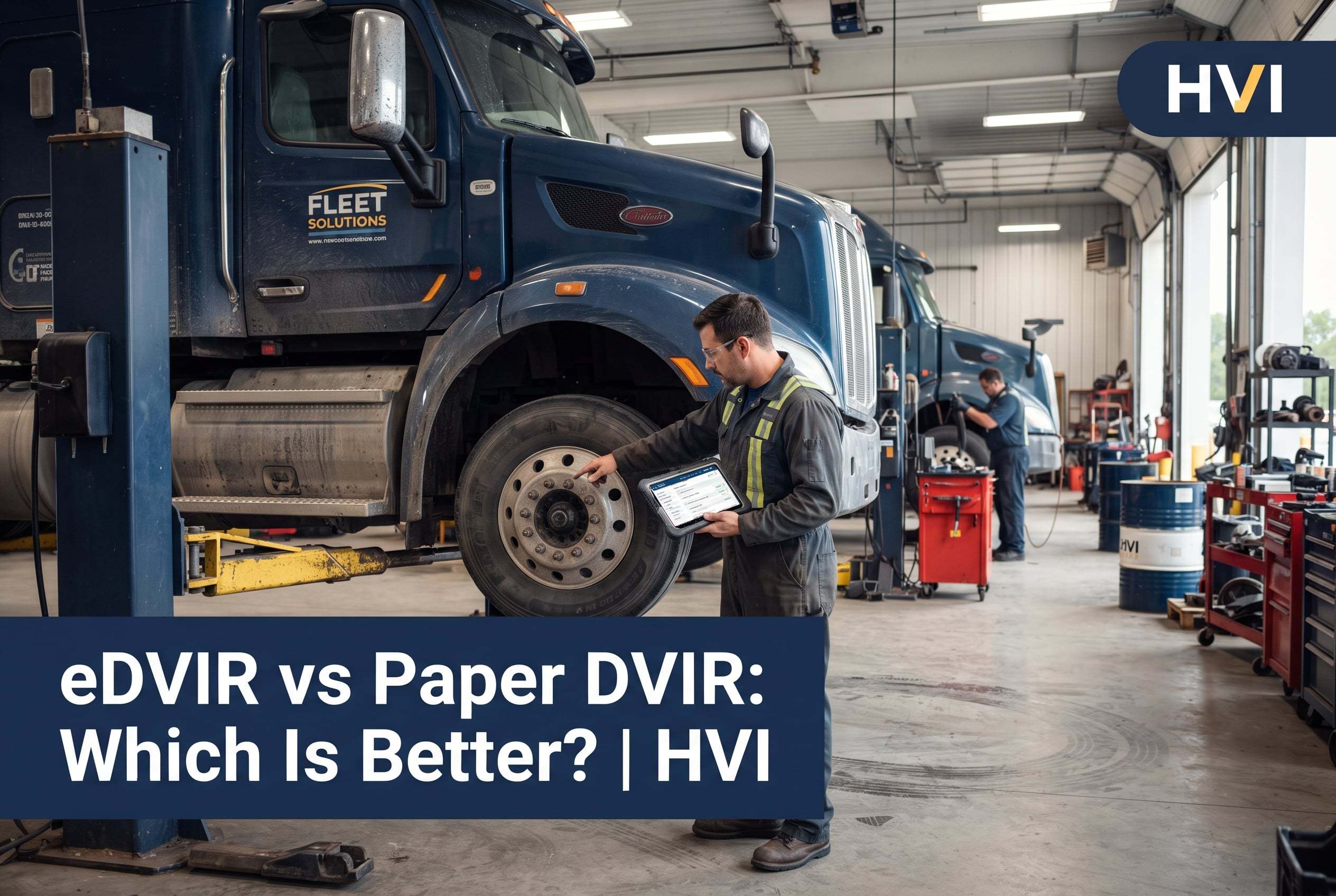
The right question isn't whether eDVIR is better than paper — that comparison has been settled by industry data, by the FMCSA's March 2026 final rule, and by any auditor you've talked to in the last year. The real question is whether your specific fleet should switch this quarter, next quarter, or wait a year. That comes down to three numbers: how many hours your team currently spends on paper DVIRs, what your last audit pass rate actually was, and what a single missed defect would cost you in insurance and litigation exposure. This page walks the switch decision the way a fleet manager would — the honest cost, the real payback timeline, the five signals it's already overdue, and what a two-to-four-week transition actually looks like. Book a demo to see the switch calculator applied to your fleet size.
Should Your Fleet Switch from Paper to eDVIR?
The honest comparison isn't feature-by-feature — it's whether the switch pays for itself before your next renewal. Here's the calculator, the payback timeline, and the five signals it's already overdue.
- Fleet size 20 trucks
- Paper DVIR hours/month 40 hrs
- Last audit pass rate 78%
Paper DVIRs are still legal after the FMCSA's March 2026 rule — the rule authorized digital, it did not ban paper. But "still legal" and "still competitive" are different things. Paper systems pass 73% of audits; digital pass 96%. Paper systems cost the average 20-truck fleet about 40 hours of admin time monthly; digital cuts that by roughly two-thirds. Every one of those numbers is a lever the switch calculator uses. Here's how they compound.
The three questions that decide it
Ignore the feature comparison for a minute. The three questions below tell you whether the switch is a "next quarter" decision or a "already overdue" one. Answer them honestly.
How many hours does your team spend on paper DVIRs each month?
Count driver fill-out time, dispatch review, filing, and the mechanic-and-office chase-down when a defect note gets lost. The average 20-truck fleet lands at 30–50 hours. At $35/hour loaded labor, that's $12,600–$21,000 a year in pure administrative overhead — before you count what the missed defects cost.
What was your last audit pass rate?
Not "did we pass" — the actual score. Paper systems average 73% pass rate at DOT and OSHA audits. Digital averages 96%. The delta is documentation completeness and the audit trail that paper cannot produce. If your last review found any missing signatures or unreadable dates, that gap is the answer.
What would one missed defect actually cost?
Not "did we have a crash" — the exposure. A DVIR-related citation runs $1,270 to over $16,000 per occurrence. A dispatch-with-known-defect finding can hit $23,048. A crash with an unfiled defect on the same vehicle turns into a nuclear-verdict discovery exhibit. Paper systems lose defect notes constantly. Digital systems block dispatch until repair is signed off.
Two of the three answers pointing to the same conclusion means the switch is already overdue. Three means you're bleeding money every month you wait. Book a demo to run the calculator on your actual numbers
What the switch actually costs — and when it pays back
The most under-covered part of every "eDVIR vs paper" article is the honest cost breakdown. Software subscription plus training plus transition time. Here's what the numbers actually look like at four common fleet sizes — and when they turn positive.
-
Small 5 trucksPayback: 2.6 months
-
Mid 20 trucksPayback: 3.4 months
-
Large 50 trucksPayback: 3.2 months
-
Enterprise 100+ trucksPayback: 2.9 months
Annual switching costAnnual savings (admin time + audit-risk reduction)
Payback lands between 2.6 and 3.4 months across every fleet size. The savings then compound annually while the cost stays flat — and none of that counts the insurance premium impact, which typically arrives at the next renewal 6–12 months out. Start free and start the payback clock
The 5 signals it's already time
These are the operational patterns that tell a fleet manager the switch is overdue, in the language of what actually happens on the ground. Any three of these together and the ROI clock is already running against you.
-
You've had an audit finding on documentation completeness Missing signatures, unreadable dates, or gaps between defect and repair certification. Paper's structural weakness. Digital DVIR platforms enforce the three-signature chain automatically — the audit finding literally cannot happen.
-
A defect note has been lost between yard and maintenance Every fleet running paper has done this at least once. In the best case it's a minor annoyance. In the worst case it's a dispatch-with-known-defect finding at $23,048 per occurrence — or a discovery exhibit at trial.
-
Your insurance broker asked for a DVIR completion report Underwriters increasingly ask for DVIR chain-completion rates at renewal. Paper systems can't produce it — digital reports it in real time. "We don't have that data" is now a pricing signal that leads to conservative underwriting.
-
Your CSA Vehicle Maintenance BASIC is climbing The 2026 SMS overhaul added a new "Driver Observed" category that directly scores the quality of driver-conducted inspections. Photo-verified digital DVIRs are the strongest evidence available in that category. Paper contributes nothing.
-
You're burning 30+ hours a month on DVIR admin Filing, review, chasing missing signatures, digging for a specific vehicle's history when an auditor asks. The switch reduces this by roughly two-thirds. Every hour recovered is an hour redirected to actual maintenance work — or to sleep.
Three or more checked means the switch is already returning positive ROI in your operation — you're just paying the cost side without collecting the savings side. Book a demo — see the numbers modeled on your fleet
What the 2-to-4-week transition actually looks like
The biggest myth about switching from paper to digital DVIRs is that it takes months and disrupts the fleet. The reality is closer to two-to-four weeks with almost no downtime, and here is the honest week-by-week.
-
Week 1Template setup Configure inspection templates per vehicle type (tractor, trailer, forklift, loader) mapped to the FMCSA 11-item minimum. Set defect routing rules and photo-required fields. Roughly two hours of admin time total.
-
Week 2Driver training Single 30-minute session per driver. Show the app, walk one inspection, answer questions. Most drivers pick it up on their second real DVIR. No CDL-holder in the country needs a two-day class for this.
-
Week 3Parallel-run week Drivers submit both paper and digital during the first live week. Catches any template gaps, edge cases, or offline-mode questions before you commit fully.
-
Week 4Paper retired Digital-only cutover. Historical paper DVIRs stay filed for the 3-month retention minimum, then archive. Every new inspection lives in the digital record from day one.
End-to-end, the transition costs the fleet manager a few hours over a month. The payback then compounds every subsequent month. Start free and begin week one today
From a compliance manager who made the switch
What sold my CFO wasn't the feature comparison. It was the payback math. I showed her our paper DVIR admin was costing about 45 hours a month across dispatch and the shop. She asked how long the switch would take. I said four weeks. She asked what it costs. I said less than five thousand a year for our size. She signed the same afternoon.
What I didn't tell her, because I couldn't prove it yet, was the audit piece. Three months in we got a random review, and I produced 90 days of DVIRs, defect records, and repair certifications in about eight minutes on my phone. The auditor asked if he could see the platform. That's when I knew the switch was permanent.
Frequently asked questions
Is my fleet required to switch to eDVIR after the March 2026 FMCSA rule?
No. FMCSA's Docket FMCSA-2025-0115, effective March 23, 2026, explicitly authorizes electronic DVIRs by adding clarifying language to 49 CFR 396.11 and 396.13 — but it does not mandate them. Paper DVIRs remain fully compliant if executed correctly. The rule was requested by industry stakeholders (NTTC in particular) to remove the interpretive ambiguity that had kept some carriers on paper. What the rule signals, more than what it requires, is FMCSA's direction: electronic records are the encouraged compliance path, cost-saving methods are actively supported, and the enforcement environment increasingly expects instant document retrieval. Paper remains legal; it does not remain equal. Fleets that stay on paper post-rule are choosing to compete with a slower audit-response capability, weaker CSA Driver Observed evidence, and no defect-chain enforcement — all of which are pricing signals to insurers and enforcement officers.
How long does the switch from paper to eDVIR actually take?
Two to four weeks for most fleets, based on industry implementation data across carriers with 5 to 500 vehicles. Week one is template configuration — mapping inspection items to your specific vehicle types (tractors, trailers, forklifts, loaders, dozers) and setting defect routing rules. Week two is driver training, typically a single 30-minute session per driver; no CDL-holder needs more time than that to learn a guided mobile checklist. Week three is often a parallel-run week where drivers submit both paper and digital to catch any template gaps or offline-mode edge cases before full cutover. Week four is paper retirement. Historical paper DVIRs stay filed for the 3-month FMCSA retention minimum and then archive normally. The total time cost to the fleet manager is a handful of hours across the month, and the payback clock starts the first day drivers use the digital workflow.
What is the real return-on-investment on switching to eDVIR?
Across common fleet sizes, payback lands between 2.6 and 3.4 months. The math works because two large categories of savings compound while the software cost stays flat. First, administrative time: the average paper-DVIR fleet spends 30-50 admin hours per month per 20 trucks on fill-out, review, filing, and defect chase-down. Digital cuts that by roughly two-thirds. At a $35/hour loaded labor cost, that's $12,600-$21,000 saved annually for a 20-truck fleet, before anything else. Second, audit-risk reduction: paper systems average 73% audit pass rate versus 96% for digital, and every DVIR-related citation runs $1,270 to over $16,000 per occurrence. Avoiding one preventable citation typically covers the software cost for a year. Longer-term, insurance premium impact and CSA score improvements add further compounding value, though those show up at renewal cycles 6-12 months out. Even without counting the insurance and CSA effects, first-year ROI is consistently 4x-8x the software cost.
What if we lose internet on a job site — does digital DVIR still work?
Yes. Every serious eDVIR platform, including HVI, is designed to work offline for drivers on remote job sites, in tunnels, in mountains, and anywhere else without reliable cell signal. Inspections are completed on the phone or tablet, saved locally on the device, and automatically sync to the cloud the moment connectivity returns. Photos, GPS coordinates, timestamps, and signatures are captured at the time of inspection using the device's own hardware, so nothing is dependent on real-time connectivity to complete a valid, compliant DVIR. This is one of the more common concerns fleet managers raise before evaluating a switch, and it's the concern that dissolves fastest during a demo — the platforms have been built to handle it because so many fleets operate in low-connectivity environments. The FMCSA 3-signature chain, retention obligations, and audit-trail requirements are all satisfied by the offline-then-sync workflow.
Which fleet sizes benefit most from switching to eDVIR?
Every fleet size sees positive ROI, but the shape of the benefit shifts as fleet size changes. Small fleets (2-9 trucks) see the fastest absolute payback and the biggest per-truck impact on their admin overhead, because paper-DVIR admin is disproportionately expensive at small scale — there's no economy of scale on filing cabinets. Mid-size fleets (10-50 trucks) see the largest total dollar savings because the audit-risk exposure and admin-hours base are both meaningful, and the software cost is still small. Large and enterprise fleets (50+ trucks) get the biggest strategic upside: real-time fleet-wide dashboards, CSA trending, defect pattern analysis across vehicles, and the audit-defensibility that insurers and lawyers price on. There is no fleet size at which paper is the economically rational choice under current FMCSA and CSA conditions; there are only fleets that have switched and fleets that will.
Run the switch calculator on your actual fleet
HVI turns the paper-to-digital DVIR switch into a two-to-four-week workflow: photo-verified mobile inspections, three-signature chain enforced structurally, defect-to-work-order routing, 48-hour audit exports, and a cost model that starts paying back before the second quarter closes. No hardware, no rip-and-replace, no long implementation. See it modeled on your numbers.
No credit card · No hardware · Live on your fleet in 2–4 weeks