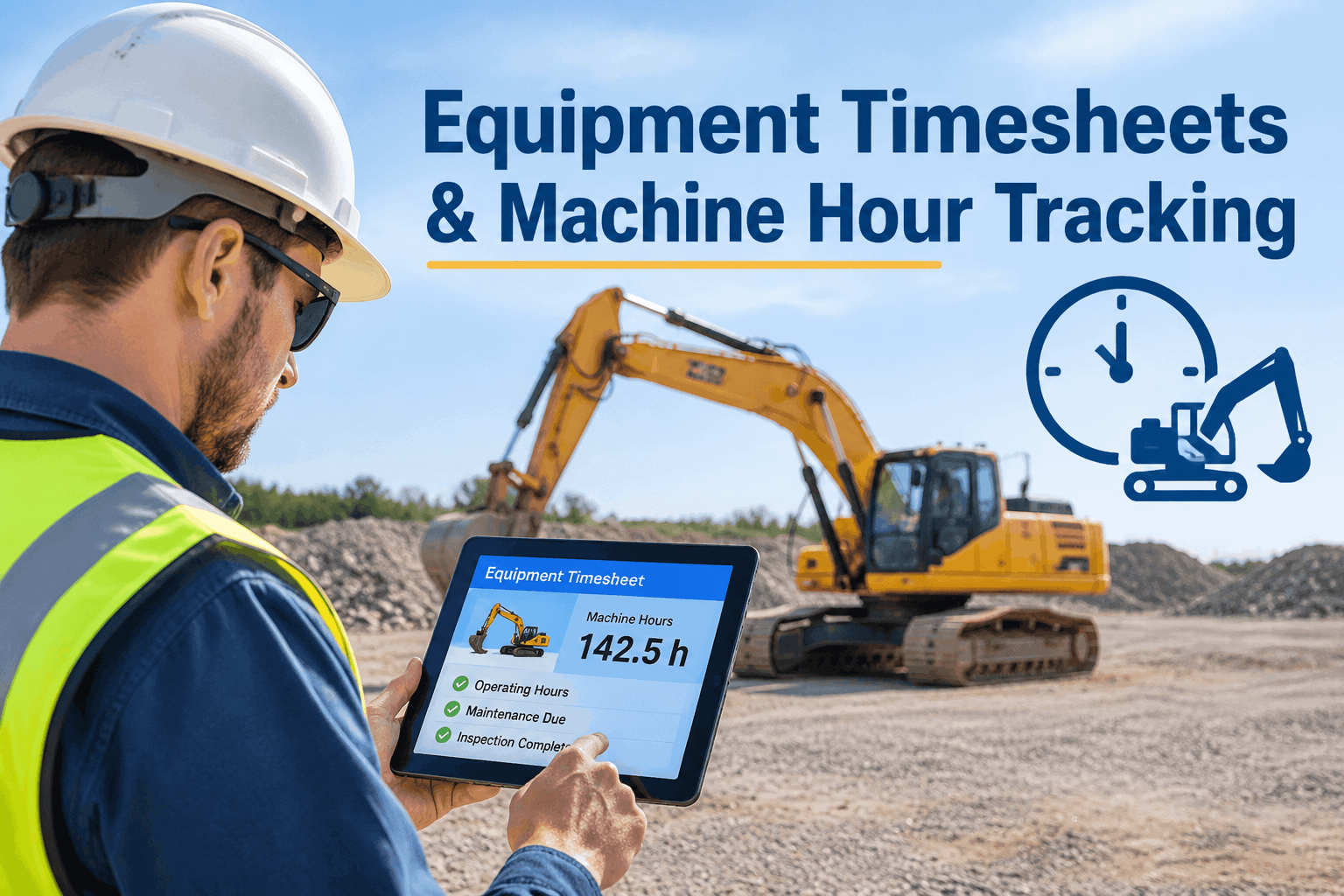
Ask three people what hours a machine ran last week and you'll get three answers — the operator's memory, a number scribbled on a clipboard, and an hour-meter nobody wrote down. That gap is where PM slips: a service due at 500 hours quietly runs at 560 because the equipment timesheets feeding the schedule were guesswork. Capturing machine hours accurately is what makes every hour-based PM trigger, utilization number and warranty claim actually true. Book a demo of digital hour capture to see it work.
Capture the hours, trust the schedule
Digital equipment timesheets turn hour-meter readings into clean records — so PM fires on time, utilization is visible, and the number behind every service is one you can stand behind.
Every hour-based maintenance plan, every utilization report and every resale valuation rests on one number: how many hours the machine actually ran. When that number is captured cleanly, the whole system downstream works — PM triggers on time, idle assets get spotted, and warranty and resale claims hold up. When it's captured on memory and loose paper, the errors compound quietly until a missed service turns into a failure. This guide covers where machine hours come from, why manual capture drifts, how to compare capture methods, and how clean equipment timesheets feed a maintenance schedule you can trust.
What a wrong hour costswhy sloppy equipment timesheets drift into real money
Hours don't have to be wildly off to cause problems. A consistent small error — a meter read late, a day estimated instead of recorded — pushes every downstream decision off by the same amount.
PM fires late
A service due at 500 hours runs at 560 because the hours lagged. Oil, filters and wear parts all stay in service past their window.
Utilization is blind
You can't see which machines are overworked and which sit idle, so rentals, transfers and buy decisions run on gut feel instead of hours.
Warranty at risk
OEM claims often hinge on documented service at the right hour interval. A shaky hour record is a claim an OEM can question.
Resale value sinks
A buyer pays for a documented hour history. No clean log means a lower price and a harder sale on used iron.
None of these is dramatic on its own — they're the slow leaks that make a fleet cost more than it should. Accurate equipment hour tracking plugs all four at the source. See meter-based maintenance best practices for the PM side, or book a demo of hour-based PM triggers.
How the hours get capturedcomparing the ways teams record machine hours
There's no single right method — it depends on your fleet and your sites. But each option trades accuracy against effort, and knowing the trade-off keeps you honest about how reliable your numbers really are.
Memory / estimate
Operator recalls the day's hours later.
Watch outDrifts fast; no audit trail.
Paper timesheet
Hours written on a sheet, keyed in later.
Watch outLost sheets, transcription errors, delay.
Digital hour log
Operator logs the hour-meter reading on a phone.
Watch outNeeds the habit built into the daily routine.
Telematics feed
Hours pulled automatically from the machine.
Watch outNot every machine is connected; still needs reconciling.
Most fleets land on a mix: telematics where it exists, a digital hour log everywhere else, and paper only as a fallback. The goal is the same — a reading tied to a date, a machine and a person. See how daily operator reporting captures the reading as part of the shift, or start free and log your first machine.
From hour-meter to work orderhow a captured reading becomes a triggered service
A number on a timesheet is only useful if it does something. The value is in the chain that turns a daily reading into a scheduled, closed service — automatically.
- 1ReadOperator logs the hour-meter at shift start or end
- 2RecordReading ties to the machine, date and person
- 3TrackRunning total builds the asset's hour history
- 4TriggerPM due at the next hour interval fires a work order
- 5CloseService done, logged, counter reset for the next cycle
That's the whole point of capturing machine hours well: the reading isn't the deliverable, the on-time service is. When the chain runs on clean data, nobody has to remember when the next oil change is due — the hours do it. Explore hour-based PM scheduling end to end, or book a demo of the reading-to-work-order chain.
What a good hour record looks likethe fields that make equipment timesheets trustworthy
A reliable equipment hour record isn't just a number — it's a number with enough context to be checked, trusted and used. Build these fields into the log and the data stops being disputable.
The basics
- Machine ID and asset number
- Date and shift of the reading
- Operator who logged it
- Hour-meter reading, not an estimate
The context
- Hours run this shift, not just the total
- Idle vs. working time where it matters
- Site or job the hours were logged against
- Any meter rollover or replacement noted
The trust layer
- A photo of the meter where accuracy is critical
- Time-stamped, so the reading can't be back-dated
- Stored against the asset, not a loose file
- Exportable for warranty or resale
Captured this way, a timesheet isn't a chore the office chases — it's a defensible record that proves the hours, the service and the machine's whole working life. Start free and build your hour-log fields once for the whole fleet, or book a demo to see a complete hour record.
From the equipment desk
We lost a warranty claim once because our hour records were a mess — the OEM asked when the 1,000-hour service was done and all we had was a guy's memory and a paper sheet nobody could find. Now the operator logs the meter every morning with a photo, it rolls straight into the asset's history, and the PM fires itself. The number I care about isn't the hours — it's that I haven't had a single late service or a disputed claim since. That started with just capturing the reading properly.
Equipment timesheets FAQs
What are equipment timesheets?
Equipment timesheets are records of how many hours a machine ran, usually captured from its hour-meter reading and tied to a date, asset and operator. Unlike employee timesheets, they track the machine's operating hours — the number that drives hour-based preventive maintenance, utilization reporting, warranty claims and resale value.
Why track machine hours instead of calendar dates?
A machine that runs 12 hours a day wears far faster than one that runs two. Hour-based maintenance schedules service to actual use, so a hard-working machine gets serviced sooner and a lightly used one isn't serviced needlessly. Calendar-only schedules either over-service idle equipment or under-service heavily used equipment.
What's the most accurate way to capture equipment hours?
Telematics feeds pulled straight from the machine are the most accurate where available. For machines without it, a digital hour log — the operator entering the hour-meter reading on a phone, ideally with a photo — is reliable and auditable. Paper timesheets and memory estimates are the least accurate and drift quickly.
How do equipment hours connect to preventive maintenance?
Each captured reading builds the machine's running hour total. When that total reaches a set interval — say every 250 or 500 hours — the system triggers a preventive maintenance work order automatically. Accurate hour capture is what makes those triggers fire on time instead of late, which is the whole point of tracking the hours.
How does HVI handle equipment hour tracking?
HVI captures hour-meter readings as part of the daily inspection or operator report, stores them in each asset's maintenance history, and uses them to schedule preventive maintenance by machine hours. Readings can be photo-backed and time-stamped, and the hour history exports for warranty or resale — so your equipment timesheets become defensible records, not loose paper.
Stop running maintenance on guessed hours
HVI turns equipment timesheets into trustworthy records: hour-meter readings captured at the shift, built into each asset's history, and used to trigger preventive maintenance by machine hours. See how clean hour capture tightens your PM schedule, warranty claims and utilization — book a demo on your own fleet.
No credit card · Hour-log and PM templates from day one