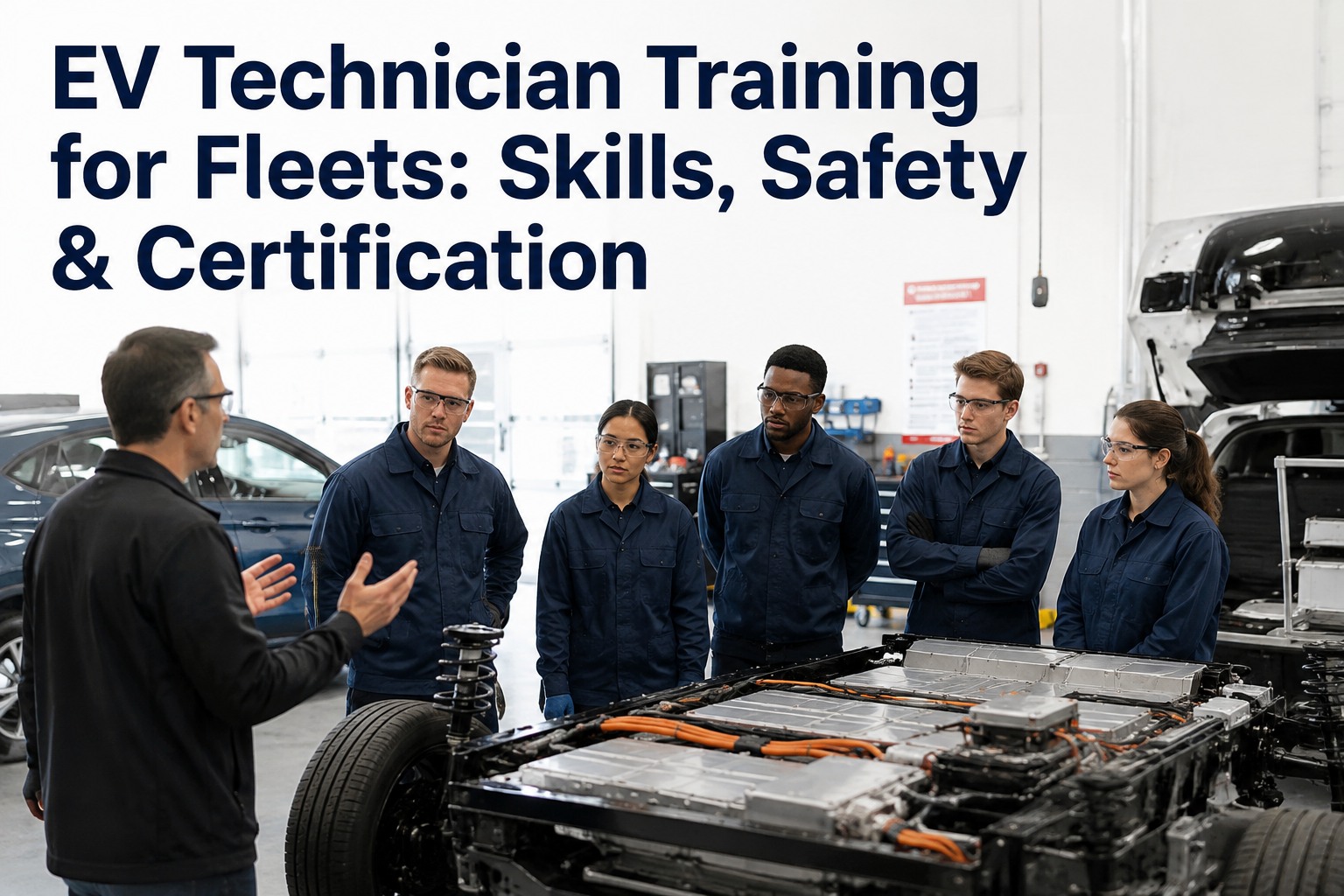
EV technician training is the workforce transition every fleet will face — and most are running the schedule backwards. Certifying technicians takes 6-18 months (ASE xEV Level 1 & 2, ASE L3, OEM programmes, NFPA 70E), while EV deployment often accelerates faster than expected. Fleets that map certification against their EV curve avoid the mid-transition gap where BEV trucks sit on the yard but no in-house tech can safely touch a high-voltage system — book a demo to manage EV technician training and competency in HVI.
EV Deployment vs Technician Certification — Build the Workforce Ahead of the Fleet
Waiting until BEV trucks arrive to start certifying technicians creates a 12-18 month gap where nobody in-house can safely service the high-voltage systems. This matrix maps what you need before that.
Pilot / early phase
Growing deployment
Majority transition
Fully electrified
Each stage represents 12-24 months of certification runway from a standing start. If your fleet plan says 30% BEV in 18 months, Level 2 certification for 40-50% of your techs starts today — not when the vehicles arrive.
The rest of this page walks the 3-tier certification framework (Awareness / Qualified / Specialist), the certifying bodies fleets actually recognise, the OEM-specific overlay that's non-negotiable for warranty work, and the competency records HR and safety need to hold. Book a 30-minute demo to see EV training records tracked per technician in HVI.
The 3-tier EV technician certification framework
ASE and its industry-wide xEV standards group all EV-relevant work into three practical tiers. Every fleet workshop needs each tier represented in its workforce mix — and the transition sequence between tiers takes 6-18 months per technician. This is the framework HR, training, and workshop leadership need to align on before the fleet plan gets aggressive.
Level 1 — Awareness
- Who: Everyone who might be near an EV
- Scope: Recognise hazards, boundaries, PPE basics
- Certification: ASE xEV Level 1 (Awareness)
- Time to certify: 4-8 hours online
- Can do: Work near EVs, basic non-HV tasks
- Cannot do: Any HV system work
Level 2 — Qualified
- Who: Technicians authorised for HV work
- Scope: HV isolation, LOTO, PPE, basic HV service
- Certification: ASE xEV Level 2 (Electrical Safety)
- Time to certify: 2-5 days classroom + practical
- Can do: HV isolation, verified de-energised work
- Cannot do: Complex HV diagnosis, live measurement
Level 3 — Specialist
- Who: Senior technicians & diagnostic leads
- Scope: Battery diagnosis, ePowertrain, live HV measurement
- Certification: ASE L3 (Light Duty Hybrid/EV Specialist)
- Prereqs: ASE A6 (Electrical) + A8 (Engine Performance)
- Time to certify: 6-18 months experience + exam
- Can do: Full HV diagnosis & repair
OEM-specific training
- Who: Techs working on specific EV OEM warranty
- Scope: Manufacturer proprietary diagnostics & procedures
- Providers: Volvo, Freightliner, Peterbilt, Kenworth, Tesla, others
- Time to certify: 1-4 weeks per OEM per year ongoing
- Required for: Warranty work, complex battery repairs
- Not substitutable: ASE L3 does NOT replace OEM training
The most common mistake in workforce planning is assuming ASE L3 is the "top of the ladder" and OEM-specific training is optional. It's the reverse in practice: ASE certification proves the technician can safely and competently work on any EV; OEM-specific training proves they can do it on a specific make/model to warranty standards. Both are required for a fleet running multi-OEM BEV trucks. Fleets running a single OEM (e.g., a Freightliner-only shop) still need the ASE foundation because it's what most jurisdictions accept as evidence of competency under NFPA 70E and OSHA 1910.335. Book a demo to see per-tech certification tracking with expiry alerts in HVI.
Certification providers — who fleets actually accept
Multiple training providers offer EV technician programmes and not all of them carry equal weight with fleet insurers, OEM warranty programmes, or state/provincial safety authorities. The below covers the providers whose credentials are most widely recognised across North American and European fleet operations.
| Provider / body | Programme | Region & recognition |
|---|---|---|
| ASE (National Institute for Automotive Service Excellence) | xEV Level 1, xEV Level 2, ASE L3 (Light Duty Hybrid/EV Specialist) | USA & Canada, industry gold standard |
| NFPA 70E | Electrical Safety in the Workplace — 2024 edition (2026 update publishing) | USA, aligned to OSHA General Duty Clause; retraining every 3 years |
| DEKRA | EV Safety Training aligned to NFPA 70E & OSHA | USA, EU, global — commercial fleet focused |
| AFVI (Alternative Fuel Vehicle Institute) | EV 101 through advanced programmes aligned to ASE Level 1 | USA, commercial fleet & transit focused |
| Tesla START | 12-week capstone at partner colleges | USA/Canada, direct-hire pathway to Tesla Service |
| OEM programmes | Freightliner, Volvo, Peterbilt, Kenworth, Mack, Ford, GM, Tesla, others | Manufacturer-specific, required for warranty |
| IMI TechSafe / EV Levels 1-4 | IMI EV certification framework (Levels 1 through 4) | UK, EU, Australia — industry standard |
| SkillsUSA / community colleges | Entry-level EV programmes integrated with automotive curricula | USA, pipeline for junior technicians |
The combination that stands up under audit and insurance review: ASE xEV certification (Levels 1 & 2 baseline, ASE L3 for specialists), NFPA 70E training with 3-year retraining cadence, and OEM-specific training for every make on the yard. UK and EU fleets substitute IMI TechSafe / EV Levels for the ASE piece but the structure is otherwise identical. Fleets in Australia typically follow either the IMI framework or a state-specific equivalent (SafeWork). Book a demo to see multi-provider certification tracking with expiry alerts in HVI.
The core skill areas EV technicians actually need — beyond the credentials
Certifications prove foundational safety and knowledge. Real EV work demands specific hands-on skills that only develop through practice on live vehicles under supervision. Five skill areas separate a Level 2 qualified technician from a truly capable EV service technician.
HV isolation & verification
Correct LOTO for each vehicle type, service disconnect location, capacitor discharge wait time (typically 5-10 minutes per OEM), verification with insulated meter to prove zero voltage. Every EV service starts with correct isolation.
Battery diagnostics
Cell balance monitoring, state-of-health assessment, thermal management diagnosis, cooling system service, individual module testing, and interpretation of OEM battery-management-system fault codes. Battery work is where most warranty disputes concentrate.
ePowertrain systems
Traction motor diagnosis, inverter fault analysis, DC-DC converter service, on-board charger diagnostics, thermal management for power electronics, and understanding of how motor-inverter-battery interactions surface as symptoms.
Diagnostic equipment
OEM-specific diagnostic tools (SDP3, ServiceLink, JPRO, EasyDTC, TechTool), insulated multimeters rated CAT III/IV to 1000V, insulation testers, safe access to service documentation, and correct calibration/certification schedules.
The fifth skill — often the differentiator between a good EV technician and a great one — is the ability to read the ePowertrain as an integrated system rather than a collection of components. A single symptom (e.g., reduced range, motor derate, charging failure) can trace to battery, inverter, motor, thermal, or software root causes. Training that produces technicians who can systematically isolate root cause across those layers is what separates the shop that fixes EVs first-time from the shop that keeps swapping parts. Start a free HVI trial to route EV work orders by required competency tier.
Competency records — what your insurer and safety authority actually want to see
Training records are the evidence — not the training itself
OSHA 29 CFR 1910.335 puts the burden on the employer to verify demonstrated skill of technicians working on high-voltage vehicles. NFPA 70E aligns the same way. Insurance carriers writing garage-keepers policies for EV-heavy fleets now routinely audit training records at renewal. The training itself is a prerequisite — the records are the evidence that stands up when someone asks. Six items belong in every technician's EV competency file. Employee name and employee ID. Every certification held with certifying body, level, certificate number, issue date, and expiry date — ASE xEV Level 1, ASE xEV Level 2, ASE L3, NFPA 70E, IMI TechSafe, and every OEM-specific credential (Volvo, Freightliner, Peterbilt, Kenworth, Tesla, others). Retraining history with dates and providers — NFPA 70E requires retraining every 3 years or after equipment change or incident; most OEM programmes require annual refresher. Practical assessment records where applicable — a technician's demonstrated ability on a specific procedure, not just their classroom pass. Any incident-related retraining triggered by a near-miss or safety event, with what was retrained and why. Photograph of current cards or wallet credentials where the certifying body issues one. Retention: minimum for the technician's employment plus 3 years, longer where OSHA or state authority requires. When your insurance auditor arrives, or when an incident triggers an investigation, this file is the evidence that carries the day — and its absence is the finding that leads to a citation or a claim denial. Digital competency records against each technician's profile, tied to work-order routing so an EV job cannot be assigned to an uncertified technician, is where fleet software either earns its cost in this transition or reveals its gaps.
A fleet maintenance director on the workforce plan that took 18 months
We're a regional delivery fleet, 340 trucks total, planning to hit 40% BEV by end of 2026 with Freightliner eCascadias and some Ford E-Transits. We started workforce transition in Q3 2024 — 18 months before our first meaningful BEV deployment. First move: all 42 workshop staff through ASE xEV Level 1 in 60 days. Second: 12 technicians nominated for Level 2, done over 6 months in cohorts of 4. Third: 4 senior techs on the ASE L3 pathway with A6/A8 prerequisites. Fourth: Freightliner-specific training scheduled around delivery of first eCascadia batch.
What we didn't anticipate: the retention lift. Certified EV technicians are actively recruited by other fleets. Two of our Level 2 techs got approached with 20-30% higher offers. We matched, kept them, but that was an unplanned budget hit. Advice for fleets starting the plan: budget for compensation adjustment alongside training cost. Certified EV techs are a scarce resource and the market prices them accordingly.
Frequently asked questions
What certifications does an EV technician need?
The industry-standard framework is three tiers plus an OEM-specific overlay. Level 1 — Awareness (ASE xEV Level 1 or equivalent): required for anyone who might come near EVs including repair, sales, or support staff. 4-8 hours online. Prepares users to recognise hazards but does not authorise HV work. Level 2 — Qualified (ASE xEV Level 2): required for technicians authorised to work on high-voltage systems. Covers HV isolation, lockout-tagout, PPE, and de-energised HV service. 2-5 days classroom plus practical. Authorised for verified de-energised HV work. Level 3 — Specialist (ASE L3, Light Duty Hybrid/Electric Vehicle Specialist): the industry-standard EV service credential for senior technicians and diagnostic leads. Requires ASE A6 (Electrical/Electronic Systems) and A8 (Engine Performance) as prerequisites. Covers battery systems, HV safety procedures, drive system diagnostics, power electronics. Typically 6-18 months of experience plus exam to certify. Authorised for full HV diagnosis and repair including live measurement where required. OEM-specific training overlay is separate and required for warranty work on specific vehicle makes (Volvo, Freightliner, Peterbilt, Kenworth, Tesla, others). ASE L3 does NOT replace OEM training. UK/EU fleets follow the IMI TechSafe / EV Levels 1-4 framework in place of the ASE structure.
What is the ASE L3 certification and how do you get it?
ASE L3 is the Light Duty Hybrid/Electric Vehicle Specialist certification issued by the National Institute for Automotive Service Excellence, and it is the industry-standard credential for hands-on EV service in North America. It certifies that a technician has demonstrated the knowledge and skills required to diagnose and repair hybrid and electric vehicles including battery systems, HV safety procedures, drive system diagnostics, power electronics, and hybrid supporting systems. Prerequisites: candidates must first hold both ASE A6 (Electrical/Electronic Systems) and ASE A8 (Engine Performance) certifications. This prerequisite structure is intentional — the L3 is built on a foundation of electrical knowledge that technicians who lack solid grounding in automotive electrical systems typically struggle with. Certification path: hold A6 and A8, accumulate practical EV service experience (typically 6-18 months), study using ASE L3 study materials, then sit and pass the exam. Recertification: every 5 years to keep the credential active. ASE L3 does not replace OEM-specific training for warranty work, but it is what insurers, safety authorities, and hiring managers most commonly accept as evidence of general EV service competency.
Is NFPA 70E training required for EV technicians?
NFPA 70E (Standard for Electrical Safety in the Workplace) is widely recognised as OSHA's recommended method for meeting electrical safety obligations under the General Duty Clause, and it is the framework most fleet workshop safety programmes align to. The 2024 edition is current, with the 2026 update expected to publish early 2026. For technicians working on high-voltage EV systems, NFPA 70E training covers arc-flash hazards, approach boundaries, PPE requirements, lockout-tagout, and safe work practices for energised electrical work. Retraining is required at intervals specified by NFPA and employer policy — minimum every 3 years, or after equipment changes or after an incident. While NFPA 70E is not strictly a regulation, OSHA cites it in enforcement actions under 29 CFR 1910.335, and insurance carriers auditing EV-heavy fleets routinely check for current NFPA 70E training in the technician's competency file. UK fleets follow HSE guidance and IMI EV standards; EU fleets follow their national implementations. In all jurisdictions, the practical answer is yes — NFPA 70E or equivalent electrical safety training is a required component of the competency evidence for HV work.
How long does it take to train an EV technician?
Timeline depends on starting point and target tier. Level 1 Awareness: 4-8 hours online. Achievable in a single working day for any staff member. Level 2 Qualified: 2-5 days of classroom plus practical training. Realistic elapsed time from enrolment to certification is 4-8 weeks accounting for course scheduling. Level 3 Specialist (ASE L3): 6-18 months from a strong electrical baseline. Technicians who already hold ASE A6 and A8 can pursue L3 in 6-12 months; technicians starting without those prerequisites need to sit A6 and A8 first, extending the total to 12-24 months. OEM-specific training: typically 1-4 weeks per OEM per year of ongoing training. NFPA 70E: 8-24 hours initial, with 3-year retraining cadence. Fleet workforce transition timeline: for a shop of 40 technicians targeting 40% BEV coverage, budget 18 months from workforce plan approval to full-mix readiness. The bottleneck is not usually the training itself but the sequencing of who attends when without leaving the workshop understaffed, and the ASE L3 pathway which is the longest track.
Do I need OEM-specific training if my technicians hold ASE L3?
For safety and general diagnostic competency, ASE L3 is sufficient across most makes. For warranty work on specific vehicle makes, ASE L3 does not replace OEM-specific training. Every commercial EV OEM (Freightliner, Volvo, Peterbilt, Kenworth, Mack, Tesla, Ford, GM, and others) runs its own manufacturer-specific technician training programme covering proprietary diagnostic tools, factory-authorised repair procedures, battery module procedures, and warranty documentation requirements. Warranty work performed by a technician without current OEM certification may be rejected by the manufacturer even if the technician is otherwise ASE L3 qualified. For a fleet running a single OEM, the OEM programme alone can technically cover the safety and warranty requirements, but the ASE foundation is still what most insurers and safety authorities accept as evidence of general EV service competency — and it makes the technician marketable across makes if fleet composition changes. For fleets running multiple EV OEMs, the practical answer is both: ASE foundation for baseline competency plus current OEM certification for every make on the yard. Budget 1-4 weeks per OEM per year for ongoing OEM training refresh.
Build your EV workforce ahead of your EV fleet — on one connected record
HVI holds each technician's ASE xEV, ASE L3, NFPA 70E, IMI TechSafe, and OEM-specific certifications with expiry dates and 90/60/30-day renewal alerts. Routes EV work orders only to technicians with current qualifications on that vehicle type. Produces per-technician competency records for insurance audit, OEM warranty compliance, or workforce planning. When the auditor asks or a Level 2 tech reaches renewal date, the record is one screen. Live in under two weeks. No hardware. No credit card.
Trusted by fleet, delivery, transit & utility operations across USA, Canada, UK, EU & Australia · Ready on day one