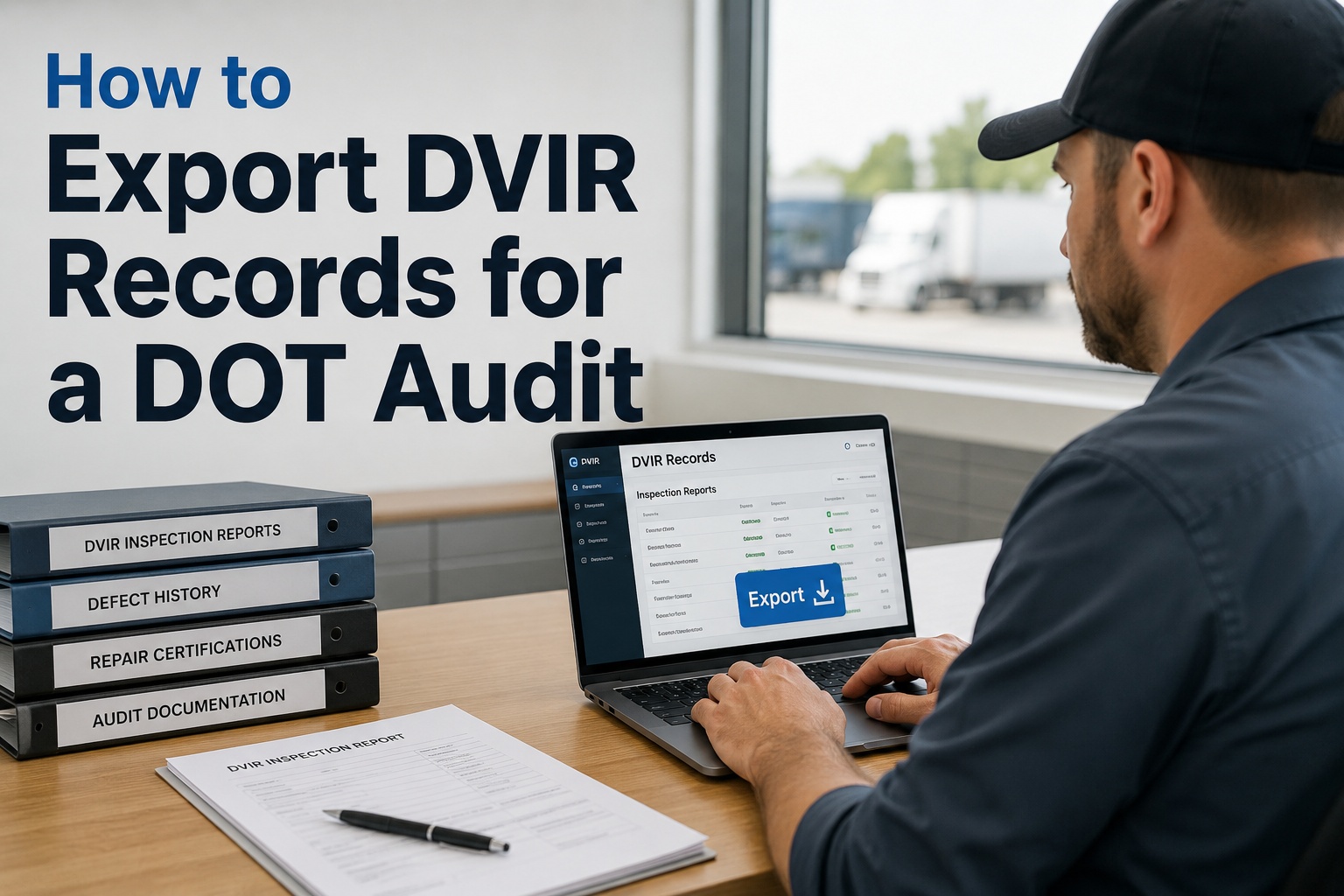
Exporting DVIR records for a DOT audit is an 8-step workflow: identify the requested vehicles + date range, locate reports, verify defects, confirm repair certifications, verify driver review signatures, organize by vehicle and date, export in readable format, and review before submission. Under 49 CFR §396.11(a)(4), motor carriers retain DVIRs + repair certifications + driver review certifications for 3 months minimum. Paper-based fleets typically need days; digital DVIR platforms produce the same package in minutes. Book a demo .
How to Export DVIR Records for a DOT Audit
Auditors request a sample of vehicles + a date window. The task is producing every DVIR + repair certification + driver acknowledgment for that sample in a submission-ready package. Here's the workflow.
A DOT compliance review isn't a whole-fleet document dump — auditors sample. A typical request looks like "DVIRs for units 142, 187, and 224 for the past 90 days, with associated repair certifications and driver acknowledgments." What separates fleets that respond in hours from fleets that struggle for days is not the volume of records requested but where those records live and how quickly the three-signature chain can be verified for each documented defect. This guide walks through the 8-step DVIR export workflow used to respond to that kind of request, the retention rules that determine what must be produced, the failure modes that consistently trip up paper-based operations, and how digital DVIR platforms structurally close the gap between "records exist" and "records can be produced on demand." The regulatory content behind each step traces back to 49 CFR §396.11 (DVIR recordkeeping) and §396.13 (driver review and acknowledgment); the workflow itself is operational discipline layered on top of those rules.
What DVIR records the auditor actually requestsRetention windows, sample scope, and the full 3-record package per vehicle
Under §396.11(a)(4), motor carriers must retain the DVIR + certification of repairs + certification of driver's review for 3 months from the date the report was prepared. Auditors typically request records covering that 90-day window or longer (many compliance reviews sample 3-6 months), across a defined subset of vehicles and drivers — not the whole fleet. Understanding what's actually requested is step zero to producing it. Book a demo to see HVI's audit-response workflow
The federal minimum retention is 3 months from the date the written report was prepared, covering all three documents in the chain (DVIR + repair certification + driver review certification). Many fleets extend digital retention to 12-24 months or longer to support crash defense and litigation exposure.
Auditors sample. Typical request covers 10-20% of vehicles and drivers across a defined date window, sometimes with specific vehicles called out (recent incident, roadside violation, or CSA hot spot). The sample is meant to be representative of overall compliance discipline.
For every DVIR documenting a defect, the auditor expects to see the full chain: (1) the DVIR itself with defect described and reporting-driver signature, (2) the mechanic/carrier repair certification per §396.11(a)(3), and (3) the next-driver acknowledgment per §396.13(c). Missing any one document is a citable violation.
Records must be available on demand to authorized officials. "We'll have to look for those" is already interpreted as a records-availability finding. Standard response window is 48 hours or less for well-organized fleets; digital systems typically produce audit packages in minutes.
The 8-step export workflow — audit request to submission-ready packageWhat to do in order, what to verify at each step, what to catch before submission
The 8-step workflow is designed to produce a complete, auditor-ready DVIR export package that closes each 3-signature chain for the requested vehicles and date range. Each step catches a specific failure mode before it becomes an audit finding.
Read the audit request carefully. Note specific vehicle IDs, VINs, or unit numbers requested; note the start and end dates of the window. If the request is broad ("all DVIRs for tractors in dedicated fleet"), clarify scope with the auditor before pulling records. Working from a documented request scope prevents both under-production (missing records = finding) and over-production (extra records = extra audit surface).
Search the record system(s) for every DVIR filed against the requested vehicle IDs within the date window. On paper-based systems this means searching depot filing cabinets, mechanic's office folders, and driver logbook attachments. On digital systems this is a filter by vehicle + date range. Confirm each operating day is either represented by a DVIR OR justified by an operational absence (vehicle out of service, driver on leave, no operations that day). Gaps in operating days without DVIRs need explanation.
For each DVIR retrieved, identify what defects were reported by the driver. Every defect creates a chain link that needs closure: the mechanic's repair certification (step 4) and the next-driver acknowledgment (step 5). "No-defect" DVIRs (where filed as company policy) don't need a chain closure but still count as compliance evidence.
Under §396.11(a)(3), each defect must have a repair certification: either the mechanic certifies the repair was performed OR that repair is not necessary for safe operation. Match every defect from step 3 to a corresponding certification. Missing certifications are among the most-common audit findings and require immediate escalation — you can't create a certification retroactively for an audit.
For every DVIR with a documented defect and repair certification, verify the next driver's acknowledgment signature. This closes the third link in the chain. The next-driver acknowledgment is the most-frequently-missed signature and the most-common source of citable violations. Confirm the acknowledgment date is BEFORE the vehicle's next operation, not after.
Structure the export package by vehicle (primary), then by date (secondary). For each vehicle: all DVIRs in chronological order, each DVIR followed immediately by its associated repair certification and next-driver acknowledgment. This is how auditors read compliance records — making them navigate a disorganized package increases scrutiny across the whole submission.
Standard export format is PDF with clean pagination, legible signatures, and each vehicle in its own file or section. Digital DVIR platforms produce this natively; paper-based systems typically require scanning + OCR + re-organization. Photo evidence attached to defect entries should be included where relevant. Confirm timestamps are visible and readable.
Final pre-flight check: every requested vehicle has DVIRs for the operating days in the window, every defect has a repair certification, every certification has a next-driver acknowledgment, and every document is legible. Any incomplete chain flagged in review is far less costly to acknowledge to the auditor upfront than to have discovered during their examination. Document the review process itself — who reviewed, when, what gaps were noted.
Chain-linked records at creation time is what removes the reassembly-at-audit problem entirely — the export step becomes a filter query rather than a reconstruction project. Book a demo to see linked-chain records in action
Common DVIR audit-export mistakes and how to prevent themThe failure modes that repeatedly produce audit findings across fleets of every size
The same handful of mistakes appear again and again in DVIR audit findings. Each has a specific structural fix — not more training, not more effort, but a workflow change that removes the failure mode. Start a free trial to see the audit-ready workflow in action.
Failure mode: Internal retention schedule uses "2 months" or "60 days" instead of the actual §396.11(a)(4) 90-day minimum. Audit request for a 90-day window finds gaps in the older records.
Fix: Explicitly document retention schedule at 90-day federal minimum and align system purge dates. Better: retain digitally at 12+ months to eliminate the risk entirely.
Failure mode: Reporting-driver signature and mechanic certification are present, but the next-driver §396.13(c) acknowledgment is missing. Vehicle was operated without the closing chain signature. Single most-cited audit finding in DVIR reviews.
Fix: Dispatch-blocking workflow — vehicle cannot be released for next operation until the assigned next driver captures the acknowledgment signature.
Failure mode: Repair certification exists but is filed separately from the DVIR that generated the defect. Auditor cannot trace defect-to-repair thread. Chain break creates a citable finding even though the repair happened.
Fix: Link every repair certification to the originating DVIR at record creation time, not at audit time. Digital DVIR platforms structure records this way by default.
Failure mode: DVIRs live in driver logbooks, repair certifications in the mechanic's paperwork, acknowledgments on dispatch clipboards, and each depot maintains its own retention schedule. Assembling a per-vehicle chain for audit takes days.
Fix: Centralize DVIR + repair certification + driver acknowledgment into one records system accessible from any location. Enables audit-response measured in minutes rather than days.
Quarterly self-audit against a random 10-20% sample of vehicles is the operational discipline that catches these four mistake patterns before an actual audit does. Book a demo to see HVI's self-audit sample-export workflow
From a compliance officer on DVIR audit-export workflow
Our last compliance review request landed on a Tuesday morning: DVIRs for 8 tractors and 12 trailers, past 90 days, full chain. Six months earlier that would have been a five-day scramble — runners going to three depots, mechanics pulling repair certifications from paper files, dispatch trying to piece together which driver acknowledged what on which morning. We had digitized the DVIR workflow eight months prior. The Tuesday-morning request went out from the safety desk at 9:15 AM as a filter query. The 20-vehicle 90-day package with every chain closed came back at 9:23. We sent the PDF to the auditor by 10 AM.
What that saved us wasn't the eight days of labor. What it saved us was showing up to the audit response with confidence instead of anxiety, and knowing before the auditor did that we had zero chain gaps in the sample. The audit outcome was clean. But the operational shift was: DVIR export stopped being an emergency workflow and became a two-tap query. Everything upstream — the driver's post-trip, the mechanic's certification, the next driver's acknowledgment — had to already work, which is why we changed those first. The export is the last mile; the chain discipline is the first.
Frequently asked questions
How do you export DVIR records for a DOT audit?
Exporting DVIR records for a DOT audit follows an 8-step workflow: (1) identify the specific vehicles and date range the auditor requested; (2) locate every DVIR report filed against those vehicles across the window; (3) review each DVIR to identify reported defects; (4) verify a §396.11(a)(3) repair certification exists for every reported defect; (5) verify the §396.13(c) next-driver acknowledgment signature exists after each repair certification; (6) organize records by vehicle (primary) then date (secondary), with each DVIR immediately followed by its associated repair certification and next-driver acknowledgment; (7) export the organized records in a readable submission-ready format (typically PDF with clean pagination and legible signatures); (8) review the complete package for chain gaps before submitting to the auditor. The workflow closes each 3-signature chain per DVIR (reporting driver + mechanic certification + next-driver acknowledgment) which is what auditors trace when reviewing DVIR records. Paper-based fleets typically need days to complete the workflow across scattered filing systems; digital DVIR platforms produce the same audit-ready package in minutes with vehicle and date-range filtering that assembles the full chain per record automatically.
How long must DVIR records be kept?
Under 49 CFR §396.11(a)(4), motor carriers must retain the driver vehicle inspection report + the certification of repairs + the certification of the driver's review for 3 months (90 days) from the date the written report was prepared. All three documents in the DVIR chain must be retained together for the full 3-month period. Missing any one document within the retention window is a citable violation even if the other two documents exist. Best-practice retention typically extends well beyond the 3-month federal minimum — many fleets retain DVIR records for 12-24 months (or longer) to support crash defense documentation, insurance claim response, warranty verification, and multi-year defect pattern analysis. Digital DVIR retention makes extended periods essentially cost-free once the records infrastructure is in place. Retention timing matters for audit response: if an audit requests 90 days of records and your internal retention schedule purges at 60 or 75 days, you have gaps in the older records that produce automatic findings regardless of the actual quality of the underlying DVIR discipline. Explicit alignment of internal retention schedule to the federal minimum (or beyond) prevents this failure mode.
What DVIR records can a DOT auditor request?
A DOT auditor performing a compliance review typically requests DVIR records for a sample of vehicles and drivers across a defined date window — not the entire fleet. Common sample scope is 10-20% of vehicles and drivers with a 90-day (or longer) date window, sometimes with specific vehicles called out based on recent roadside inspection results, incidents, or CSA data. For each vehicle in the sample, the auditor expects the full DVIR chain per record: the DVIR itself with driver-reported defects and reporting-driver signature (§396.11), the mechanic or authorized carrier person's repair certification for each defect (§396.11(a)(3)), and the next-driver acknowledgment signature confirming review and repair certification before operation (§396.13(c)). Missing any one document in the chain is a separate citable violation. Auditors trace threads — picking specific defects and following them through repair and acknowledgment — rather than reading every record. An unbroken thread across the sample builds confidence in the whole program; a broken thread triggers deeper file examination. Records must be produced within a reasonable time frame (48 hours is a commonly-cited response window); "we'll have to look for those" is interpreted as a records-availability finding regardless of whether the records eventually surface.
What documents should be included in a DVIR audit file?
A complete per-vehicle DVIR audit file for a given date window should include: (1) every DVIR filed against the vehicle across the window, in chronological order, with reporting-driver signatures visible and legible; (2) for every DVIR that documented a defect, the associated §396.11(a)(3) repair certification (either "repair performed" with mechanic identification and date, OR "repair not necessary for safe operation" with basis for the determination); (3) for every DVIR with a documented defect and repair certification, the next-driver §396.13(c) acknowledgment signature dated before the vehicle's next operation; (4) any photo evidence attached to defect entries where the fleet captures photo documentation; (5) operational context for any gaps (vehicle out of service, driver on leave, no operations that day) so the auditor understands why some operating days lack DVIRs. The package should be organized by vehicle (primary) then chronologically by date (secondary), with each DVIR immediately followed by its associated chain documents. PDF format with clean pagination is the standard export deliverable. Extended-retention fleets often include a cover page summarizing retention policy, records system used, and export methodology to preempt process questions from the auditor.
Do electronic DVIRs meet FMCSA requirements for audit records?
Yes — electronic DVIRs meeting 49 CFR §390.32 requirements are fully compliant for audit records. Electronic DVIRs have been permitted since 2018 under §390.32, and FMCSA has added explicit electronic DVIR authorization language directly to both §396.11 and §396.13 to remove any ambiguity. Electronic records must be readily accessible, capable of being produced in printed format upon request from authorized federal, state, or local officials, and maintained with integrity throughout the required retention period. Electronic signatures meeting §390.32 standards satisfy the multi-signature chain requirements (reporting driver + mechanic certification + next-driver acknowledgment). Practical audit-response advantages of electronic DVIRs are significant: automated vehicle and date-range filtering that assembles the full chain per record, timestamped signature records providing stronger audit-defensible evidence than paper equivalents, searchable multi-vehicle history supporting the sample-based audit request pattern, and export in PDF format ready for auditor submission. Paper-based fleets facing recurring audits typically find the digital transition pays back through audit-response time savings alone, before accounting for compliance improvements from dispatch-blocking chain enforcement. Specific applicability of electronic DVIR options to a given operation should be confirmed with qualified DOT compliance counsel.
The export is the last mile; the chain discipline is the first — both live in one records system
HVI centralizes DVIR + repair certification + driver acknowledgment as one linked record per vehicle per day, supports vehicle and date-range filtering, exports complete 3-signature chain packages in PDF format ready for auditor review, and maintains retention beyond the §396.11(a)(4) minimum for crash defense and litigation support — the digital DVIR infrastructure that turns audit-export from an emergency workflow into a two-tap query.
No credit card · No hardware · Setup in minutes