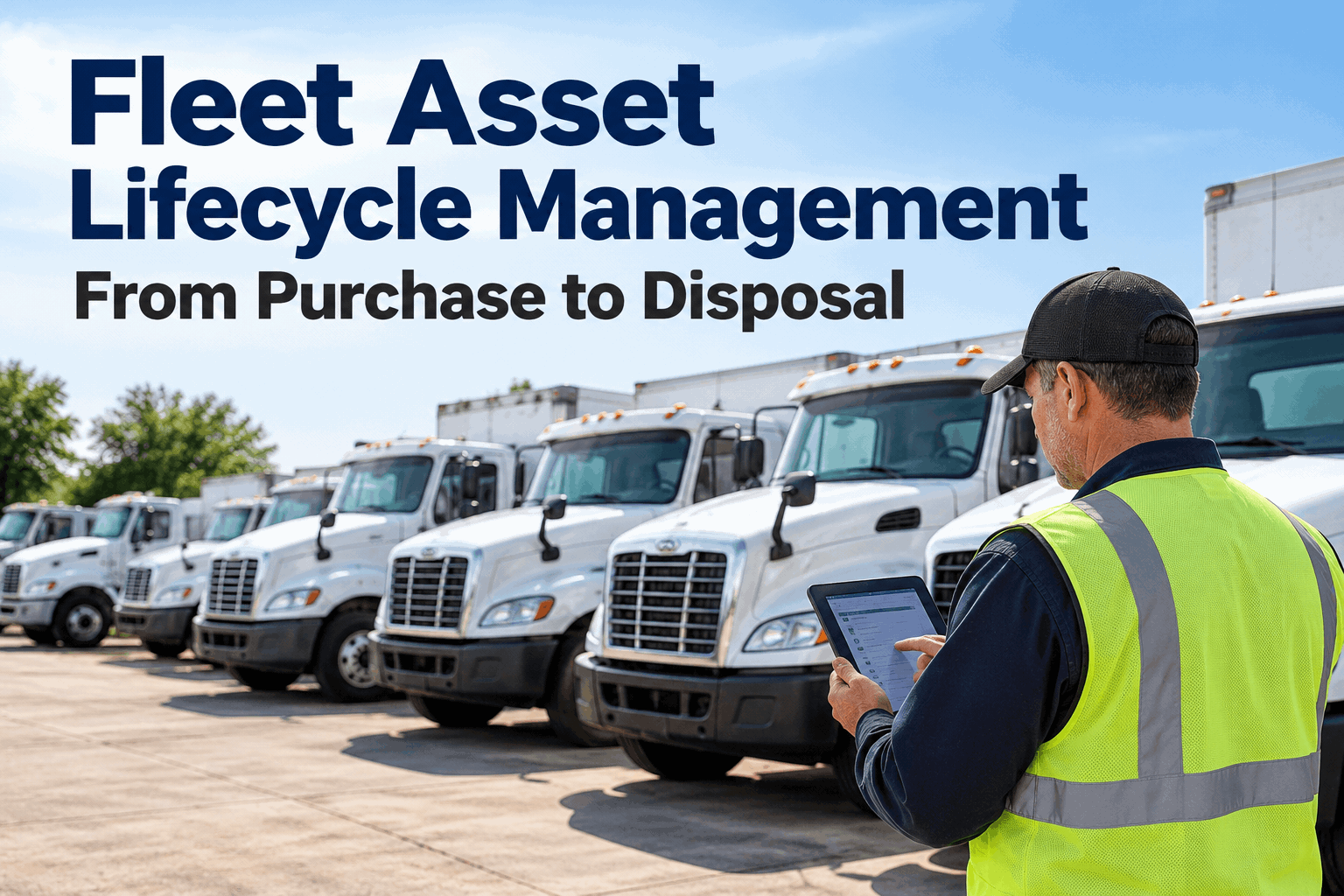
Fleet asset lifecycle management breaks down for a reason nobody puts on the whiteboard: the decisions are easy, but the record they depend on is scattered. Purchase price is in accounting, fuel is on the card statement, repairs live in a binder, and whether the truck earns its keep is in the maintenance manager's head. When it's time to decide keep-or-replace, you're reconstructing the asset's whole life from memory. Book a demo of per-asset cost history to see the full life of a unit in one place.
Fleet Asset Lifecycle Management: One Record, Purchase to Disposal
Every truck writes its financial story across five stages. The fleets that replace at the right time aren't smarter — they just have the whole story in one place instead of five.
The lifecycle model itself is well understood — acquire, deploy, operate, evaluate, dispose. What actually decides whether fleet asset lifecycle management works is less glamorous: can you see everything one asset cost you, from the day it arrived to the day you sell it, without a week of digging? Below is what each stage should be writing into that record, where the record usually breaks, and what a complete one lets you decide.
What Each Fleet Asset Lifecycle Stage Should Recordfive stages, five sets of data the asset's record needs
Think of the lifecycle not as five phases of activity but as five chapters the asset's record should be writing automatically. Miss a chapter and the replacement decision at the end is guesswork.
Acquire
The cost basis for everything that follows. Capture purchase price, spec, finance terms and in-service date — the baseline every later number is measured against.
Records: purchase cost, spec, warranty startDeploy
The asset enters the register and gets a home. Assign it, set its PM schedule by meter or calendar, and log the opening odometer or hours so utilization has a starting line.
Records: assignment, PM plan, baseline meterOperate & Maintain
The longest chapter and the one that decides the asset's fate. Every fuel entry, PM, repair and inspection logs against the unit — this is where cost-per-mile is actually built.
Records: fuel, PM, work orders, downtimeEvaluate
Read the record. Cumulative cost, cost-per-mile versus the class average, utilization and repair frequency tell you whether this asset is still earning or quietly bleeding.
Records: cost-per-mile, utilization, keep/replaceDispose
Close the book while the asset still has value. Timing the sale against residual value and a clean service history recovers more than a last-minute dump at auction.
Records: residual, sale/retire, recoveryStages one, two and five each write once. Stage three writes every single day — which is exactly why it's the chapter that goes missing. Keeping it complete is the whole game, and it's where booking a demo of automated cost logging earns its place in fleet asset lifecycle management.
Where the Fleet Asset Record Breakswhy lifecycle data scatters — and what it costs you
The lifecycle theory assumes you have one complete record per asset. In most fleets you don't — you have fragments in four places that never add up until someone spends a day making them.
When these four never merge, you find out a truck was a money pit only after you've poured another year of repairs into it. A single asset record pulls them together — fuel, parts, labor and downtime all logged against the unit — so the keep-or-replace call rests on one cumulative number, not four partial ones. That's the practical core of lifecycle management software, and it pairs with the deeper cost-curve math in HVI's lifecycle value analysis guide.
Fleet Asset Lifecycle Management Software in Actionone unit's complete record, acquisition to today
This is what the scattered four silos look like once they live in one place. Every number tied to one truck, its whole life visible at a glance — and the one metric that tells you where it sits on the curve.
No binder, no four-way reconciliation — the truck's whole financial life on one screen, with the cost-per-mile gap that signals the decision already calculated. That record is the asset-management core that the rest of fleet asset lifecycle management is built on, and you can sign up free and build your first asset profile in an afternoon.
Fleet Asset Record Completeness Checklistcan you answer these for any unit in under a minute?
This is the real test of your fleet asset lifecycle management, not the theory. Pick any truck in your fleet and run it. The ones you can't answer fast are the chapters missing from its record.
- Purchase price and in-service date are on record
- Warranty terms and spec are logged, not lost
- A baseline odometer or hour reading was captured
- Every repair and part is logged against the unit
- Fuel cost rolls up per asset, not just per card
- Downtime and PM compliance are tracked, not guessed
- Cumulative lifetime cost is one number, instantly
- Cost-per-mile can be compared to the class average
- Service history survives to support resale value
Couldn't answer one fast? That unit's record has a hole, and the keep-or-replace call on it is a guess. Book a demo and run your own worst asset through this list — the gaps show up in minutes.
What a Complete Record Unlocks in Lifecycle Coststhe metrics that only work when the data is whole
None of these total-cost-of-ownership numbers are hard to understand. They're just impossible to trust when the underlying record has holes. Complete the record and they become the backbone of every lifecycle decision — book a demo of lifecycle cost reporting to see all four on a live fleet.
Purchase plus fuel, maintenance, downtime and disposal — the only figure that tells the asset's true cost, and the one a scattered record can never produce.
The single best keep-or-replace signal. When one unit's number climbs well past the class average and stays there, the record is telling you it's time.
An asset that isn't working isn't earning. Low utilization flags a unit to redeploy or dispose before its carrying cost quietly eats the budget.
A clean, complete service history sells the truck for more — and tells you when to sell before another year of repairs erases the gain.
A Fleet Manager on Lifecycle Record-Keepingwhat changed when the asset history lived in one place
We always knew the lifecycle theory — acquire, run it, replace it. What we didn't have was the number. I'd argue to replace a truck and finance would ask what it had actually cost us, and I'd be pulling fuel reports and repair invoices for a week to answer. Once every cost logged against the unit, that argument took thirty seconds. We caught two trucks running 40% over class-average cost-per-mile that we'd have run another year on gut feel.
Make fleet asset lifecycle management a record, not a reconstruction
HVI's asset management logs every cost against the unit — acquisition, fuel, PM, repairs, downtime, disposal — so total cost of ownership, cost-per-mile and the replace-or-keep call are one click, not one week. Live in under two weeks, no hardware.
No credit card · No hardware · Asset profiles ready on day one
Fleet asset lifecycle management — common questions
What is fleet asset lifecycle management?
It's managing a fleet asset across its whole life — acquisition, deployment, operation and maintenance, evaluation, and disposal — as one connected record rather than separate events. The goal is to know what each asset truly costs over its life so you can run it, replace it, and sell it at the right time.
What are the stages of the fleet asset lifecycle?
Five: acquire (purchase and spec), deploy (register and baseline), operate and maintain (fuel, PM, repairs, downtime), evaluate (cost-per-mile and keep-or-replace), and dispose (sell or retire at the right residual value). The operate-and-maintain stage runs longest and generates most of the data that drives the final decision.
How do you know when to replace a fleet asset?
The clearest signal is cost-per-mile climbing well past the class average and staying there, backed by rising unplanned repairs and falling utilization. That judgment only holds if the asset's full cost record is complete — which is why lifecycle management is really a data-completeness problem before it's a decision.
Why does lifecycle management need a single asset record?
Because the decision depends on total cost, and total cost lives in four places — accounting, the fuel card, repair invoices, and the manager's memory. Until those merge against the unit, you can't produce a cumulative number you'd defend to finance. One record turns a week of digging into one click.
How does HVI support fleet asset lifecycle management?
HVI is the asset-record layer. It logs every work order, part, fuel entry and inspection against the unit, so lifetime cost, cost-per-mile and utilization are always current. It isn't a GPS or accounting system — it's the maintenance-and-cost history that the replace-or-keep decision actually runs on.