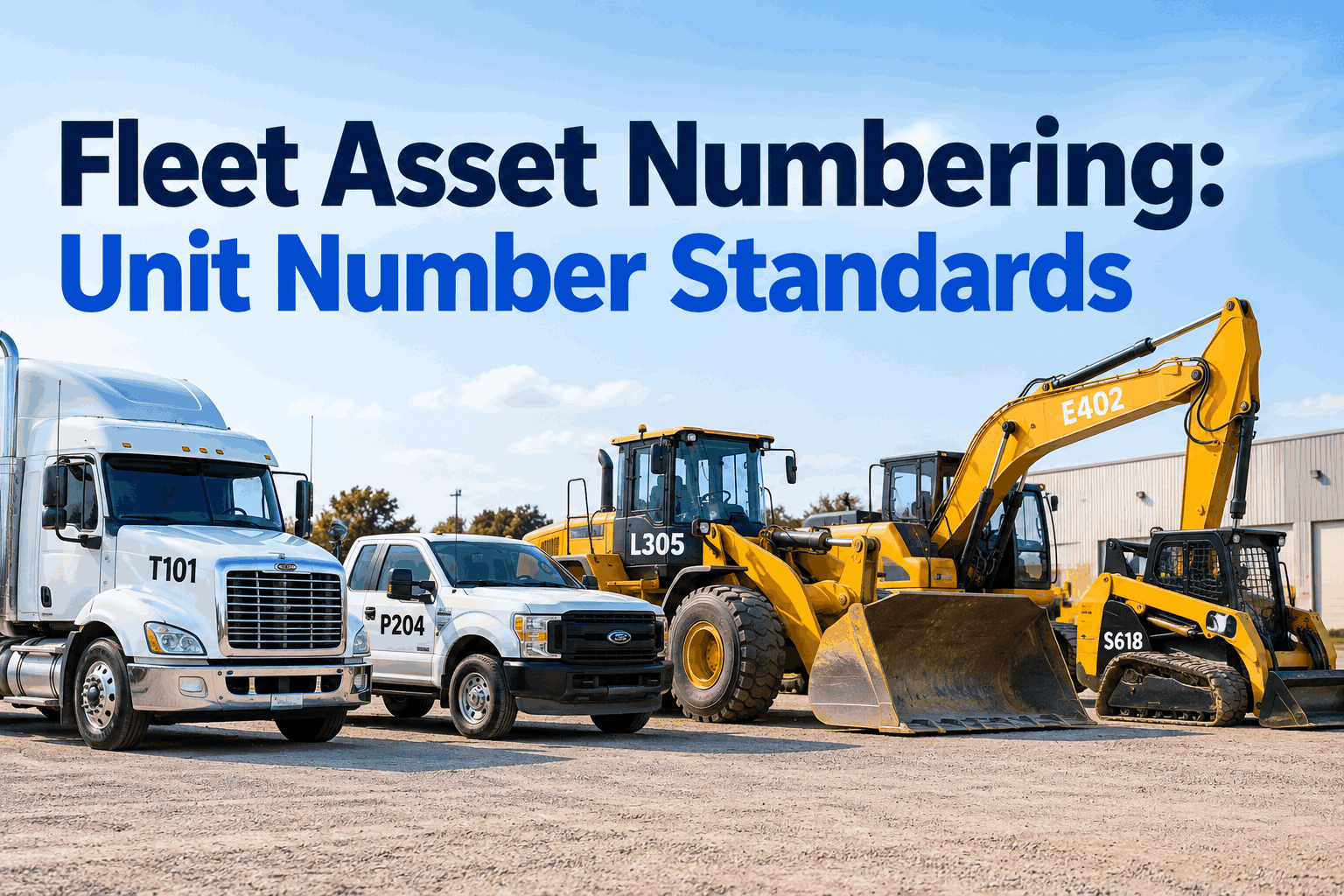
Fleet asset numbering is the quiet backbone of every well-run fleet. Give each vehicle and machine one clear, consistent unit number and every inspection, work order,and fuel log has somewhere to live. Skip it, and you get "the white truck" and "Dave's loader" — names that mean nothing the day you pull a report. Start free and give every asset one identity.
Every asset deserves one number that means something
A good unit number isn't random — it's a tiny code that tells you what the asset is, where it lives, and which one it is, at a glance. Here's how to build a scheme that scales.
This is a practical guide to fleet asset numbering — why a consistent scheme matters, the two main approaches, what to put in a unit number, the rules that keep it clean as you grow, and how the number becomes the thread that ties every record to the right machine.
Why fleet asset numbering is worth getting right
A fleet runs on records — inspections, work orders, fuel, parts, costs. Every one of those records has to attach to a specific asset, and the unit number is what it attaches to. When the number is consistent, the data is clean. When it's a free-for-all, the data is a guess.
The unit number is assigned once and never changes for the life of the asset — not when it moves yards, not when it changes drivers, not when it's repainted. That permanence is what makes years of history add up.
Get it right and a new hire can find any machine's full history in seconds — something you can set up free. Get it wrong and you're matching "the one by the fence" to a VIN on a spreadsheet, every time something needs logging.
Two ways to number a fleet
There are two basic approaches to fleet asset numbering, and the right one depends on how big and how mixed your fleet is. Most fleets land on a blend — simple where it can be, smart where it helps.
Just number them in order: 001, 002, 003…
- Dead simple to assign and never runs out
- No decoding rules for anyone to learn
- The number tells you nothing on its own
- "Unit 148" — a truck? a trailer? where?
Encode meaning: TRK-HOU-042
- The number itself says type, site and unit
- Sorts and filters cleanly by category
- Scales across mixed fleets and locations
- Needs a documented standard to stay consistent
Rule of thumb: the bigger and more varied the fleet, the more a smart scheme earns its keep — but keep codes short and only encode what won't change.
What to put in a unit number
A smart unit number is just a few segments, each answering one question. The trick is encoding only the things that stay true for the life of the asset — put something changeable in the code and you break your own rule the day it changes.
TRK, TRL, EXC, GEN — a short code for what the asset is. The most useful segment, and one that never changes.
Home yard, region or business unit. Useful for multi-site fleets — but only if home base is genuinely stable.
A running number within the group — 001, 002, 003. Zero-padded so they sort correctly in every system.
Year, driver, or current project — anything that changes. Keep those as asset fields, not in the number itself.
That last one is the rule most schemes break. The temptation is to pack the whole story into the code — but a number that encodes the 2021 model year or the current driver stops being true the moment either changes. Keep the number stable; let the asset record hold everything that moves.
The rules that keep a numbering scheme clean
A scheme doesn't fail on day one — it fails slowly, as shortcuts and exceptions creep in. These are the rules that keep fleet asset numbering consistent long after the person who designed it has moved on.
The reuse rule is the one that bites hardest. Retire unit 042, sell the truck, then hand "042" to a new loader, and two years of a truck's maintenance history now sits under a machine that never did any of it. Numbers are cheap — spend a new one every time.
Fleet asset numbering ties every record together
Here's why fleet asset numbering matters more than it looks: the unit number is the single key that every other record points back to. It's not paperwork — it's the hub your whole fleet history hangs on.
This is the payoff. When the number is consistent, pulling a unit's complete life — every inspection, repair, service and dollar — is one search, and a quick demo shows it live. When it isn't, that history is scattered under three spellings and nobody trusts the total.
Building your scheme in four steps
You don't need a consultant to set this up — just a clear decision on each segment, applied consistently. Here's the whole process, start to finish.
List your asset types
Group the fleet and pick a short code for each type — TRK, TRL, EXC, GEN. Keep them to three letters.
Decide what else to encode
Add location only if you run multiple sites and home base is stable. If not, skip it — simpler is better.
Set the sequence format
Choose a fixed length and zero-pad it — 001 to 999. Decide who assigns the next number in each group.
Document it and load it
Write the one-page standard, then enter every asset under its new number in your fleet system.
Tip: run the old and new numbers side by side for a transition period so nothing falls through the cracks while people adjust.
We grew from 20 trucks to 90 across four yards, and our numbering was pure chaos — every yard did its own thing, and the same unit number existed in three places. Pulling a cost report was a nightmare. We stopped, built one scheme — type, yard, sequence — and re-tagged the whole fleet over a month. Now every asset has one number, the number's on a QR tag on the machine, and a tech scans it to pull up the full history on their phone. It sounds boring, but it's the single thing that made the rest of our fleet data trustworthy.
How HVI turns your numbering into an asset register
A numbering scheme on a spreadsheet is a start; a numbering scheme that every record attaches to is a system. HVI's asset management is where your unit numbers become the live backbone of the fleet.
One record per unit
Each asset carries its unit number, type, location, make, model and serial — your scheme, made real.
QR tag on the machine
Generate a QR tag for each unit — scan it in the field to pull the right asset's history instantly.
Everything rolls up
Inspections, work orders, PM and costs all attach to the unit — so reports are accurate by default.
It's the same idea behind every mixed-fleet asset tracking setup and every asset lifecycle decision in HVI — the unit number is the key, and once it's clean, the whole fleet's history lines up behind it.
Fleet asset numbering — FAQs
The questions fleet administrators ask most when setting up a scheme
What is fleet asset numbering?
Fleet asset numbering is the system you use to give every vehicle, trailer and piece of equipment a unique, permanent unit number. That number is how every record — inspections, work orders, preventive maintenance, fuel and cost — attaches to the right asset. A good scheme is consistent and fixed-length, assigned once and never changed or reused, so an asset's full history stays together for its entire life in the fleet.
Should I use sequential or smart (intelligent) numbering?
It depends on your fleet. Sequential numbering (001, 002, 003) is dead simple and works well for small, single-type, single-site fleets. Smart or intelligent numbering encodes meaning — like TRK-HOU-042 for truck, Houston, unit 42 — so the number itself tells you type, location and unit, which pays off as you scale across mixed fleets and multiple sites. Many fleets blend the two: a short type and location code plus a zero-padded sequence.
What should a unit number include?
Encode only things that stay true for the life of the asset. A useful smart number has an asset-type code (TRK, EXC, GEN), optionally a location or division code if you run multiple stable sites, and a zero-padded sequence (001, 002). Avoid putting the model year, the current driver, or the active project in the number — those change, and the moment they do, your number is wrong. Keep those as fields on the asset record instead.
Can I reuse a unit number after an asset is sold?
No — retire the number for good. If you reuse a retired number on a new asset, you merge two machines' histories under one identifier, and every cost and maintenance report that spans the changeover becomes unreliable. Unit numbers are effectively free, so always assign a fresh one. The old number stays attached to the disposed asset's archived record, which keeps your historical reporting accurate.
How does asset numbering work in fleet software like HVI?
In HVI, each asset is a record identified by its unit number, with fields for type, location, make, model and serial. You can generate a QR tag for each unit so technicians scan it in the field to pull the right asset's history. Because every inspection, work order, PM schedule and cost attaches to that unit number, your reports roll up accurately by asset, type or location — turning your numbering scheme from a spreadsheet into a living, searchable register.
Give every asset one number — and a home for its whole history
Set up your fleet asset numbering scheme, then make it real: register every unit in HVI, tag each machine with a QR code, and watch every inspection, work order and cost attach to the right asset automatically. Clean numbers in, trustworthy fleet data out.