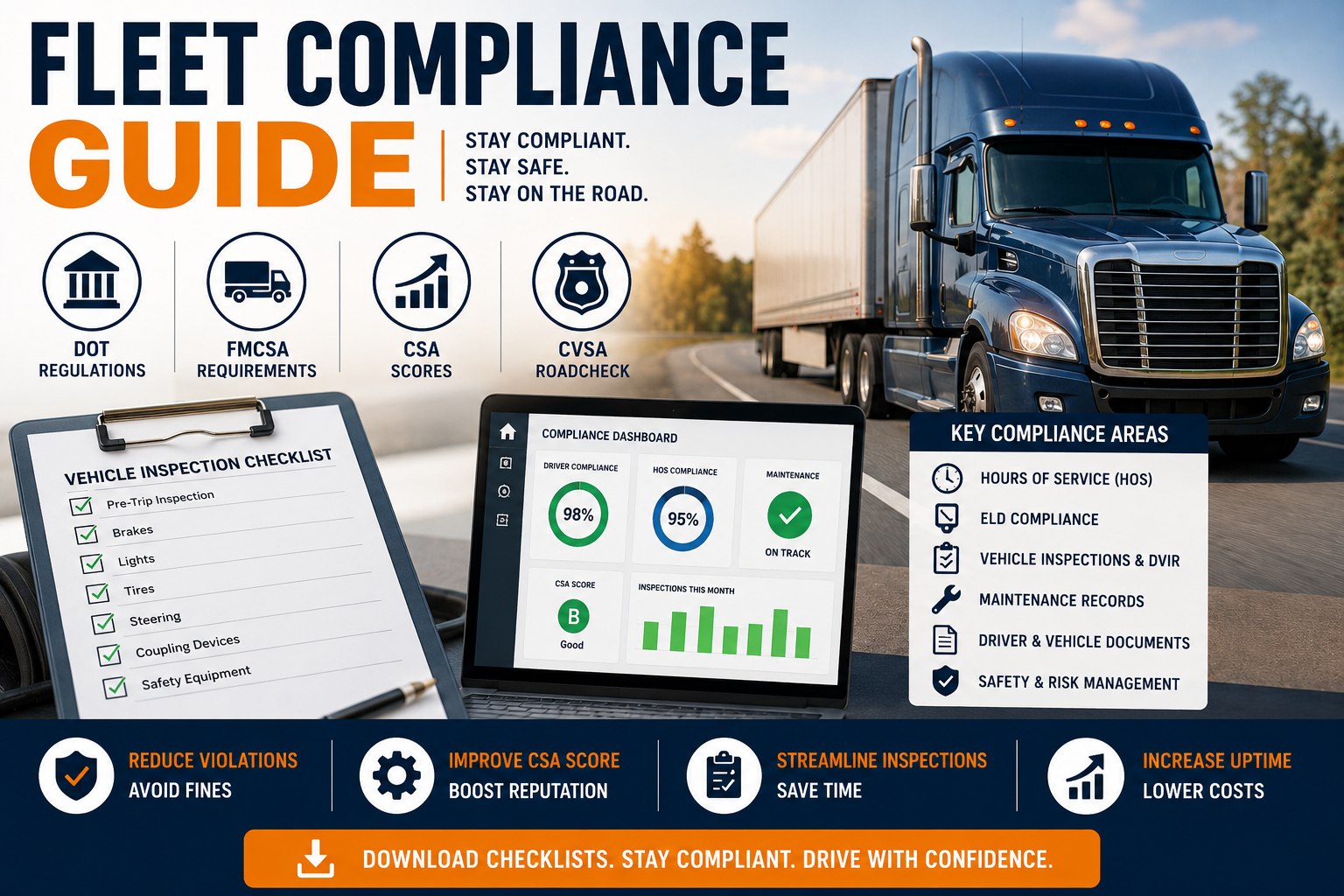
Only about 7% of motor carriers pass a DOT audit with zero violations. The other 93% aren't reckless — they just have compliant records scattered across spreadsheets, glove boxes, and three different systems, and a gap somewhere no one was watching. Fleet compliance isn't one rule; it's a stack of them — DOT authority, FMCSA regulations, your CSA score, CVSA inspections, Hours of Service, annual inspections, DVIRs, and the records that prove all of it. This guide maps the whole landscape, points you to the deep-dive on each piece, and flags what changed in 2026 — because the CSA scoring system, ELD list, and DVIR rules all shifted this year. Book a compliance demo to see your inspection and maintenance records audit-ready in one place.
The Fleet Compliance Guide: Every Rule, One Map
DOT authority, FMCSA regulations, CSA scores, CVSA Roadcheck, Hours of Service, inspections, and records — the complete compliance stack, what each one requires, what changed in 2026, and where to go deeper on each.
The number that starts it all
- OOS vehicle fine
- up to $19,277
- Roadside checks / yr
- ~4 million
- Audit warning
- Often minimal
Compliance is continuous, not annual
What changed in fleet compliance for 2026
Before the map, start here — because more shifted this year than in any year since the ELD mandate. If your compliance program still runs on last year's assumptions, it's already accumulating risk.
-
Feb 2026
CSA scoring overhauledBASICs became Compliance Categories. Out-of-service violations now carry double severity weight, violations count for 12 months instead of 24, and Vehicle Maintenance split into two categories — including a new "Driver Observed" category for defects a pre-trip should catch.
-
Mar 23 2026
Electronic DVIRs formally authorizedThe FMCSA final rule (FMCSA-2025-0115) explicitly authorizes electronic DVIRs under 49 CFR 396.11 and 396.13 — with timestamps, GPS, and photos now carrying clear regulatory standing equal to paper.
-
Feb 7 2026
Three ELD devices delistedPSS ELD, Black Bear ELD, and RT ELD Plus lost their grace period. Drivers still using them face immediate out-of-service orders — verify your device on the FMCSA registered list.
-
Oct 2025
MC numbers eliminatedMotor Carrier numbers were retired. Your USDOT number is now the sole federal identifier — filings and documents referencing an old MC number can cause problems at roadside and audit.
Two of those four — the CSA "Driver Observed" category and the eDVIR rule — land squarely on daily inspections, which is where most fleets have the least visibility. See how the 2026 changes reshape your inspection workflow
The seven pillars of fleet compliance
Fleet compliance breaks into distinct areas, each with its own rules, records, and deadlines. Here's the map — what each pillar requires and where to go for the full breakdown. Miss any one and it can trigger an audit flag or a CSA hit on all the others.
DOT & FMCSA foundation
Your operating authority and identity as a carrier: an active USDOT number (now the sole federal identifier), proper operating authority, insurance from $750K to $5M by cargo type, and a new-entrant safety audit within your first 18 months.
- Identifier
- USDOT number
- New-entrant audit
- Within 18 months
CSA score & SMS
The Safety Measurement System that ranks your fleet against peers across compliance categories. It drives your insurance rates, shipper relationships, and audit odds — and it was overhauled in February 2026 with heavier weighting on out-of-service violations.
- OOS weight (2026)
- 2×
- Violation window
- 12 months
CVSA Roadcheck & inspection levels
The roadside enforcement system — six CVSA inspection levels, from the 37-step Level I to driver-only Level III. In the 2025 Roadcheck, 22.6% of inspected vehicles were placed out of service, brakes leading at 41%.
- 2026 Roadcheck
- May 12–14
- Focus
- Cargo & ELD tampering
Inspections & maintenance
The largest violation category by volume. Every CMV needs an annual periodic inspection under 49 CFR 396.17 (Appendix A) plus daily driver DVIRs under 396.11 — which the FMCSA estimates prevent roughly 14,000 accidents a year.
- Annual inspection
- Every 12 months
- DVIR
- Daily, per driver
Hours of Service & ELD
Duty-cycle limits under 49 CFR Part 395 — 11 hours driving, a 14-hour window, a 30-minute break, and 60/70-hour weekly caps — recorded on a registered ELD. Violations carry penalties up to $16,000 ,and immediate out-of-service exposure.
- Driving limit
- 11 hours
- ELD records kept
- 6 months
Records & retention
The paperwork that proves everything else. Each record type has its own retention window — and missing MVRs are the single most common Driver Qualification File error, cited thousands of times over the past five years.
- DVIR records
- 3 mo (12 best)
- Accident register
- 3 years
Drug & Alcohol Clearinghouse
Query the Clearinghouse pre-employment and annually for every CDL driver, run a compliant random pool (50% drug, 10% alcohol), and report positives fast. Missing a program is an automatic audit failure that can cost your authority.
- Random rates
- 50% / 10%
- Query
- Pre-hire + annual
These seven don't sit in isolation — a maintenance violation shows up in your CSA score, an HOS problem surfaces at a CVSA inspection, a records gap sinks a DOT audit. Compliance is the whole stack staying green at once. See the vehicle-side pillars in one dashboard
Quick self-check: how audit-ready are you?
Run through these eight. Tick the ones your fleet has covered right now — not "we could find it," but genuinely in place and producible in 48 hours. Watch the meter as you go; the gaps are exactly what an auditor looks for first.
Each unticked box is a gap that shows up in a CSA score or a DOT audit before it shows up to you.
Ticking a box in your head is easy; proving it under a compliance review is the hard part — and that's the whole difference between the 7% and the 93%. Book a demo to make every one of these producible in one click
What triggers a DOT audit
Audits rarely come out of nowhere — they're triggered, and most triggers are visible in your own data before the letter arrives. Knowing them is how you stay ahead of one.
-
Poor CSA / SMS scoresPercentiles above intervention thresholds in any category flag you for a compliance review.
-
Crashes & high crash rateA serious crash, or a pattern of them, draws FMCSA attention fast.
-
ComplaintsCitizen or driver complaints can put a carrier directly on the review list.
-
New-entrant & random selectionNew carriers get an automatic audit within 18 months; others can be selected at random.
The common thread: by the time the notification arrives, your records need to already be in order — continuous compliance monitoring beats a 30-day scramble every time. Book a demo to stay continuously audit-ready
Record retention at a glance
Half of failing an audit is simply not having the right record for long enough. These are the retention windows that trip fleets up most — the ones auditors ask for first.
- DVIRs3 months minimum12 months best practice
- ELD / HOS records6 monthsPlus supporting documents
- Annual inspection report14 monthsReport or decal on vehicle
- Driver Qualification FileEmployment + 3 yrsMVRs the #1 error
- Accident register3 yearsPer recordable event
- Drug & alcohol positives5 yearsRefusals & RTD too
Digital records make these effortless — the retention clock runs automatically and the file is searchable the moment it's asked for, which is a large part of why digital fleets clear audits at far higher rates. Book a demo to see one-click record retrieval
Paper compliance vs. a digital system
The rules are the same either way. What changes is whether you can prove compliance on demand — and that difference is exactly what an audit tests.
Paper & spreadsheets
- Records scattered across files, email, and cabs
- Retention windows tracked by memory
- DVIR defects that never reach the shop
- No proof of when or where an inspection happened
- A 30-day scramble when the audit letter arrives
HVI digital compliance
- Every inspection and record in one searchable system
- Retention tracked automatically per record type
- Defects auto-route to work orders and repairs
- eDVIRs with GPS, timestamp, and photo evidence
- Audit-ready records produced in one click
Fleets that move to digital DVIRs commonly report a large drop in DVIR-related audit findings — not because the rules got easier, but because the proof finally exists and is findable. Book a demo to centralize your vehicle compliance
Expert view
People think a DOT audit is about whether you follow the rules. It's not — it's about whether you can prove you followed them, on the day the auditor asks. Those are completely different problems.
We had good drivers and well-maintained trucks and still sweated every audit, because the proof was in five places. The day our inspections, DVIRs, and maintenance records lived in one system with the retention clock running itself, the audit stopped being an event. It became a report we could pull in a click. That's the whole game.
Frequently asked questions
What does fleet compliance actually involve?
Fleet compliance is the full set of federal requirements a motor carrier must meet to operate legally and safely. It spans seven main areas: your DOT and FMCSA foundation (an active USDOT number, operating authority, and insurance); your CSA score under the Safety Measurement System; CVSA roadside inspections and the six inspection levels; vehicle inspections and maintenance (annual periodic inspections under 49 CFR 396.17 plus daily driver DVIRs under 396.11); Hours of Service and ELD requirements under Part 395; records and retention (Driver Qualification Files, ELD data, accident registers, and more); and the Drug and Alcohol Clearinghouse program. These areas connect — a maintenance violation affects your CSA score, an HOS problem surfaces at a roadside inspection, and a records gap sinks a DOT audit — so compliance means keeping the whole stack current at once, not treating each piece in isolation.
What changed in fleet compliance for 2026?
Several significant changes took effect. The CSA Safety Measurement System was overhauled in February 2026: the BASICs became Compliance Categories, out-of-service violations now carry double the severity weight of non-OOS violations, the violation window dropped from 24 months to 12, and Vehicle Maintenance was split into two categories including a new "Driver Observed" category for defects a pre-trip inspection should catch. The FMCSA final rule (FMCSA-2025-0115), effective March 23, 2026, formally authorized electronic DVIRs under 49 CFR 396.11 and 396.13. Three ELD devices — PSS ELD, Black Bear ELD, and RT ELD Plus — were delisted, with the grace period ending February 7, 2026. And as of October 2025, MC numbers were eliminated, making the USDOT number the sole federal identifier. The eDVIR and "Driver Observed" changes both land on daily inspections, raising the stakes on inspection quality and documentation.
What triggers a DOT compliance audit?
Audits are almost always triggered rather than random, and most triggers are visible in your own data first. The five common ones are: poor CSA Safety Measurement System scores that exceed intervention thresholds in any category; a serious crash or a high crash rate; complaints filed by citizens or drivers; new-entrant status, since new carriers receive an automatic safety audit within 18 months of getting authority; and random or targeted selection, increasingly focused on specific areas where FMCSA data already shows a problem. Because most triggers show up in your scores and inspection history before an audit letter arrives, the best defense is continuous compliance monitoring — having your Driver Qualification Files, DVIRs, maintenance records, HOS logs, and inspection reports already in order rather than assembling them in a 30-day scramble after notification.
How long do I have to keep fleet compliance records?
Retention windows vary by record type, and getting them wrong is one of the most common audit failures. DVIRs must be kept a minimum of 3 months, though 12 months is best practice since CSA considers a longer violation window. ELD and Hours of Service records must be kept 6 months, along with supporting documents like bills of lading and fuel receipts. The annual periodic inspection report must be retained 14 months, with the report or a decal kept on the vehicle. Driver Qualification Files must be kept for the length of employment plus 3 years after the driver leaves — missing MVRs are the single most common DQF error. Accident registers are kept 3 years per recordable event, and drug and alcohol program records for positives, refusals, and return-to-duty are kept 5 years. Digital systems track these windows automatically, which removes a whole category of audit risk.
Are electronic DVIRs and digital records compliant?
Yes. The FMCSA final rule FMCSA-2025-0115, effective March 23, 2026, explicitly authorizes electronic DVIRs under 49 CFR 396.11 and 396.13, removing any prior ambiguity. An electronic DVIR that captures all required information — vehicle identification, defects found or a "no defects" certification, the driver's signature, and repair verification — has clear regulatory standing equal to paper. Electronic records also carry practical advantages that matter during an audit: GPS and timestamp data proving when and where an inspection happened, photo evidence that makes defects dispute-proof, automatic retention tracking, and instant retrieval. This is a large part of why fleets using digital inspection and record systems clear audits at substantially higher rates than paper-based operations. The rules didn't get easier — the proof simply became reliable and findable.
Make the vehicle side of compliance run itself
HVI is the inspection-and-maintenance backbone of a compliant fleet — eDVIR-compliant digital inspections, annual inspection tracking, preventive maintenance scheduling, defect-to-work-order workflows, and a complete records history with retention handled automatically. Book a demo and see your DOT audit turn from a 30-day scramble into a one-click report.
No credit card · No hardware · Live on your fleet in under two weeks