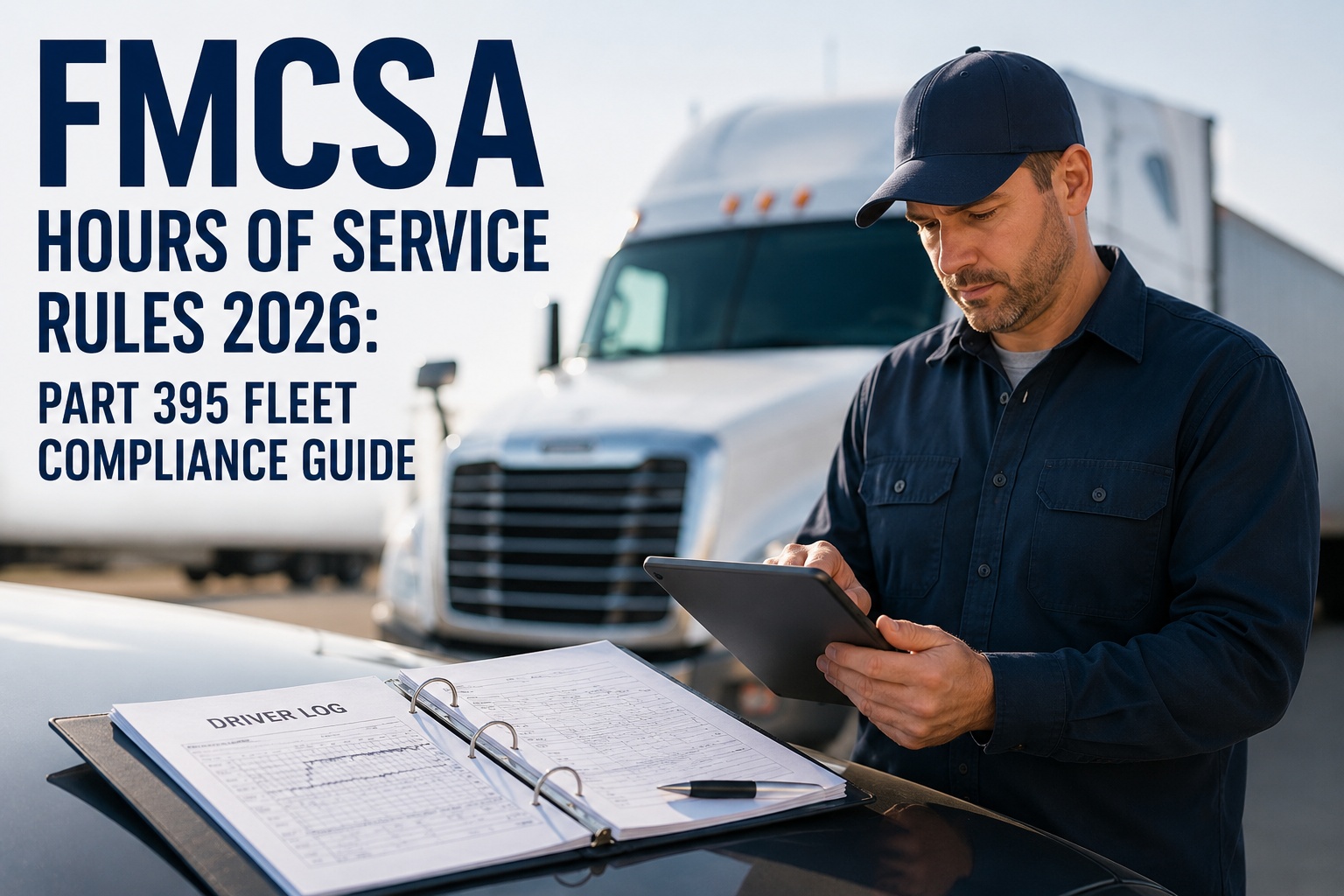
Hours-of-service compliance is not a single 11-hour rule — it's four independent limits ticking at the same time on every driver's shift, plus a 34-hour restart, plus the split sleeper berth, plus a set of exceptions each with their own eligibility. Miss any one and the penalties reach $16K per violation under 49 CFR § 395.13, plus OOS orders, plus CSA points that sit for 24 months. This 2026 Part 395 guide walks all four core limits, the exceptions, and the record-keeping. Book a demo .
The 4 HOS Clocks Ticking on Every Driver's Shift
Every property-carrying driver runs 4 independent time limits at once. Violate any one and the shift stops — regardless of the others.
Part 395 exists because fatigued driving in a 40-ton vehicle is a public safety risk the federal government determined worth regulating comprehensively. The rules have been refined repeatedly — the Sept 2020 final rule loosened the 30-min break to allow on-duty not-driving time, expanded the short-haul exception from 100 to 150 air-mile radius, extended the adverse driving conditions provision to add 2 hours to both the driving limit and the window, and rewrote the sleeper berth split provision. Fleets running on pre-2020 playbooks are missing genuine flexibility. Fleets that don't understand where the exceptions actually apply are exposing themselves to violations that shouldn't have happened.
How the 4 clocks interact on a real shiftWalking through the interactions that trip up otherwise-compliant drivers
The confusion is rarely about any single rule — it's about how the 4 rules bind at once. Three scenarios below show the most common ways compliant drivers unintentionally cross a line. Book a demo to see HOS visualization in HVI
The 14-hour window trap
Driver comes on duty at 6am. Long loading delay at shipper eats 4 hours of on-duty not-driving. Driver starts driving at 10am, has 8 hours driving in the tank. Wants to complete a 10-hour drive to destination. Runs into the 14-hour wall at 8pm — loading time counted against the window even though not driving.
The 30-minute break miss
Driver hits 8 cumulative driving hours and takes no break. Continues driving 30 more minutes to the next truck stop. That entire 30-minute segment past the 8-hour mark is a violation — even though the driver did stop at 8:30. The break must occur BEFORE crossing the 8-hour driving mark, not after.
The 70-hour weekly wall
Driver on 70-hour/8-day schedule sits at 67 on-duty hours across the past 7 days. Available today = 3 hours before hitting the wall. Dispatch assigns an 8-hour run; driver accepts. At hour 3, driver hits the weekly limit mid-run. OOS at nearest safe location. 34-hour restart or roll off the oldest days.
The exceptions — who qualifies and what changesMisapplying an exception you don't qualify for is itself a violation
Part 395.1 defines a set of exceptions from the standard HOS framework. Each exception has specific eligibility criteria, changes specific parts of the standard rules, and preserves others. Misapplication is common and consequential — a driver claiming short-haul who exceeds the 150 air-mile radius by 5 miles has violated both the underlying HOS rule AND the exception.
Tracking which exception applied to which shift is the single most-common documentation gap in HOS audits. Book a demo to see how exception documentation ties into HVI's inspection and driver-assignment records
Records of Duty Status (RODS) — what 49 CFR 395.8 requiresSince Dec 2019, ELD is mandatory for most CMV drivers required to keep RODS
Records of duty status document what a driver was doing every hour of every day. Under 49 CFR § 395.8, most drivers required to keep RODS must use an FMCSA-registered ELD (Electronic Logging Device). ELDs automatically capture driving time from vehicle engine data, preventing the log manipulation that plagued paper-based RODS. Start a free trial to see how HVI complements your ELD data with operational context.
Four duty statuses
Off duty · Sleeper berth · Driving · On duty not driving. Every minute of every day is one of these four. ELD captures driving automatically; driver manually annotates the other three.
Retention: 6 months
Motor carriers must retain RODS for 6 months per 49 CFR § 395.8(k). ELD platforms handle this automatically; paper-log operations must maintain a physical file.
Driver access
Drivers must be able to display current-day and previous 7 days of RODS to a roadside officer on request — on the ELD screen or a compliant printout.
Certification
Driver must certify each day's RODS as accurate. Edits after the fact are permitted but must be flagged as edits with reason; unlogged driving or unexplained gaps are violation indicators.
ELD malfunction procedures
If the ELD malfunctions, driver reverts to paper logs immediately, notifies carrier within 24 hours, carrier repairs or replaces within 8 days. Malfunction periods documented.
Short-haul exception
Drivers qualifying for the 150 air-mile short-haul exception under 49 CFR § 395.1(e)(1) are not required to keep RODS or use an ELD — a timecard record is sufficient.
HOS violations — what triggers OOS at roadsideNot every HOS violation grounds the driver; these do
The CVSA North American Standard Out-of-Service Criteria define which HOS violations result in immediate out-of-service orders at roadside inspection. Under CVSA criteria, a driver will be placed out of service for these specific violations.
Driving more than 3 hours beyond the 11-hour limit
Immediate OOS. Documented on driver's record with citation. CSA HOS Compliance BASIC points.
Driving after the 14-hour window expired
Any driving past the 14th consecutive hour. Immediate OOS regardless of driving hours remaining in the tank.
Driving after exceeding 60/70-hour weekly limit
Continuing to drive after crossing the weekly cap. Immediate OOS. Requires 34-hour restart or waiting for oldest days to roll off.
False or falsified RODS
Deliberately falsifying logs or ELD entries. Federal criminal exposure under 49 U.S.C. § 521. Automatic disqualification consideration.
No RODS / no ELD when required
Driver required to keep RODS but has no logs (paper or ELD). OOS until compliant records can be produced or reconstructed.
ELD non-compliance
Non-registered ELD, malfunctioning ELD without paper log backup, or driver unable to display current + prior 7 days. Varies by inspector; often OOS.
All six violation types produce a citation on the driver's record and CSA points on the carrier's HOS BASIC score — whether or not OOS is issued at the moment. Book a demo to see the operational records that support HOS audit response
From a fleet safety director on HOS visibility
Our HOS compliance failures were never about drivers who didn't understand the rules — they were about drivers who miscalculated their available hours in the moment, or dispatchers who assigned loads without checking the driver's remaining cycle. On a 120-tractor OTR fleet, that was translating into 15–20 HOS violations per quarter and a HOS BASIC score creeping toward intervention threshold.
We changed two things. First, dispatch got a live view of every driver's remaining hours before loads went out — not a report they pulled the next morning. Second, we started reviewing every exception use (adverse driving, sleeper split, short-haul) at end of shift to confirm the eligibility criteria were actually met. Violations dropped 70% inside two quarters. The rules didn't change; the visibility did.
Frequently asked questions
What are the FMCSA hours of service rules for truck drivers?
Under 49 CFR Part 395, property-carrying CMV drivers must comply with four core limits: (1) the 11-hour driving limit — maximum 11 hours of driving after 10 consecutive hours off duty; (2) the 14-hour on-duty window — cannot drive after the 14th consecutive hour from coming on duty, and this window does not pause for breaks; (3) the 30-minute break — required after 8 cumulative driving hours, satisfied by off-duty, sleeper berth, OR on-duty not-driving time under the Sept 2020 rule; and (4) the 60/70-hour weekly limit — cannot drive after accumulating 60 hours in 7 days or 70 hours in 8 days depending on carrier operating schedule, with a 34-hour off-duty period resetting the weekly cycle. All four clocks tick concurrently — compliance requires all four passing at the same time. Property-carrying drivers required to keep RODS must use an FMCSA-registered ELD per the Dec 2019 mandate.
Does the 14-hour on-duty window pause during breaks?
No. The 14-hour on-duty window is consecutive from the moment a driver comes on duty — breaks, meals, loading time, paperwork, and fueling all consume the window even when the driver is not driving. Only a full 10-hour off-duty period (or a qualifying sleeper berth split) restarts the 14-hour clock. This is the single most-missed rule in Part 395: drivers commonly assume a 30-minute break stops all clocks, but only the 30-min break requirement itself is satisfied — the 14-hour window continues running throughout. A driver who comes on duty at 6am hits the 14-hour wall at 8pm regardless of how many breaks were taken during the day. The exception is the adverse driving conditions provision under 49 CFR § 395.1(b), which adds up to 2 hours to both the driving limit and the window when the driver encounters unexpected weather or road conditions.
What is the 30-minute break rule and when does it apply?
Under 49 CFR § 395.3(a)(3)(ii), property-carrying CMV drivers must take a 30-minute break before driving if 8 cumulative hours of driving time have passed without at least a 30-minute interruption. The break must occur BEFORE crossing the 8-hour driving mark — taking the break after the 8-hour point does not cure the violation. Since the Sept 2020 final rule, the break can be satisfied by any non-driving period: off-duty time, sleeper berth time, OR on-duty not-driving time (waiting at a loading dock, fueling, paperwork). Before Sept 2020, only off-duty and sleeper berth time counted, which was a significant operational constraint for many fleets. The 30-min break does not apply to drivers qualifying for the short-haul exception under 49 CFR § 395.1(e)(1).
What is the 60/70-hour rule and how does the 34-hour restart work?
Under 49 CFR § 395.3(b), property-carrying CMV drivers cannot drive after accumulating 60 on-duty hours in 7 consecutive days (for carriers not operating every day of the week) or 70 on-duty hours in 8 consecutive days (for carriers operating every day of the week). The cycle is rolling — today's available hours are calculated by adding today's projected on-duty time to the total for the prior 6 or 7 days and checking against the cap. The 34-hour restart provision allows drivers to reset the weekly cycle by taking at least 34 consecutive hours off duty (or sleeper berth). After a qualifying restart, the driver has a fresh 60 or 70 hours available. Without a restart, drivers "roll off" the oldest day — each day drops off after the 7-day or 8-day window passes, freeing up those hours for the current day.
Does HVI provide ELD compliance and hours-of-service tracking?
HVI is not itself an ELD device and does not provide the real-time RODS capture required under 49 CFR § 395.22 — that hardware and functionality come from FMCSA-registered ELD providers (Samsara, Motive, Geotab, Omnitracs, and others on the FMCSA-registered ELD list). What HVI supports is the operational context that fleet compliance and safety teams use alongside their ELD platform: driver assignments to specific vehicles, vehicle inspection records and DVIRs, maintenance history, defect documentation, and searchable inspection history at the driver and asset level. When an HOS compliance question requires cross-referencing what vehicle a driver was on, whether that vehicle had recent DVIR flags, or whether maintenance events could explain an on-duty pattern, HVI is where that operational data lives. Your ELD platform is where the RODS themselves live.
Give your compliance team the operational context around HOS
HVI supports driver assignments, vehicle inspection records, DVIRs, maintenance history, defect documentation, and searchable inspection history — the operational data that sits alongside your ELD RODS when compliance questions arise. HVI is not an ELD device; ELD hardware and real-time RODS capture come from FMCSA-registered ELD providers. HVI is the operational layer that answers the vehicle-and-maintenance side of any HOS review.
No credit card · No hardware · Operational context ready on day one