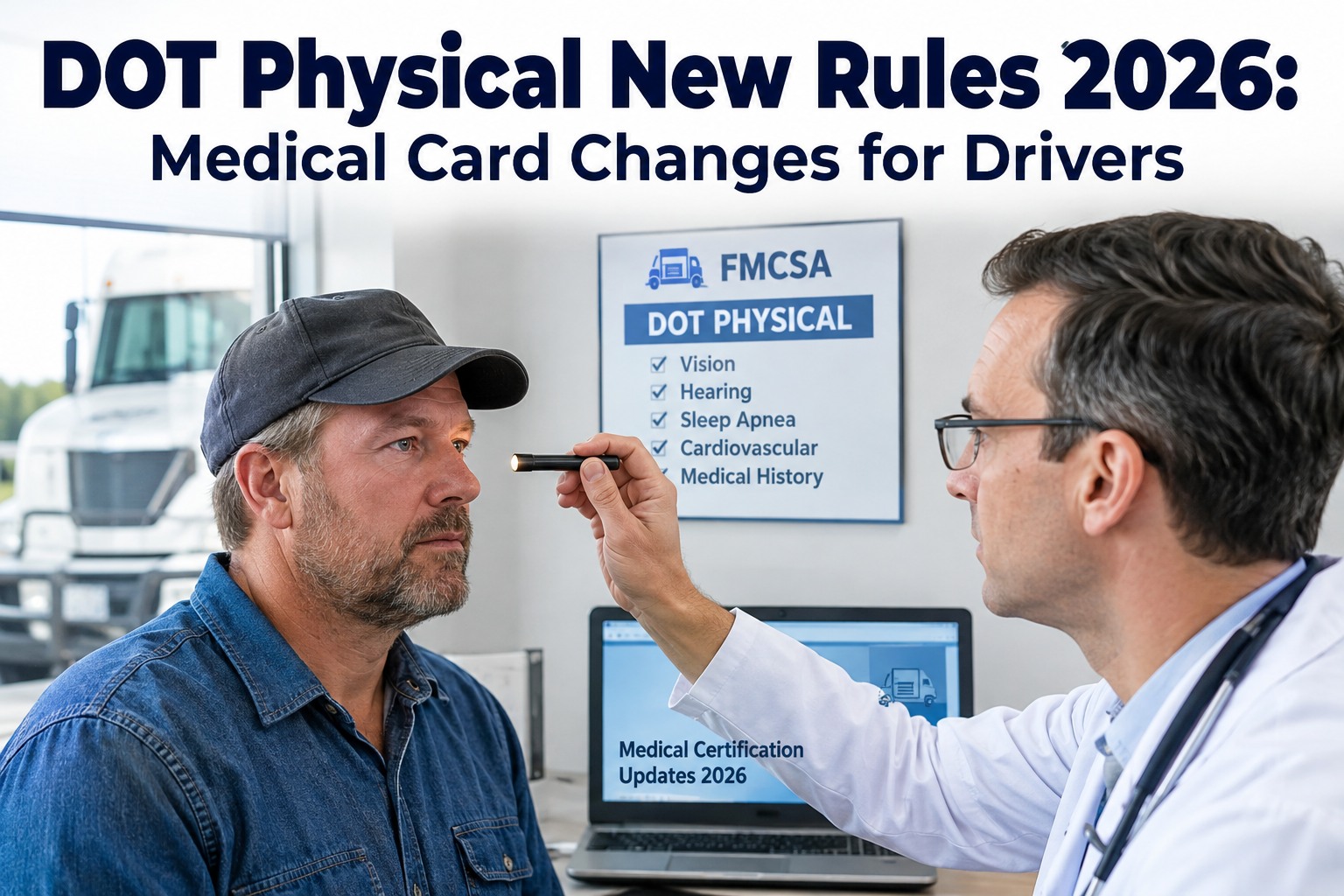
If you're bracing for a stack of new medical standards in 2026, here's the relief: the DOT physical itself barely changed. What changed is how the medical certificate travels. The real 2026 story is the National Registry II transition — results now flowing electronically from examiner to state — plus a temporary paper-card exemption with a hard October deadline. Most "DOT physical new rules 2026" headlines blur genuine changes with standards that have existed for years. This playbook separates the two. Book a demo to see driver medical records managed in HVI.
DOT Physical New Rules in 2026
The big 2026 change isn't a new medical test — it's how certification is transmitted and proven. Here's what's actually new, what isn't, and what your fleet must track.
Administrative and educational overview — not medical or legal advice. Medical examiners make qualification decisions.
The DOT physical rules changed more in 2025 and 2026 than in the previous decade — but almost entirely on the recordkeeping side, not the medical side. A driver still sees a certified medical examiner, still gets evaluated against the same physical qualification standards, and still receives a medical certificate. What's different is that the certificate is now part of a national electronic system, and a temporary exemption is bridging the gap while states catch up. Getting this distinction right is the difference between a calm 2026 and a scramble.
The real 2026 change: National Registry II
National Registry II (NRII) is the genuine shift. It moves DOT medical certification from a paper document the driver hand-carries to the state, into a secure electronic chain. Here's how a certification now flows.
A certified medical examiner performs the DOT physical and determines qualification.
The examiner submits the exam results directly to FMCSA's National Registry.
FMCSA electronically sends the certification data to the State Driver's Licensing Agency (SDLA).
The certification posts to the driver's CDLIS motor vehicle record as proof of qualification.
The goal is a system that's harder to defraud and faster to verify — no more relying solely on a paper card that can be lost or forged. But "faster" assumes every state and examiner is fully online, and that's exactly the wrinkle 2026 is managing. When the electronic posting lags, a validly certified driver can look uncertified on their record — which is where the exemption comes in. Book a demo to track electronic certification status per driver
The 2026 paper-MEC exemption, and its deadline
Because a handful of states hadn't finished implementing NRII, FMCSA issued a temporary exemption so drivers aren't penalized for system delays. This is the single most operationally important 2026 item for fleet managers — and it has a firm expiration.
Interstate CDL and CLP holders and motor carriers may rely on a paper copy of the Medical Examiner's Certificate (Form MCSA-5876) as proof of medical certification for up to 60 days after it's issued, while the electronic record catches up.
FMCSA has stated it does not anticipate granting additional nationwide NRII waivers or exemptions after this six-month window. Fleets should plan for a fully electronic proof-of-certification world after this date.
For a driver-qualification file, this changes the workflow: after every CDL/CLP driver's exam, someone has to verify the electronic record actually posted — not just file the paper card and move on. Miss that verification and a roadside inspection can turn a certified driver into an out-of-service event. Start free on HVI to flag when a driver's electronic certification hasn't posted in time.
What did not change: the medical standards
Here's where a lot of 2026 content goes wrong — treating long-standing medical standards as if they're brand-new rules. These conditions are evaluated under standards and guidance that predate 2026. Knowing their real status keeps your program accurate.
Vision
The Alternative Vision Standard took effect in March 2022, not 2026. It replaced the old federal vision exemption program: an ophthalmologist or optometrist completes the Vision Evaluation Report (MCSA-5871), then a medical examiner qualifies the driver, with a road test for first-time qualification.
Insulin-treated diabetes (ITDM)
Certifiable under 49 CFR 391.46 since the 2018 final rule — no FMCSA exemption needed. The treating clinician completes the ITDM Assessment Form (MCSA-5870), the examiner must receive it within 45 days, and certification runs up to 12 months. Unchanged in 2026.
Obstructive sleep apnea
There is no OSA-specific regulation and no mandatory national screening test. It's evaluated under the general respiratory standard using examiner judgment per the 2024 Medical Examiner's Handbook. No new 2026 sleep apnea rule was introduced.
Cardiovascular
Assessed under existing physical qualification standards and Medical Examiner's Handbook guidance. No universal new cardiac screening test was introduced in 2026 — examiners continue to evaluate cardiovascular fitness case by case as they have.
The pattern is clear: the medical bar for qualifying didn't move in 2026. Vision and ITDM shifted years ago from exemption programs to examiner-driven certification; sleep apnea and cardiac remain matters of examiner judgment under existing guidance. Anyone telling you 2026 brought a sweeping new medical test is selling confusion. Always verify specifics against current FMCSA sources, since guidance can change. Book a demo to keep condition documentation organized per driver
Regulation vs. guidance: know the difference
A big reason DOT-physical content gets muddled is that people treat every FMCSA document as equally binding. They're not. Understanding the hierarchy is what lets you read a headline and know whether it actually affects compliance.
The CFR (like 49 CFR 391.41, 391.46) and published final rules carry the force of law. The NRII final rule and the vision/ITDM standards live here.
Time-limited relief from a rule, like the 2026 paper-MEC exemption. Real and enforceable — but they expire, so the date matters as much as the content.
Advisory guidance that helps examiners apply the standards. Influential, but not the same as a regulation — the 2024 Handbook guides judgment, it doesn't create new mandatory tests.
When a headline says "new DOT rule," the first question is which tier it's in. A final rule changes obligations; a Handbook update refines examiner guidance; an exemption grants temporary flexibility with a deadline. The 2026 story is really a final rule (NRII) plus a temporary exemption — not a wave of new medical mandates. Book a demo to keep your compliance program anchored to what's actually binding
The 2026 fleet playbook
Strip away the noise and the fleet's job in 2026 is administrative: keep certifications current, verify electronic posting, and stay ready for the post-October fully-electronic world. Here's the practical checklist — all record-keeping, no medical decisions.
For each CDL/CLP driver, confirm the certification actually posts to the motor vehicle record — don't just file the paper card.
When relying on a paper MCSA-5876, log the issue date and watch the 60-day limit so you never lean on paper proof longer than allowed.
Track every driver's certificate expiration with reminders well ahead, so renewals happen before a lapse.
For vision (MCSA-5871) or ITDM (MCSA-5870), make sure forms arrive within their required windows so certification isn't delayed.
Build the habit now, so when the exemption ends you're already verifying electronic status as standard practice.
Maintain a searchable, complete driver-qualification record so any inspection or audit is a lookup, not a scramble.
Every item here is documentation and follow-up — precisely the work that slips through spreadsheets and inboxes, and precisely where a system pays for itself. HVI is built for this administrative layer: tracking certificates, posting status, expirations, and supporting documentation, with fleet-wide visibility. It doesn't make medical decisions — certified examiners do. Start free and turn the 2026 transition into a tracked workflow instead of a fire drill.
From a compliance manager mid-transition
The panic in our office was that 2026 meant new physicals and new medical standards. It didn't. What it actually meant was that our old habit — take the driver's paper card, drop it in the file, done — could now leave us exposed, because the state record might not show certified for days.
We had one driver flagged at a scale because his electronic status hadn't posted, even though his physical was valid and his paper card was in hand. After that we started verifying the electronic record after every exam and tracking the 60-day window. The rules didn't get harder; our paperwork just had to get sharper.
Know what changed — and manage what matters
The honest summary of DOT physical new rules in 2026 is that the medical exam didn't get harder; the medical certificate went digital. The National Registry II transition moves certification into a secure electronic chain from examiner to state to driving record, and a temporary exemption — effective April 11 through October 11, 2026 — lets fleets rely on a paper MCSA-5876 for up to 60 days while states finish implementing the system. Meanwhile, the medical standards people worry about — vision, insulin-treated diabetes, sleep apnea, cardiovascular — are governed by rules and guidance that predate 2026, not sweeping new mandates. Separating the genuine change from the recycled myths is the whole game.
What that leaves for fleets is an administrative challenge, and a real one: verifying electronic posting after every exam, tracking the 60-day paper window, monitoring expirations, keeping condition documentation on time, and staying audit-ready as the exemption sunsets. That's exactly the workload HVI is built to carry — centralizing driver medical certificates, expiration dates, posting status, and supporting documentation, with reminders and fleet-wide visibility, while every medical qualification decision stays with the certified examiners who make them. Always confirm the latest requirements against FMCSA and the National Registry, since the transition is still evolving. Book a demo to manage DOT medical records in HVI.
Frequently asked questions
What actually changed for the DOT physical in 2026?
The main 2026 change is administrative, not medical. Through the National Registry II (NRII) transition, DOT medical certification moved from a paper document the driver hand-carries to the state into a secure electronic system: certified medical examiners submit exam results directly to FMCSA's National Registry, FMCSA transmits the data to State Driver's Licensing Agencies, and the certification posts to the driver's commercial driving record. Alongside this, FMCSA issued a temporary exemption, effective April 11 through October 11, 2026, allowing interstate CDL and CLP holders and motor carriers to rely on a paper copy of the Medical Examiner's Certificate (Form MCSA-5876) as proof of certification for up to 60 days after issuance, because several states had not finished implementing NRII. What did not change is the medical exam itself — drivers are evaluated against the same physical qualification standards by the same certified examiners. The conditions people often assume are "new 2026 rules," such as vision, insulin-treated diabetes, sleep apnea, and cardiovascular standards, are governed by rules and guidance that predate 2026. Always confirm current details against FMCSA sources, as the transition is ongoing.
When does the 2026 paper medical card exemption expire?
The temporary exemption is effective April 11, 2026, and expires October 11, 2026 — a six-month window. During that period, interstate CDL holders, CLP holders, and motor carriers may rely on a paper copy of the Medical Examiner's Certificate (Form MCSA-5876) as proof of a driver's medical certification for up to 60 days after the certificate is issued, which provides a backup while the electronic record catches up. FMCSA has stated that it does not anticipate granting additional nationwide NRII waivers or exemptions after this six-month duration, so fleets should treat October 11, 2026 as the point to be fully prepared for electronic proof of certification. FMCSA also recommends that certified medical examiners continue issuing the paper MCSA-5876 to drivers in addition to submitting results electronically during the transition — a "belt and suspenders" approach. The practical implication for carriers is that a paper card is only valid proof for up to 60 days after issuance, so if a driver's motor vehicle record does not show a certified status within that window, the driver needs the electronic record resolved to avoid a qualification gap. Verify the current status of the exemption directly with FMCSA, as timelines can change.
Did FMCSA add new sleep apnea or cardiac screening rules in 2026?
No. FMCSA did not introduce a universal mandatory sleep apnea screening requirement or a universal new cardiac screening test in 2026. Obstructive sleep apnea continues to have no OSA-specific federal regulation; it is evaluated under the general respiratory qualification standard, with the certified medical examiner using professional judgment based on risk factors, consistent with the 2024 Medical Examiner's Handbook guidance. Cardiovascular conditions are likewise assessed under existing physical qualification standards and Handbook guidance, with examiners evaluating fitness case by case rather than applying a newly mandated universal test. It's important not to confuse guidance in the Medical Examiner's Handbook with new binding regulation — the Handbook is advisory material that helps examiners apply the existing standards, not a source of new mandatory screening rules. A great deal of online content blurs this distinction, presenting long-standing considerations or advisory recommendations as brand-new 2026 requirements. When evaluating any claim about a "new" medical rule, check whether it stems from an actual final rule and regulation or from advisory guidance, and confirm against current FMCSA sources.
Are the vision and diabetes (ITDM) standards new for 2026?
No, both predate 2026. The Alternative Vision Standard became effective in March 2022. It replaced the older federal vision exemption program with an examiner-driven process: an ophthalmologist or optometrist completes the Vision Evaluation Report (Form MCSA-5871), then a certified medical examiner determines whether the driver meets the vision and other physical qualification standards, with a road test administered by the employing motor carrier for a driver being qualified under the standard for the first time. The insulin-treated diabetes mellitus (ITDM) framework goes back further, to a 2018 final rule that took effect in 2018, and is codified at 49 CFR 391.46. Under it, a driver with ITDM no longer needs a federal exemption; instead, the treating clinician completes the ITDM Assessment Form (Form MCSA-5870) attesting to a stable insulin regimen and properly controlled diabetes, the certified medical examiner must receive that form within 45 days of its completion, and the examiner can certify the driver for up to 12 months. Neither standard is a 2026 change, though both remain very relevant to how fleets manage supporting medical documentation and its timing.
How should fleets manage driver medical records during the NRII transition?
The NRII transition turns driver medical certification into a records-and-verification workflow, and managing it well is entirely administrative — no medical judgment required from the fleet. The key practices are: after every CDL or CLP driver's physical, verify that the certification actually posts to the driver's motor vehicle record rather than simply filing the paper card; when relying on a paper MCSA-5876 during the exemption window, log the issue date and track the 60-day limit so you never depend on paper proof longer than allowed; monitor every driver's medical-card expiration with advance reminders; ensure condition-specific documentation such as the vision (MCSA-5871) or ITDM (MCSA-5870) forms arrives within its required window; and build the habit of electronic-status verification now so you're ready when the exemption ends on October 11, 2026. This is exactly the kind of tracking that fails in spreadsheets and email. A platform like HVI centralizes driver medical certificates, expiration dates, posting status, and supporting documentation, with reminders and fleet-wide visibility, so driver-qualification files stay complete and audit-ready — while every medical determination remains with the certified medical examiners who are qualified to make it.
Manage DOT medical certification through the 2026 transition
HVI centralizes driver medical certificates, expiration dates, the 60-day paper-MEC window, and electronic posting status — with reminders and fleet-wide visibility — so your DQ files stay audit-ready through the NRII transition and after the exemption ends. All the administrative work handled; every medical decision left to the examiners. Mobile-first, live in under two weeks.
No credit card · Medical cert & expiration tracking · Posting-status alerts on day one