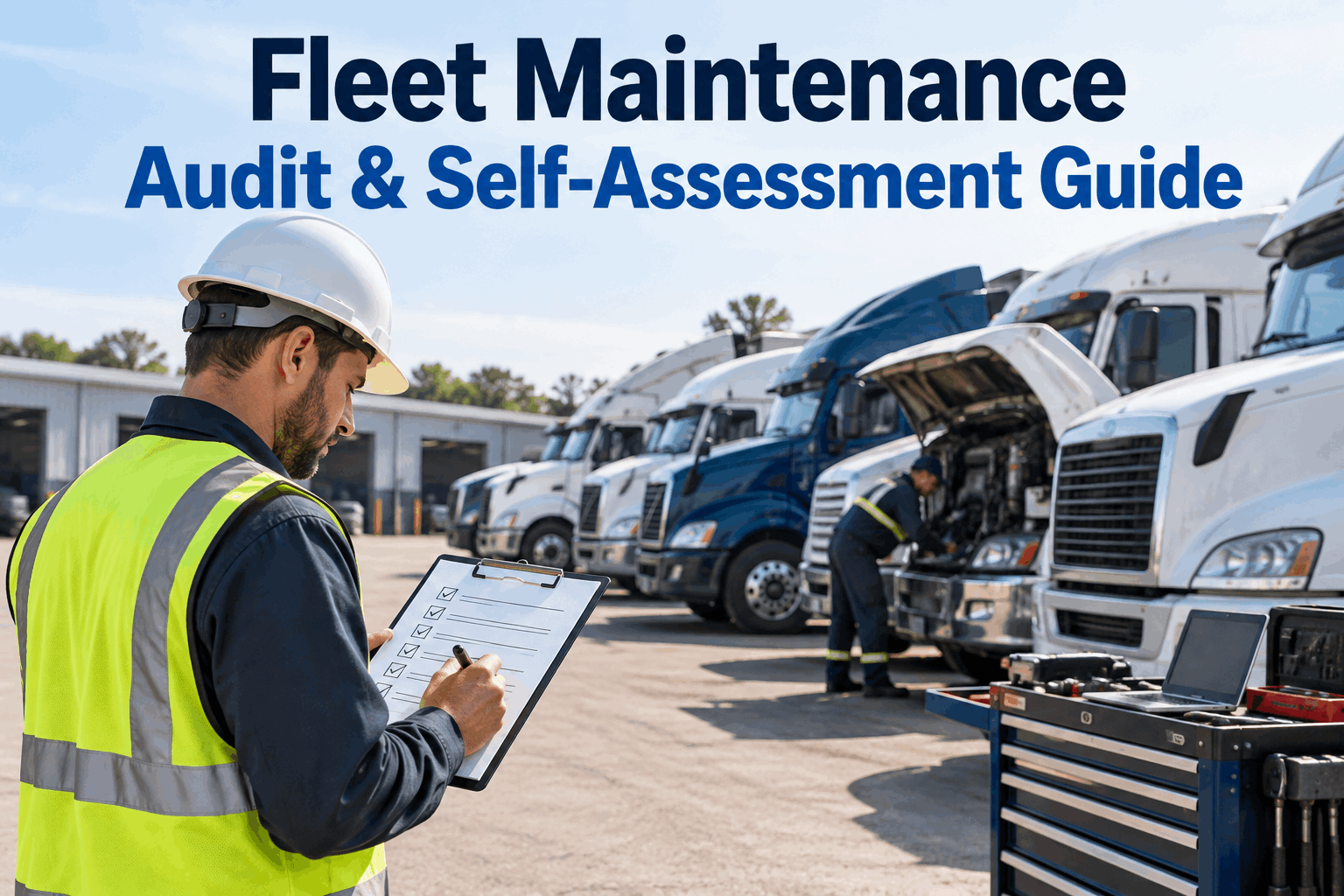
A fleet maintenance audit isn't really about the paperwork — it's about whether the paperwork is true. Any programme can produce a folder of signed PMs and completed work orders; the audit's job is to find out whether that record reflects what actually happened on the shop floor, or whether inspections were rubber-stamped, PMs back-dated, and defects quietly closed without a repair. The gap between the record and the reality is where risk, cost and the next breakdown live. Book a demo to see an audit run from real data, not a filing cabinet.
Do Your Records Match Reality?
A fleet maintenance audit asks one hard question: does the documented work match the work that was actually done? Where the two drift apart is where your real programme gaps are.
Here's the method — why an audit is more than a paperwork check, the five domains to assess, where records quietly drift from reality, how to score each domain, paperwork audits versus data-backed ones, and how to make it continuous instead of an annual scramble.
An audit isn't a paperwork checka full folder can still hide a failing programme
The trap most self-assessments fall into is checking that documents exist rather than whether they're true. A complete folder of signed inspections proves paperwork discipline, not maintenance quality — and the two can be worlds apart.
Existence isn't evidence. A signed PM sheet tells you a form was filled in, not that the filter was actually changed. A real audit verifies the work behind the record — cross-checking PM completion against schedules, defects against repairs, and parts used against the jobs done — so a tidy folder can't hide a programme that's quietly slipping. The paperwork is where you start looking, not where you stop.
The five domains to auditscore each one, don't lump them together
A fleet maintenance audit breaks into five domains, and a programme can be strong in one and failing in another. Scoring them separately is what turns a vague "we're probably fine" into a clear picture of exactly where the gaps are.
Together these five are the whole programme — miss one and the audit has a blind spot, because a fleet with immaculate PM records can still be running unqualified techs or unreconciled parts. Each domain maps to data you already generate, which is what makes scoring them objective rather than a matter of opinion, and what lets you compare this quarter's audit honestly against the last.
Where records quietly drift from realitythe gaps a real audit hunts for
If records never lied, an audit would be a formality. They drift in a handful of predictable ways — usually not from dishonesty but from pressure, shortcuts and habit. These are the four an audit should go looking for by name.
The common thread is that each gap is invisible to a paperwork review but obvious in the data, because the data carries the timestamps, links and quantities a signature never will. A folder audit can only confirm a form was signed; a data audit can see it was signed at 6:02am for a job that supposedly took two hours. That's the difference between catching these gaps and rubber-stamping past them. Start free and surface the gaps in your own records.
How to score each domainturn a judgement into a rating you can track
An audit finding is only useful if it's rated, so you can prioritise the fixes and measure progress next time. A simple three-level rating per domain turns "needs work" into something you can act on and re-check.
Records and reality clearly diverge — slipping or back-dated PMs, pencil-whipped inspections, or parts that don't reconcile. This is where the next breakdown or failed external audit is hiding, so it gets fixed first.
Mostly sound but with visible gaps — some late PMs, the occasional unlinked defect, a few unqualified sign-offs. The process works but isn't tight, so it needs tightening before it slides.
Records verifiably match reality — on-time PMs, inspections that find real defects, parts reconciled to jobs and current qualifications. The job here is to sustain it and not let it drift back.
Rate all five domains this way and the audit produces a scorecard, not a wall of notes — a one-glance snapshot you can put in front of leadership, act on in priority order, and compare against the next review to prove the programme actually moved. A finding without a rating is just a comment; a rating is something you can manage against a target.
Paperwork audit vs data-backed auditwhy the annual folder review keeps missing things
The traditional audit is a person with a clipboard sampling a folder once a year. It catches missing documents and little else, because it can't see the timestamps and links that reveal whether the work was real. A data-backed audit checks the whole population, continuously.
- A sample of the folder, once a year
- Confirms documents exist, not that work was done
- Blind to timestamps, links and quantities
- A scramble before the auditor arrives
- The whole population, continuously
- Verifies work behind the record
- Sees late PMs, unlinked defects, phantom parts
- Always audit-ready, no scramble
The difference isn't effort — it's what's knowable. A clipboard sampling a fraction of the folder once a year simply cannot see what a system watching every job in real time can. HVI's digital audit checklists capture the evidence as the work happens, so the audit reads the real record instead of reconstructing it from memory and signatures months later. Book a demo to move past the folder review
From annual scramble to continuouswhere the audit meets your data
The reason audits are dreaded is that they're a once-a-year reconstruction of a year's work. When the evidence is captured live, the audit stops being an event and becomes a dashboard you can read any day.
PM compliance verified
Completion is checked against the schedule automatically, so slipping or back-dated PMs surface as a number on a dashboard, not a suspicion you have to go digging to confirm.
Defects traced to repairs
Every inspection fault is linked to its work order and its close-out, so an unlinked or unresolved defect can't hide inside a record that looks closed on the summary.
Cost per asset flags outliers
A unit whose maintenance cost doesn't match its logged work is exactly where records and reality have parted ways — the anomaly points the audit straight at the gap.
That's the shift: the audit stops being an annual event you brace for and becomes analytics you read continuously, always current and always defensible. When an external auditor, an insurer or a regulator does come calling, there's nothing to reconstruct — the evidence is already there, already scored. Book a demo to make your audit continuous
From a maintenance director
Our paperwork was immaculate — that was exactly the problem. On paper we were at 98% PM compliance, and I believed it until we actually cross-checked completion times against the schedule and found a chunk of PMs being signed off on the due date but done a week or two later, if at all. Same story with parts: booked out with no job to match. None of it was malice, just a shop under pressure taking shortcuts and papering over them. Auditing from the data instead of the folder is the only reason we found it — and now the scorecard tells me the truth every month, not once a year.
How HVI runs a maintenance auditpull the data, score the domains, close the gaps
A maintenance audit holds up when it reads the real record instead of a reconstructed one. HVI's analytics, PM compliance and cost-per-asset data make the self-assessment continuous, objective and defensible.
Pull the real data
PM, inspection, work-order and parts records with the timestamps and links a folder lacks.
Score the five domains
Rate each domain at risk, developing or controlled — an objective scorecard, not opinion.
Close the gaps & re-check
Fix the at-risk domains first, then re-run to prove the programme actually improved.
See how the audit, the scorecard and the underlying evidence come together inside HVI's inspection and maintenance platform, reading the records your shop already generates every day. Walk through your own numbers and see where records and reality diverge in a quick demo
Fleet maintenance audit: quick answers
What is a fleet maintenance audit?
A fleet maintenance audit is a structured assessment of whether your maintenance programme is actually working — not just whether the paperwork exists. It verifies that documented work reflects real work across five domains: PM compliance, inspection quality, work orders, parts controls and technician qualifications. The goal is to find the gaps between what the records claim and what actually happened on the shop floor, and to rate each domain so the fixes can be prioritised.
How is a maintenance audit different from a compliance check?
A compliance check confirms that required documents exist and meet a standard — the right forms, filled in and retained. A maintenance audit goes further and asks whether those documents are true: were the PMs actually done on time, did inspections find real defects, did defects become repairs, do parts used match the jobs. A folder can pass a compliance check and still fail an audit, because existence isn't evidence that the work behind the record was done.
What should a fleet maintenance audit cover?
Five domains. PM compliance: are scheduled services done on time and to interval. Inspection quality: are inspections finding real defects rather than passing everything. Work orders: do defects become work orders and close with a real repair. Parts controls: do parts used reconcile with the jobs done. Technician qualifications: are the people signing off certified and current. Scoring each separately reveals where the programme is strong and where it's quietly failing.
How often should you audit fleet maintenance?
The traditional answer is annually, but a once-a-year folder review is exactly why gaps go unnoticed for months. The better approach is continuous self-assessment: when PM compliance, defect-to-repair links and parts reconciliation are tracked in your maintenance data, the audit becomes a dashboard you can read any day rather than a scramble before an external auditor arrives. You still do a formal review periodically, but you're never surprised by what it finds.
How does HVI help with maintenance audits?
HVI captures the evidence as work happens, so an audit reads the real record instead of reconstructing it. PM compliance is verified against schedules, every inspection defect is linked to its work order, parts are reconciled to jobs, and cost per asset flags the units where records and reality have parted ways. That lets you score the five audit domains objectively, produce a scorecard for leadership, and keep the programme audit-ready continuously instead of scrambling once a year.
Know your records tell the truth
HVI runs your maintenance audit from live data — PM compliance verified, defects traced to repairs, parts reconciled to jobs, and cost per asset flagging the outliers — so you score all five domains on evidence and stay audit-ready every day of the year.
No credit card · Run your first self-assessment on day one
- PM compliance vs schedule
- Inspection quality, not speed
- Defects linked to work orders
- Parts reconciled to jobs
- Technician quals current