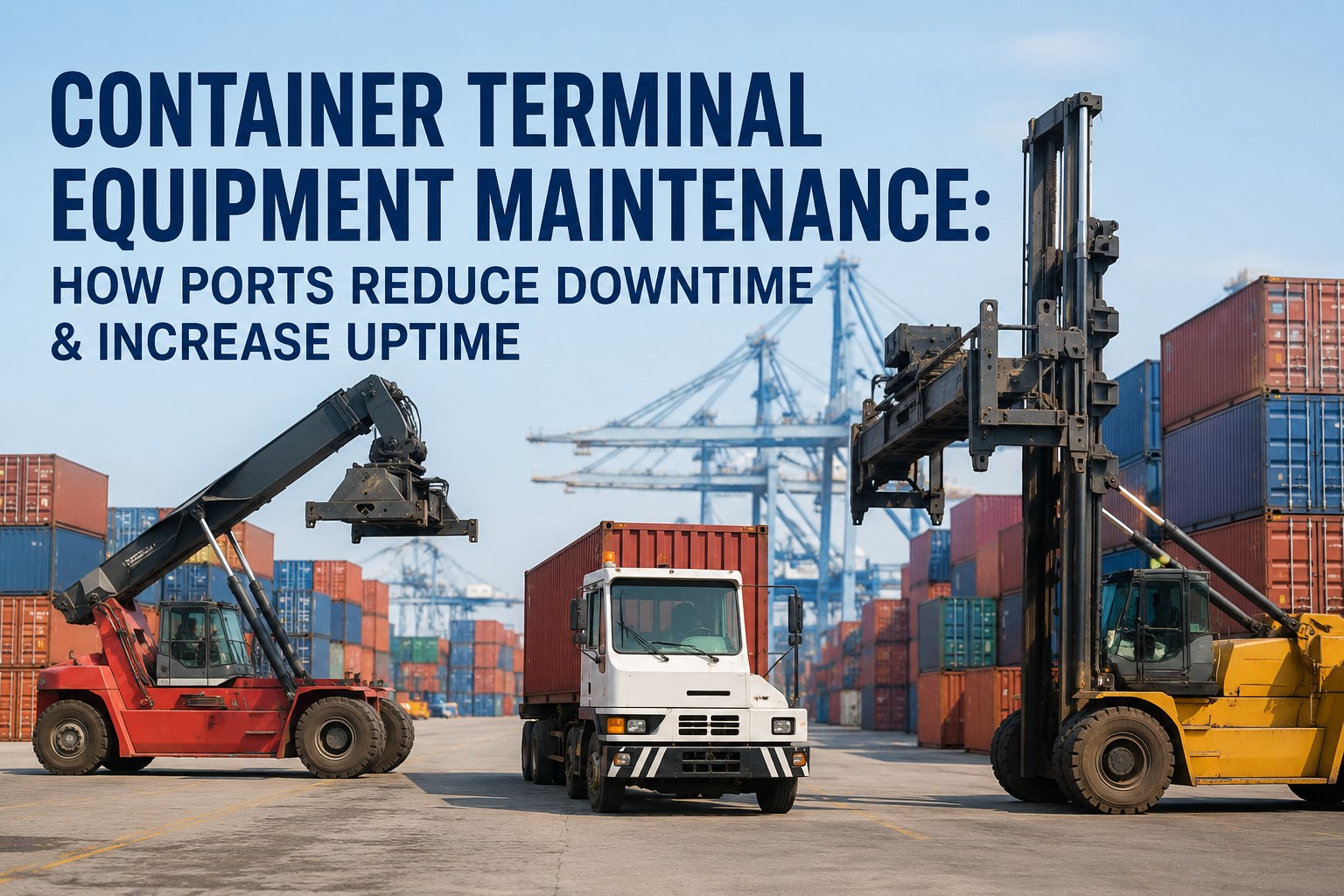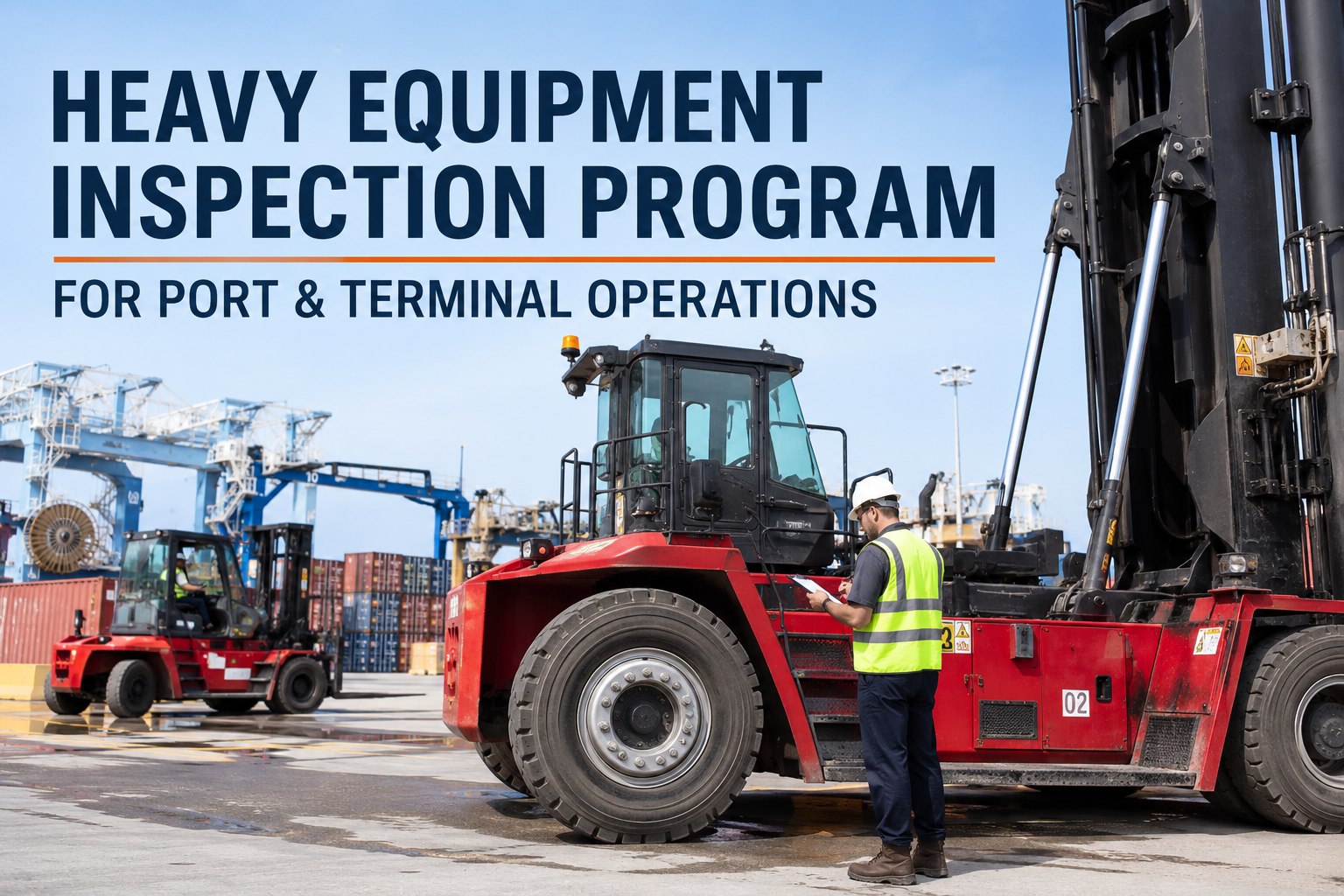
A port or marine terminal runs on one of the most diverse heavy-equipment fleets anywhere: ship-to-shore cranes the height of a building, rubber-tired and rail-mounted gantries, mobile harbor cranes, reach stackers and top handlers, empty and laden container handlers, straddle carriers, terminal tractors, forklifts, chassis, and the spreaders and lifting gear that connect them to the cargo. Building one inspection program across all of that is a different problem from inspecting a single machine — because the equipment doesn't share a single inspection cadence. A terminal tractor needs a pre-shift roadworthiness check every shift; a ship-to-shore crane must be examined annually and tested as a unit quadrennially under OSHA 29 CFR 1917.50, with certificates kept readily available and operator certifications, load-test records, and hydraulic and structural PM intervals all run on their own clocks. A program that misses any one of those cadences is both a safety gap and a compliance exposure — and on a terminal where a single crane down can stall a vessel and a whole berth, it's an expensive one. This guide lays out how to build a heavy equipment inspection program for port and terminal operations: the fleet's distinct equipment classes, the multi-tier inspection cadence, the certification and load-test requirements, and the recordkeeping that ties it together. book a 30-minute walkthrough to see it on your terminal.
One terminal, a dozen equipment classes, four inspection cadences. A real program ties them together.
HVI runs the whole port fleet from one platform — STS and gantry cranes, reach stackers, container handlers, terminal tractors, and forklifts — tracking daily pre-shift checks, annual examinations, quadrennial certification, load tests, hydraulic and structural PM, and operator certs, with alerts before anything lapses and audit-ready records.
Why a port program is different
Most inspection programs cover one equipment type on one schedule. A terminal program has to span a heterogeneous fleet on several schedules at once — that's the whole challenge.
The program is a system of cadences, not a checklist
The defining feature of port equipment is that it doesn't share one inspection rhythm. The same terminal simultaneously owes a daily operator pre-shift on its tractors and forklifts, an annual examination and a quadrennial unit certification on its cranes and derricks under 29 CFR 1917.50, current annual load-test records, hydraulic and structural preventive maintenance on operating hours, and a stack of operator certifications and TWIC cards that expire on their own timelines. A program is the system that keeps every one of those clocks visible and current across the whole fleet — which is exactly what a paper binder and a wall calendar can't do at terminal scale.
The port equipment fleet
A program starts with knowing the fleet. Port equipment falls into a few families, each with its own inspection focus — and a single generic form fits none of them.
STS, RTG & RMG
Ship-to-shore, rubber-tired gantry, and rail-mounted gantry cranes — the certificated heavy lifters. Focus: structure, wire rope, hoist and trolley drives, brakes, spreader, twistlocks, headblock, and work lights for night operations.
Mobile harbor cranes
Flexible quayside lifters on tires or rails. Focus: boom and luffing systems, outriggers and stability, steering and drive, hydraulics, load-indicating devices, and the same certification and load-test discipline.
Reach stackers & container handlers
Reach stackers, top handlers, and empty/laden container handlers. Focus: boom and spreader, hydraulics and cylinders, tires, mast and forks, twistlocks, and load and stability systems for stacked containers.
Tractors, forklifts & straddles
Terminal tractors, counterbalance and reach forklifts, straddle carriers, and chassis. Focus: daily pre-shift roadworthiness — brakes, steering, tires, lights, fifth wheel, hydraulics — and pedestrian-hazard devices.
Each family carries its own inspection focus and cadence, from a daily forklift check to a quadrennial crane certification — one template can't span them. sign up free and run equipment-class templates across the whole terminal, or book a demo to see the fleet view.
The four-tier inspection cadence
The heart of a port program is layering the inspection schedules so nothing falls through. These four tiers run simultaneously across the fleet.
Operator pre-shift
Before each shift, operators check their equipment — crane walk-arounds and RTG/RMG pre-operational checks, terminal-tractor and forklift roadworthiness, spreader and twistlock condition, work lights for night moves. The first line of defense, on every machine.
Preventive maintenance
Hydraulic systems, drives, brakes, and structural components serviced on operating hours at the OEM interval. Tracking each machine's hours is what makes PM land on time instead of after a failure.
Examination & load test
Each certificated crane and derrick is examined annually, with load-test records kept current. The annual exam is a complete visual examination of all visible parts, with certificates readily available.
Unit certification test
Every four years, each crane and derrick is tested as a unit — a proof load 25% over the rated safe working load — by an OSHA-accredited person, with the certificate kept readily available for inspection.
These tiers run in parallel, not in sequence: a crane can be due for a daily walk-around, an hours-based hydraulic service, an annual exam, and its four-year unit certification all in the same month. The program's job is to surface each one before it lapses. And the penalty for letting certification slide is severe — when certificated equipment is out of service for six months or more beyond a certification due date, it needs a full re-certification including the proof-load test before it can re-enter service. HVI tracks all four tiers per machine and alerts before each comes due. book a demo to see cadence tracking.
Certification, load tests & the SWL discipline
The certificated cranes carry compliance requirements no yard truck does. These are the rules that define the program's regulatory backbone.
Certificated by an accredited person
Under 29 CFR 1917.50, each crane and derrick moving cargo must be certificated by a person accredited under Part 1919, who issues OSHA Form 71 on passing or Form 72 for deficiencies. Shop and maintenance cranes not moving cargo are excluded.
The 25% proof load
The quadrennial unit test applies a proof load 25% in excess of the rated safe working load, with an examination of all supporting structures and components carried out alongside it and again annually thereafter.
Mark and respect the SWL
Cargo-handling gear with a safe working load over five short tons must have its SWL plainly marked, loose gear and single-sheave blocks marked as tested — and the SWL must never be exceeded.
Certificates of test and examination must be made readily available for inspection — which at terminal scale means a system that can produce any machine's current certificate in seconds, not a search through a filing cabinet. sign up free and keep every certificate and load-test record audit-ready.
The regulatory map
A port program answers to more than one rulebook. Knowing which standard governs what keeps the whole operation compliant.
OSHA Marine Terminals
29 CFR Part 1917 governs employment within a marine terminal, including the use and routine maintenance of equipment; 1917.45 and 1917.50 cover cranes, derricks, and certification.
Powered industrial trucks
Forklift and powered-industrial-truck operator training and daily condition checks apply to the yard fleet, alongside the marine-terminal rules.
Cargo gear certification
Part 1919 accredits the persons and agencies that certificate shore-based material-handling devices and issue the official OSHA certification forms.
USCG security & IMDG
USCG 33 CFR Parts 101–106 maritime security, the IMDG Code for dangerous goods, and NFPA 307 fire protection round out the terminal's compliance picture.
No single standard covers the whole terminal, and the consequence of a gap differs by equipment — an uncertificated crane, an untrained forklift operator, or an expired load test are each their own exposure. A program maps each requirement to the equipment and the clock it lives on. HVI builds the marine-terminal cadence and the operator-certification tracking into one system.
Operator certifications & recordkeeping
Equipment compliance is only half the program — the people operating it carry their own credentials, and the records tie everything together for an audit.
Track the credentials
Crane operator certifications, forklift and PIT training under 1910.178, TWIC card validity, medical fitness, and equipment-type authorizations all expire on their own dates — and an operator without a current qualification shouldn't be on the machine.
Alert before expiry
A program flags certifications and inspections approaching expiry before they lapse, so a renewal happens ahead of the deadline rather than an unqualified operator or an out-of-cert crane being caught at dispatch or by an inspector.
Records ready for inspection
Certificates, load tests, daily inspections, and PM history must be readily available — for OSHA, for insurance, and for the next audit. Digital records produce any machine's history in seconds.
every clock. The difference between a port inspection program and a pile of checklists is integration: one platform that holds every equipment class, every inspection tier, every certificate, and every operator credential, and surfaces whatever is coming due across the whole terminal. That's what keeps a heterogeneous fleet both safe and continuously compliant — and keeps a vessel from waiting on a crane that quietly fell out of certification. HVI is that single system for the terminal.
Paper & spreadsheets vs. HVI
Both technically track inspections. Only one keeps every equipment class and every cadence visible at once, alerts before anything lapses, and produces the certificate an inspector asks for in seconds.
Paper / spreadsheets
- One generic form across a dozen equipment classes
- Annual exam & quadrennial cert tracked by memory
- Load-test & SWL records scattered across the yard
- Operator certs & TWIC expiries missed
- Certificate hunt when an inspector arrives
- No fleet-wide view of what's coming due
With HVI software
- Equipment-class templates for cranes to forklifts
- Daily, annual & quadrennial cadences tracked per machine
- Load-test, certificate & SWL records in one place
- Operator cert & TWIC expiry alerts before lapse
- Any certificate produced in seconds, audit-ready
- Fleet-wide dashboard of everything coming due
uptime, protected. On a terminal, equipment availability is throughput — a crane out of certification or a handler down for an overdue service can stall a vessel and back up a whole berth. A real inspection program protects both safety and uptime by keeping every cadence current across the fleet, so equipment is ready when the ship is. HVI turns the multi-cadence burden into one managed system across cranes, handlers, and the yard fleet alike.
Frequently asked questions
What equipment does a port inspection program cover?
A port and terminal inspection program spans an unusually diverse fleet, which is what makes it a program rather than a single checklist. On the quay side it covers ship-to-shore (STS) cranes, rubber-tired gantry (RTG) and rail-mounted gantry (RMG) cranes, and mobile harbor cranes. In the yard it covers reach stackers, top handlers, empty and laden container handlers, straddle carriers, terminal tractors, counterbalance and reach forklifts, and chassis and trailers. It also covers the spreaders, twistlocks, headblocks, and lifting attachments that connect the machines to the cargo, plus support equipment. Each family has its own inspection focus — structure, wire rope, and brakes on a crane; boom, spreader, and hydraulics on a handler; roadworthiness on a tractor — and its own cadence, from a daily forklift check to a quadrennial crane certification. Because of that diversity, a single generic form doesn't fit, and equipment-class templates are essential. HVI's inspection and maintenance software manages the full terminal fleet from one platform. sign up free and cover your whole fleet.
How often must port cranes be inspected and certified?
Port cranes follow a layered schedule. At the daily level, operators perform a pre-operational walk-around or check before each shift. On operating hours, hydraulic, drive, brake, and structural preventive maintenance is performed at the manufacturer's intervals. Annually, each certificated crane and derrick must be examined — a complete visual examination of all visible parts — with load-test records kept current. And every four years, under OSHA 29 CFR 1917.50, each crane and derrick must be tested as a unit, applying a proof load 25% in excess of the rated safe working load, performed by a person accredited under Part 1919, with an accompanying examination of all supporting structures. The certificates of these tests and examinations must be made readily available for inspection. Importantly, if certificated equipment is out of service for six months or more beyond a certification due date, it requires a full re-certification including the proof-load test before re-entering service. HVI's inspection and maintenance software tracks all of these cadences per machine and alerts before each comes due. book a demo to see certification tracking.
What OSHA standards apply to marine terminal equipment?
Several standards apply at once, which is part of why a port program is complex. The core is OSHA 29 CFR Part 1917, Marine Terminals, which governs employment within a marine terminal including the use and routine maintenance of equipment; within it, 1917.45 addresses cranes and derricks and 1917.50 sets the certification requirements for material-handling devices that move cargo. The certification itself is performed by persons and agencies accredited under 29 CFR Part 1919, the Cargo Gear Certification regulations, which also define the official OSHA Form 71 certificate and Form 72 deficiency notice. The yard fleet's forklifts and powered industrial trucks fall under 29 CFR 1910.178 for operator training and condition checks. Beyond OSHA, terminals also manage USCG 33 CFR Parts 101–106 maritime security, the IMDG Code for dangerous goods, and NFPA 307 for fire protection. No single rulebook covers the whole terminal, so the program maps each requirement to the equipment and schedule it governs. HVI's inspection and maintenance software builds these requirements into the terminal workflow. sign up free and map compliance to your fleet.
Why does port equipment need a program rather than just checklists?
Because the fleet is heterogeneous and the schedules don't align. A single machine on a single cadence can be managed with a checklist, but a terminal simultaneously owes a daily operator pre-shift on its tractors and forklifts, hours-based preventive maintenance on hydraulics and drives, an annual examination and load test on its cranes, a quadrennial unit certification with a proof-load test, and a continuously expiring set of operator certifications and TWIC cards. Those clocks run in parallel — the same crane can be due for a daily walk-around, an hours-based service, an annual exam, and its four-year certification in the same month. A pile of paper checklists and a wall calendar can't keep all of that visible and current across a dozen equipment classes, and a missed cadence is both a safety gap and a compliance exposure that can pull a crane out of service. A program is the integrated system that surfaces whatever is coming due across the whole fleet, before it lapses. HVI's inspection and maintenance software is that system. book a demo to see the program in action.
How does HVI support a port and terminal inspection program?
HVI is an inspection and maintenance software platform that manages an entire terminal fleet from one system — STS, RTG, and RMG cranes, mobile harbor cranes, reach stackers, top handlers, container handlers, straddle carriers, terminal tractors, forklifts, and chassis. Operators run equipment-class-specific inspections from a phone or tablet, from a daily forklift or terminal-tractor pre-shift to a crane walk-around, with photo capture on defects, and a critical defect tags the machine out of service and opens a work order. The platform tracks all four inspection tiers per machine — daily pre-shift, hours-based preventive maintenance, annual examination and load test, and the quadrennial unit certification — and alerts before any comes due, so nothing lapses. It stores load-test records and OSHA certificates so any machine's current documentation is produced in seconds for an audit, and it tracks operator certifications, forklift and PIT training, TWIC validity, and medical fitness with expiry alerts. The result is one dashboard showing everything coming due across the fleet. book a demo and we'll map the program onto your terminal on the call.
Run the whole terminal fleet — every class, every cadence — from one program.
HVI manages port and terminal equipment from one platform — cranes, handlers, tractors, and forklifts — tracking daily pre-shift checks, hours-based PM, annual examinations and load tests, and quadrennial certification, with operator-credential and TWIC expiry alerts, out-of-service tagging, and OSHA certificates produced in seconds. Keep the fleet safe, compliant, and ready when the ship is.
No credit card required · Live in under two weeks · Multi-class templates + four-tier cadence tracking + certification & load-test records + operator-cert alerts in one platform