A preventive maintenance checklist is the single highest-leverage document on a fleet's shop floor. Done right, it converts $8,000 to $25,000 unscheduled breakdowns on Class 8 tractors into $600 to $2,500 scheduled service appointments — a 5x to 10x cost delta on the same underlying wear. Skipped or done sloppily, and the fleet drifts into reactive-only maintenance where every road failure costs roughly 4x its scheduled equivalent and CSA scores start telling regulators the story. This page walks the three PM service tiers (A/B/C) that structure every credible preventive maintenance schedule, the complete heavy truck PM checklist across six major systems, the five most common PM mistakes and their downstream costs, and the mile-marker schedule template that turns discipline into routine. Book a demo after you work through the checklist yourself.
Every system. Every service. One checklist.
6 heavy truck systems, 30 required checks, tracked per unit and per service tier — this is what a live PM inspection board actually looks like.
Every row above represents a discrete PM system, stepping through the truck's mechanical stack in sequence. The three completed systems are non-negotiable at every A, B, and C service; the three in-progress systems are where PM programs most commonly drift when the shop gets busy. Below is the tier structure, the full 30-item checklist you can work through, the mistakes that quietly erode PM compliance, and the mile-marker schedule that keeps the whole program on rails.
The 3 PM service tiers — A, B, and C
Every fleet preventive maintenance program organizes around three service tiers — A, B, and C — that stack in complexity and interval. Service A is the routine "stay alive" inspection; Service B adds deeper drivetrain work; Service C adds major component teardown and rebuild. The tier structure matters because it decides how much PM cost you carry per truck per year and how much unscheduled downtime you avoid.
or 250 engine hours
- Engine oil & filter change
- Fuel and air filter replacement
- All fluid levels checked
- Chassis lubrication
- Tire pressure & tread check
- Brake & walkaround inspection
(every 3rd A service)
- Everything in Service A
- Transmission fluid change
- Differential fluid change
- Coolant test & top-up
- Air dryer & brake system service
- Alignment check
(major component work)
- Everything in Service A + B
- Fuel injector service
- Valve adjustment
- Brake reline (if needed)
- Coolant flush & DPF cleaning
- Comprehensive electrical test
The tiers compound rather than replace each other — every A service you skip becomes a B service problem, and every B service you skip becomes a C service problem. Interval discipline is what keeps PM programs profitable over the truck's full life. Book a demo to see A/B/C service tiers tracked per truck automatically
The complete heavy truck PM checklist — 30 items
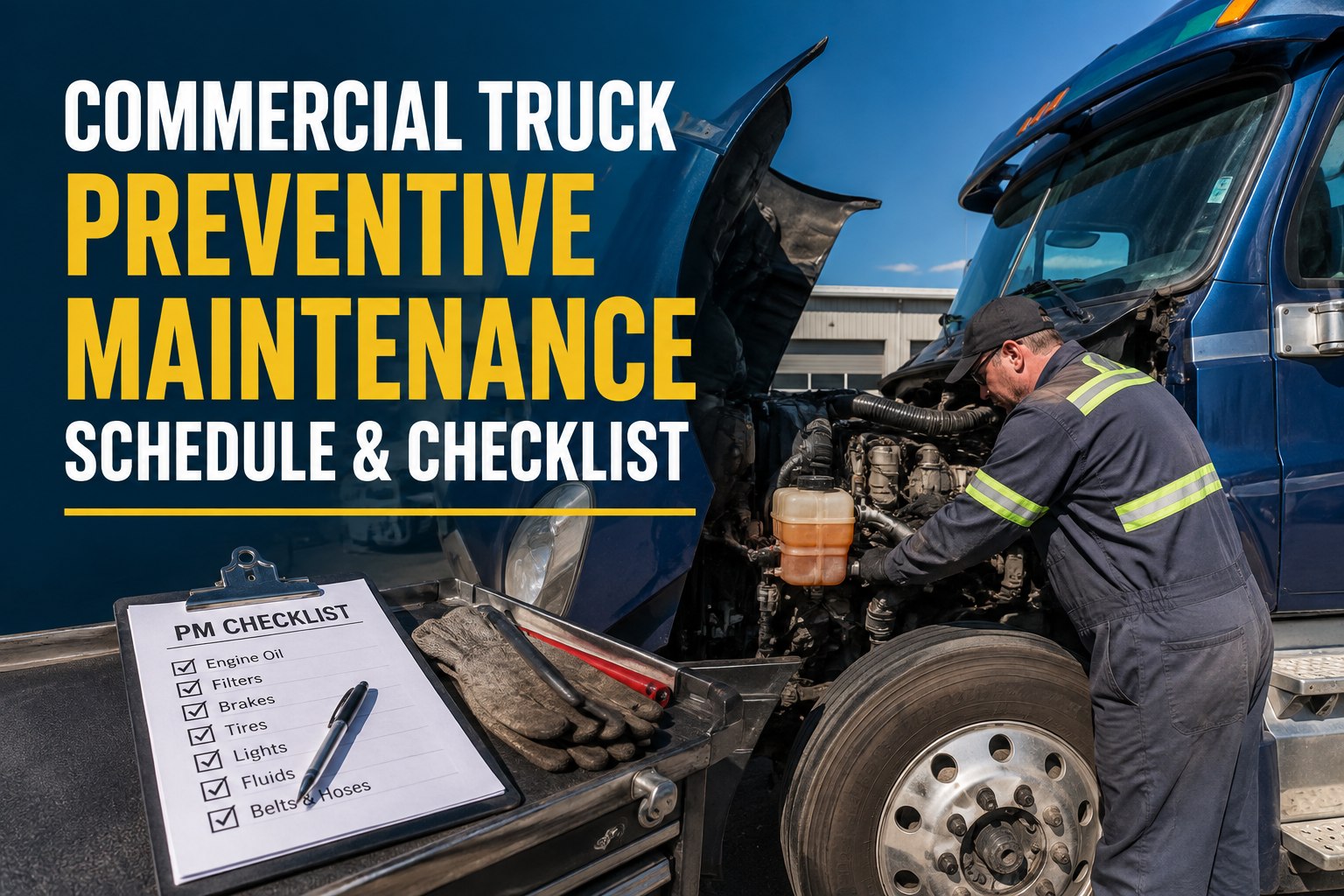
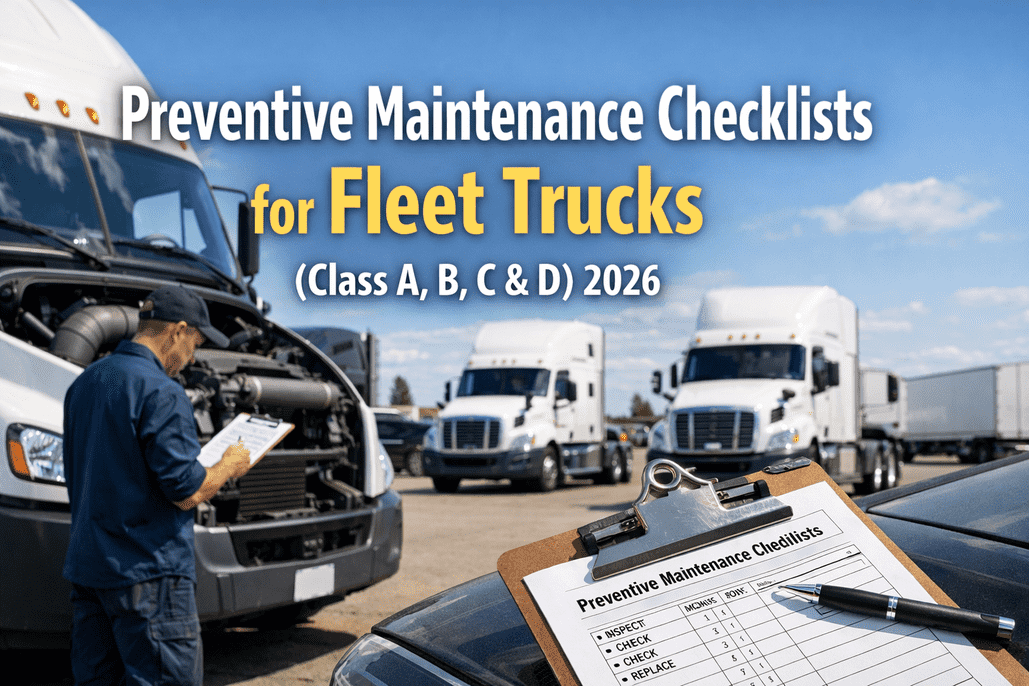
Below is the 30-item preventive maintenance checklist that covers every system on a Class 8 tractor. Work through each category before releasing the truck to service; check items off as you complete them. Every item ties back to either FMCSA compliance, warranty preservation, or breakdown prevention.
Any item that fails inspection should trigger a work order with a repair or replacement action before the truck returns to service. Log completion for the record and file the PM under the truck's service history. Start free and turn this checklist into a scheduled workflow on day one
5 costly PM mistakes and what they actually cost
Every seasoned maintenance manager has watched PM programs fail in the same five ways. Each mistake has a direct downstream cost — usually much larger than the PM cost avoided in the first place.
Skipping A services when the shop gets busy
Engine oil degrades past viscosity spec, fuel filters plug, water enters the fuel system, air filters restrict flow.
Same schedule for every truck regardless of duty cycle
High-duty units run past service windows unnoticed; low-duty units get over-serviced with no wear to justify the labor.
Tracking intervals by miles only, not engine hours
Idle-heavy fleets (waste, delivery, transit) accumulate wear on engine hours, not miles. Paper says truck is current; wear says otherwise.
PM records not searchable or auditable
Warranty claims denied for missing service history. Resale value discounted at trade-in. FMCSA audit findings on maintenance records.
Reactive-only culture (no PM schedule at all)
Failures happen everywhere, unpredictably, always on the road. DOT out-of-service rate 3x to 5x higher than industry average.
Every mistake above eventually surfaces in the same place: the annual maintenance budget as a line labeled "unscheduled." A PM program that hits its intervals moves that line down 60% to 75% within 12 months. Book a demo to see PM intervals enforced by workflow, not memory
The mile-marker PM schedule template
Preventive maintenance intervals are not guesses — they're mile-marked patterns you can lay out for the truck's full life. Here's what the first 250,000 miles of a Class 8 tractor's PM schedule looks like, service by service.
The pattern repeats: A service every 25K miles, B service every 75K to 100K miles, C service every 250K miles. Layered discipline compounds — fleets on this schedule average 300% to 500% longer lifetime miles per tractor than fleets on reactive-only maintenance. Book a demo to see the template loaded per truck automatically — or start free and enroll your first truck this week .
From a maintenance director who turned reactive into scheduled
When I took over as maintenance director, we ran no PM schedule to speak of — trucks came in when they broke. Unscheduled downtime was 18% of fleet hours. First thing I did was digitize a PM checklist and enforce A/B/C intervals off the mileage log.
Six months in, unscheduled downtime was 6%. Twelve months in, our tractor lifetime-mile projection went from 550K average retire to 850K. That's not maintenance discipline — that's 60% more asset yield on the same trucks with the same drivers.
Frequently asked questions
What is preventive maintenance for heavy trucks?
Preventive maintenance for heavy trucks is the practice of servicing every unit on a mileage-based, hours-based, or time-based schedule — before a failure occurs — rather than reacting to breakdowns after they happen. A structured PM program organizes services into three tiers (A, B, and C) that stack in complexity: Service A covers routine oil, filter, and fluid changes plus visual inspection; Service B adds transmission, differential, and air system service; Service C adds major component work including injector service, valve adjustment, and DPF cleaning. The core value proposition is cost delta: a scheduled service costs $250 to $500 for A, $800 to $1,600 for B, and $2,500 to $5,000 for C, while the equivalent unscheduled breakdown of the same underlying wear typically costs 4x to 10x more. Well-run PM programs also preserve OEM warranty coverage, meet FMCSA inspection requirements, extend truck lifetime mileage significantly, and produce the maintenance records that trucks need for resale value.
What's the difference between A, B, and C service?
The three PM service tiers stack in complexity and interval. Service A is the routine touch-service — performed every 15,000 to 25,000 miles or 250 engine hours — and covers engine oil change, oil filter, fuel filter, air filter, all fluid level checks, chassis lubrication, brake inspection, tire pressure, and walkaround inspection. Duration is 2 to 4 hours and typical cost is $250 to $500. Service B is performed every 45,000 to 75,000 miles (typically every third A service) and includes everything in A plus transmission fluid change, differential fluid change on both axles, coolant testing, air dryer cartridge service, deeper brake system inspection, and alignment check. Duration is 6 to 10 hours and typical cost is $800 to $1,600. Service C is the major service, performed every 100,000 to 150,000 miles, and includes everything in A and B plus fuel injector service, valve adjustment, brake reline if needed, coolant flush, DPF cleaning, and comprehensive electrical testing. Duration is 12 to 24 hours or multi-day; typical cost is $2,500 to $5,000.
What items should be on a heavy truck PM checklist?
A complete heavy truck PM checklist covers six major systems and roughly 30 line items. Engine, cooling, and fluids (6 items): engine oil and filter, fuel filters, air filter, coolant, power steering fluid, belts and hoses. Brakes and air system (5 items): brake linings, brake adjustment, air tank drain and air dryer, air lines, parking brake test. Drivetrain (4 items): transmission fluid, differential fluid, U-joints and driveshaft, driveline lubrication. Suspension and steering (5 items): leaf springs, shock absorbers, kingpins and steering linkage, air bags, steering play. Tires and wheels (4 items): tire pressure, tread depth, wheel and rim condition, lug nut torque. Cab, electrical, and aftertreatment (6 items): all exterior lighting, battery and terminals, wipers and mirrors and horn, DEF quality and level, DPF differential pressure, emergency equipment. Every item ties back to FMCSA compliance, warranty preservation, or breakdown prevention.
How often should heavy trucks receive preventive maintenance?
Interval structure depends on three signals: OEM specification, actual miles driven, and engine hours accumulated. For a typical Class 8 tractor running long-haul, Service A is due every 15,000 to 25,000 miles or approximately 250 engine hours. Service B is every 45,000 to 75,000 miles. Service C is every 100,000 to 150,000 miles. For fleets with idle-heavy duty cycles (waste, transit, refuse), engine hours matter more than miles because wear compounds during idle hours — a truck idling four hours a day accumulates roughly 25 miles of engine wear per idle hour, which mileage-based scheduling misses. Best practice for mixed fleets is to trigger PM on whichever comes first: mileage threshold, engine-hour threshold, or calendar interval (typically 6 months). Software-based interval tracking handles this multi-trigger logic automatically.
Can PM software really improve maintenance compliance?
Yes, and the improvement is measurable within the first quarter. PM software solves the core problem of interval tracking — knowing which truck is due for which service based on live mileage or engine hours — through automatic alerts before service windows open, work order generation at trigger, digital record retention for every PM completed, and integration with DVIR so driver-reported defects route directly into the PM queue. Fleets moving from paper-based PM tracking to software typically see PM compliance rates rise from 60% to 75% up to 90% to 95% within 90 days, unscheduled downtime drop 50% to 70% inside the first year, and truck lifetime miles extend by 30% to 60% on the same equipment. The record-keeping benefit compounds too: warranty claim success rates improve significantly, FMCSA audit findings drop to near zero on maintenance records, and resale value at trade-in reflects the complete service history. The software cost is trivial against the recovered downtime and warranty preservation on any fleet above 20 vehicles.
Turn PM into a scheduled workflow — and cut unscheduled downtime 50 to 70%
HVI tracks A, B, and C service intervals per truck by mileage or engine hours, alerts before service windows open, generates work orders automatically, produces digital PM records for warranty and audit, and routes DVIR defects into the PM queue. Live in under two weeks — and typical fleets extend truck lifetime miles 30% to 60% on the same equipment.
No credit card · No hardware · PM tracking ready day one