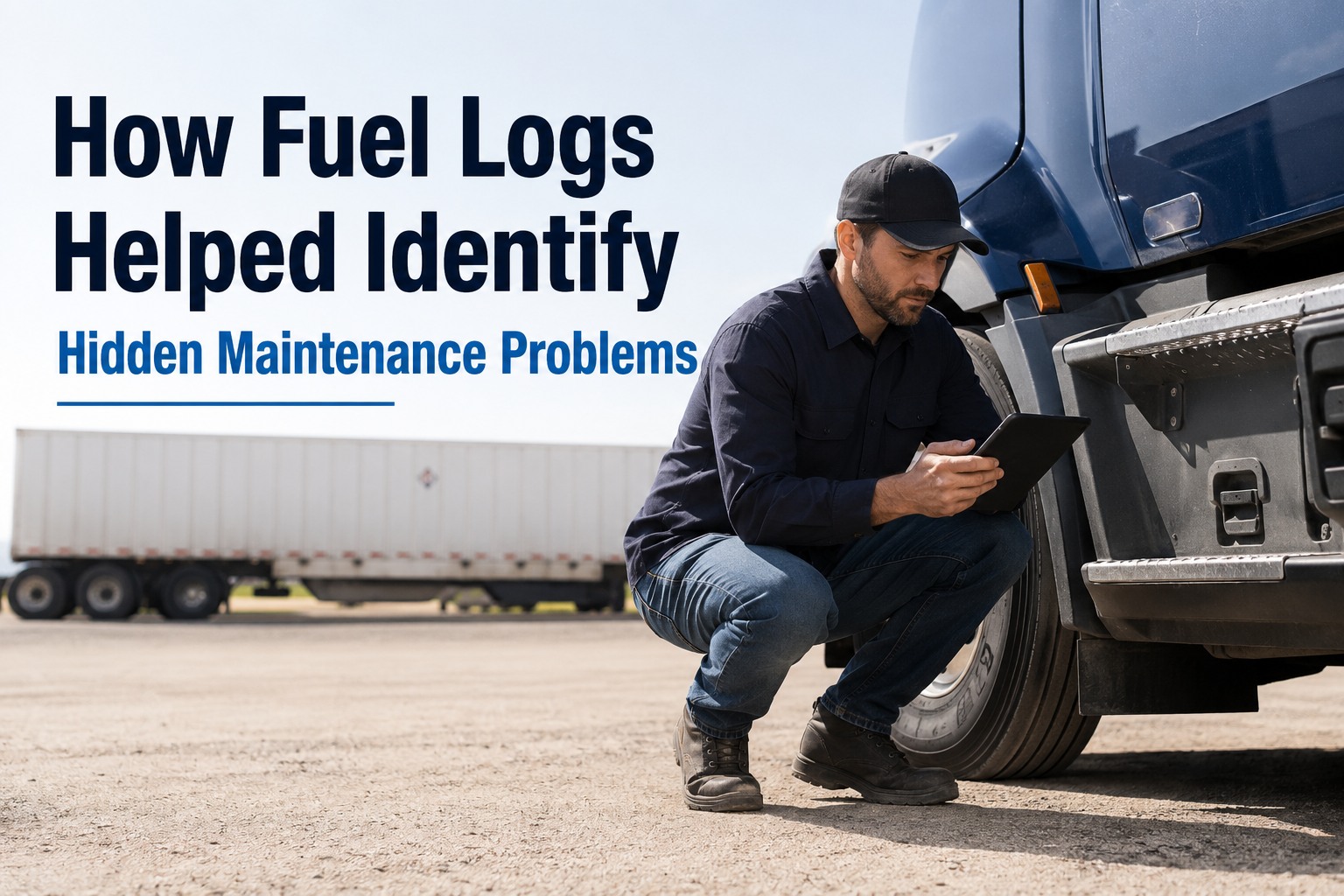
The fuel bill was creeping up, and nobody could say why. Same routes, same loads, same drivers — but the cost per mile kept climbing across a handful of vehicles, and it looked like just the price of diesel doing what diesel does. Then one fleet manager did something simple: instead of treating fuel logs as an accounting record, he started reading them as a diagnostic. The pattern jumped out immediately. A vehicle whose MPG had quietly slipped 12% with no change in route or load wasn't burning more fuel because of prices — it was burning more because something mechanical was wrong.A 10–15% MPG drop with no load or route change is one of the most reliable early warnings a vehicle can give you, and the window between that warning and a roadside failure is measured in days to weeks, not months. By matching fuel data against each vehicle, he started catching clogged filters, dragging brakes, and fouling injectors while they were still cheap fixes — not breakdowns. This is the story of how fuel logs became an early-warning system, what they revealed, and how any fleet can do the same. book a 30-minute walkthrough to see it mapped onto your own fleet.
A vehicle's fuel log isn't an expense report. It's the engine telling you something's wrong.
HVI tracks fuel use per vehicle, surfaces the MPG drop that signals a developing fault, ties it to the inspection that finds the cause, and turns it into a work order — so a clogged filter gets caught at $50 instead of becoming a $2,500 pump failure on the shoulder.
The mystery: a fuel bill with no explanation
Every fleet has felt it — fuel cost climbing on vehicle that haven't changed what they do. The instinct is to blame diesel prices. The data tells a different story.
Cost up, nothing changed
Same routes, same loads, same drivers — but cost per mile creeping up on specific vehicles. It looked like fuel prices; it was mechanical drag nobody could see.
The decline is gradual
Hidden faults develop slowly, so the MPG slide is easy to miss day to day — until the data is laid side by side and the pattern is undeniable.
Here's the reframe that changed everything: fuel economy is the cheapest diagnostic signal a vehicle produces. Almost every developing mechanical fault — restricted fuel delivery, added rolling resistance, a dragging brake — shows up as extra fuel burned before it shows up as a breakdown. The fleet was already collecting that signal on every fill. It just wasn't reading it.
The realization: fuel data points at the fault
The breakthrough was connecting two things the fleet already had — fuel logs and inspections — so an MPG drop didn't just raise a question, it triggered a look under the vehicle.
Track MPG per vehicle
Fuel use logged against each vehicle over time, so every vehicle has a normal baseline and any deviation from it stands out instead of hiding in a fleet average.
Flag the unexplained drop
When a vehicle's economy fell with no route, load, or driver change, the system flagged it — separating a real mechanical signal from normal day-to-day variation.
Trigger a targeted inspection
The flag drove a focused inspection of the usual culprits — and turned the finding into a work order, so the cause was fixed while it was still cheap.
The power is in the pairing: fuel data tells you which vehicle and roughly when, and the inspection tells you what and where. Neither alone closes the loop — together they turn a rising fuel bill into a specific, scheduled repair. HVI keeps fuel tracking and inspections in the same platform so the signal and the fix connect.
What the logs revealed
Once MPG drops triggered inspections, the same culprits kept turning up — each a cheap fix that fuel data caught weeks before it would have stranded a vehicle.
Every one of these was invisible on a fuel-card statement and obvious the moment MPG was tracked per vehicle and tied to a look under the hood. sign up free and turn fuel data into an early-warning system for your fleet, or book a demo to see fuel-to-fault tracking live.
The payoff: catch it cheap, not catastrophic
The value wasn't just lower fuel cost — it was catching faults in the shop instead of on the shoulder. The economics of early detection are lopsided.
cheaper to catch early. A $50 fuel filter caught from an MPG flag versus a $2,500-plus injection-pump failure plus days of downtime is a fifty-to-one swing — and that's before the towing, the late load, and the lost driver hours. Fuel logs don't just trim the fuel bill; they convert catastrophic surprises into scheduled, cheap repairs. The signal was free the whole time. HVI just makes the fleet read it.
How to replicate it on your fleet
This took no new sensors and no telematics overhaul — just reading data the fleet already produced on every fill, and pairing it with the inspection it already ran.
Before: fuel as an expense
- Fuel logs filed for accounting, never analyzed
- Rising cost blamed on diesel prices
- MPG drops hidden in a fleet-wide average
- Mechanical faults found only at breakdown
- A $50 filter becomes a $2,500 pump failure
- Fuel and maintenance data live in separate worlds
After: fuel as a diagnostic
- MPG tracked per vehicle against its own baseline
- Unexplained drops flagged automatically
- Each flag triggers a targeted inspection
- Faults caught weeks before they fail
- Cheap fixes scheduled, not emergency repairs
- Fuel data and inspections in one platform
The whole shift came down to one mental switch: stop seeing the fuel log as money already spent and start seeing it as the engine reporting its own health. The data was always there — the only change was reading it and acting on it. HVI makes that automatic, with no new hardware on the vehicle.
Frequently asked questions
Can fuel data really reveal mechanical problems?
Yes — fuel economy is one of the most reliable early-warning signals a vehicle produces, because almost every developing mechanical fault burns extra fuel before it causes a breakdown. A 10–15% drop in MPG with no change in route, load, or driver is a recognized early indicator of a problem, and the window between that warning and a roadside failure is typically measured in days to weeks rather than months. Restricted fuel delivery from a clogged filter, fouled injectors disrupting the spray pattern, a dragging brake adding resistance, underinflated tires increasing rolling resistance, a dirty air filter, or a failing sensor can each show up as a measurable economy decline first. The key is tracking MPG per vehicle against its own baseline so a real signal stands out instead of hiding in a fleet average. HVI's inspection and maintenance software tracks fuel per vehicle and surfaces the drops that warrant a look. sign up free and turn fuel data into an early-warning system.
What mechanical issues show up first as worse fuel economy?
The most common culprits behind an unexplained MPG drop are a clogged fuel filter, which restricts fuel delivery and, left alone, can damage the injection pump within weeks; fouled or dirty injectors, which disrupt the fuel spray pattern enough to cause measurable power loss and economy decline; a dragging brake such as a stuck caliper, which adds constant resistance and is also a safety concern; underinflated tires, which increase rolling resistance so the engine burns more fuel to maintain speed; a dirty air filter, which chokes airflow and throws off the air-fuel mixture; and a failing oxygen or pressure sensor, which can reduce fuel economy dramatically by causing the engine to run rich or lean. Each is comparatively cheap to fix when caught early and expensive when it progresses to failure. HVI's inspection and maintenance software ties a flagged fuel drop to a targeted inspection of exactly these items. book a demo to see fuel-to-fault diagnosis.
How much can catching a fault early actually save?
The savings are lopsided in favor of early detection. The classic example is the fuel filter: a roughly $50 maintenance item that, ignored on a high-mileage vehicle, damages the high-pressure injection pump within weeks and turns into a $2,500-plus repair — and that's before adding towing, the late load, and lost driver hours from a roadside breakdown. That's a fifty-to-one swing on a single component. Beyond the avoided catastrophic repair, fixing the underlying fault restores fuel economy, so the cost-per-mile comes back down across the fleet, and fewer breakdowns mean less unplanned downtime. The point of reading fuel logs as a diagnostic is precisely to convert expensive surprises into cheap, scheduled repairs. HVI's inspection and maintenance software is built to surface those signals and route them to a work order before the cheap fix becomes a costly one. sign up free and start catching faults at the $50 stage.
Do I need telematics to use fuel data this way?
No. While telematics and engine-data systems are powerful and can automate a lot of this, the approach in this story worked with data the fleet already produced on every fill-up — fuel volume and mileage logged per vehicle. The essential move is per-vehicle tracking, so each vehicle is measured against its own baseline rather than a fleet average that hides the outliers, and then pairing an unexplained drop with a targeted physical inspection to find the cause. That makes it accessible to fleets of any size, including those without a telematics rollout, and it can always be enriched with engine data later. Most of the value comes from systematically reading and acting on the fuel data you already have, not from new hardware. HVI's inspection and maintenance software is built around that approach, keeping fuel tracking and inspections in one place. book a demo to see the no-telematics setup.
How does HVI help connect fuel data to maintenance?
HVI is an inspection and maintenance software platform that keeps fuel tracking and equipment maintenance in the same place, which is what lets a fuel signal turn into a fix. It tracks fuel use per vehicle over time so each vehicle has its own baseline, and surfaces the unexplained MPG drops — no route, load, or driver change — that signal a developing mechanical fault. From there, the flag drives a targeted inspection run on a phone or tablet with photo capture, and any defect found auto-creates a work order routed to the shop, so the clogged filter or dragging brake gets fixed while it's still cheap rather than becoming a roadside failure. Because inspections, work orders, fuel data, and full maintenance history all live in one platform, the signal, the diagnosis, and the repair stay connected end to end — and you get a documented record per vehicle for cost analysis and audits. No new hardware required. book a demo and we'll map the software onto your fleet on the call.
Stop blaming diesel prices. Start reading what the fuel log is telling you.
HVI tracks fuel per vehicle, surfaces the MPG drops that signal a developing fault, triggers the inspection that finds the cause, and routes it to a work order — all in one platform with your maintenance history. Catch the clogged filter at $50 instead of the $2,500 pump failure on the shoulder. No new hardware, just the data you already collect, finally read.
No credit card required · Live in under two weeks · Per-vehicle fuel tracking + MPG-drop flags + targeted inspections + work orders in one platform