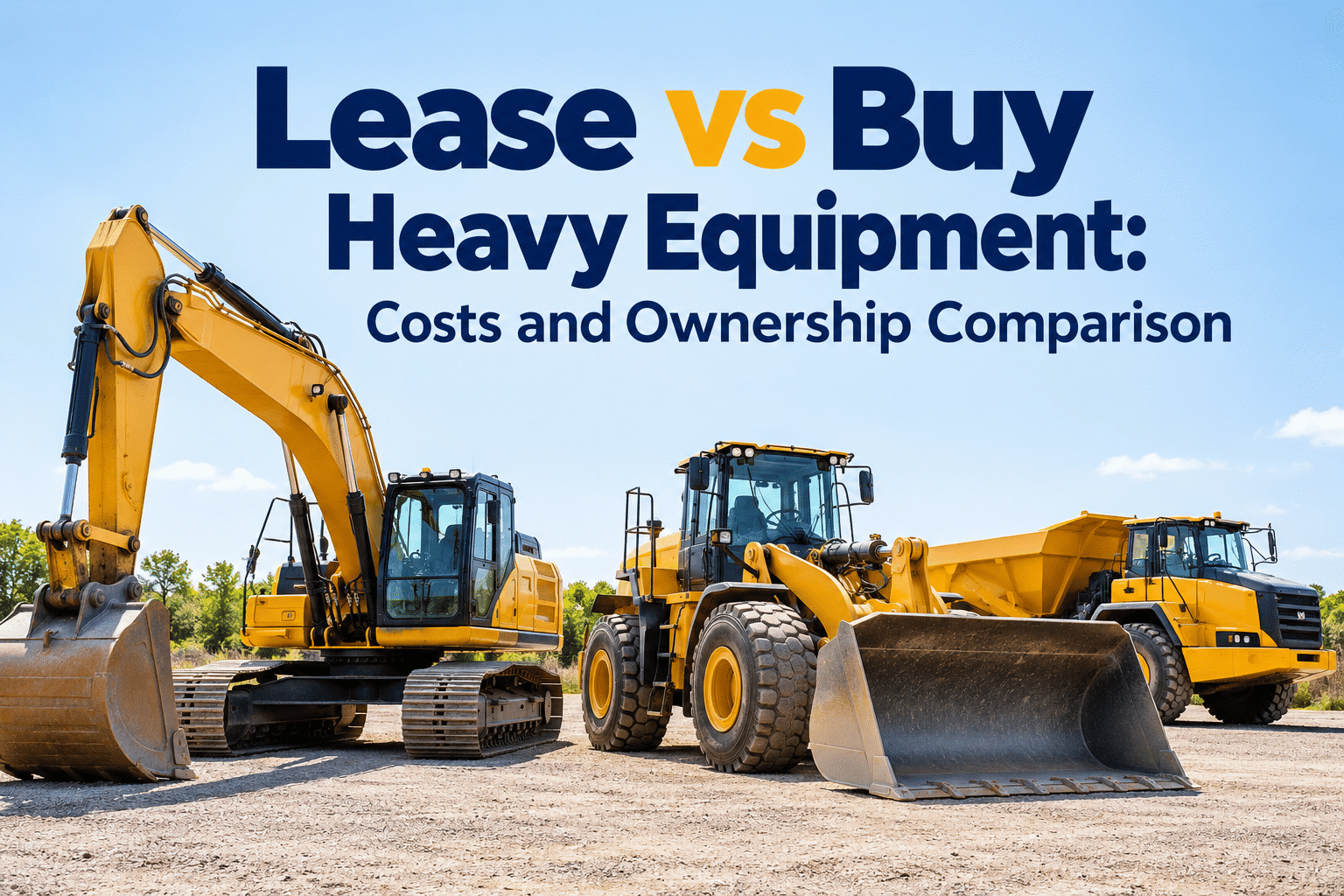
Two quotes on the desk put the same excavator in your yard: a finance deal to buy, and a lease. The lease vs buy heavy equipment call isn't about which looks cheaper this month — it's matching the financing path to how long you'll keep the machine and how tight your cash is. Guess wrong and you either lock up capital you needed, or lease-forever a core asset you should have owned. Book a demo to see each machine's true lifecycle cost first.
Lease vs Buy Heavy Equipment: The Real Numbers, Side by Side
Same excavator, two financing paths. One protects your cash flow; the other builds an asset you own. Here's how to tell which one this machine needs.
Lease it
- Little to no money down
- Fixed, predictable monthly cost
- Easy upgrade, no resale hassle
- No equity, higher interest
Buy it
- Builds a sellable asset
- Lower lifetime cost at high use
- Section 179 & depreciation
- Big upfront, you own the repairs
The split above is the decision in one glance. But "it depends" isn't an answer you can sign a contract on. Below is the line-by-line cost comparison, the three lease structures that change everything, the cash-flow picture over five years, and a plain checklist to route any machine to lease or buy — grounded in real numbers, not sales talk.
Line by linelease vs buy heavy equipment, across every cost that moves
The quote on your desk only shows the monthly number. The real lease vs buy heavy equipment comparison runs across eight cost dimensions — and most of them never appear on either quote. Here's the full side-by-side.
| Cost factor | Lease | Buy (financed) |
|---|---|---|
| Money down | Little to none | Typically ~20% down |
| Monthly cost | Fixed, predictable | Loan payment + running costs |
| Interest rate | Usually higher than a loan | Usually lower than a lease |
| Maintenance | Often light (depends on lease) | All on you |
| Tax treatment | Payments often deductible | Section 179 + depreciation |
| Asset / equity | None until buyout | You own it, can sell it |
| Resale / residual | Risk sits with lessor | You keep the resale value |
| End of term | Return, renew or buy out | Keep running it for free |
Read down the two columns and the pattern is clear: leasing buys you cash-flow certainty and flexibility; buying buys you equity and a lower cost per hour over a long life. Neither is "better" — it depends on how long this machine stays in your fleet and how hard it works. That's the number most owners can't produce on demand, and it's exactly what HVI's cost analysis tools hold per machine. Book a demo to pull real cost-per-hour by asset before you commit to either column.
Not all leases are the samethree structures that change the whole math
"Leasing" isn't one thing. The structure decides whether you get tax deductions, whether the machine ends up yours, and whether it even counts as a lease to the tax office. Pick the wrong one and the math you ran falls apart.
Works like a long rental. Payments are usually deductible as an ordinary expense, but you don't own the machine and can't claim depreciation on it.
Documented as a lease but treated like a purchase — nominal buyout, term covering most of the useful life. May let you claim Section 179 and depreciation.
Lower monthly payments, but at term you buy at the machine's then-current market value — or hand it back. Best when you expect to upgrade.
One more thing the quotes won't mention: under current accounting rules (ASC 842), both finance and operating leases now show up on your balance sheet as a right-of-use asset and a liability — so "off the books" leasing isn't what it used to be. If a machine is a long-term keeper, a $1-buyout or an outright purchase usually wins; if it's fast-obsolescing or short-project kit, a true operating lease keeps you flexible. Sign up free and log every machine's service history so a lease buyout decision is backed by its real condition.
The cash-flow picturewhere your money actually goes, year by year
The clearest way to feel the difference is to watch five years of cash. Leasing is a flat line of predictable payments with nothing at the end. Buying is a big hit up front, then a lighter run, then a machine you own outright that keeps earning for free.
first-year tax saving from a full $60,000 Section 179 deduction — plus resale value at the end
total tax saving over 5 years on $69,000 of payments — but nothing owned at the end
Buying wins on total cost and resale; leasing wins on cash-flow smoothing and residual-value risk. The tipping factor is how long you keep it.
Note the 2026 backdrop: 100% bonus depreciation is back for equipment placed in service, and the Section 179 deduction cap sits at $2.56M — which tilts the math toward buying for most small and mid-size fleets that can carry the upfront cost. Book a demo to model this on your own machines with real cost data instead of a generic example.
Route this machinea plain lease-or-buy decision checklist
Run any machine through this before you sign. The more boxes you tick in a column, the stronger that column is for this specific asset — it's not about the fleet in general, it's about this one unit and this one job.
- Cash flow is tight or seasonal
- You'll use the machine <3–4 years
- The tech obsolesces fast
- You want to upgrade without reselling
- Predictable monthly budgeting matters most
- It's project-specific, not a core unit
- It's a core, high-hour workhorse
- You'll keep it 5+ years
- You can carry the upfront capital
- You want the Section 179 write-off
- Resale value at end matters to you
- The machine holds value and ages slowly
Every item on that list leans on data you'd rather have than guess — actual engine hours, how long similar machines have lasted in your fleet, real maintenance cost as the unit ages. That's the per-asset record HVI's asset management keeps, so your lease-or-buy call sits on evidence. Book a demo to run this checklist against your real fleet data. It's the same discipline behind the rent-vs-own utilization break-even — that page handles short-term rental math, this one handles the financing structure once you've decided to commit.
Where HVI fitsthe lifecycle data behind a confident decision
Whichever route you pick, the decision is only as good as the data under it. HVI gives you the per-machine numbers lenders and lease reps won't — what each asset actually costs to run, how its maintenance is trending, and how much life is left before a buyout or trade.
Parts, labor and fuel roll into one per-asset rate in analytics & reporting — the honest input to any lease-vs-buy model.
Every work order and PM service on record, so a lease buyout or resale is priced on real condition, not a guess.
Operator daily reporting and telematics capture real runtime, so "how long will we keep it" is measured, not assumed.
Asset management flags machines whose rising cost signals it's time to exercise a buyout or move on.
From an equipment manager who's signed both
I used to lease everything because the monthly number looked clean. Then I pulled five years of cost data on two identical loaders — one leased, one bought — and the owned one had cost us about 20% less all-in once resale was counted. Now I don't decide on the quote alone. I check the machine's hours and maintenance trend first, and the lease-or-buy call practically makes itself.
Lease vs buy heavy equipment — FAQs
Is it better to lease or buy heavy equipment?
Neither is universally better. Lease when cash flow is tight, the machine is short-term or fast-obsolescing, and predictable payments matter. Buy when it's a core, high-hour machine you'll keep 5+ years and you can carry the upfront cost — ownership usually wins on total cost once resale is counted.
What are the main types of equipment leases?
Three common ones: a true (operating) lease that works like a rental with deductible payments, a $1-buyout/capital lease that's treated like a purchase and may allow Section 179, and a fair-market-value (FMV) lease with lower payments where you buy at market value or return it at term.
Does Section 179 apply to leased equipment?
It applies when you buy, or when a capital/$1-buyout lease is treated as a purchase for tax purposes. A true operating lease generally doesn't qualify because you don't own the asset. The 2026 Section 179 cap is $2.56M, and 100% bonus depreciation is available for qualifying equipment placed in service.
How does leasing affect cash flow vs buying?
Leasing spreads cost into fixed monthly payments with little or no money down, which protects working capital — useful for seasonal or thin-cash operations. Buying usually needs about 20% down plus financing, a bigger upfront hit, but leaves you owning an asset that keeps earning once the loan is paid.
How does HVI help with a lease-vs-buy decision?
HVI gives you the per-machine numbers the decision rests on: true cost per hour, full maintenance history, real engine hours and remaining life. With those on screen you can model lease vs buy on your own data and know when to exercise a buyout, keep running an owned asset, or trade it in.
Sign the lease-or-buy decision that your own numbers support
HVI tracks true cost per hour, maintenance history and remaining life for every machine — the data that turns a lease-vs-buy gut call into a defensible one. Model it on your own fleet, live in under two weeks.
No credit card · No hardware · Asset cost tracking ready on day one