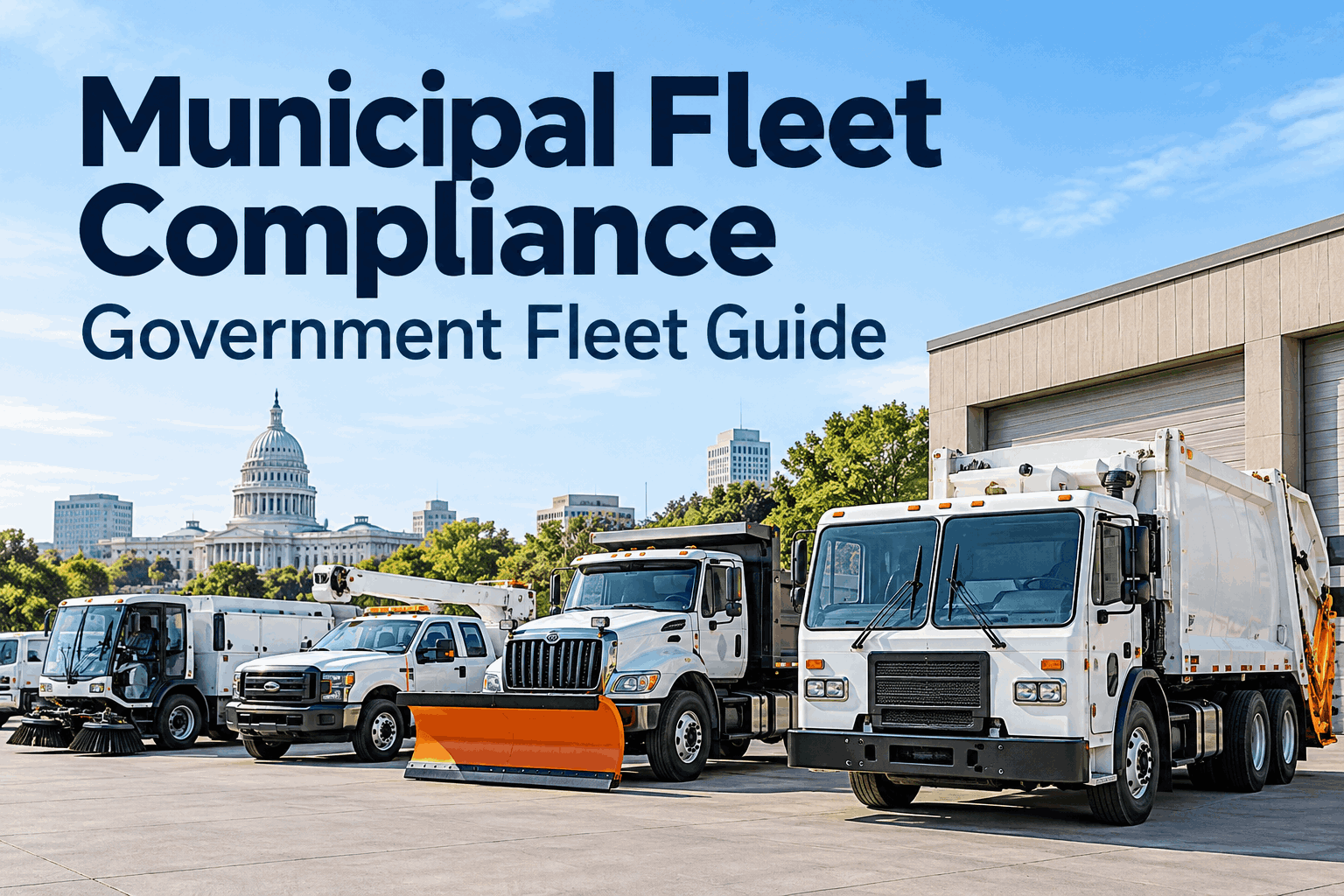
Municipal fleet compliance is harder than commercial fleet compliance for one reason: a city doesn't run one kind of vehicle under one set of rules — it runs a dozen, each with its own. Police cruisers, fire apparatus, refuse packers, snow plows, parks trucks and admin sedans all sit in the same yard under different rulebooks. Book a demo to see mixed-fleet compliance managed in one place.
One Fleet, Many Rulebooks
A municipal fleet is really several fleets in one yard — each vehicle class under different inspection, maintenance and driver rules. Managing that mix is the real municipal fleet compliance challenge.
Here's the municipal fleet compliance picture — why a mixed public-sector fleet is uniquely hard to keep compliant, the four requirement areas every class shares, why one inspection cadence can't cover them all, how jurisdiction-specific rules stack on top, and how centralized records turn an audit into a search. (This guide covers US public-sector fleets; specific requirements vary by state and locality.)
Why municipal fleets are uniquely hard to keep compliantit's the mix, not the size
A commercial carrier usually runs one broad vehicle type under one regulatory regime. A municipal fleet does the opposite — it packs wildly different vehicles into one operation, and each brings its own compliance obligations. The fire truck answers to different standards than the refuse packer, which answers to different rules than the mayor's sedan.
The challenge isn't a big fleet — it's a mixed one. When every class follows a different inspection schedule, maintenance standard and driver requirement, a single checklist or a shared spreadsheet quietly leaves gaps. Municipal fleet compliance is really the job of running many small compliance programs at once, without letting any of them slip.
The four requirement areas every class sharesdifferent rules, same four buckets
However varied the vehicles, municipal fleet compliance comes down to four areas that apply to every class — the details differ, but the buckets don't. Getting each one right, per class, is what keeps the whole fleet defensible.
Inspections
Daily or pre-trip checks appropriate to each class — a fire pump test isn't a plow's pre-trip, and both differ from a sedan's.
Maintenance
Preventive schedules by class and use — heavy refuse and plow cycles wear far faster than a low-mileage admin car.
Driver qualifications
CDLs for the heavy trucks, endorsements for air brakes or hazmat, plus the license and training records to prove them.
Records & reporting
The proof behind all of it — inspection logs, work orders, driver files — ready for an audit or a council request.
These four are also what a public-sector audit walks through, one class at a time — and a gap in any one, on any class, is a finding. A fire truck with a current pump-test record but a lapsed driver medical is still non-compliant, just as a perfectly-maintained plow with no inspection log on file can't prove it. Building all four into a class-aware routine — rather than a one-size checklist — is where a digital inspection and maintenance platform earns its place across a mixed fleet. Book a demo to map the four areas to each class
Why one inspection cadence can't cover them alleach class runs on its own clock
The instinct is to set one PM and inspection schedule for the whole fleet. It fails immediately, because a snow plow that runs flat-out for three winter months and a parks truck that idles all summer simply don't wear on the same clock. Compliance intervals have to follow the class, not the calendar alone.
Set the cadence too loose for the plows and you miss safety-critical wear; set it too tight for the sedans and you burn budget on needless service. Multi-interval scheduling — a different clock per class — is what keeps each vehicle both compliant and cost-efficient, and it's the backbone of sound municipal fleet maintenance. Start free and set a cadence per vehicle class.
Jurisdiction-specific rules stack on topthe same truck, different rules by where it runs
On top of the class differences, municipal fleets answer to overlapping jurisdictions. Federal DOT rules apply to the heavy trucks, state rules layer on inspection and registration requirements, and the city or county adds its own policies. A single vehicle can sit inside all three at once.
This is where a rigid, one-region setup falls short: a fleet that operates across county or state lines, or answers to several agencies, needs its compliance rules configured per jurisdiction, not hard-coded once. A county fleet whose trucks cross into a neighboring state for mutual-aid work, or a regional authority serving several municipalities, can't run on a single fixed rule set — the requirements genuinely differ by where the vehicle is and who it answers to. Region-configurable profiles are what let the same fleet meet different local requirements without standing up a separate system for each jurisdiction. Book a demo to configure rules by jurisdiction
Where municipal fleet compliance breaks downthe four gaps that surface in an audit
When a public-sector fleet takes a compliance finding, it usually traces to one of these four gaps — each a side effect of managing a mixed fleet with tools built for a uniform one.
The common thread is treating a mixed fleet as if it were uniform. Closing the gaps means giving each class its own compliance setup while keeping every record in one place — the approach behind audit-ready safety and compliance management. Book a demo to close the mixed-fleet gaps
Centralized records turn an audit into a searchwhere compliance meets accountability
Public-sector fleets face a scrutiny commercial fleets don't: council oversight, public records requests, and audits that expect documentation on demand. The difference between a stressful audit and a routine one is whether the records for every class sit in one searchable place.
One record, every class
Inspections, PM and driver files for police, fire, refuse, plows and admin — all in one system, not scattered.
Searchable on demand
Pull the history for any vehicle, class or period in seconds when a council member or auditor asks.
Exported for reporting
Clean exports for audits, council reports and public records requests, without a scramble.
That's the shift centralization makes: compliance stops being a filing exercise spread across departments and becomes a single source you can answer from. When a public records request or a mid-year audit lands, the fleet office isn't assembling binders from six departments — it's running a query. That responsiveness is its own form of accountability, and it changes how the fleet is seen by the people it reports to. Start free and put every class's records in one place.
From a municipal fleet manager
We manage everything from ladder trucks to lawn-mowers, and for years we tried to run it all off one inspection form and one PM schedule. It worked until it didn't — the plows would take a finding in a winter audit because the generic pre-trip didn't cover the hydraulics, and meanwhile we were changing oil on admin cars that barely moved. The moment we set a real profile per class — its own checklist, its own interval, its own driver requirements — the findings stopped and the budget actually loosened up because we weren't over-servicing half the fleet. And when the annual audit came, I pulled every record by class in about a minute instead of spending a week assembling binders.
How HVI simplifies municipal fleet complianceprofile by class, schedule by duty, export on demand
Municipal fleet compliance gets manageable when each class has its own setup and every record lives in one place. HVI's region-configurable profiles, multi-interval scheduling and export do exactly that across a mixed public-sector fleet.
Profile by class
Each class gets its own checklist, records and jurisdiction rules.
Schedule by duty
Multi-interval PM so each class runs on its own maintenance clock.
Export on demand
Every class's records ready for audit, council or public request.
See how a mixed municipal fleet becomes many tidy compliance programs in one system with HVI's government fleet inspection and maintenance software. Walk through your own class profiles in a quick demo
Municipal fleet compliance: quick answers
What is municipal fleet compliance?
Municipal fleet compliance is the practice of keeping a public-sector fleet's vehicles, drivers and records in line with the inspection, maintenance and regulatory requirements that apply to them. What makes it distinct from commercial fleet compliance is the mix: a city runs many vehicle classes — police, fire, refuse, snow, parks, admin — each under different rules, often across overlapping federal, state and local jurisdictions. Compliance means meeting all of those requirements per class and holding the records to prove it.
Why is municipal fleet compliance harder than commercial?
Because of the variety, not the volume. A commercial carrier typically runs one broad vehicle type under one regulatory regime, so a single checklist and schedule can work. A municipal fleet packs very different vehicles into one operation — a fire truck, a refuse packer and a sedan have almost nothing in common in their inspection, maintenance and driver requirements. Managing that means running many small compliance programs at once, which uniform tools built for a single fleet type tend to leave gaps in.
What are the main municipal fleet compliance requirements?
They fall into four areas that apply to every class, with the details varying by vehicle: inspections (daily or pre-trip checks suited to the class), maintenance (preventive schedules by class and use), driver qualifications (CDLs, endorsements and training records where required), and records and reporting (the documentation behind all of it). On top of these, jurisdiction-specific rules from federal DOT, state agencies and local government stack on, so the exact requirements depend on both the vehicle class and where it operates.
Why can't one inspection and PM schedule cover a whole municipal fleet?
Because vehicle classes wear on completely different clocks. A snow plow running flat-out for a few winter months, a refuse packer working daily, a high-mileage police cruiser and a rarely-used admin sedan all need different inspection and preventive-maintenance frequencies. A single shared schedule inevitably over-services the light vehicles — wasting budget — while under-servicing the hard-working ones, which risks both safety and compliance. Multi-interval scheduling, with a cadence per class, keeps each vehicle both compliant and cost-efficient.
How does HVI help with municipal fleet compliance?
HVI lets a municipal fleet set a compliance profile per vehicle class and jurisdiction — each with its own inspection checklist, preventive-maintenance interval and required records — so a mixed fleet runs many compliance programs at once from one system. Multi-interval scheduling gives each class its own maintenance clock, and every record is kept centrally and exported on demand for audits, council reports or public records requests. That turns scattered, class-by-class compliance into one searchable, audit-ready source.
Run every class compliant, from one place
HVI turns a mixed municipal fleet into many tidy compliance programs — a profile per class and jurisdiction, a maintenance clock per duty cycle, and every record centralized and audit-ready — so nothing slips between the police cruiser and the snow plow.
No credit card · US public-sector focused · Set your first class profile today
- Profile each vehicle class separately
- Set inspections suited to each class
- Schedule PM by duty, not one calendar
- Map federal, state & local rules
- Keep every record in one place