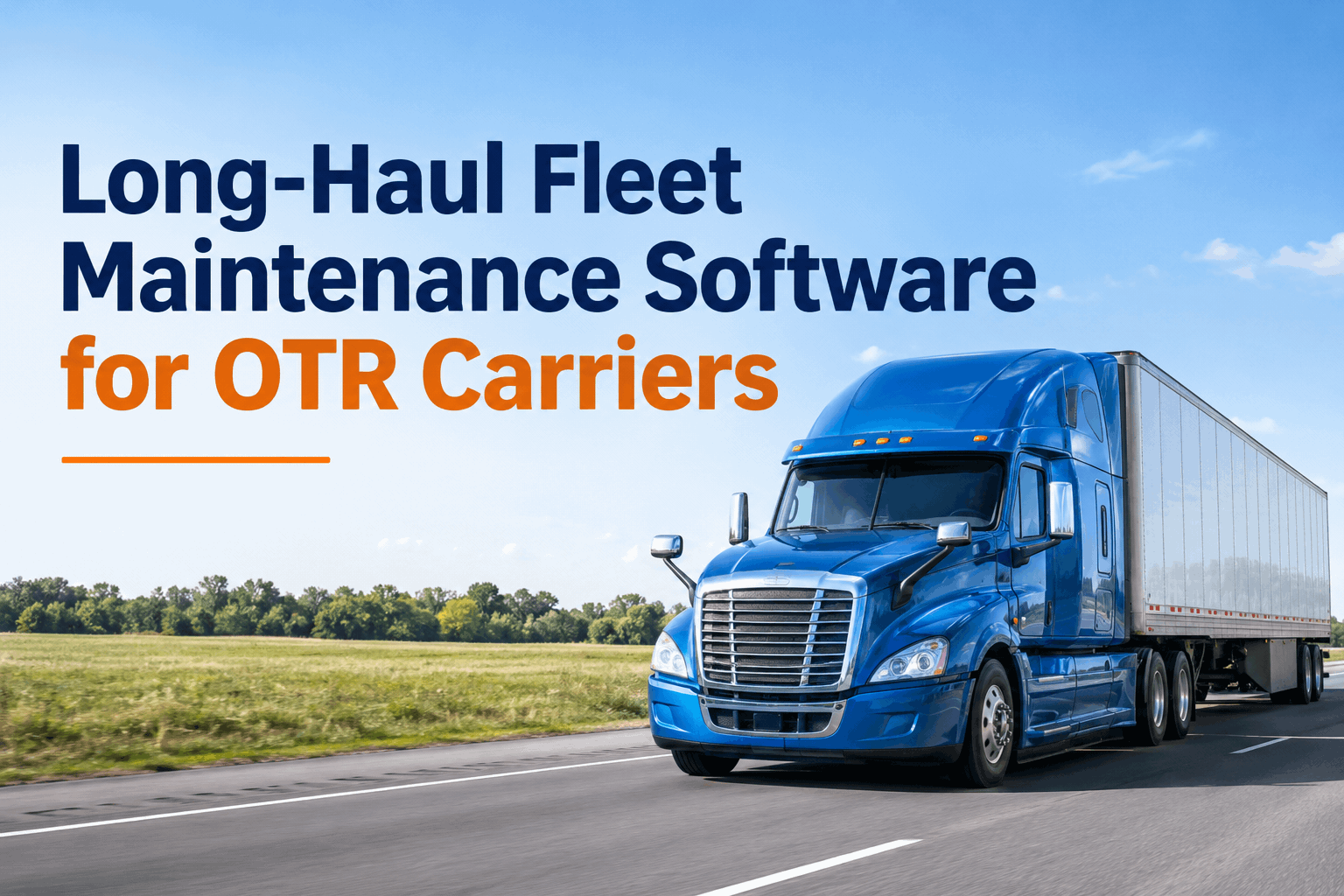
An OTR truck can log 100,000 to 150,000 miles a year and stay out two to three weeks at a stretch — which means when something goes wrong, it almost never happens near your shop. Long-haul fleet maintenance software for OTR carriers exists for that exact problem: true mileage-based PM, trailers tracked independently of whatever tractor happens to be pulling them, and a defect record that works from wherever the truck actually is. Sign up free and set up your first OTR tractor's maintenance profile.
Long-Haul Fleet Maintenance Software for OTR Carriers
An OTR tractor is rarely near home when something needs attention. HVI tracks mileage-based PM, tractor and trailer history separately, and routes defects to a work order no matter which state the truck is actually sitting in.
Mile 0
~25K mi
Swap
Ready
Why OTR Maintenance Breaks When the Truck Is States Away
A local or vocational fleet can walk out to a truck and check it. An OTR carrier has to trust a record it can't physically verify until the truck comes home.
Calendar PM Misses the Mark
A truck running 3,000 miles a week blows past a calendar-based PM reminder in days — mileage, not the date, is what actually matters here.
Trailers Lose Their History
Drop-and-hook means a trailer pairs with a different tractor every few days — if the record follows the tractor, the trailer's history disappears.
Defects Get Called In, Not Logged
A driver phones in an issue from the road, someone writes it on a sticky note, and the fix happens at whatever shop is nearest — with no record tying it back.
DOT Stops Happen Anywhere
A roadside inspection doesn't wait until the truck is home. Without a record on the driver's phone, there's nothing to show the inspector on the spot.
Give Every OTR Truck a Record That Travels With It
Mileage-based PM, defect tracking, and DOT-ready records that work the same whether your truck is in the yard or three states away.
What OTR Fleet Maintenance Software Should Actually Do
A long-haul fleet needs software built around mileage and distance, not a vocational or courier template — sign up free to set this up for your own fleet.
True Mileage-Based PM Scheduling
PM intervals driven by actual miles covered, with alerts that reach the driver and dispatch before a truck runs past due mid-route.
Tractor and Trailer, Tracked Apart
Each trailer keeps its own inspection and repair history independent of whichever tractor is currently pulling it.
Roadside Defect Capture
A driver logs a defect from a phone anywhere in the country, and it routes straight to a work order instead of a phone call nobody wrote down.
DOT-Ready Inspection History
Every DVIR and repair dated and stored on the driver's phone, ready to show an inspector at any roadside stop, in any state.
Fleet-Wide Service History
Dispatch and maintenance see the same mileage, PM status, and open defects for every unit, whether it's on the yard or 1,500 miles out.
A Call-In Repair vs a Tracked OTR Record
- PM tracked by calendar date, not actual mileage covered
- Trailer history lost every time it swaps to a new tractor
- Defects called in, written down, and easy to lose track of
- No inspection record on hand at a roadside DOT stop
- Dispatch and maintenance working from different information
- PM scheduled by actual mileage, alerting before it's overdue
- Trailer history follows the trailer, not the tractor
- Every defect logged from the road, routed to a work order
- Full inspection history on the driver's phone at any stop
- One shared record for dispatch, maintenance, and the driver
Self-Check: Does Your OTR Fleet's Record Travel With the Truck?
Run through this before your next unit heads out for a multi-week run. Every unticked box is a gap you'll only find out about when the truck calls in trouble.
Left more than one box unticked? Your fleet's maintenance record stops at the yard gate. Book a long-haul fleet demo and we'll show you how to make it travel with the truck.
Expert View — From an OTR Fleet Maintenance Director
Our trucks are gone two or three weeks at a time, so for years our maintenance record was whatever the driver remembered to call in. A trailer would swap tractors in Ohio and whatever history we had on it basically vanished until it rolled back through our yard. Once we started tracking the trailer itself instead of just the tractor, and let drivers log defects straight from their phone wherever they were, we stopped finding out about problems after they'd already turned into a breakdown on I-80. The truck being three states away isn't an excuse not to know what's going on with it anymore.
Conclusion — Build a Record That Doesn't Stop at the Yard Gate
Long-haul fleet maintenance software for OTR carriers has one job a local or vocational tool was never built for: keeping an accurate record of a truck and trailer that are almost never physically at the shop. True mileage-based PM, trailer history tracked apart from the tractor, roadside defect capture, and DOT-ready records replace a system built on phone calls and whatever the driver remembers to mention. For the broader picture of fleet maintenance software across your trucking operation, see HVI's fleet maintenance software for trucking carriers overview. Sign up free and set up your OTR fleet today.
Keep Every OTR Truck's Record Moving With It
HVI tracks mileage-based PM, tractor and trailer history separately, roadside defect capture, and DOT-ready inspection records for your entire OTR fleet. No credit card required to start.
- Mileage-based PM alerts
- Independent trailer history
- Roadside defect-to-work-order
- DOT-ready inspection history