PM compliance rate tells a fleet maintenance manager whether preventive maintenance is happening before the service window closes—not merely whether technicians eventually finish the job. When oil changes, brake inspections, and engine-hour services slip, the shop inherits a growing queue of overdue work. This guide shows how to calculate PM compliance, define defensible targets, and turn late services into an actionable recovery plan. Sign up free to track fleet PM schedules.
PM Compliance Rate: Know Which Services Made the Window
One due date. Three possible outcomes. A clearer way to measure whether your fleet's planned maintenance is actually on time.
The service window—not the work-order close button—determines on-time compliance.
What Counts as PM Compliance?
PM compliance rate is the percentage of preventive maintenance tasks due in a defined reporting period that were completed within their allowed maintenance window. It measures timeliness; PM completion rate measures whether scheduled jobs were finished at all.
Service completed by its approved date, mileage, or engine-hour threshold, including any explicitly documented tolerance.
Service finished after the allowed window. It remains a miss for the original reporting cohort.
Service was due, but remains unfinished when the measurement period closes.
Set the due-window policy before measuring. A 250-engine-hour service, for example, should not be evaluated solely against a calendar date if engine hours are the controlling interval. For regulated or safety-critical work, follow the applicable maintenance requirements rather than adding an arbitrary grace period.
PM Compliance Rate Formula and Worked Example
Use the same due-date cohort in both the numerator and denominator. Do not move late jobs into a later week just because they were closed later.
In this example, 40 PMs reached their due point. Thirty-four were completed within the approved window, four were finished late, and two remain open. The PM compliance rate is 85%; the eventual completion rate could be higher, but that does not erase the missed windows. Book a demo to explore PM scheduling and maintenance records in HVI.
What Is a Good PM Compliance Rate?
There is no single defensible target for every fleet. Asset criticality, service intervals, shift patterns, and the definition of an acceptable window all affect the number. The bands below are illustrative management thresholds, not published universal industry benchmarks.
Start with your actual baseline, then establish separate targets for safety-critical services and routine PMs. A single fleetwide average can hide repeated misses on a small group of high-risk vehicles.
Where PM Compliance Slips: A Due-Window Autopsy
Most missed services are not a mystery once the team traces the job backward from its due threshold. This example shows where a routine fleet PM can lose its service window.
Don't just label the job “late”
Record the actual blocker: asset availability, parts readiness, shop capacity, or scheduling error. Assign an owner and a next action.
Reviewing missed PMs this way makes the metric useful. The percentage says how often the shop met the schedule; the cause record explains what to change. Start free to organize preventive maintenance and repair records.
Four Controls That Raise On-Time PM Completion
Focus on the few operating habits that protect the due window before it closes.
Forecast due work
Review upcoming calendar, mileage, and engine-hour services. Prioritize critical assets and tasks with limited access windows.
Stage the job
Confirm required parts, service instructions, technician capacity, and a vehicle-release slot before the due date.
Close with evidence
Record the actual completion date and relevant meter reading, with inspection or work-order details where appropriate.
Learn from every miss
Keep original due thresholds, classify delays, and check whether repeat blockers are improving week to week.
From PM Schedules to Maintenance Records
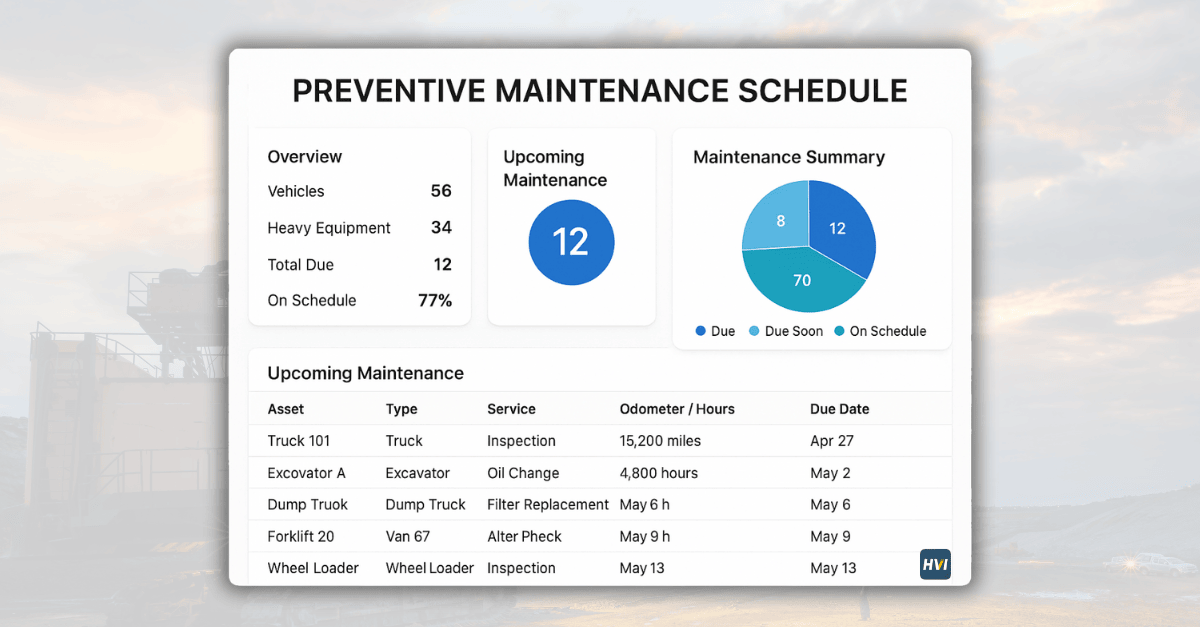
A spreadsheet may show a due date, but keeping the schedule useful also requires a clear record of the vehicle, the service, the work performed, and any outstanding defects.
Preventive maintenance
Organize planned service intervals and keep upcoming PM work visible.
Work orders
Document repair activity, service completion, and follow-up work.
Analytics and reporting
Review maintenance activity and use consistent records to calculate meaningful KPIs.
HVI provides maintenance scheduling and recordkeeping tools; confirm the specific availability of a prebuilt PM-compliance percentage report during a product demo. Book a demo to review HVI preventive maintenance reporting options.
Five Rules for a Trustworthy PM Compliance KPI
Define the metric once and apply the same policy to every asset group and reporting period.
Freeze the original due point. Rescheduling a late PM must not rewrite the historical measurement.
Count every due PM once. Avoid counting a work order twice after reopening or rescheduling.
Separate planned exclusions. Document retired assets, duplicate tasks, and legitimately cancelled PMs.
Use consistent thresholds. Specify whether due windows are based on date, mileage, engine hours, or a documented combination.
Segment the fleet. Review compliance by asset class, location, service type, and criticality—not only the grand total.
PM Compliance Rate FAQs
What is the PM compliance rate formula?
Divide the number of preventive maintenance jobs completed within their approved due windows by the number of PM jobs due in the same reporting period, then multiply by 100. Define exclusions and tolerance rules consistently.
What is a good PM compliance rate benchmark?
There is no universal benchmark that fits every fleet. Many teams use progressively higher internal targets, but the appropriate threshold depends on equipment criticality, the due-window policy, and operating conditions. Treat example bands as planning illustrations rather than industry standards.
How is PM compliance different from PM completion rate?
PM compliance measures work completed on time. PM completion rate measures how much planned work was eventually completed. A PM completed after its due window can count toward completion but not on-time compliance.
Should overdue PMs remain in the original reporting period?
Yes, for an on-time compliance measure based on due-date cohorts. Keep the original due date and classify the job as late or open; otherwise rescheduling can make historical results look better without improving maintenance performance.
How can HVI support preventive maintenance compliance tracking?
HVI's preventive maintenance scheduling, asset records, work orders, and reporting capabilities can support the data and workflow needed to manage due services. Ask for a demo to verify the exact reporting configuration available for your fleet.