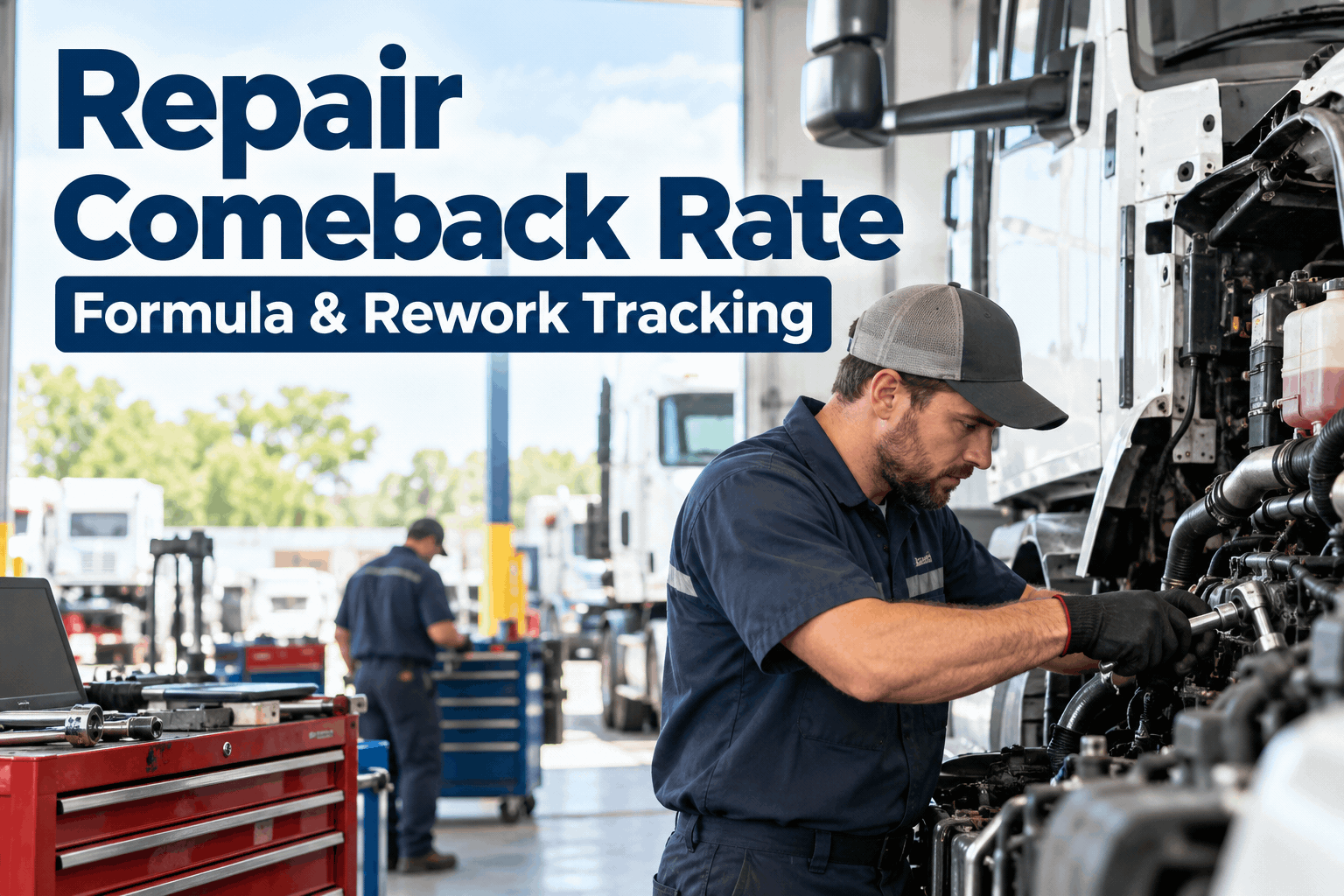
Tuesday morning: truck 214 leaves the shop after a cooling-system repair. By Thursday, the driver reports the same overheating warning. The original work order says “complete,” but the truck is back in the bay, the route needs cover, and your technicians are diagnosing the same complaint again. First time fix rate shows how often your fleet avoids that second visit—and whether a repair stays fixed after the vehicle returns to work.
First-Time Fix Rate: Did the Repair Actually Hold?
Measure repairs that stay resolved—not just work orders marked closed. Learn the formula, spot repeat failures, and build a stronger repair-to-release process.
First Time Fix Rate Formula for Fleet Maintenance
Use a consistent repair population and follow-up rule before comparing teams or months. A repeat visit for the same unresolved fault counts against the original first fix; an unrelated new fault does not.
100 initial repairs. 16 comebacks.
If 84 of 100 eligible repairs stay resolved during your chosen review window, first-time fix rate is 84%. The other 16 need review—not an automatic technician blame score.
Use one unit of measurement: the initial repair event, not every subsequent work order. Otherwise a comeback can inflate the denominator and distort the result.
Start with a documented follow-up period—for example, 30 days—and apply it consistently. Recent repairs whose follow-up window has not finished should be labeled pending validation, not prematurely counted as successes. For a walkthrough of connected repair records, Book a Demo of HVI Repair History and Reporting.
Repeat Repair Tracking: Follow the Evidence, Not the Blame
When a vehicle returns, the important question is not simply who closed the job. It is what the first repair missed—and which part of the shop process needs improvement.
HVI's inspection records, work orders and maintenance history can help the shop compare the original defect with the return visit. Sign Up Free to Organize Fleet Repair Records and establish a repeat-repair review process.
What Counts as a First-Time Fix—and What Doesn't?
Clear counting rules make the KPI credible. Publish them with the report so dispatch, maintenance and leadership understand the same number.
Fault resolved and verified
The original complaint is addressed, the vehicle passes the required release checks, and the same problem does not return during the defined follow-up window.
Same defect returns
A second unplanned repair is needed for the same underlying fault or an incomplete first repair, even if a new work order number is opened.
Different fault or staged work
An unrelated new defect should not erase an earlier success. Planned multi-stage repairs need a documented inclusion or exclusion rule.
See the Repair History Behind Every Comeback
Connect inspection findings, repair work orders and asset history so your shop can investigate repeat defects with better context.
How to Improve First Time Fix Rate Without Rushing Repairs
Better repair quality begins before the vehicle reaches the bay and continues after the work order is closed.
Capture the fault precisely
Record driver symptoms, fault codes, operating conditions and inspection findings. “Truck running rough” is not enough to diagnose reliably.
Check parts and job readiness
Review service history, verify the needed parts and tools, and assign the right skills before taking the vehicle out of service.
Document the actual correction
Record what was tested, what was replaced, readings or measurements, and any unresolved conditions requiring follow-up.
Verify under relevant conditions
Complete the appropriate functional checks, close safety-critical defects only when resolved, and explain the repair to dispatch or the driver.
Example checklist; tailor to OEM procedures, asset type and safety requirements.
This is where connected maintenance management and digital inspections become useful: they preserve what the technician knew, what was done and what the next shift needs to see. Book a Demo to Review HVI Work Order History.
Fleet Repair KPIs to Track Alongside First-Time Fix Rate
FTFR measures whether the job held. It does not explain every cost or every hour of downtime. Pair it with a small set of complementary measures.
For a broader measurement framework, see HVI's fleet maintenance KPI guide. The first-time fix rate deserves its own investigation because a shop can close jobs quickly while the same trucks keep returning. Book a Demo to Explore Fleet Maintenance Reporting.
A 30-Day First-Time Fix Improvement Plan
Do not start with an arbitrary target. First make the metric trustworthy, then identify which repeat repairs are avoidable.
Agree on eligible repairs, the repeat-fault definition, review window and exclusions.
Match return visits to original work orders and group causes by diagnosis, parts, execution and handover.
Improve fault intake, parts staging or release verification based on the most common cause.
Check validated FTFR, repeat-repair count and downtime together. Continue what works.
A sensible target is one your fleet can sustain without cutting corners. Segment by repair complexity and vehicle class, then set improvement goals against your own baseline. If your records are scattered across paper, email and separate spreadsheets, Sign Up Free to Centralize Fleet Maintenance Records.
Make the First Fix Count
HVI brings fleet inspections, work orders and maintenance history into a connected workflow. Explore how that visibility can support repeat-repair investigations and more informed maintenance decisions.
First-Time Fix Rate FAQs
What is a good first time fix rate for a fleet shop?
There is no universal target that fits every fleet. Job complexity, vehicle age, repair type and the repeat-fault review window change the result. Establish a consistent baseline, compare similar work and aim for sustained improvement without compromising safety.
How do you calculate first time fix rate?
Divide eligible initial repair events that remain resolved after the agreed follow-up period by all eligible initial repair events, then multiply by 100. For example, 84 successful first repairs out of 100 eligible jobs gives 84%.
Is first time fix rate the same as repeat repair rate?
They are related but not always exact inverses. If both use the same repair population, time window and recurrence definition, the two measures can complement each other. Different counting rules produce different results.
Should an unrelated new fault count as a comeback?
No. A new, unrelated defect should be recorded separately. A repeat should involve the same unresolved problem or a materially related cause under the fleet's documented definition.
How can HVI help track first-time repair success?
HVI supports inspections, work orders, asset maintenance history and reporting. Those records can help managers compare an initial repair with a later defect and investigate repeat work. Confirm the exact FTFR calculation and reporting configuration during a product demo.