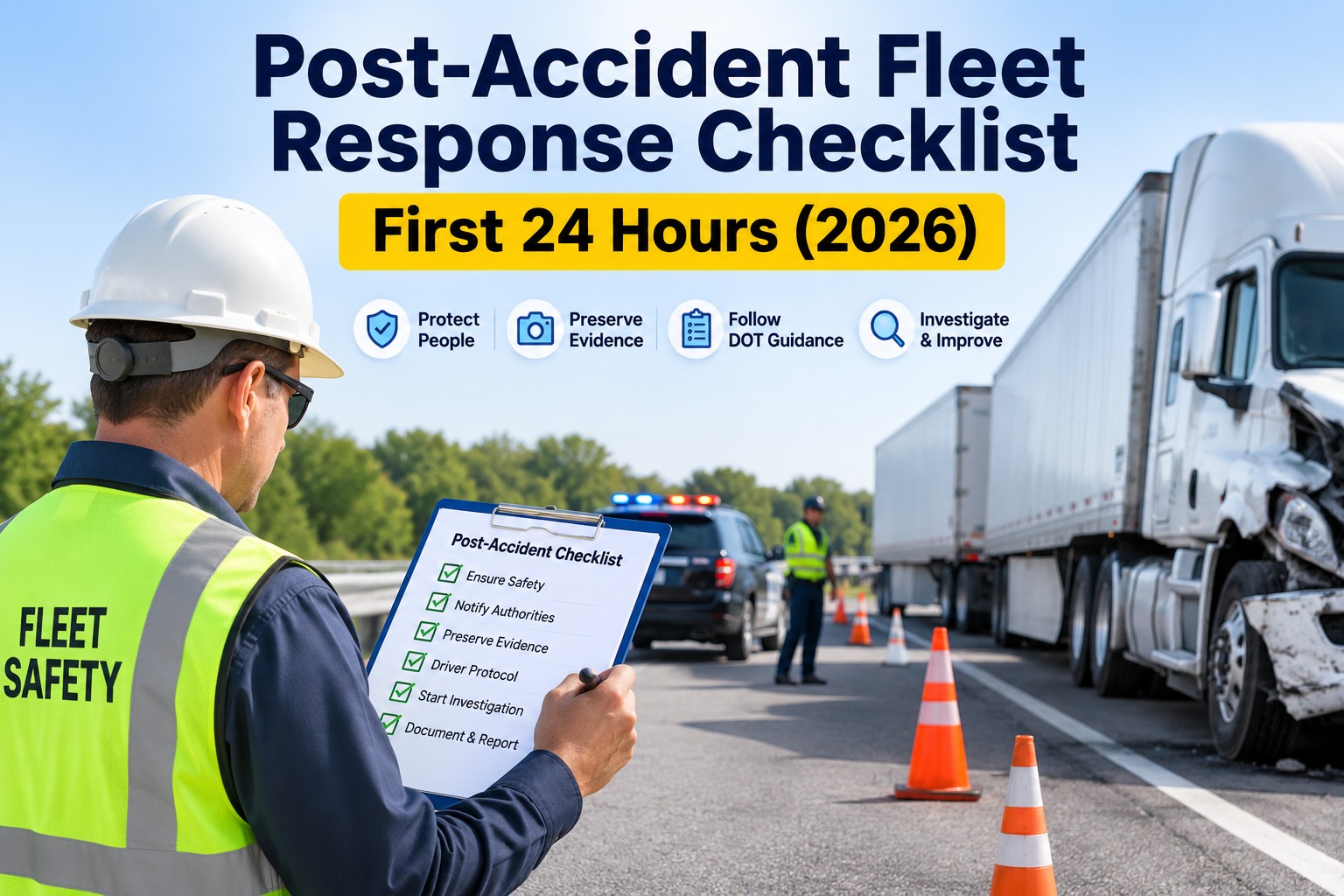
A commercial vehicle accident starts a clock. Not a metaphor — an actual regulatory countdown, running from the second of impact. What a fleet does in the first 24 hours determines whether the incident stays a manageable insurance claim or becomes a $36 million nuclear verdict. This post-accident fleet response checklist walks the exact sequence — driver protocol, company chain of notification, FMCSA test deadlines, and the evidence that disappears fastest — or book a 15-min HVI demo to see it automated end-to-end.
The Compliance Countdown
Four regulatory deadlines. Every fleet has to hit them. Miss one, and the accident stops being about the crash.
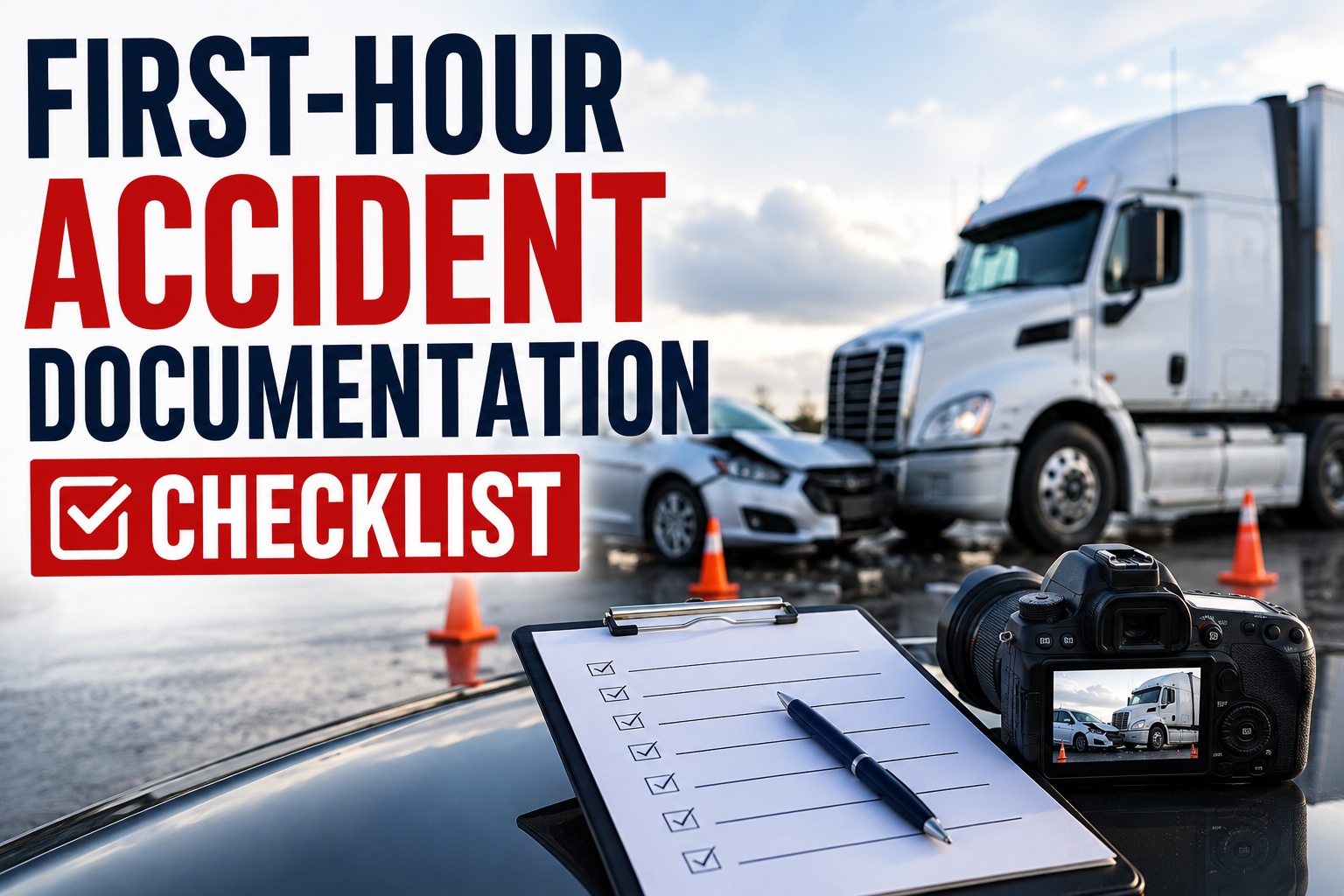
A post-accident fleet response checklist covers the first 24 hours in five sequenced phases: scene management (0–30 minutes), company notification (0–2 hours), FMCSA post-accident testing (8/32 hours), evidence preservation (24 hours), and investigation documentation. The regulatory floor is 49 CFR §382.303 and §390.15. The practical goal is different: preserve the evidence that determines whether the incident settles at insurance limits or escalates into a nuclear verdict.
The First 30 Minutes: What the Driver DoesLife-safety first. Then the clock starts on everything else.
Before compliance, before the phone calls, before anything: nobody dies at the scene. Every step below is a lever the driver can pull in the first half-hour that either preserves the case or destroys it.
Move to a safe location if the vehicle is drivable. Hazards on. Triangles or flares deployed. Injuries take absolute priority over vehicles — nothing else on this list matters if a person is bleeding out.
Speak only to police, EMS, and dispatch. Not to the other party. Not to bystanders. Not to insurance from the scene. A recorded "sorry" at minute 4 becomes the plaintiff's exhibit A at trial.
Vehicles, damage, license plates, VINs, road conditions, skid marks, weather, signage, cargo. Wide shots for context, close-ups for detail. Two minutes of photos now saves six figures of reconstruction cost later.
Driver's licenses, insurance cards, tag numbers. Any witness who saw the crash: full name and phone. Police report number as soon as issued. Nothing verbal — only what's on paper or in a photo.
The moment the scene is safe, the driver calls in. That call starts the company's compliance clock, evidence preservation workflow, and insurance notification chain. Nothing happens until dispatch knows.
The First 2 Hours: What the Company DoesThe response chain that either protects the fleet or exposes it
The instant dispatch takes the call, a coordinated chain has to fire. Not sequentially with pauses — all at once, by different people. Here's the split.
The 8/32 Hour DOT Test WindowsThe one deadline where "we forgot" becomes evidence of negligence
FMCSA 49 CFR §382.303 does not treat post-accident testing as optional when the triggers are met. Miss the window, miss the documentation for why, and the missing test itself becomes the plaintiff's most powerful evidence.
Evidence That Disappears FastThe window closes on each of these differently. Preserve them in order.
Book a demo to see the evidence-preservation workflow that HVI kicks off automatically the moment an incident is logged. The half-life of every evidence category is different — and the ones with the shortest window are the ones plaintiffs' attorneys go after first.
Engine control module data can overwrite in as little as 30 minutes of continued driving. Download requires a lock-out on the truck immediately.
Loop recording overwrites in 24–72 hours on most systems. Pull the SD card or trigger cloud upload before it's gone.
Skid marks, gouge marks, debris field, fluid stains. Weather and traffic obliterate these within days. Third-party reconstructionist needs to be on scene within 24–48 hours.
Witnesses forget details fast, contaminate memory with news coverage, and become unreachable within a week. Recorded statements same day, not next month.
Standard retention on many ELDs. Litigation hold within the 30-day window locks the record before rotation deletes it.
Paper DVIRs vanish. Missing inspection records become the plaintiff's negligence exhibit. Digital records with audit trail are the only defense.
The $36M Reason to Get This RightNuclear verdicts aren't rare anymore. And the record is a signal.
The math has changed. Between 2010 and 2018, the average commercial truck crash verdict grew from $2.3 million to $22.3 million (Marathon Strategies, ATRI). The median nuclear verdict — anything over $10 million — hit $36 million in 2022, roughly 50% higher than a decade earlier. Verdicts over $100 million reached a record 49 cases in 2024.
Post-accident tests conducted on time. ECM downloaded. Dashcam preserved. DVIR audit trail intact. Case usually resolves within policy limits.
Failed compliance becomes the plaintiff's exhibit A. Reptile-theory arguments amplify. Nuclear verdict range typical, sometimes higher.
The delta is not the accident. The delta is the paperwork. A crash where the driver was 100% at fault, handled with clean compliance, often settles for a fraction of a crash where the driver was blameless but the fleet lost the dashcam.
Paper Response vs Digital ResponseSame accident. Two very different outcomes at trial.
- Checklist in a binder nobody opens
- Notification by phone tag
- Test scheduling manual, often missed
- ECM download requested days later
- Records scattered across email & folders
- Audit trail: partial, contested
- Incident opens the full checklist automatically
- Safety, insurance, IT alerted in one action
- Test scheduling with clock and reminders
- ECM download workflow triggered instantly
- Single audit-ready file per incident
- Audit trail: complete, timestamped, defensible
Quick Questions
When is FMCSA post-accident testing required?
Under 49 CFR §382.303, post-accident testing is required when a CMV was involved in a public-road accident and any of three conditions apply: (1) a human fatality — test regardless of fault or citation; (2) bodily injury requiring medical treatment away from the scene AND the driver receives a citation; or (3) disabling damage requiring the vehicle to be towed AND the driver receives a citation. Fatality is the only trigger that requires testing regardless of citation. The other two require both an injury or disabling damage AND a citation issued to the CMV driver.
What are the exact time windows for post-accident drug and alcohol tests?
Target for both tests is 2 hours from the accident. Alcohol testing must cease attempts after 8 hours (§382.303(d)(1)). Controlled substance testing must cease attempts after 32 hours (§382.303(d)(2)). If either window is missed, the employer must prepare and maintain a written record explaining why. That written record is what FMCSA asks for on audit — and its absence is what plaintiffs' attorneys point to in litigation.
How long does a fleet have to keep post-accident records?
The FMCSA Accident Register under §390.15 must be maintained for a minimum of three years after the date of each accident. Drug and alcohol test records under §382.401 have their own retention: negative test results kept 1 year, positive results and refusals kept 5 years. In practice, most fleets keep complete accident files indefinitely because litigation can be filed anywhere from 1 to 6 years after the incident, depending on state statute of limitations.
What evidence should be preserved fastest after an accident?
Priority order by half-life: ECM/ECU data (can overwrite within hours of continued driving); dashcam and interior video (loop-overwrite in 24–72 hours); scene physical evidence like skid marks and debris (obliterated by weather and traffic in 1–3 days); witness memory (accurate for hours, degraded within a week). Telematics and HOS records typically have 30-day retention, so a litigation hold within that window is critical. Maintenance and DVIR records have no half-life if digital — but paper DVIRs routinely go missing, which is why digital inspection records become critical evidence.
What's the penalty for failing to conduct a required post-accident test?
FMCSA monetary penalties for failing to conduct a required post-accident alcohol or drug test range from roughly $8,000 to over $15,000 per violation. Beyond the fine itself, the missing test becomes powerful evidence in civil litigation — opposing counsel routinely argues that the absence of a test result creates an inference of impairment, which juries often accept. In an era where median nuclear verdicts against trucking companies sit at $36 million, a missed post-accident test is one of the highest-leverage compliance failures a fleet can make.
Turn the first 24 hours into a workflow, not a scramble.
HVI's incident management module opens the full §382.303-timed checklist the moment an incident is logged. Notification chain, test scheduling, ECM download trigger, dashcam preservation, and audit-ready file — automated. The compliance record writes itself. So does the litigation defense.