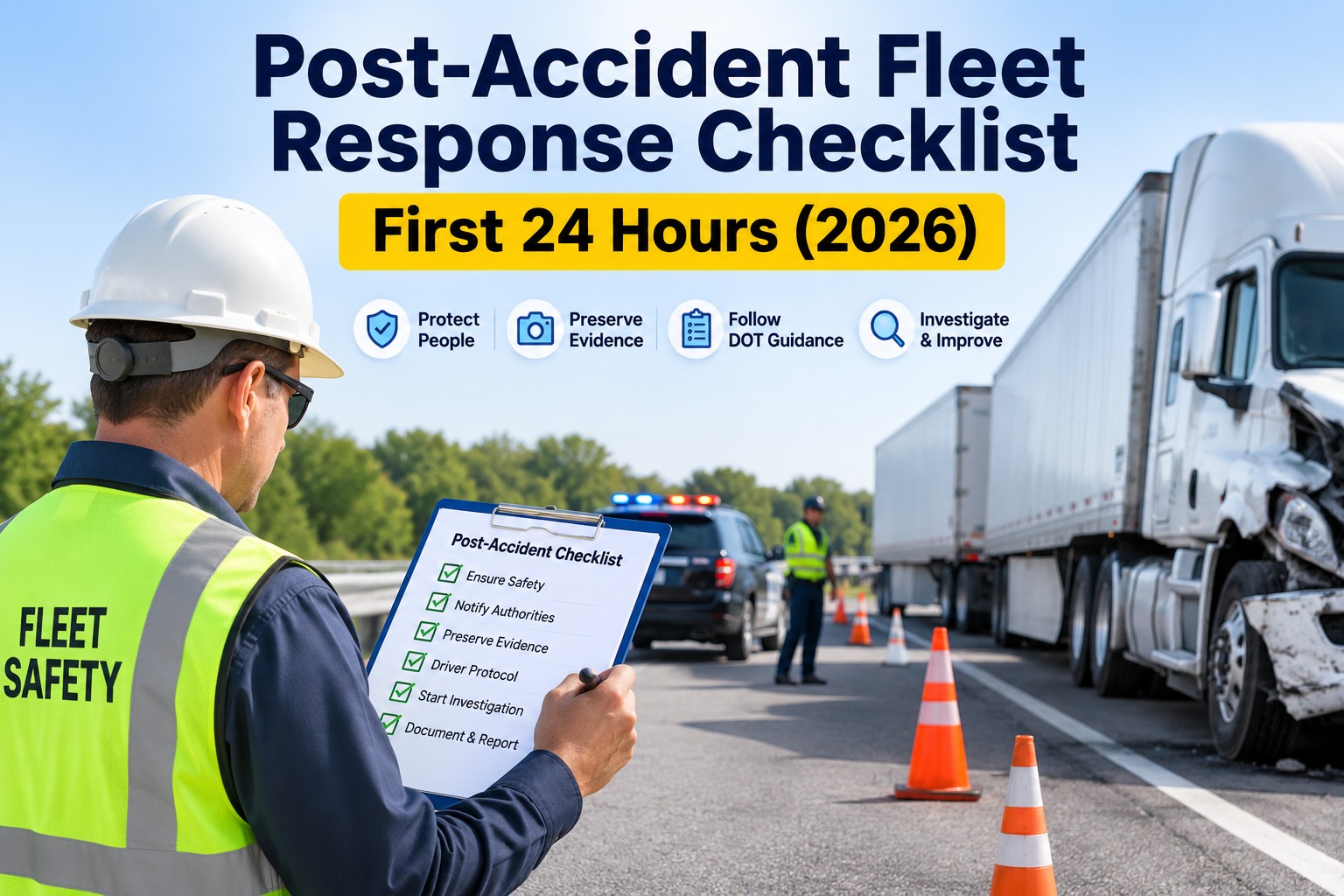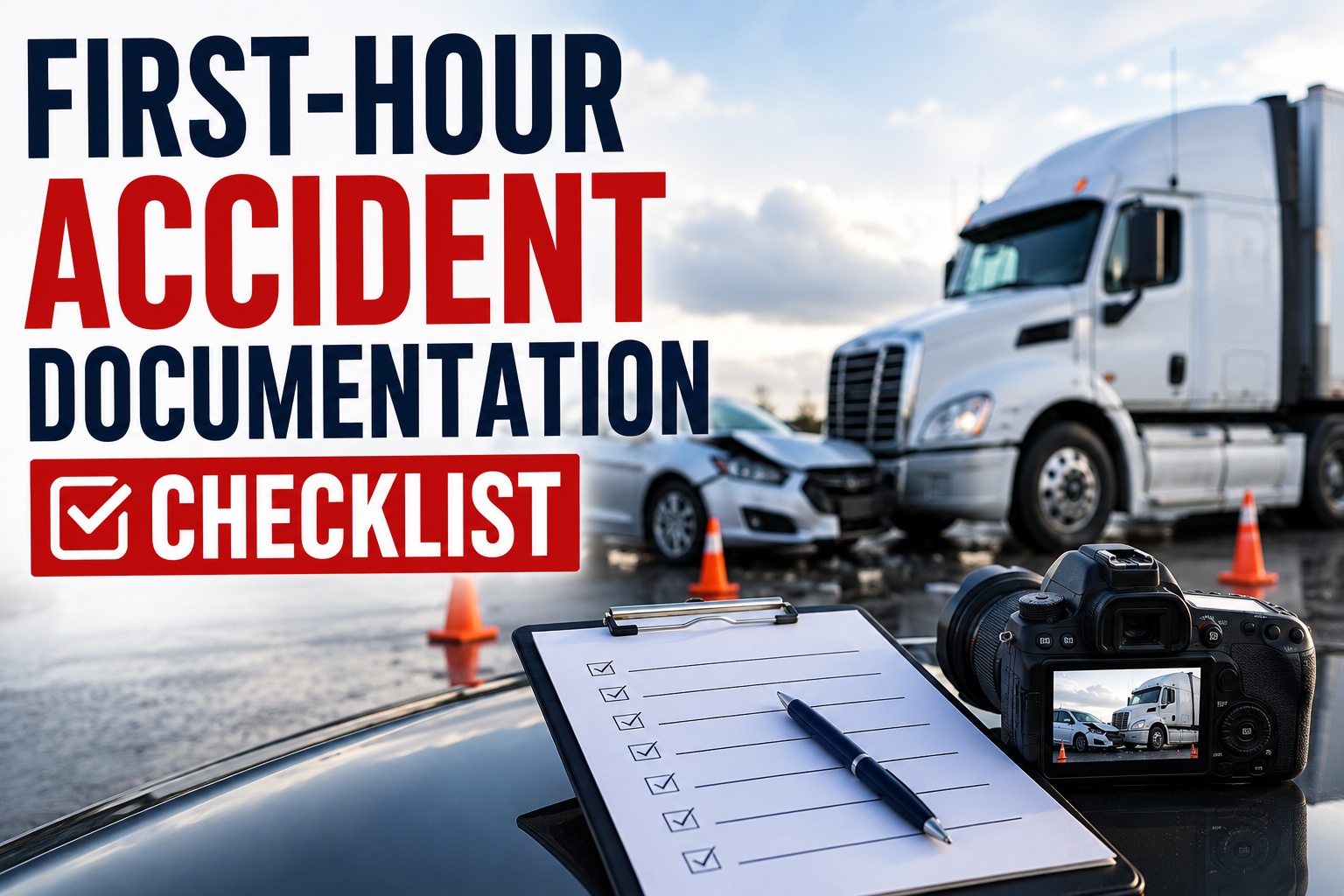
The first hour after a commercial vehicle accident is the one that decides how the next three years go. Witnesses drift away, dashcam footage on nearby vehicles gets auto-overwritten within 30 days, weather changes the scene, and drivers — shaken and hurt — forget details they'd have remembered clearly at minute five. Meanwhile the other side's attorneys and investigators are already moving. This first-hour accident documentation checklist is built the way it needs to be used: as a timed action sequence broken into four windows across the first 60 minutes, plus the FMCSA obligations that follow. Print it, save it, put it in the cab. Book a demo to see a digital incident report that captures the whole checklist in one guided workflow.
The First-Hour Fleet Accident Documentation Checklist
A minute-by-minute action sequence for what a driver, safety manager, and dispatcher must capture in the 60 minutes after a commercial vehicle accident — plus the FMCSA registers, tests, and retention obligations that follow.
- 0–5 min safety & 911
- 5–15 min scene photos
- 15–30 min statements
- 30–60 min data preserved
Two things make the first hour non-negotiable. First, the evidence that decides fault, coverage, and litigation exposure is disappearing in real time — some of it in minutes, most of it inside 30 days. Second, the other side's investigators start working the case within hours, and everything they build is against the version of events you didn't preserve. What follows is what to capture and when, in the order it needs to happen at the scene.
The four windows of the first 60 minutes
Every accident is different. The sequence isn't. Tap a window below to see what to do and when — and tick each item as you complete it. Safety comes first, then scene, then statements, then data preservation.
Safety, 911, and never admit fault
Photograph everything, from four angles
Statements and identifying information
Preserve data before it disappears
The whole loop is about 60 minutes of focused work — and it prevents almost every downstream evidence gap that becomes a problem in claims, audits, or litigation. See the full checklist as a guided digital form
The six evidence categories that matter most
The four-window sequence above collects information across six distinct evidence categories — and understanding which is which helps prioritize when time runs short. Each of these gets requested by attorneys, insurers, and auditors, in exactly this order of importance.
Scene photos
Wide shots, close-ups, all four sides of every vehicle, roadway conditions, and physical evidence like skid marks and debris. Timestamps and GPS metadata matter.
Driver statement
The driver's factual account of what happened, captured while fresh. Written and signed, not just verbal. Do not include admissions of fault or speculation about cause.
Witness information
Name, phone, address, and a brief note on what they saw. Witnesses go home; if you don't have their contact info in the first hour, you're unlikely to find them later.
Vehicle damage
Damage documented on your vehicle and, where safely possible, the other vehicle. Close-ups of the point of impact, plus overall context shots showing the full damage pattern.
Video & telematics
Dashcam clips (yours and any nearby vehicles), ELD data around the event, hard-braking and speed telemetry, GPS trace. Preservation hold within the first hour is critical.
Documentation
Driver's license, medical certificate, current DVIR, last annual inspection, bill of lading, weight ticket. This is the "we can prove we were compliant" package.
Fleets that capture all six categories in the first hour typically resolve claims two to three times faster than those relying on memory and police reports alone. Start free and log all six from one guided form
How evidence decays — a fast-shrinking window
The "why first-hour" argument is entirely about how quickly evidence stops being available. Every one of these has a real half-life, and none of it is recoverable once the window closes.
-
Minutes
Fluid trails, debris pattern, sun angleTraffic cleanup begins immediately; positions and orientations vanish before officers finish paperwork.
-
Hours
Skid marks, weather conditions, driver memory of detailsRain washes marks. Weather shifts. Recall of specific movements degrades sharply after a few hours.
-
Days
Witness availability, minor injury visibilityWitnesses leave the area, change numbers, forget details. Bruising and soft-tissue injuries may not present for 24–72 hours.
-
30 days
Nearby business & traffic-cam surveillanceMost commercial surveillance loops overwrite every 30 days or less. Preservation requests must reach the business inside that window.
None of these are hypothetical. The 30-day auto-overwrite on surveillance systems is standard, and once it happens the footage is gone permanently. That alone is why the first-hour preservation hold matters. Book a demo to see automated preservation-hold requests
FMCSA obligations that follow the first hour
Beyond the scene, federal rules attach specific documentation and testing obligations to any DOT-recordable accident. These aren't optional and the clocks on them start the moment of the crash.
What counts as a DOT-recordable accident
Any CMV involved in a crash resulting in a fatality, an injury requiring immediate medical treatment away from the scene, or vehicle damage requiring tow-away. If any one is true, the accident register and post-accident testing rules apply.
Post-accident testing clock
Alcohol testing within 8 hours; controlled-substance testing within 32 hours. Required for any fatality, and for injury or tow-away accidents where the CMV driver receives a citation. If tests aren't performed in time, document why in writing.
Accident register & 3-year retention
Every DOT-recordable crash must be logged in the carrier's accident register with date, city and state, driver name, injuries or fatalities, and any hazmat release. Retain three years, plus supporting documentation generated for state or insurer reports.
The register itself is short; the supporting documentation is what auditors ask for. Everything captured in the first-hour checklist above forms that supporting file. Start free and build the register and supporting file automatically
From a safety director who's worked both sides
I've been on the phone with a driver twenty minutes after a wreck who was worried about his truck. And I've been on the phone with the same driver a month later, in tears, because he doesn't remember whether the light was yellow or red when he entered the intersection. Both those calls are normal.
The whole point of the first-hour checklist is that it takes the memory piece off the driver. Photos, GPS, timestamps, the witness's number written down — that's the record that shows up in court. Not what anyone remembers a year later. Get that first hour right and the next three years get a whole lot quieter.
Frequently asked questions
What should a commercial vehicle driver document at the scene of an accident?
The first-hour documentation runs across four windows. In the first 5 minutes, the priorities are safety and 911 — check for injuries, call for medical and police response, and set triangles per 49 CFR 392.22. From 5 to 15 minutes, photograph everything: all vehicles from four sides, the roadway, skid marks, debris, traffic controls, weather, license plates, VINs, and DOT numbers on any other commercial vehicles. From 15 to 30 minutes, capture identifying information and statements — the other driver's license, insurance, and plate; contact information for every witness before they leave; the responding officer's name, badge, and report number; and any spontaneous statements made by other parties. From 30 to 60 minutes, dispatch and the safety manager preserve digital evidence: ELD data, telematics, dashcam footage, current DVIR, cargo paperwork, and preservation requests to any nearby surveillance cameras. Throughout, do not admit fault, do not speculate, and do not post to social media.
What is a DOT-recordable accident under FMCSA rules?
Under 49 CFR 390.5T, an accident involving a commercial motor vehicle is DOT-recordable if it results in any one of three outcomes: a fatality; an injury requiring immediate medical treatment away from the scene; or disabling damage to any vehicle requiring tow-away from the scene. If none of those three occur, the crash is generally not DOT-recordable and does not require entry in the accident register, though internal documentation is still strongly recommended for insurance and litigation purposes. If any of the three thresholds is met, the incident must be entered in the accident register under 49 CFR 390.15 with date, city and state, driver name, injuries or fatalities, and any hazmat release, and post-accident testing rules under 49 CFR 382.303 apply. Fires in a commercial motor vehicle, even without collision, have been included in the accident definition since 1962.
How long do I have to complete post-accident drug and alcohol testing?
Under 49 CFR 382.303, the alcohol test must be administered as soon as practicable following the accident but no later than 8 hours after; the controlled-substance test must be completed as soon as practicable but no later than 32 hours after. Testing is required for any accident involving a fatality, and for injury or tow-away accidents where the CMV driver receives a citation from law enforcement within the applicable window. If for any reason the tests cannot be performed within those windows, the carrier must document in writing the specific reasons — the driver was unconscious, in surgery, at a facility that couldn't test, and so on — because a failure to test without a documented reason is itself a violation. Post-accident testing records must be retained for at least three years per FMCSA drug-and-alcohol testing regulations, and results must be reported to the FMCSA Drug and Alcohol Clearinghouse.
What must the FMCSA accident register include and how long is it kept?
Under 49 CFR 390.15, the accident register must contain, at a minimum, the date of the crash, the city or town and state nearest to where the crash occurred, the driver's name, the number of injuries and fatalities, and whether hazardous materials — other than fuel spilled from the fuel tanks of the motor vehicle involved — were released. FMCSA does not require a specific form, so carriers have flexibility in format, but the register must be updated, complete, and produced on request. It must be retained for three years. In addition to the register itself, 49 CFR 390.15(b) requires retention of supporting documentation generated by the carrier or driver for state or insurer reports — the internal incident report, photos, witness lists, statements, and any communications sent to the insurer or state accident reporting authority. Full state or third-party accident reports are not required to be retained, but internally generated documentation is.
Why is the first hour after an accident so important?
Because most of the evidence that decides fault, insurance coverage, and litigation exposure is disappearing in real time from the moment of the crash. Fluid trails, debris orientation, and sun angle change within minutes as traffic reopens. Skid marks and weather conditions change within hours. Witnesses leave the area within a day, and after several days their memories of specific details fade sharply. Nearby business and traffic-cam surveillance footage — often the most decisive evidence in a serious crash — is typically auto-overwritten within 30 days or less, meaning if a preservation request doesn't reach the operator inside that window, the footage is gone permanently. Meanwhile, opposing insurers and plaintiff attorneys begin their own investigation within hours of a serious crash and are not preserving evidence for the carrier's benefit. A structured first-hour checklist captures everything before it decays, and it's the single strongest defense against the version of events the carrier didn't preserve.
Put the whole checklist in the driver's pocket — and the safety manager's dashboard
HVI turns the first-hour checklist into a guided mobile incident report with photo capture and GPS/timestamps, witness and statement fields, automatic ELD and dashcam preservation, immediate dispatch notification, and an audit-ready accident register that builds itself. Every one of the six evidence categories, every FMCSA obligation, every retention rule — in one workflow.
No credit card · No hardware · Live on your fleet in under two weeks